
Dividend Snapshot
Dividend / Share
₹3.00
30% on ₹10 face value
Dividend Type
Final
FY2025-26
Dividend Yield
1.29%
on CMP ₹233 (04-Sep-2026)
Record Date
11-Aug-2026
Ex-date same day (T+1)
Announcement
19-May-2026
Board recommendation
AGM Approval
18-Aug-2026
67th AGM — approved
Payment
≤17-Sep-2026
Within 30 days of AGM (expected)
Estimated Outflow
₹14.5 Cr
≈4.83 crore shares × ₹3
*Yield moves with price. On the current price of ₹233 the yield is ~1.29%; around the 19-May-2026 announcement (price ≈ ₹190) the indicative yield was ~1.58%. Source: Screener, exchange filings, TipRanks.
Dividend Announcement Summary
What was announced
At its board meeting on 19 May 2026, Kopran's directors recommended a final dividend of ₹3.00 per equity share of ₹10 face value for the year ended 31 March 2026. Shareholders approved it at the 67th AGM on 18 August 2026, where all five ordinary resolutions passed with strong support. As a final dividend it needed AGM sign-off before it could be paid — unlike an interim dividend, which the board can pay on its own.
Board & Corporate Context
The same results showed a record Q4 (highest-ever quarterly revenue and EBITDA) but a weaker full year. Alongside the dividend, the board re-appointed Mr. Varun Somani and appointed Mrs. Namrata Somani as director. A Scheme of Amalgamation (Kopran Laboratories Limited into Kopran Limited) is under NCLT review, and the new Panoli API facility began commercial production on 31 March 2026.
Key Dates Timeline
| Event | Date | What it means for you |
|---|---|---|
| Announcement (Board) | 19-May-2026 | Dividend recommended with FY26 results. |
| Record Date | 11-Aug-2026 | You must be on the register on this day to qualify. |
| Ex-Date | 11-Aug-2026 | Buy before this day to be eligible (T+1 settlement). |
| AGM (Approval) | 18-Aug-2026 | Members formally declared the dividend. |
| Payment Date | ≤17-Sep-2026 (expected) | Must be paid within 30 days of AGM declaration. |
The exact credit date is set by the company; the law requires payment within 30 days of the AGM declaration (18-Aug-2026), so on or before ~17-Sep-2026.
Dividend Yield Analysis
How the Yield Is Built
Dividend yield = dividend per share ÷ price. On the current price of ₹233, ₹3 works out to ~1.29%. Around the announcement (price ≈ ₹190) it was ~1.58%. The stock is up ~31% over the past year, so the same ₹3 now buys a lower yield than it did in mid-2026 — the yield fell because the price rose, not because the payout grew.
Yield Reality Check
Kopran's ~1.29% is above the pharma industry average (~0.8%, Simply Wall St) and above peers like Aarti Drugs (~0.48%) and RPG Life Sciences (~0.96%). But a higher yield here is not a sign of generosity: the dividend has been frozen at ₹3 for five years, while the payout ratio has climbed to 56% as profits fell. The yield looks decent mainly because the absolute dividend has held while earnings shrank.
Dividend History Analysis
Dividend and Earnings History
| Financial Year | Dividend / Share | EPS (Consolidated) | Payout Ratio |
|---|---|---|---|
| FY2025-26 | ₹3.00 | ₹5.33 | 56% |
| FY2024-25 | ₹3.00 | ₹7.99 | 38% |
| FY2023-24 | ₹3.00 | ₹10.57 | 28% |
| FY2022-23 | ₹3.00 | ₹5.65 | 53% |
| FY2021-22 | ₹3.00 | ₹12.66 | 24% |
| FY2020-21 | ₹3.00 | ₹14.24 | 21% |
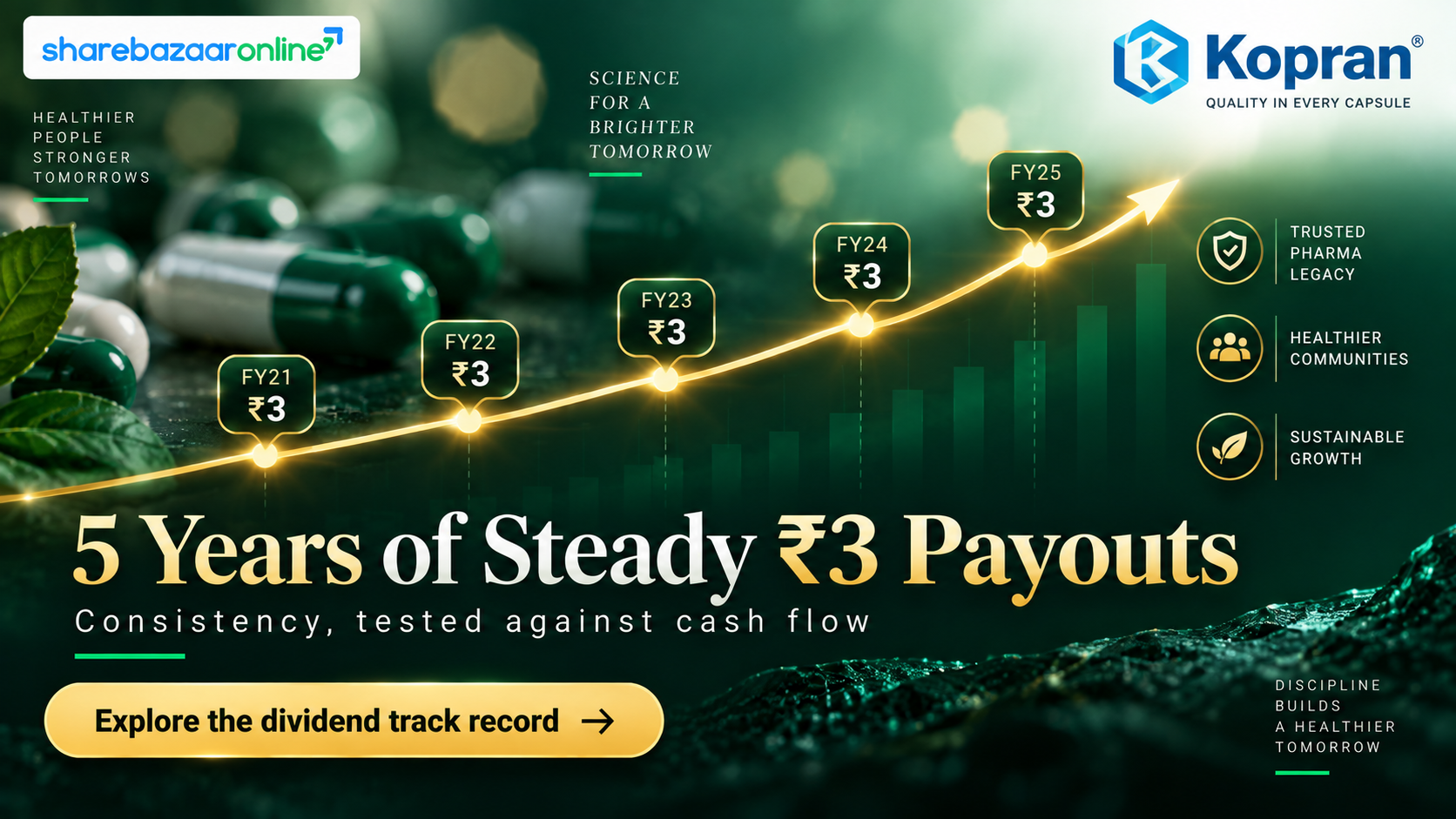
Classification: Consistent Payer — but a flat, not growing, dividend. Kopran has paid ₹3 every year since FY21 (before that, dividends were negligible). There have been no cuts or suspensions in this window, which is a genuine positive. The catch: the dividend has not increased in five years, and the payout ratio has more than doubled (21% → 56%) — a mechanical result of a shrinking bottom line, not a bigger cheque.
Financial Performance Analysis
Consolidated P&L (₹ Crore)
| Metric | FY24 | FY25 | FY26 | FY26 vs FY25 |
|---|---|---|---|---|
| Revenue | 615 | 630 | 681 | +8.1% |
| Operating Profit | 74 | 73 | 62 | −15% |
| OPM % | 12% | 12% | 9% | −3 pts |
| Net Profit | 51 | 39 | 26 | −33% |
Operating Leverage — in Reverse
This is the crux: revenue rose ~8% but net profit fell ~33%. The gap is margin compression — operating margin slipped from 12% to 9% as expenses grew faster than sales (expenses ₹557 Cr → ₹619 Cr). A one-off loss-making Q2 FY26 (net loss of ₹9.92 Cr, negative operating margin) dragged the full year down before a record Q4 (PAT ₹18.87 Cr) partly rescued it.
Quarterly Swing (Consolidated, ₹ Cr)
| Quarter | Revenue | OPM | PAT |
|---|---|---|---|
| Q1'26 | 135 | 10.5% | 7.5 |
| Q2'26 | 118 | −4.5% | −9.9 |
| Q3'26 | 194 | 9.1% | 9.3 |
| Q4'26 | 234 | 14.1% | 18.9 |
| Q1'27 | 154 | 10.3% | 6.7 |
Cash Flow Analysis
Consolidated Cash Flows (₹ Crore)
| Metric | FY24 | FY25 | FY26 |
|---|---|---|---|
| Operating Cash Flow | 43 | 42 | 67 |
| Investing (mostly capex) | −44 | −56 | −65 |
| Free Cash Flow | −13 | −17 | ≈0 |
| Net Cash Flow | 1 | 11 | −19 |
Key Finding: The Dividend Is Not Funded by Free Cash Flow
Operating cash flow is actually healthy and improving — ₹67 Cr in FY26, or 117% of operating profit (cash conversion is real, not accounting profit). The problem is that heavy expansion capex (₹65 Cr, largely the Panoli plant) consumes almost all of it, leaving free cash flow at roughly zero in FY26 and negative in FY24-FY25. So the ₹14.5 Cr dividend is being paid out of operating cash while growth capex is part-funded by borrowings — a point to weigh carefully.
Balance Sheet Strength
Net Worth
₹530 Cr
Equity 48 + Reserves 482
Borrowings
₹153 Cr
FY24: ₹99 Cr → FY26: ₹153 Cr
Book Value
₹110
Per share
Liquid Investments
₹0 Cr
No large cash pile
Debt Is Rising With Capex
Borrowings have climbed from ₹99 Cr (FY24) to ₹153 Cr (FY26) as the company built out fixed assets (₹208 Cr → ₹346 Cr, with CWIP converting to plant). Leverage is still moderate against a ₹530 Cr net worth, but the direction is up — debt is financing growth while a dividend is being paid.
Working Capital Is Stretching
Debtor days rose to 141 (from 125), inventory days ~137, and the cash conversion cycle sits near 146 days. Receivables growing faster than sales is a classic pressure point for a company that also wants to keep paying a fixed dividend.
Dividend Sustainability Analysis
Coverage Scorecard
- Earnings coverage: EPS ₹5.33 ÷ ₹3 = 1.78× (down from 2.66× in FY25). Still above 1×, but the cushion is thinning.
- Payout ratio: 56% of consolidated profit — the highest in five years.
- FCF coverage: free cash flow ≈0, so the payout is not covered by free cash flow.
- Cash buffer: no meaningful investments/cash reserve to fall back on.
- Debt trend: rising (₹99 Cr → ₹153 Cr).
Overall Classification
Moderately Sustainable
The ₹3 is comfortably covered by earnings and operating cash flow today, and the small ₹14.5 Cr absolute size makes it easy to maintain. But with falling profit, zero free cash flow, and rising debt, there is little room to grow it — and a further earnings slide would push the payout ratio uncomfortably high.
Peer Comparison
| Company | Dividend Yield | Payout | ROE | ROCE |
|---|---|---|---|---|
| Kopran | ~1.29% | 56% | 4.9% | 6.7% |
| RPG Life Sciences | ~0.96% | 18% | NA* | NA* |
| Aarti Drugs | ~0.48% | NA* | NA* | NA* |
| Pharma Industry Average | ~0.8% | — | — | — |
Kopran's headline yield tops these peers, but read it with the payout ratio: RPG Life Sciences pays out only ~18% (lots of headroom, growing dividend), whereas Kopran pays out 56% with a flat dividend and lower ROE/ROCE. A higher yield backed by a much higher payout and weaker returns is a lower-quality yield.
*NA = not independently verified in this report. Sources: Screener, Simply Wall St, Wisesheets. Figures are latest-available and move with price.
Promoter Impact Analysis
Promoter Holding
44.43%
Somani group
Public / Retail
55.06%
~56,900 holders
FII Holding
0.51%
Minimal
DII Holding
0.00%
No institutional cover
Who Gets the ₹14.5 Cr
Promoters receive ~₹6.4 Cr (44.43% of the outflow); public/retail shareholders receive ~₹8.0 Cr. Because promoter holding is below 50%, the majority of every dividend rupee flows to minority shareholders — the payout is broadly shared, not promoter-skewed.
Ownership Signals
Promoter stake has been stable at ~44% with zero pledge, which is reassuring. But near-zero DII and thin FII ownership means the stock has little institutional research coverage or price support — a structural risk for retail holders.
Taxation Analysis
How Dividends Are Taxed in India
Dividends are taxed in the hands of the investor at their applicable income-tax slab rate. Dividend income is generally taxed under Income from Other Sources. TDS at 10% applies when the total dividend received from the company exceeds ₹10,000 during the applicable financial year, subject to applicable tax rules and conditions.
Kopran-Specific Example (₹3/Share)
Holding: 1,000 shares; dividend ₹3/share.
Gross dividend = ₹3,000 (below ₹10,000 → no TDS)
Tax @30% + cess = ₹936 → net ₹2,064
Tax @20% + cess = ₹624 → net ₹2,376
Effective post-tax yield (30% slab, CMP ₹233) ≈ 0.90%
Key Risks
- Earnings volatility: FY26 profit fell 33% and one quarter (Q2) was loss-making. Lumpy, project-driven API revenue makes profits — and dividend headroom — unpredictable.
- Zero free cash flow: capex is absorbing all operating cash, so any dividend growth would likely need debt or a capex pause.
- Rising leverage: borrowings rose from ₹99 Cr to ₹153 Cr; interest cost and repayment compete with dividends.
- Working-capital stress: debtor days at 141 and a 146-day cash cycle tie up cash and raise receivables risk.
- Thin institutional ownership: ~0% DII and ~0.5% FII mean low coverage and weaker price support.
- Merger & regulatory overhang: the Kopran Laboratories amalgamation is still under NCLT review, and API businesses carry USFDA/regulatory inspection risk.
What To Monitor
- Operating margin recovery: can Kopran hold the Q4 momentum (14% OPM) or does it drift back toward 9%?
- Panoli plant ramp-up: new capacity commissioned 31-Mar-2026 — watch utilisation, revenue contribution and return on the capex.
- Free cash flow turning positive: the single most important signal for whether the dividend can eventually grow.
- Debt trajectory: does leverage peak and fall as capex completes, or keep rising?
- Receivables & cash cycle: a fall in debtor days would show working-capital discipline returning.
- Merger outcome & USFDA status: NCLT approval of the amalgamation and clean regulatory inspections.
Conclusion
Positives
- Five-year streak of steady ₹3 dividend payouts
- Dividend yield of ~1.29%, above the pharma industry average
- ₹3 dividend remains covered by earnings and operating cash flow
- Small absolute dividend outflow of ~₹14.5 Cr
- Majority of dividend payout flows to minority/public shareholders
Negatives / Watch-outs
- FY26 profit fell ~33% despite revenue growth
- Dividend has remained flat at ₹3 for five years
- Payout ratio has increased to 56%
- Free cash flow is approximately zero due to heavy capex
- Borrowings are rising and working capital remains stretched
Kopran's ₹3 final dividend for FY2025-26 keeps a five-year streak of steady payouts intact and, at ~1.29%, offers a yield above the pharma average. That consistency and the broad spread of the payout to minority shareholders are the clear positives.
The honest counterpoint: this is a flat dividend on a shrinking profit base. The payout ratio has doubled to 56%, free cash flow is essentially zero because expansion capex is eating operating cash, and debt is rising. Operating cash flow (₹67 Cr) still covers the small ₹14.5 Cr cheque comfortably — so the dividend looks maintainable but not primed to grow until margins recover and free cash flow turns positive. Income investors get reliability today; dividend-growth investors will want proof that the new capex starts paying off.
Frequently Asked Questions
What dividend has Kopran announced for 2026?
What is the Kopran dividend yield?
What is the record date for the Kopran dividend?
What is the ex-date for the Kopran dividend?
When will the Kopran dividend be paid?
Who is eligible to receive the Kopran dividend?
How is the Kopran dividend taxed?
Is the Kopran dividend sustainable?
What is Kopran's dividend history?
Why did profit fall while the dividend stayed the same?
What should investors monitor going forward?
What is Kopran's promoter holding and where does the dividend go?
Disclaimer
This report is prepared by ShareBazaar Online for information and educational purposes only and does not constitute investment, financial, legal or tax advice, nor a recommendation to buy, sell or hold any security. Figures are compiled from company filings and public sources (Screener, exchange disclosures, TipRanks, Simply Wall St and others) and may contain errors or become outdated; market prices and yields change continuously. Dividend dates and amounts are subject to company and regulatory processes. ShareBazaar Online has made reasonable efforts to ensure accuracy but does not guarantee it and accepts no liability for any loss arising from the use of this information. Please verify all data from official sources and consult a SEBI-registered investment adviser before making any investment decision.