
Dividend Snapshot
Dividend Per Share
₹0.60
Final Dividend • FY 2025-26 • 6% of ₹10 face value
Real Dividend Yield (on CMP)
0.25%
On CMP of ₹244.00 — re-verify against live price before acting
Company
Jio Financial Services Limited (JFSL)
NSE: JIOFIN • BSE: 543940 • ISIN: INE758E01017
Dividend Type
Final Dividend
Recommended by the Board on April 17, 2026; approved at the Third AGM held August 26, 2026
Dividend Announcement Summary
The Board of Directors of Jio Financial Services Limited, at its meeting held on April 17, 2026, recommended a final dividend of ₹0.60 per equity share (face value ₹10 each, i.e. 6%) for the financial year ended March 31, 2026. The recommendation accompanied the Board's approval of the company's audited consolidated and standalone financial results for Q4 and full-year FY26. This was only the second dividend declared by JFSL since its listing in August 2023, following a ₹0.50 per share final dividend paid for FY 2024-25 — representing a 20% step-up in the per-share payout year-on-year.
The dividend required shareholder approval at the company's Annual General Meeting, which was held on August 26, 2026. The record date for determining shareholder eligibility was fixed as August 10, 2026, and the company has indicated that payment is expected within seven days of the AGM, subject to the statutory outer limit of 30 days from the AGM date under the Companies Act, 2013.
Other Board decisions on the same date: the Board accepted the resignation of Group CFO Shri Abhishek Haridas Pathak (effective April 20, 2026), approved the appointment of Ms. Annapoorna Venkataramanan as the new Group CFO (effective May 11, 2026), and approved an Employee Stock Option Plan 2026 covering up to 3.2 crore options, subject to shareholder approval. These are corporate governance developments and are not directly linked to the dividend payout.
Key Dates Timeline
Board Meeting / Announcement Date
April 17, 2026
AGM Date
August 26, 2026
Record Date
August 10, 2026
Ex-Date (Inferred, T+1 Settlement)
August 7, 2026*
Payment Date
Not Disclosed by Company (expected within 7 days of AGM; statutory outer limit 30 days from AGM)
Financial Year
FY 2025-26 (year ended March 31, 2026)
*Ex-date is calculated as one trading day prior to the record date under India's T+1 rolling settlement cycle. This is an editorial inference, not a company disclosure, and should be cross-checked against the official NSE/BSE corporate-action circular. As the record date of August 10, 2026 has already passed, eligibility for this dividend is now a matter of historical record rather than a forward-looking event.
Dividend Yield Analysis
The face-value yield illusion: A "6% dividend" headline refers to ₹0.60 paid against JFSL's ₹10 face value — it is not the return an investor actually earns. The real dividend yield, calculated on the current market price (CMP), is what matters for portfolio decisions.
Real Yield on Latest CMP (₹244.00, Aug 26, 2026)
0.25%
(₹0.60 ÷ ₹244.00) × 100
Yield on Announcement-Date CMP (₹243.67, NIV)
0.25%
Not Independently Verified — desk re-run recommended against official NSE close of April 17, 2026
Yield reality check: JFSL's sub-0.3% yield is not a red flag — it is structurally consistent with a young, high-growth financial holding company still deploying capital into its lending, insurance broking, payments and asset management subsidiaries rather than a mature dividend-paying business. The company's Stock P/E of over 78x and trading at roughly 1.16 times book value reflect a growth/valuation story rather than an income stock. Investors buying JIOFIN for the dividend alone are, at present CMP levels, receiving a token payout rather than meaningful income — the incremental 20% step-up from ₹0.50 to ₹0.60 is a signal of a young cash-generative franchise beginning to share early profits, not a high-yield proposition today.
Dividend History Analysis
JFSL listed on NSE and BSE on August 21, 2023, following its demerger from Reliance Industries Limited. It has declared dividends in only two of its three full financial years as a listed entity.
FY 2023-24
No Dividend Declared
FY 2024-25 (Final)
₹0.50 per share (5% of face value)
FY 2025-26 (Final)
₹0.60 per share (6% of face value)
YoY Growth in DPS
+20%
Classification: Emerging Payer. With only two annual dividend data points, JFSL cannot yet be classified as a Consistent Payer in the traditional sense used for mature dividend stocks. There have been no special dividends, no bonus issues, no stock splits and no dividend cuts or suspensions to date — the short track record is unblemished, and the payout has grown each year it has been declared, but investors should treat this as an early-stage dividend policy rather than an established one.
Financial Performance Analysis
Consolidated Revenue FY26 vs FY25
₹3,513.26 cr vs ₹2,042.91 cr (+71.97%)
Consolidated PAT FY26 vs FY25
₹1,560.90 cr vs ₹1,612.59 cr (-3.21%)
Operating leverage has inverted — revenue up, profit down. Total revenue grew a strong 71.97% YoY, driven by interest income (up sharply as the lending book scaled) and dividend income from subsidiaries, yet consolidated net profit actually declined 3.21% for the year and fell 13.88% in Q4FY26 alone (₹272.22 cr versus ₹316.11 cr in Q4FY25). The gap is explained by three cost lines that grew far faster than revenue: finance costs surged from a negligible ₹7.65 crore in FY25 to ₹745.09 crore in FY26 as the company ramped up borrowings to fund its NBFC and payments bank operations; employee benefits expense rose 80.19% to ₹387.27 crore on headcount and business expansion; and other expenses more than tripled to ₹754.96 crore. This is a classic margin-compression story of a scaling financial conglomerate, not a sign of business deterioration — operating profit before finance costs remains healthy, but the capital-intensive build-out of the lending and payments bank franchise is now visibly showing up in the P&L.
Standalone vs Consolidated divergence: On a standalone (parent-only) basis, JFSL's FY26 profit actually grew strongly to ₹681.03 crore from ₹548.91 crore in FY25 (+24.08%), aided by ₹405.22 crore of dividend income received from subsidiaries. Since the dividend is declared and paid by the standalone entity, this standalone cash-generation strength — not the consolidated group P&L — is the more directly relevant lens for assessing the parent's capacity to fund the payout.
Cash Flow Analysis
Reported profit is not cash — and this is the single most important forensic flag in JFSL's FY26 results. Consolidated operating cash flow (OCF) was negative ₹15,438.64 crore in FY26, deteriorating further from an already-negative ₹10,088.73 crore in FY25, even as consolidated PAT stayed solidly positive at ₹1,560.90 crore.
Why the gap exists: The single largest driver is a ₹15,634.37 crore increase in the loan book during the year, as JFSL's NBFC arm (Jio Credit) and payments bank scaled up lending and deposit-linked assets. This is a working-capital and balance-sheet-growth phenomenon typical of a young, fast-scaling NBFC/Core Investment Company — every rupee lent out shows up as a cash outflow in the operating section even though it sits on the balance sheet as a performing, interest-earning asset. It is materially different from the "profits are opinions, cash is fact" red flag seen in operating companies whose receivables are ballooning faster than revenue for collection-quality reasons.
Free Cash Flow FY26
Negative ₹15,438.64 cr
Dividend Funding Source
Cash Reserves & Financing Inflows (Not Current-Year FCF)
The dividend itself — both this year's recommended payout and the prior year's ₹317.66 crore actually paid in FY26 — is funded not from operating cash flow but from the company's very large investment book (₹133,088.67 crore consolidated) and standalone cash reserves, which were themselves built up from the original demerger transfer from Reliance Industries and subsequent warrant-conversion proceeds of ₹3,956.25 crore received in FY26. Investors should not extrapolate the negative OCF as a distress signal; it should instead be monitored over the next 2-3 years to confirm the lending book matures into a positive operating cash generator, which is the normal trajectory for an NBFC once its loan book stabilises.
Balance Sheet Strength
Total Consolidated Assets (FY26)
₹1,63,497.08 crore
Total Equity (FY26)
₹1,33,853.59 crore
Total Borrowings (Debt Securities + Other Borrowings)
₹21,768.36 crore (up from ₹3,970.00 cr in FY25, +448%)
Debt-to-Equity Ratio
0.16x
Borrowings jumped sharply as JFSL began leveraging its balance sheet to fund lending growth, but the base was near-zero, and the resulting debt-to-equity of 0.16x remains conservative by NBFC standards, where ratios of 3-6x are common for mature lenders. Cash and bank balances stood at ₹3,598.29 crore, and the investment book of ₹133,088.67 crore — largely holdings in joint ventures and subsidiaries such as Jio Payments Bank, Jio BlackRock entities and Allianz Jio Reinsurance — dwarfs the total dividend outflow of ₹381.19 crore many times over. On pure balance-sheet coverage, the company has ample headroom for the dividend; the balance sheet is not the constraint on the payout — the sizing of the payout itself has been deliberately conservative.
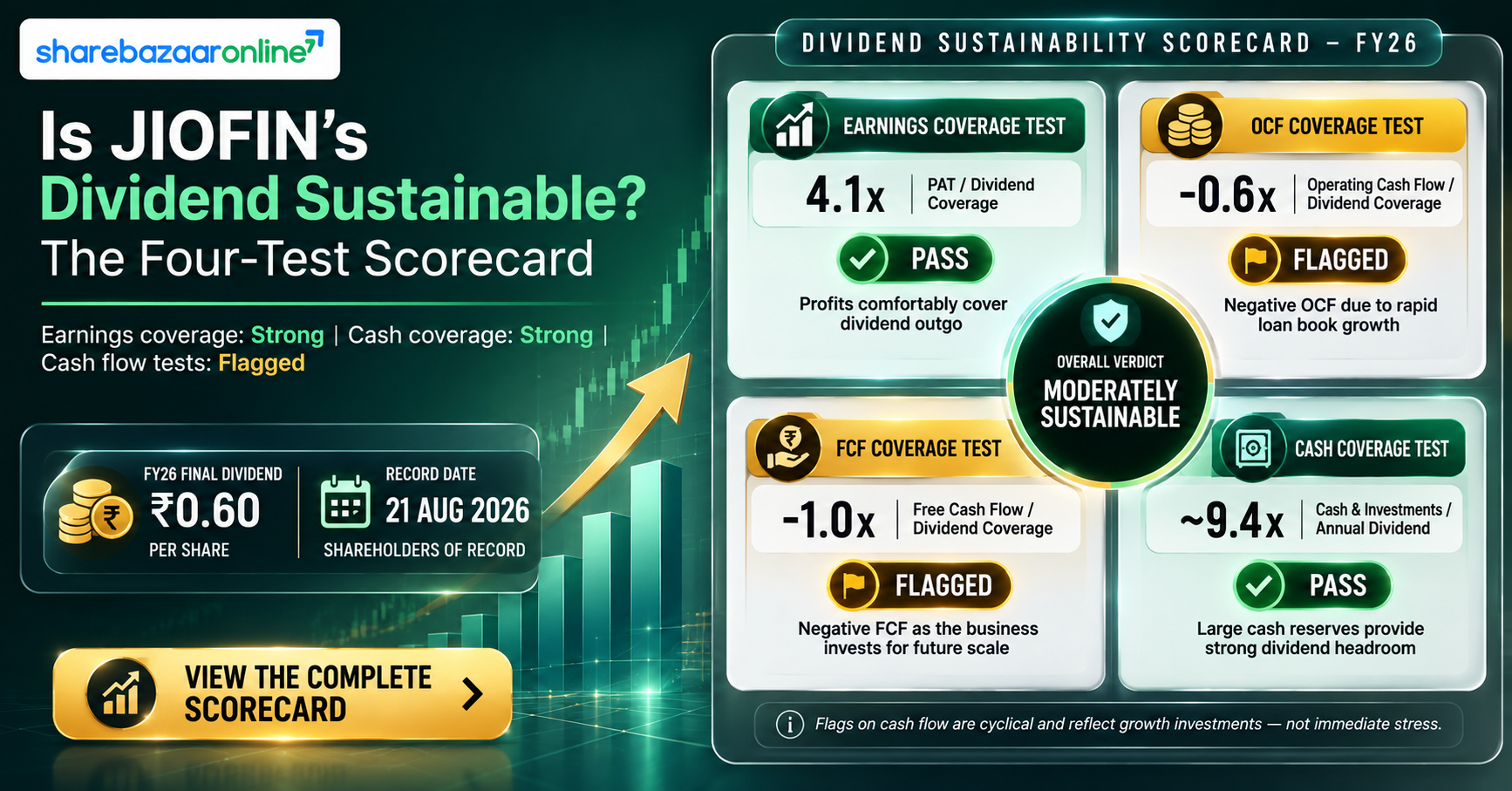
Dividend Sustainability Analysis
Test 1: Earnings Coverage (EPS ÷ DPS)
4.10x — Strong
Test 2: OCF Coverage
Not Meaningful (OCF Negative)
Test 3: FCF Coverage
Not Meaningful (FCF Negative)
Test 4: Cash / Liquidity Coverage
9.4x on Cash & Bank Balances — Strong
Verdict: Moderately Sustainable. JFSL clears the earnings-coverage and cash-coverage tests comfortably — the payout ratio of just 24.42% of consolidated PAT leaves a wide margin, and cash and bank balances alone cover the dividend outflow more than nine times over. It fails the OCF and FCF tests in the mechanical sense, but this failure is structural rather than a distress signal: as a Core Investment Company with an NBFC and payments bank scaling their loan and deposit books, negative operating cash flow driven by loan disbursement growth is the expected pattern, not a warning sign, provided the balance sheet (equity of ₹1.34 lakh crore, conservative 0.16x debt-to-equity) can absorb it — which it currently can. Investors should monitor whether OCF trends toward breakeven as the lending book matures in FY27-28; a continued widening of negative OCF alongside rising leverage over multiple years, rather than this single year, would be the genuine red flag.
Peer Comparison
Jio Financial Services (JIOFIN)
Dividend Yield: ~0.25%
Payout Ratio: 24.42%
ROE: 1.19% • ROCE: 1.86%
Bajaj Finance
Dividend Yield: ~0.55-0.70%
Payout Ratio: Not Disclosed by Company (in this report)
Established NBFC, mature dividend payer
Bajaj Finserv
Dividend Yield: ~0.07-0.10%
Payout Ratio: Not Disclosed by Company (in this report)
Diversified financial holding company, comparable structure to JFSL
Sector Context
Diversified financials/NBFC sector dividend yields in India typically range 0.1%-1.0%, reflecting a broader preference for capital appreciation over income in high-growth lenders.
JFSL's yield sits within the low band typical of growth-stage diversified financial holding companies, comparable in structure to Bajaj Finserv, which similarly holds diverse lending, insurance and asset management businesses under one listed entity and also carries a sub-0.2% yield. Peer keyword and traffic-intelligence metrics for this comparison could not be independently sourced this cycle (see SEO section) and are flagged accordingly.
Promoter Impact Analysis
Promoter Holding (as at FY26 year-end / dividend-relevant period)
47.12%
Promoter Holding (Latest, post-warrant conversion, Jun 2026)
49.13%
Estimated Promoter Dividend Income
₹179.62 crore
Estimated Minority/Public Dividend Income
₹201.57 crore
At the FY26 year-end shareholding of 47.12%, the Reliance/Ambani-family promoter group is estimated to receive roughly ₹179.62 crore of the total ₹381.19 crore dividend outflow, with the remaining ₹201.57 crore flowing to institutional (FII/DII) and public/minority shareholders, who together hold the majority of the register. Promoter holding has since risen to 49.13% following conversion of a tranche of preferential warrants originally allotted in September 2025, meaning promoter participation in future payouts is set to rise further. The distribution impact on minority shareholders is proportionate to their holding and involves no disproportionate benefit to the promoter group in this specific dividend action.
Taxation Analysis
Under Indian income tax law, dividends received from domestic companies are fully taxable in the hands of the shareholder at their applicable income tax slab rate, and are classified as "Income from Other Sources." The dividend distribution tax regime that once made dividends tax-free for investors was abolished with effect from FY 2020-21. Companies deduct TDS at 10% under Section 194 if the total dividend paid to a resident individual shareholder exceeds ₹10,000 in a financial year; for JFSL shareholders with modest holdings, this ₹10,000 threshold means most retail investors receiving this particular ₹0.60/share dividend will see no TDS deducted at source, though the income remains fully taxable on self-assessment.
Worked Example (illustrative, generic slab)
Investor holds 1,000 shares • Dividend = ₹10/share • Tax Slab = 30%
Gross Dividend: ₹10,000.00
Tax @30%: ₹3,000.00
Net Dividend: ₹7,000.00
Applied to JFSL's Actual FY26 Dividend
Investor holds 1,000 JIOFIN shares • Dividend = ₹0.60/share • Tax Slab = 30%
Gross Dividend: ₹600.00
Tax @30%: ₹180.00
Net Dividend: ₹420.00
Effective Post-Tax Yield on CMP (₹244.00): 0.17%
Key Risks
1. Rapidly rising leverage: Borrowings grew 448% YoY to fund NBFC and payments bank growth; continued aggressive leveraging without matching asset-quality discipline could pressure future coverage ratios.
2. Negative and widening operating cash flow: OCF has been negative for two consecutive years and deepened in FY26; if the lending book does not mature into net cash generation as expected, near-term financial flexibility could tighten.
3. Declining consolidated profit despite revenue growth: Q4FY26 PAT fell 13.88% YoY and full-year PAT declined 3.21%, driven by sharply rising finance and employee costs — a trend that bears watching into FY27.
4. Low return ratios: ROE of 1.19% and ROCE of 1.86% remain well below both mature NBFC peers and the company's cost of capital, reflecting the large idle/under-deployed investment book still being redirected into operating businesses.
5. Key managerial transition: The Group CFO transition (Abhishek Pathak's exit effective April 20, 2026, and the appointment of a new CFO effective May 11, 2026) introduces a period of financial-leadership handover risk at a time when the company is scaling its balance sheet rapidly.
6. Regulatory and joint-venture execution risk: Multiple new ventures (Jio Payments Bank, Jio BlackRock asset management/broking entities, Allianz Jio Reinsurance) are all in early operational stages and carry execution and regulatory-approval risk that could affect group profitability and, by extension, future dividend capacity.
What To Monitor
1. Trajectory of operating cash flow: Watch whether OCF narrows toward breakeven over FY27-28 as the NBFC loan book and payments bank deposit base mature.
2. Asset quality of the scaling loan book: Track gross/net NPA trends at Jio Credit as disbursements accelerate rapidly from a low base.
3. ROE/ROCE improvement: Monitor whether return ratios climb meaningfully from current sub-2% levels as capital gets deployed into higher-yielding businesses.
4. Progress of BlackRock and Allianz joint ventures: Track regulatory approvals and scale-up of the asset management, broking, and reinsurance joint ventures, which represent significant future earnings optionality.
5. Dividend payout consistency: Watch whether the company declares a third consecutive annual dividend in FY27 and whether the payout ratio is maintained near the current conservative ~24% level or expanded.
6. New CFO's financial strategy: Watch for any shifts in capital allocation, leverage policy or dividend philosophy communicated by incoming Group CFO Ms. Annapoorna Venkataramanan after she takes charge from May 11, 2026.
Conclusion
Jio Financial Services' FY26 final dividend of ₹0.60 per share marks a 20% step-up from its maiden FY25 payout, reflecting the early, cautious dividend policy of a company still in the capital-deployment phase of its lifecycle. The headline 6% figure on face value should not be confused with the far more modest ~0.25% real yield on the current market price. On coverage metrics, the payout is comfortably affordable — a low 24.42% payout ratio, 4.10x earnings coverage and roughly 9.4x cash coverage all point to a well-cushioned distribution. The one genuine forensic flag is negative and widening operating cash flow, which is structurally explained by rapid loan-book growth at the group's NBFC and payments bank subsidiaries rather than by any deterioration in core profitability, but it is worth tracking over the next several quarters. Investors should read this dividend as an early signal of capital discipline from a young, fast-scaling financial conglomerate rather than as an income opportunity in its own right. This is analysis, not investment advice — readers must form their own view in light of their individual circumstances.
Frequently Asked Questions
What dividend has Jio Financial Services announced for FY2025-26?
What is the real dividend yield on Jio Financial Services shares?
What was the record date for the JFSL FY26 dividend?
What was the ex-date for this dividend?
When will the dividend be paid?
Who was eligible to receive this dividend?
How is the JFSL dividend taxed for investors?
Is Jio Financial Services' dividend sustainable?
What is Jio Financial Services' dividend history?
What should investors monitor going forward?
Why is Jio Financial Services' operating cash flow negative despite reporting a profit?
How much will Jio Financial Services' promoters receive from this dividend?
Disclaimer
This article is published by ShareBazaar Online for general informational and educational purposes only and does not constitute investment advice, a recommendation, or a solicitation to buy, sell or hold any security. ShareBazaar Online is not a SEBI-registered investment advisor or research analyst. All figures are sourced from the company's regulatory filings, stock exchange disclosures, and publicly available third-party data as cited; figures not disclosed by the company are marked "Not Disclosed by Company," and keyword/search-intent metrics not independently verifiable this cycle are marked NIV (Not Independently Verified). Market prices are subject to change and should be re-verified before making any decision. Readers should consult a SEBI-registered investment advisor and conduct their own due diligence before making any investment decision. ShareBazaar Online accepts no liability for any loss arising from the use of this content.