
Dividend Snapshot
Aditya Birla Lifestyle Brands Limited (ABLBL) has declared its maiden final dividend of ₹0.50 per equity share for the financial year ended 31 March 2026 (FY 2025-26). This is the first dividend the company has paid since it began trading on 23 June 2025 following its demerger from Aditya Birla Fashion and Retail Limited. The payout equals a 5% dividend on the ₹10 face value, but as this article explains in detail, the headline "5%" figure is a face-value percentage, not the return an investor actually earns on the market price.
Core Dividend Facts
- Dividend Per Share: ₹0.50
- Dividend Type: Final Dividend (FY 2025-26)
- Dividend on Face Value: 5% (Face Value ₹10)
- Real Dividend Yield: ~0.58% (on CMP ₹86.9)
- Record Date: 7 August 2026
- Payment: on or after 17 September 2026
What The Numbers Really Say
- Estimated total outflow: ~₹61 crore
- Dividend payout ratio: ~36% of FY26 profit
- Earnings coverage: 2.8x (EPS ₹1.40 vs DPS ₹0.50)
- Free cash flow coverage: ~14.7x
- The 187% profit "jump" is a low-base effect, not a margin story
- Borrowings (incl. lease liabilities): ~₹3,018 crore
The one-line takeaway: ABLBL's first dividend is small, comfortably covered by cash flow and easily affordable, but it sits on top of a highly leveraged, thin-profit retail balance sheet. The dividend is sustainable in size; the earnings quality behind it deserves closer reading. All key figures below have been computed from the company's consolidated financials, not estimated.
Dividend Announcement Summary
On 7 May 2026, the Board of Directors of Aditya Birla Lifestyle Brands Limited recommended a final dividend of ₹0.50 (Fifty Paisa) per equity share of face value ₹10 each for the financial year ended 31 March 2026. As per the company's exchange intimation under Regulation 42 of SEBI (LODR) Regulations, 2015, the dividend was subject to the approval of members at the ensuing Annual General Meeting (AGM), and is to be paid on or after Thursday, 17 September 2026.
Filing Details
- NSE Symbol: ABLBL
- BSE Scrip Code: 544403
- ISIN: INE14LE01019
- CIN: L46410MH2024PLC423195
- Announcement Date: 7 May 2026
- Financial Year: 2025-26
Approval Status
The dividend was recommended by the Board and put to shareholders for approval at the company's 2nd Annual General Meeting held on 19 August 2026. A final dividend requires member approval before it becomes payable, unlike an interim dividend which the Board can pay directly. Readers should confirm the approved status from the AGM outcome filed with the exchanges.
ABLBL houses the Aditya Birla Group's premium and youth western-wear brands, including Louis Philippe, Van Heusen, Allen Solly, Peter England, Simon Carter, American Eagle and Reebok. The company reports a retail footprint of roughly 4.8 million square feet, with 3,315+ brand stores, 37,500+ trade outlets and 7,000+ shop-in-shops. This is the group's youngest listed entity, separated from Aditya Birla Fashion and Retail Limited (ABFRL) so that the branded lifestyle-apparel business could be valued on its own.
Key Dates Timeline
Dividend Calendar (FY 2025-26 Final Dividend)
| Event | Date | Note |
|---|---|---|
| Announcement / Board Recommendation | 7 May 2026 | Along with Q4 & FY26 results |
| Record Date | 7 August 2026 | Per company's Reg. 42 intimation |
| Ex-Dividend Date | 7 August 2026 | Aligned with record date under T+1 |
| AGM (approval) | 19 August 2026 | 2nd AGM of the company |
| Payment Date | On or after 17 Sep 2026 | As stated by the company |
Under India's T+1 settlement cycle, the ex-date and record date now typically fall on the same trading day. Data vendors and the exchange corporate-action feed list the ex-dividend date as 7 August 2026, matching the record date the company fixed. Investors who held the shares as of the record date were eligible for the dividend; buyers on or after the ex-date were not entitled to this particular payout.
Dividend Yield Analysis
The Face-Value Illusion
The company's filing describes a "5%" dividend. That 5% is measured against the ₹10 face value — it is not the yield an investor earns. The real dividend yield is the ₹0.50 payout divided by the market price you actually pay for the share.
Yield On Current Market Price
At a current market price of about ₹86.9 (NSE close, 19 August 2026):
₹0.50 ÷ ₹86.9 × 100 = ~0.58%
So a "5% dividend" translates into a real cash yield of roughly half a percent.
Yield At Announcement
Around the announcement window (early May 2026), the stock traded near ₹105 on the NSE (approximate):
₹0.50 ÷ ₹105 × 100 = ~0.48%
Verify the exact announcement-day close before publishing, as yield is price-dependent.
Why the yield is low: ABLBL is a growth-and-expansion retailer, not a high-payout cash cow. It retains most of its profit to fund store roll-outs (notably Reebok) and to service a substantial debt and lease book. A sub-1% yield is normal for this profile — investors here are positioned for potential capital appreciation and margin recovery, not for dividend income. For comparison, the broad Indian market's median yield sits around 0.3%, so ABLBL's ~0.58% is modest but not unusual for a specialty retailer.
Dividend History Analysis
Dividend Track Record
| Financial Year | Dividend Per Share | Payout Ratio |
|---|---|---|
| FY 2024-25 | Nil | 0% (transition / demerger year) |
| FY 2025-26 | ₹0.50 | ~36% |
The company was listed only in June 2025, so there is no longer dividend history to review. FY26 is the first year of any distribution.
Classification: Debut Payer
With only one dividend on record, ABLBL cannot yet be classified as a consistent, cyclical or irregular payer. It is a debut dividend payer. There is no growth trend, no history of cuts and no special dividends to analyse. The key question for income-focused readers is whether the company can maintain and grow this ₹0.50 payout in future years — and that depends on the earnings and leverage trends discussed below. A single small dividend, however welcome, does not establish a payout policy.
Financial Performance Analysis
Consolidated Profit & Loss (₹ Crore)
| Metric | FY25 | FY26 | Growth |
|---|---|---|---|
| Revenue | 7,830 | 8,396 | +7.2% |
| Operating Profit | 1,223 | 1,371 | +12.1% |
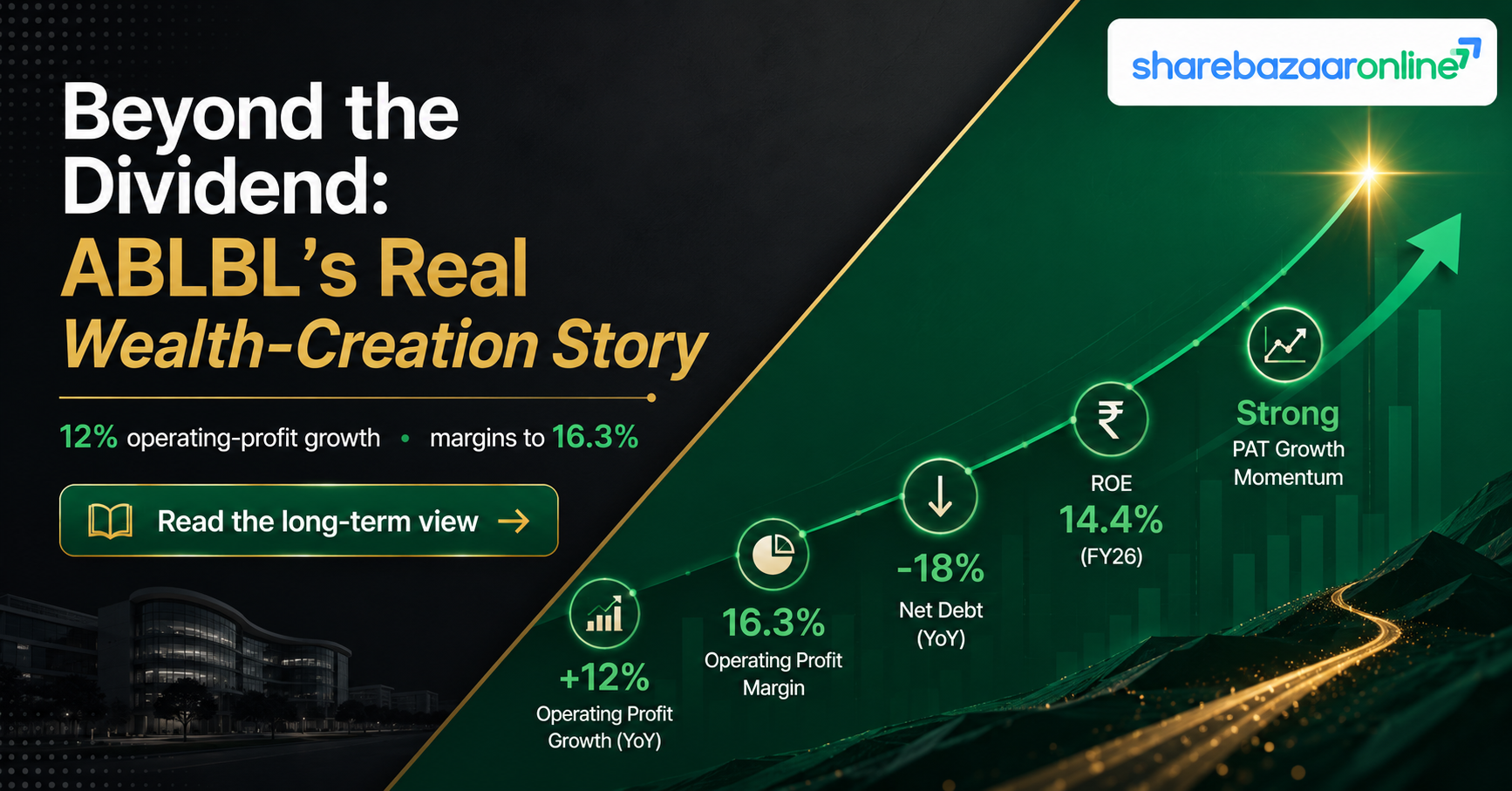
| Operating Margin | 15.6% | 16.3% | +70 bps |
| Interest | 413 | 392 | -5.1% |
| Depreciation | 706 | 795 | +12.6% |
| Profit Before Tax | 83 | 220 | +165% |
| Net Profit | 60 | 171 | +187% |
| EPS (₹) | — | 1.40 | — |
Operating Leverage: Reading Past The 187% Headline
The eye-catching +187% jump in net profit is largely a low-base effect. FY25 was a stub / transition year in which the company reported only ₹60 crore of profit as the demerger played out, dragged down by weak other income. When the denominator is tiny, even a modest absolute gain produces a dramatic percentage. The cleaner operational signal is that operating profit grew ~12% and margins improved by about 70 basis points to 16.3% — solid, but nowhere near "profit tripled." Revenue grew a steady but unspectacular 7.2%.
Where The Profit Goes
Of ₹1,371 crore of operating profit, ₹795 crore is eaten by depreciation (heavily inflated by Ind AS 116 lease accounting for a store-heavy retail model) and ₹392 crore by interest. That leaves just ₹220 crore of pre-tax profit — interest alone is 1.8x the pre-tax profit. This is the crux of ABLBL's earnings quality: a healthy store-level operation, but a thin bottom line after leverage and lease charges. A strong operating business does not automatically mean a strong net profit.
Cash Flow Analysis
Reported profit is an accounting opinion; cash is a fact. This is where ABLBL looks stronger than its slim net profit suggests. Because depreciation on leased stores is a large non-cash charge, the company's cash generation is far higher than its accounting profit.
FY26 Cash Flow (₹ Crore)
- Operating Cash Flow: 1,219
- Investing Cash Flow: -198
- Financing Cash Flow: -983
- Free Cash Flow: 896
- CFO / Operating Profit: ~92%
Profit vs Cash Divergence
Net profit was ₹171 crore, but operating cash flow was ₹1,219 crore — roughly 7x the accounting profit. The bulk of that gap is depreciation. A CFO-to-operating-profit ratio of ~92% shows earnings are converting into cash efficiently, which is a genuine positive for dividend affordability.
How This Dividend Is Funded
The estimated dividend outflow of ~₹61 crore is comfortably covered by free cash flow of ₹896 crore — a coverage of about 14.7x. The dividend is being funded from current-year cash generation, not from borrowings or asset sales. The much larger ₹983 crore financing outflow reflects debt and lease repayments, so the group is directing most of its surplus cash toward de-leveraging rather than shareholder payouts — a sensible priority given the debt load.
Balance Sheet Strength
Key Balance Sheet Items (Mar 2026, ₹ Cr)
- Equity Capital: 1,221
- Reserves: 192
- Borrowings (incl. leases): 3,018
- Fixed Assets: 3,609
- Investments: 16
- Book Value / Share: ~₹11.6
Return Ratios
- Return on Equity (ROE): ~14.9%
- Return on Capital Employed (ROCE): ~15.0%
- Operating Margin: 16.3%
- Interest Coverage: Low (flagged by data providers)
The Leverage Picture
ABLBL carries ~₹3,018 crore of borrowings against a slim reserve base. An important nuance: for an apparel retailer running thousands of stores, a large share of these "borrowings" is lease liabilities capitalised under Ind AS 116 rather than pure financial debt. Even so, interest of ₹392 crore is a heavy annual charge, and independent data providers explicitly flag the company's low interest coverage ratio as a concern. The maiden ₹61 crore dividend is a rounding error against this ₹3,018 crore liability base — equal to about 2% of borrowings — so it does not materially weaken the balance sheet, but it also underlines why the company is prioritising debt reduction over larger payouts.
Dividend Sustainability Analysis
Four-Test Sustainability Scorecard
| Test | Metric | Verdict |
|---|---|---|
| Earnings Coverage | EPS ₹1.40 vs DPS ₹0.50 = 2.8x | Strong |
| Operating Cash Flow Coverage | ₹1,219 cr vs ₹61 cr = ~20x | Very Strong |
| Free Cash Flow Coverage | ₹896 cr vs ₹61 cr = ~14.7x | Very Strong |
| Balance Sheet / Leverage | High debt & leases; low interest cover | Watch |
Overall Classification: Sustainable (In Its Current Size)
On the tests that matter for a small maiden dividend, ABLBL scores well. The ₹61 crore payout is trivially covered by both earnings (2.8x) and free cash flow (~14.7x), and it is funded from current cash generation. The single flag is the leverage profile: thin net profit after heavy interest, and a low interest coverage ratio. The dividend at this level is sustainable, but the ability to grow it meaningfully in future years is tied to further debt reduction and margin gains rather than to the current comfortable coverage.
Peer Comparison
Branded Apparel / Lifestyle Retail Peers
| Company | Div. Yield | Payout | Profile |
|---|---|---|---|
| ABLBL | ~0.58% | ~36% | Debut payer, levered |
| Page Industries | ~2.6% | ~91% | High-payout, high-ROE |
| Vedant Fashions | ~1.3-1.5% | ~50% | Asset-light, high-margin |
| Trent | ~0.1% | ~11% | Pure growth, minimal payout |
| ABFRL (parent) | Nil | — | Loss-making, no dividend |
Peer yields/payouts are approximate and drawn from public data providers; cells left blank where not independently verified. Verify latest figures before publishing.
Where ABLBL sits: its ~0.58% yield is well below dividend-oriented peers like Page Industries (which pays out most of its profit) and Vedant Fashions, but above pure-growth Trent and its own loss-making former parent ABFRL. This positioning fits its story: a newly demerged, expansion-focused, leveraged retailer that is beginning to return a token amount of cash while it still needs capital for growth and debt reduction. Page Industries and Vedant run asset-light, high-margin, low-debt models that support far higher payouts; ABLBL's store-heavy, leveraged model does not (yet).
Promoter Impact Analysis
Shareholding Pattern (Jun 2026)
- Promoters: 46.60%
- FIIs: 12.70%
- DIIs: 20.80%
- Public: 19.42%
- Others: 0.48%
Dividend Distribution By Holder (₹ Cr)
- Promoter income: ~28.4 (46.6%)
- DII income: ~12.7 (20.8%)
- Public income: ~11.9 (19.4%)
- FII income: ~7.8 (12.7%)
- Total outflow: ~61.0
The Aditya Birla Group promoters will receive an estimated ₹28.4 crore of the ₹61 crore dividend. Notably, the shareholding pattern shows an ongoing shift: FII holding has fallen sharply from ~22.6% (Jun 2025) to ~12.7% (Jun 2026), while DII holding has nearly doubled from ~11% to ~20.8% over the same period. Minority public shareholders together receive roughly ₹11.9 crore. For all holders, the cash benefit is small in absolute terms — consistent with a token maiden dividend rather than a meaningful income stream.
Taxation Analysis
How Dividends Are Taxed In India
Since the abolition of the Dividend Distribution Tax (from FY 2020-21), dividends are taxable in the hands of the shareholder at their applicable income-tax slab rate. The company deducts TDS at 10% under Section 194 only if the total dividend paid to a resident shareholder in a financial year exceeds ₹5,000. For most retail holders of ABLBL, the ₹0.50 per share payout will not cross that threshold, so no TDS would apply.
Worked Example (1,000 Shares, 30% Slab)
| Shares held | 1,000 |
| Dividend per share | ₹0.50 |
| Gross dividend | ₹500 |
| TDS (below ₹5,000 threshold) | ₹0 |
| Tax at 30% slab (+ applicable cess) | ₹150 |
| Net dividend in hand | ₹350 |
| Effective post-tax yield (on ₹86.9) | ~0.40% |
Note: the 30% figure excludes surcharge and 4% health & education cess, which raise the effective rate for higher earners. Investors in lower slabs pay less. This is illustrative, not tax advice.
Key Risks
- 1. High leverage & low interest coverage. Borrowings and lease liabilities of ~₹3,018 crore, with interest of ₹392 crore consuming most of the operating profit. Any rise in rates or slowdown in store cash flows squeezes the thin ₹220 crore pre-tax profit.
- 2. Thin net margin. Net profit margin is only ~2% of revenue. Small swings in discounting, input costs or rentals can move the bottom line sharply.
- 3. Discretionary demand cyclicality. Branded apparel is a discretionary purchase; a consumption slowdown or weak festive/wedding season directly hits revenue and same-store growth.
- 4. Execution risk on Reebok and expansion. Growth depends on rolling out new stores (including Reebok, still targeting internal breakeven) profitably. Aggressive expansion could pressure margins before it pays off.
- 5. Contingent liabilities. The group faces a reported GST demand of ~₹310 crore for FY19-23 (which it intends to contest); adverse tax or regulatory outcomes are an overhang.
- 6. Short listing history. As a company listed only since June 2025, ABLBL has a limited public track record, and its stock has been volatile (52-week range roughly ₹87 to ₹168).
What To Monitor
- 1. Debt reduction trajectory. Watch whether the large financing outflows continue to shrink borrowings and lift interest coverage quarter by quarter.
- 2. Operating margin trend. Track whether OPM holds above 16% and whether margin recovery (management's stated priority) actually flows to the net line.
- 3. Like-for-like (same-store) sales growth. The cleanest read on underlying demand, separate from new-store additions.
- 4. Reebok profitability. Monitor progress toward Reebok's internal breakeven and the pace of its store roll-out.
- 5. Free cash flow conversion. Continued high CFO/operating-profit conversion is what keeps the dividend affordable; a fall would be an early warning.
- 6. Future dividend policy. Whether the company raises the payout in FY27 will signal management's confidence in the leverage and earnings trajectory.
Conclusion
Aditya Birla Lifestyle Brands' first-ever dividend of ₹0.50 per share is a symbolic milestone for a company barely a year into public life. On the numbers, the payout is small, well-covered and easily affordable: a ~36% payout ratio, 2.8x earnings coverage and nearly 15x free-cash-flow coverage, funded entirely from current cash generation. The real yield of about 0.58% is modest — and far below the "5%" face-value headline that can mislead first-time readers.
The tension in the story is between strong cash generation and a leveraged, thin-profit balance sheet. The much-quoted 187% profit surge is a base-effect illusion; the durable signal is ~12% operating-profit growth and improving margins, partly offset by ~₹3,018 crore of debt and leases and a flagged low interest coverage. The dividend is sustainable at this level; its ability to grow rests on continued de-leveraging and margin recovery. We present the positives, negatives, risks and monitoring factors so readers can reach their own conclusions.
Frequently Asked Questions
What dividend has Aditya Birla Lifestyle Brands (ABLBL) announced?
What is the ABLBL dividend yield?
What is the record date for the ABLBL dividend?
What is the ex-dividend date?
When will the ABLBL dividend be paid?
Who was eligible for the dividend?
How is the ABLBL dividend taxed?
Is the ABLBL dividend sustainable?
What is ABLBL's dividend history?
What should investors monitor going forward?
Why did ABLBL's profit jump 187% in FY26?
How much dividend will the promoters receive?
Which brands does ABLBL own?
Does a "5% dividend" mean a 5% return?
Disclaimer
ShareBazaar Online is a financial publishing platform and is not registered with SEBI as an investment adviser or research analyst. This article is for informational and educational purposes only and does not constitute investment advice or any buy, sell or hold recommendation. Figures are drawn from the company's exchange filings and publicly available financial data and have been computed independently; some market-price-dependent figures are approximate and should be re-verified before any decision. Dividend approval, record date, and payment details are subject to the company's filings and AGM outcome. Investing in equities carries risk, including loss of capital. Readers should conduct their own due diligence and consult a SEBI-registered financial adviser and a qualified tax professional before making any investment decision. ShareBazaar Online accepts no liability for actions taken based on this content.