
Dividend Snapshot
Jayant Agro-Organics Limited (NSE: JAYAGROGN, BSE: 524330) has recommended a final dividend of ₹3.50 per equity share for the financial year 2025-26. The payout equals 70% of the face value of ₹5 per share and remains subject to shareholder approval at the company's 34th Annual General Meeting.
The Number That Matters
The eye-catching "70%" is a percentage of the ₹5 face value, not a return on the traded price. At a market price of about ₹223, the real dividend yield works out to just 1.57% — a gap of roughly 68 percentage points between the headline figure and the cash yield a buyer today actually earns.
Key Figures at a Glance
Dividend per share: ₹3.50
Dividend rate: 70% of ₹5 face value
Real dividend yield: ~1.57%
Record date: 07 August 2026
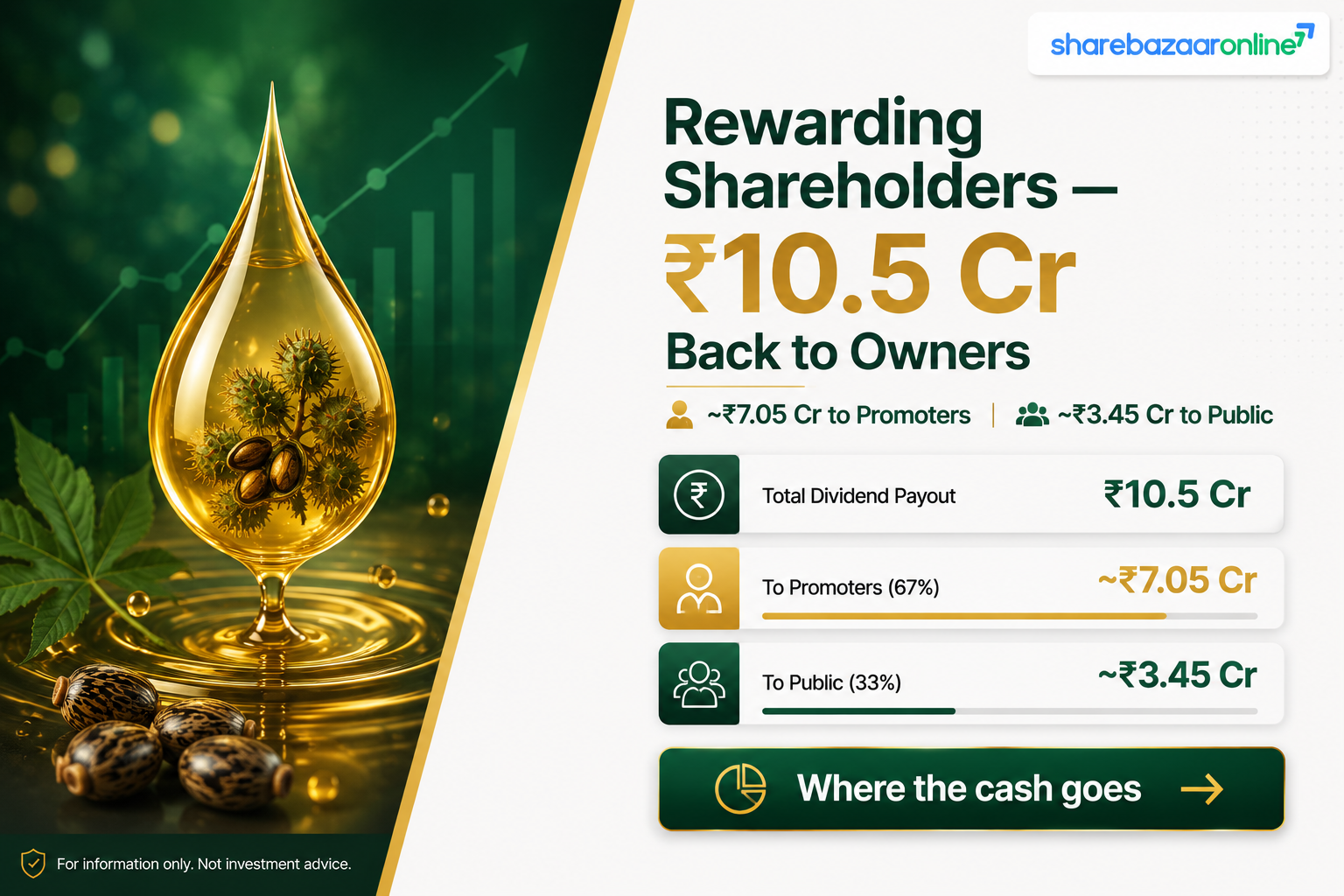
Estimated total outflow: ~₹10.5 crore
Earnings coverage: 4.80x
Dividend Announcement Summary
At its board meeting held on 29 May 2026, the Board of Directors of Jayant Agro-Organics recommended a final dividend of ₹3.50 per share (70% of face value) for FY2025-26, alongside the audited annual results. On 30 July 2026 the company filed an intimation under Regulation 42 of SEBI (LODR), fixing the record date for determining eligible shareholders.
Because this is a final dividend, it is a recommendation only until members approve it at the 34th AGM scheduled for 12 September 2026. Until that approval, the payout carries conditional "recommended / subject to approval" status. This distinction is often blurred in wire coverage, which frequently reports the dividend as if it were already declared.
The recommendation came with a headline profitability story for the March 2026 quarter, where consolidated net profit rose about 66% year-on-year. As the sections below show, that quarterly surge sits on top of a full year in which revenue and profit actually declined — a nuance retail readers should understand before reading too much into the payout.
Key Dates Timeline
Confirmed Dates
Board recommendation: 29 May 2026
Record date intimation filed: 30 July 2026
Record date: Friday, 07 August 2026
AGM (approval): Saturday, 12 September 2026
Inferred / Not Disclosed
Ex-date: 07 August 2026 — under India's T+1 settlement the ex-date and record date coincide (should be confirmed against the NSE/BSE corporate-action circular).
Payment date: Not specified in the record-date filing. If approved at the AGM, statutory rules require payment within 30 days of declaration (context only, not a confirmed date).
Note: both the record date and the ex-date (07 August 2026) have already passed. Shareholder eligibility for this dividend was therefore fixed as at the close of business on 07 August 2026 — but the cash payout still depends on AGM approval on 12 September 2026.
Dividend Yield Analysis
The Face-Value Illusion
A "70% dividend" sounds enormous, but the percentage is calculated on the ₹5 face value, giving ₹3.50 per share. What a buyer earns depends on the price paid:
At the latest price of about ₹223: yield ≈ 1.57%.
At the announcement-window price of about ₹220: yield ≈ 1.59%.
(Exact NSE close on 29 May 2026 is Not Independently Verified to the tick; the late-May trading band was used.)
Yield in Context
A real yield of about 1.57% is below a typical savings-bank rate and well under a fixed deposit. Jayant Agro is not a high-yield stock — it is a low-margin, cyclical commodity processor that returns a modest slice of profit while retaining most earnings for working capital and growth.
Why Verify Before Publishing
Every yield figure above is price-dependent. Because the ex-date has passed and the stock trades ex-entitlement, the live yield must be re-checked against the current market price before this figure is quoted anywhere.
Dividend History Analysis
Per-Share Dividend by Financial Year
| Financial Year | Dividend / Share | Approx. Payout |
|---|---|---|
| FY2018-19 | ₹2.00 | ~11% |
| FY2019-20 | Nil (loss year) | 0% |
| FY2020-21 | ₹1.00 | ~6% |
| FY2021-22 | ₹3.00 | ~10% |
| FY2022-23 | ₹5.00 | ~30% |
| FY2023-24 | ₹7.50 | ~44% |
| FY2024-25 | ₹2.50 | ~14% |
| FY2025-26 | ₹3.50 (recommended) | ~21% |
Per-share amounts reconciled from reported payout ratios and EPS. A 1:1 bonus issue in August 2017 doubled the share count; per-share figures before FY2018-19 need restatement under Ind AS 33 for a like-for-like comparison and are excluded here.
Verdict: Cyclical Payer, Not a Steady Compounder
The record shows a company that pays when profits allow and cuts when they don't — a full skip in FY2019-20 (a loss year), a peak of ₹7.50 in FY2023-24, then a sharp cut to ₹2.50 the following year. The proposed ₹3.50 is a 40% increase over last year's ₹2.50, but still less than half the FY2023-24 peak. Investors seeking predictable, growing income should treat this as a cyclical rather than a consistent dividend.
Financial Performance Analysis
The Headline vs the Full Year
The March 2026 quarter was strong: consolidated net profit of about ₹18.3 crore, up ~66% year-on-year, with quarterly EBITDA rising roughly 90%. But zoom out to the full year and the picture reverses.
FY2025-26 Full-Year (Consolidated)
Revenue: ~₹2,406 crore (down ~4.8% vs FY25)
Operating profit: ~₹104 crore (down ~4.6%)
Operating margin: ~4.3%
Net profit: ~₹50 crore (down ~6.7%)
EPS: ~₹16.80
What Stands Out
Margins are razor-thin at ~4.3% — typical of a commodity-linked castor oil processor where raw-material (castor seed) prices drive most of the cost base. A strong Q4 lifted the exit rate, but the annual trend was mildly negative on both the top and bottom line. The dividend is being paid off a slightly shrinking profit base, not a growing one.
Cash Flow Analysis
Profits Are Opinions; Cash Is Fact
In FY2025-26 the company generated ~₹44 crore of operating cash flow against reported net profit of ~₹50 crore — a cash conversion of about 88%. After capital spending, free cash flow was only ~₹10 crore.
The Tight FCF Coverage
The proposed dividend outflow of about ₹10.5 crore is almost exactly equal to FY26 free cash flow of ~₹10 crore — an FCF coverage of only ~0.95x. In plain terms, last year's free cash barely covers this payout, so any cushion comes from the balance sheet, not from surplus cash generation.
How the Dividend Is Funded
Operating cash flow comfortably covers the payout (~4.2x), so the dividend is funded primarily from current earnings and internal accruals. It is not obviously funded by fresh borrowing, but the thin free cash flow means capex and working-capital swings leave little room to spare in a weak year.
Balance Sheet Strength
Solid Net Worth, Modest Debt
Net worth stands at about ₹610 crore (equity capital ₹15 crore plus reserves ~₹595 crore), giving a book value of roughly ₹203 per share. Borrowings of about ₹131 crore imply a comfortable debt-to-equity ratio near 0.21x. Return on equity is modest at ~8.5% and ROCE around 11.6%.
The Contingent-Liability Flag
A point wire coverage rarely mentions: contingent liabilities of about ₹423 crore — roughly 0.69x net worth. These are not on-balance-sheet debt, but they are large relative to the equity base and worth watching, since an adverse outcome could materially affect the company's finances.
A separate cash-and-bank balance is not broken out in the summary financials used here and is marked Not Disclosed by Company (in the summary source); investments are shown at ~₹11 crore. The overall balance sheet nonetheless comfortably supports a ₹10.5 crore payout.
Dividend Sustainability Analysis
Four-Test Scorecard
| Test | Reading | Assessment |
|---|---|---|
| Earnings coverage | 4.80x (EPS ₹16.80 / DPS ₹3.50) | Strong |
| Operating cash flow coverage | ~4.2x (CFO ₹44 Cr / outflow ₹10.5 Cr) | Strong |
| Free cash flow coverage | ~0.95x (FCF ₹10 Cr / outflow ₹10.5 Cr) | Tight |
| Liquidity / balance-sheet cushion | Net worth ~₹610 Cr, D/E ~0.21x | Adequate |
Classification: Moderately Sustainable
On earnings and operating cash flow the payout is very comfortably covered, and a modest ~21% payout ratio leaves ample room. The one caution is free cash flow: at ~0.95x, a single weak year of capex or working-capital drag can push the dividend to rely on reserves. Given the low payout ratio and strong net worth, the dividend looks affordable — but its size will likely keep swinging with the commodity cycle, exactly as the history shows.
Peer Comparison
Jayant Agro-Organics is classified within specialty chemicals, but as a castor-focused oleochemical processor it has few directly comparable listed pure-plays. The table benchmarks its own metrics; peer cells are left blank where figures could not be independently verified for this edition.
| Company | Div. Yield | Payout | ROE | ROCE |
|---|---|---|---|---|
| Jayant Agro-Organics | ~1.57% | ~21% | ~8.5% | ~11.6% |
| Gujarat Ambuja Exports | — | — | — | — |
| Fine Organic Industries | — | — | — | — |
| Galaxy Surfactants | — | — | — | — |
Peer figures marked — are Not Independently Verified for this edition and require a data-desk re-run before publication. Jayant Agro's own low-yield, moderate-return profile is consistent with a thin-margin commodity processor rather than a premium specialty-chemicals compounder.
Promoter Impact Analysis
Where the Cash Goes
Promoters hold about 67.13% of Jayant Agro-Organics. Of the estimated ₹10.5 crore total dividend, roughly ₹7.05 crore flows to the promoter group, with the remaining ~₹3.45 crore shared among public shareholders (who hold ~32.8%).
Interpretation
High promoter ownership means the family benefits most from any payout, which can align interests but also concentrates the cash return. Institutional holding is negligible (FIIs ~0.06%, DIIs ~0.02%), so this is very much a promoter- and retail-owned stock.
Taxation Analysis
How Dividends Are Taxed in India
Since April 2020, dividends are taxed in the hands of the shareholder at their applicable income-tax slab rate. The company deducts TDS at 10% on dividend paid to a resident shareholder only once total dividend from that company in a financial year crosses the prescribed threshold (₹5,000 for most years). The gross dividend is added to "income from other sources."
Worked Example
An investor holding 1,000 shares at ₹3.50 per share, in the 30% slab:
Gross dividend: ₹3,500
TDS at 10%: ₹0 (below the ₹5,000 threshold, so no TDS)
Tax at 30% slab: ₹1,050
Net in hand: ₹2,450
Post-tax yield on a ₹223 price: ~1.10%
Illustrative only; surcharge and cess may apply at higher income levels. Not tax advice — consult a qualified professional for your situation.
Key Risks
1. Commodity price volatility. Castor seed is the dominant cost input; swings in seed prices and castor oil realisations directly compress the already thin ~4.3% operating margin.
2. Cyclical, unpredictable dividend. History shows a skip in a loss year and a cut from ₹7.50 to ₹2.50 within a year — income from this stock is not dependable.
3. Thin free cash flow. FY26 FCF (~₹10 crore) barely covered the payout; a capex-heavy or working-capital-heavy year could squeeze surplus cash.
4. Large contingent liabilities. At ~₹423 crore (~0.69x net worth), an adverse outcome could be material to the balance sheet.
5. Export and currency exposure. As an export-oriented company selling into 70+ countries, it faces demand cyclicality and rupee/foreign-currency movements.
6. Low institutional interest and liquidity. Negligible FII/DII holding and low trading volumes can amplify price moves and widen the gap between headline dividend rate and real yield.
What To Monitor
1. AGM approval on 12 September 2026 — the dividend is only a recommendation until members vote.
2. Operating margin trend — whether the strong Q4FY26 margin (EBITDA up ~90%) is sustained into FY27 or was a one-off.
3. Free cash flow recovery — can FCF move back above the dividend outflow, restoring a real cushion?
4. Castor seed and castor oil prices — the single biggest driver of profitability and, by extension, future dividends.
5. Integration of the Vithal Castor Polyols acquisition (₹25.37 crore, May 2026) — whether the bio-polyols expansion adds margin or absorbs capital.
6. Contingent-liability disclosures in the next annual report for any escalation.
Conclusion
Jayant Agro-Organics' ₹3.50 final dividend is a headline "70%" that translates to a real yield of only about 1.57% — a textbook example of the face-value illusion. The payout is well covered by earnings (4.80x) and operating cash flow (~4.2x), and the balance sheet is sound with low debt, so affordability is not in question at this modest ~21% payout.
The nuances that wire coverage tends to skip: free cash flow (~₹10 crore) only just covers the outflow; full-year FY26 revenue and profit actually declined even as the March quarter jumped ~66%; the dividend has a genuinely cyclical, cut-prone history; and roughly two-thirds of the cash goes to promoters. The payout is affordable but variable — a modest income kicker on a thin-margin commodity processor, not a reliable yield play. The figures give readers the full picture; the decision is theirs.
Frequently Asked Questions
What dividend has Jayant Agro-Organics announced for FY2025-26?
What is the actual dividend yield?
What is the record date for the Jayant Agro-Organics dividend?
What is the ex-date?
When will the dividend be paid?
Who is eligible for the dividend?
How is this dividend taxed?
Is the dividend sustainable?
What is Jayant Agro-Organics' dividend history?
How much does the total dividend cost the company?
Did Jayant Agro-Organics' profit really jump 66%?
What should investors monitor from here?
Disclaimer
This article is for informational and educational purposes only and does not constitute investment, financial, legal or tax advice, nor a recommendation to buy, sell or hold any security. ShareBazaar Online is not a SEBI-registered investment adviser. Figures are compiled from the company's exchange filings and publicly available sources and may contain errors or become outdated; items that could not be independently verified are marked accordingly. Dividend amounts and dates are subject to shareholder and regulatory approval. Market prices and yields change constantly — verify live figures before acting. Investments in securities are subject to market risks. Readers should consult a qualified, registered financial adviser and read all official documents before making any decision.