
Dividend Snapshot
IDFC FIRST Bank Ltd (NSE: IDFCFIRSTB | BSE: 539437) has recommended a final dividend of ₹0.25 per equity share for the financial year 2025-26. The figure is described in the board filing as 2.50% of face value — and that phrasing is where most retail readers go wrong. The 2.50% is calculated on the ₹10 face value, not on the market price. At the current market price the real dividend yield is far smaller, as the yield section below explains.
Dividend Announcement Summary
On 25 April 2026, the Board of Directors of IDFC FIRST Bank, at a meeting that ran from 09:30 a.m. to 03:50 p.m., recommended a final dividend of ₹0.25 per share on shares of ₹10 face value for FY 2025-26. The recommendation was made under Regulation 30 of the SEBI (LODR) Regulations, 2015, alongside the bank’s audited Q4 and full-year FY26 results.
Two conditions matter for readers. First, because this is a final dividend, it must be approved by shareholders at the ensuing Annual General Meeting (AGM) and remains “subject to shareholder approval” until the AGM concludes. Second, the AGM notice for FY 2025-26 was dispatched only in early August 2026, which places the AGM — and therefore the eligibility dates — later than several third-party aggregators currently suggest. Treat the amount as fixed and the dates as pending.
Key Dates Timeline
Important date caveat: the board’s dividend filing did not carry a record date, ex-date or payment date. Some aggregator sites list an indicative ex-date of 7 August 2026, but that appears inconsistent with the FY26 AGM notice being dispatched around 9 August 2026 — a final dividend’s record date normally follows the AGM. Readers should rely only on the official ex-date and record date once notified by the exchanges, and not on carried-forward or projected dates.
Dividend Yield Analysis
Here is the number that headlines miss. The “2.50%” in the filing is 2.50% of the ₹10 face value, which simply equals ₹0.25. It is not a 2.50% yield on your investment. Dividend yield is the dividend divided by the market price you actually pay.
At current market price (₹85.30, 19 Aug 2026)
~0.29%
₹0.25 ÷ ₹85.30
At announcement-period price (~₹67)*
~0.37%
₹0.25 ÷ ~₹67
Yield reality check: the yield today (~0.29%) is lower than it was around the announcement (~0.37%). Crucially, that is the healthy reason for a falling yield — the share price rose roughly 27% from about ₹67 in late April 2026 to ₹85 by mid-August 2026, while the dividend stayed at ₹0.25. This is the opposite of the classic “value trap”, where a high yield is produced by a collapsing price. *The announcement-period price is approximate and should be re-verified against the NSE close before publication.
Dividend History Analysis
| Financial Year | Type | Dividend/Share | % of Face Value |
|---|---|---|---|
| FY 2015-16 | Final | ₹0.25 | 2.5% |
| FY 2016-17 | Final | ₹0.75 | 7.5% |
| FY 2017-18 | Final | ₹0.75 | 7.5% |
| FY 2018-19 to FY 2023-24 | — | No Dividend | 0% |
| FY 2024-25 | Final | ₹0.25 | 2.5% |
| FY 2025-26 | Final | ₹0.25 | 2.5% |
Classification: Irregular / recently-resumed payer. IDFC FIRST Bank paid small dividends in FY16–FY18, then suspended dividends for six straight years (FY19 to FY24) through its heavy-investment and turnaround phase. It resumed with ₹0.25 in FY25 and has now repeated ₹0.25 in FY26. The pattern signals a token, capital-preserving payout rather than a rising income stream. This is a capital-appreciation stock that has only just re-started rewarding shareholders with cash — not a dividend-income stock. (Dividend history sourced from the bank’s published dividend record; per-year declaration dates should be confirmed against exchange filings.)
Financial Performance Analysis
| Metric (Standalone) | FY24 | FY25 | FY26 |
|---|---|---|---|
| Total Income (₹ Cr) | 30,322 | 36,501 | 40,549 |
| Net Profit (₹ Cr) | 2,957 | 1,525 | 1,636 |
| EPS (₹) | 4.18 | 2.08 | 1.90 |
| Dividend Payout | 0% | 12% | 13% |
Revenue up, profit down — the operating-leverage story. Total income grew steadily (FY24–FY26 CAGR of about 15.6%), yet net profit fell 48% in FY25 (₹2,957 Cr to ₹1,525 Cr) before recovering just 7% in FY26. The FY25 collapse was driven largely by elevated provisioning in the microfinance (MFI) book and margin pressure — a reminder that a bank’s profit can shrink even as its top line expands.
Why EPS fell while profit rose in FY26. Net profit rose from ₹1,525 Cr to ₹1,636 Cr, but EPS dropped from ₹2.08 to ₹1.90. The reason is dilution: the share count expanded roughly 17.5% (from about 733 crore to 861 crore shares) after the ₹7,500 Cr capital infusion converted into equity. More shares spread the same profit thinner — a nuance raw EPS headlines hide.
Earnings quality flag (Q4 FY26): reported Q4 net profit was only ₹319 Cr, but the bank stated that excluding one-time items — an isolated fraud incident, a treasury loss and an income-tax refund — normalized Q4 PAT was about ₹746 Cr, up ~145% YoY. In other words, the reported full-year figure is understated by these one-offs, which cuts both ways for analysis but means underlying earnings are stronger than the headline ₹1,636 Cr suggests.
Cash Flow Analysis
Why the usual free-cash-flow test does not apply here. For a bank, cash flow behaves very differently from a manufacturer. Deposits are a liability, loans are an asset, and cash from operations swings wildly with loan-book growth. IDFC FIRST Bank’s reported cash from operating activity was about ₹6,915 Cr in FY26, but for a lender that grew its loan book ~20% this figure is not a clean measure of “spare cash”. A negative or volatile operating/free cash flow is structurally normal for a growing bank because expanding the loan book consumes cash.
Because of this, the right sustainability lenses for a bank are earnings coverage and capital adequacy, not free-cash-flow coverage. The dividend of ~₹215 Cr is a tiny fraction of both the bank’s profit pool and its capital base, so funding it does not depend on any single year’s cash-flow statement. The sustainability section applies these bank-appropriate tests.
Balance Sheet Strength
Asset quality has improved — gross NPA fell to 1.61% (from 1.87% a year earlier) and net NPA to 0.48%. Capital adequacy of 15.60% sits comfortably above the regulatory minimum (about 11.5% including the capital-conservation buffer), and was reinforced by the ₹7,500 Cr equity infusion from marquee investors (Warburg Pincus affiliate and ADIA affiliate). A bank paying a ₹215 Cr dividend out of a ~₹47,000 Cr net-worth base is not stretching its balance sheet.
Dividend Sustainability Analysis
Test 1 — Earnings Coverage
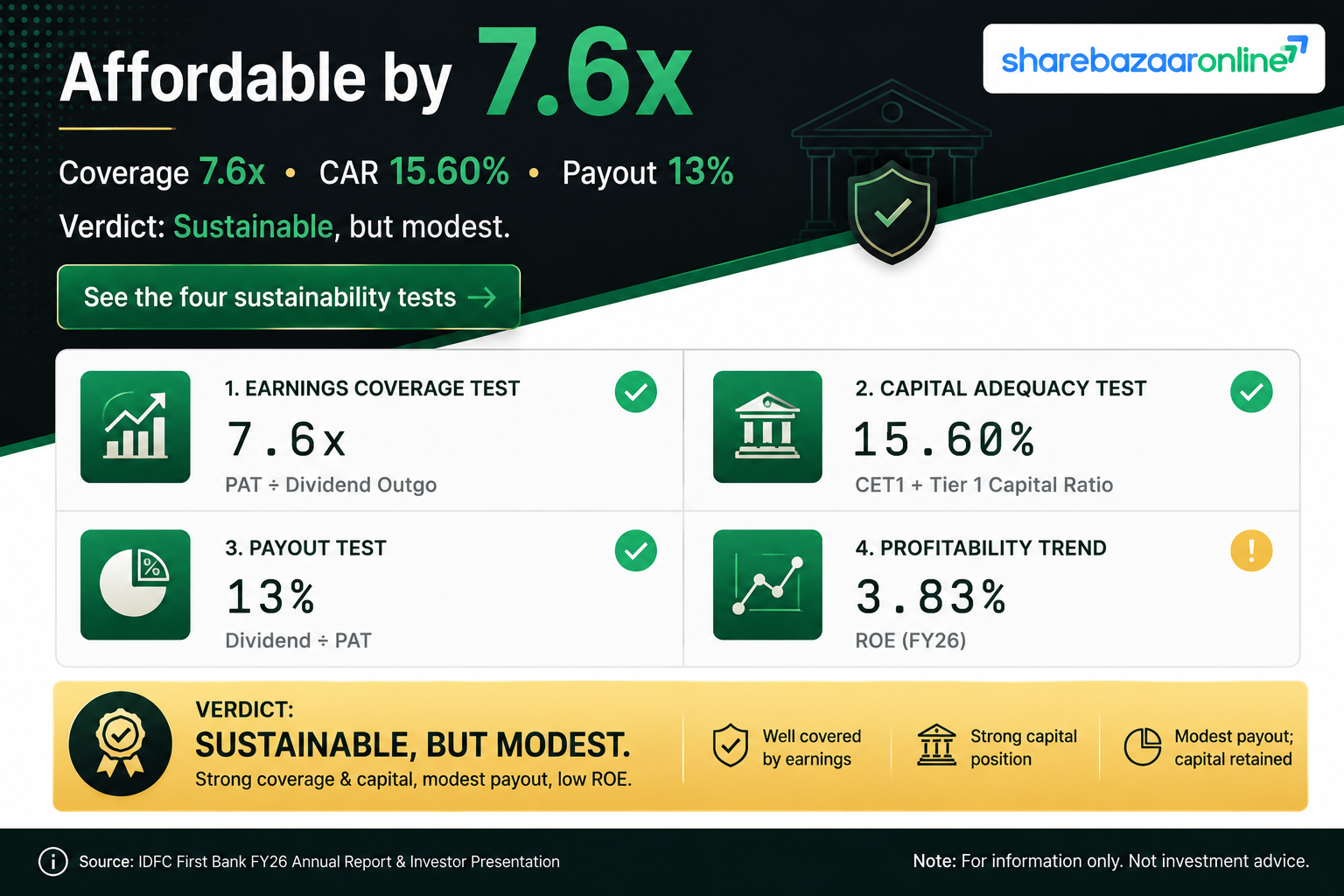
EPS ₹1.90 ÷ DPS ₹0.25 = 7.6x. Earnings cover the dividend more than seven times over. Payout ratio is only ~13%.
Test 2 — Capital Adequacy (bank test)
CAR of 15.60% is well above the regulatory floor, and RBI norms comfortably permit a payout this small. No capital constraint on the dividend.
Test 3 — Debt / Funding
Deposits fund the book; the payout is immaterial relative to the balance sheet. The bank is not borrowing to pay the dividend.
Test 4 — Earnings Trend
Profit is recovering but not yet consistent (FY25 dip, FY26 partial rebound). This is the one caution, and it explains the tiny dividend size.
Verdict: Sustainable in size, but modest by design. The ₹0.25 dividend is easily affordable — covered 7.6x by earnings and trivial against the capital base. The real constraint is not affordability but management’s choice to retain capital for growth. Investors should expect this to remain a token dividend until return ratios normalise, rather than a growing income stream.
Peer Comparison
| Bank | Face Value | Latest DPS | Div Yield | Payout |
|---|---|---|---|---|
| IDFC FIRST Bank | ₹10 | ₹0.25 | ~0.29% | ~13% |
| HDFC Bank | ₹1 | ₹22 (FY25) | ~1.1% | ~24% |
| ICICI Bank | ₹2 | ₹12 | ~1.6% | Not Verified |
| Axis Bank | ₹2 | ₹1 | ~0.08% | ~1% |
| Kotak Mahindra Bank | ₹5 | Not Verified | ~0.1% | ~3% |
| Federal Bank | ₹2 | ₹1.20 | ~0.6% | ~7% |
The non-obvious read: despite the lowest headline yield in the group, IDFC FIRST Bank’s payout ratio (~13%) is actually higher than Axis (~1%), Kotak (~3%) and Federal Bank (~7%). Its low yield is a face-value and price effect, not stinginess — a ₹10 face value plus an ~₹85 share price mechanically produces a small percentage. Where it clearly lags peers is return on equity (3.83% vs mid-teens for larger peers), which is the deeper reason its cash returns stay small. Peer cells marked “Not Verified” are left blank pending confirmation rather than estimated. Peer yields/payouts are approximate, sourced from public databases, and should be desk-verified.
Promoter Impact Analysis
This is the single most overlooked fact about IDFC FIRST Bank’s dividend: there is no promoter. Following the reverse merger of the erstwhile IDFC Ltd into the bank, promoter holding fell to 0.00% (from ~35% in September 2024). The bank is now professionally managed with no promoter group, so promoter dividend income is ₹0 — every rupee of the ~₹215 Cr flows to institutional and public shareholders.
Estimated dividend distribution by shareholder category (on ~₹215 Cr outflow, June 2026 pattern)
A quiet consequence of the merger: the Government of India directly holds ~7.79% and will receive roughly ₹16.8 Cr. Foreign investors, at ~36%, are the largest single beneficiary group. For minority/retail shareholders, the benefit is straightforward and equal per share — there is no dominant promoter capturing a disproportionate share.
Taxation Analysis
Since April 2020, dividends in India are taxed in the hands of the investor at their applicable income-tax slab rate. There is no separate dividend distribution tax paid by the company. On the TDS side, under Section 194 the bank deducts 10% TDS only if your total dividend from that company in a financial year exceeds ₹10,000 (threshold raised from ₹5,000 effective FY 2025-26). Below that, no TDS is deducted, though the income is still taxable.
Worked example — investor holding 1,000 shares
At ₹250 gross, no TDS applies (well below the ₹10,000 threshold). Post-tax, the effective yield on an ~₹85.30 price is roughly 0.21%. A holder would need about 40,000 shares for the annual dividend to cross the ₹10,000 TDS trigger. Tax outcomes depend on individual circumstances; this is a general illustration, not tax advice.
Key Risks
1. Low and volatile profitability. ROE is just 3.83% and profit fell 48% in FY25. Until return ratios normalise, cash returns to shareholders will stay minimal.
2. Microfinance / unsecured book stress. Provisioning in the MFI and unsecured segments was the main cause of the FY25 earnings drop; any renewed stress can hit profits and provisioning again.
3. Earnings dependence on other income. A large share of profitability comes from fee and treasury (“other”) income; core lending spreads remain thin, and treasury losses (as seen in Q4 FY26) can swing quarterly results.
4. Dilution risk. The share count rose ~17.5% after the ₹7,500 Cr raise; further capital raising to fund growth could dilute EPS and per-share dividends again.
5. Operational / fraud risk. An isolated fraud incident dented Q4 FY26 reported profit, underlining operational and control risks inherent to a fast-scaling digital bank.
6. Not an income stock. With a ~0.29% yield, the dividend is immaterial to total return; the investment case rests almost entirely on price appreciation, which is inherently uncertain.
What To Monitor
1. Return on equity / return on assets trajectory — the single most important variable for whether dividends can grow. Watch for ROE moving toward double digits.
2. Credit cost and MFI/unsecured provisioning — the key swing factor behind the FY25 profit fall; track quarterly credit-cost guidance.
3. Net interest margin (NIM) and cost-to-income ratio — margin direction and the FY26 cost-to-income of ~72% show whether operating leverage is turning positive.
4. Capital adequacy after growth — whether CAR (15.60%) holds up as the loan book expands, and whether further capital raises are signalled.
5. Deposit growth and CASA ratio — the foundation of low-cost funding and future profitability.
6. Payout-ratio policy — any move above the current ~13% payout would be the first genuine signal that management sees earnings as durable.
Conclusion
IDFC FIRST Bank’s FY26 final dividend of ₹0.25 per share is best understood as a signalling dividend, not an income opportunity. The “2.50% of face value” headline translates to a real yield of only ~0.29%. It is comfortably affordable — covered 7.6x by earnings, backed by a 15.60% capital adequacy ratio, and paid by a bank with no promoter and improving asset quality.
The positives are a strengthened balance sheet, improving NPAs, marquee capital backing and a rising share price. The negatives are a low ROE (3.83%), a sharp FY25 profit dip, dilution, and a dividend too small to matter for income. The bank has re-started rewarding shareholders after a six-year gap, but this remains a capital-appreciation story where the dividend is a footnote. We present the facts; the decision is yours.
Frequently Asked Questions
What dividend has IDFC FIRST Bank announced for FY 2025-26?
What is the actual dividend yield?
What is the record date for the dividend?
What is the ex-date?
When will the dividend be paid?
Who is eligible to receive the dividend?
How is this dividend taxed?
Is the dividend sustainable?
What is IDFC FIRST Bank’s dividend history?
Does IDFC FIRST Bank have a promoter, and how much dividend do promoters get?
Why did EPS fall in FY26 even though net profit rose?
What should investors monitor going forward?
Disclaimer
This article is for informational and educational purposes only and does not constitute investment, financial or tax advice. ShareBazaar Online is not a SEBI-registered investment adviser or research analyst. Nothing here is a recommendation to buy, sell or hold any security. Financial figures are compiled from company filings and public databases (including the bank’s Regulation 30 disclosure, Q4/FY26 results, and third-party financial data providers); some figures — including the announcement-date market price, peer metrics, and eligibility dates — require independent verification and may change. Dividend amount, record date, ex-date and payment date are subject to AGM approval and official exchange notification. Market prices and yields are as of the dates stated and will change. Investments in securities are subject to market risk; please read all related documents carefully and consult a SEBI-registered adviser before investing. Compute your own tax position with a qualified professional.