
Dividend Snapshot
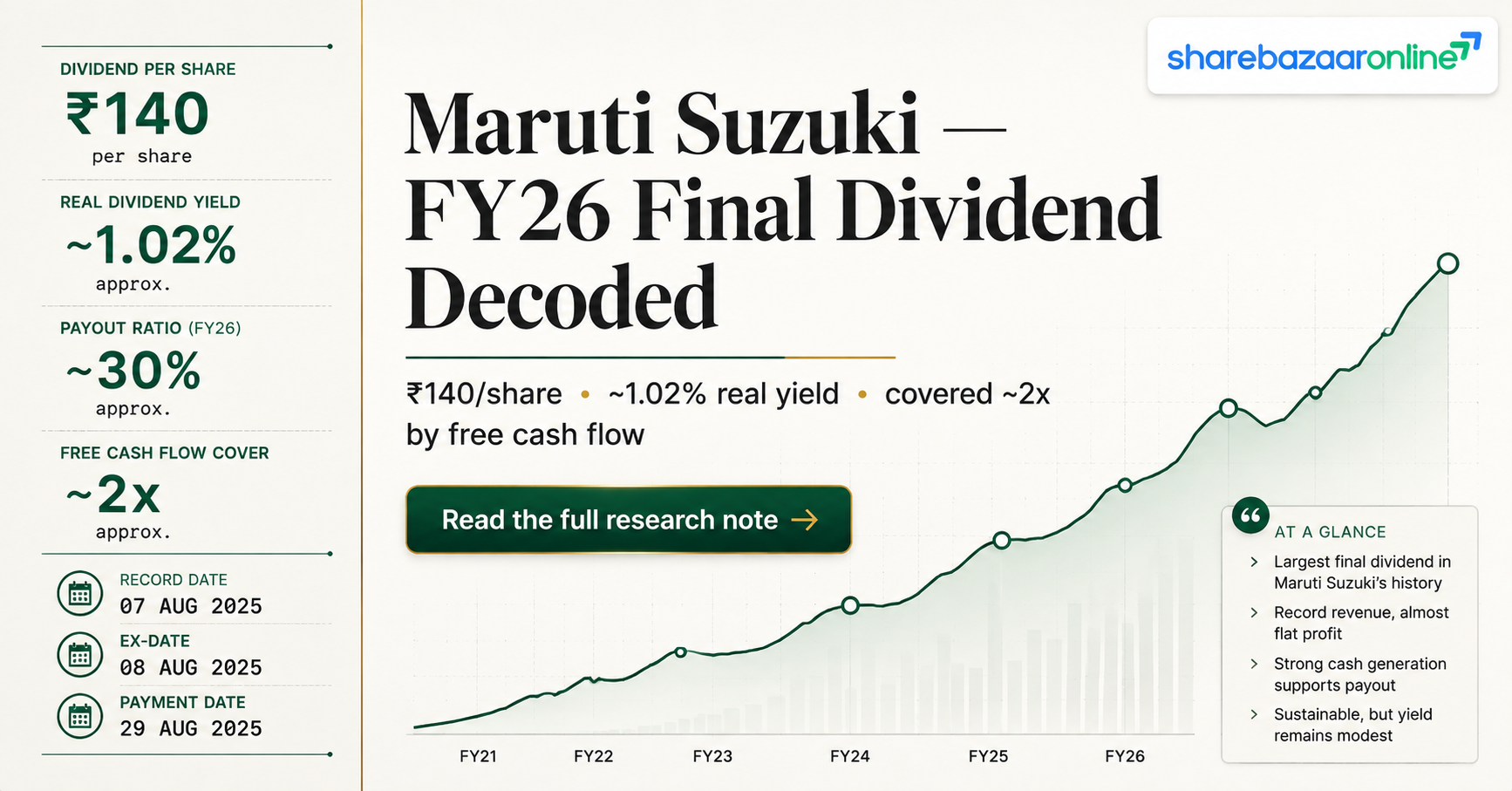
Maruti Suzuki India Limited (NSE: MARUTI, BSE: 532500) has recommended its highest-ever final dividend of ₹140 per share for the financial year 2025-26, up from ₹135 a year earlier. The headline figure of 2,800% refers to face value (₹5 per share) — against the live market price of about ₹13,760, the real dividend yield works out to roughly 1.02%.
| Dividend Type | Final Dividend (FY2025-26) |
| Dividend Per Share | ₹140 |
| Face Value | ₹5 |
| Dividend on Face Value | 2,800% |
| Total Dividend Outflow | ₹4,401.6 crore |
| Record Date | 07 August 2026 |
| Payment Date | 09 September 2026 |
| AGM Date | 31 August 2026 |
| Yield at Current Price | ~1.02% |
| Payout Ratio | ~30% of profit |
The dividend is a final dividend and remains subject to shareholder approval at the Annual General Meeting scheduled for 31 August 2026. Share price and yield figures are sourced from NSE/BSE data as of 17 August 2026 and must be re-verified against the live quote before publication.
Dividend Announcement Summary
At its board meeting on 28 April 2026, the Board of Directors of Maruti Suzuki considered the audited results for the year ended 31 March 2026 and recommended a final dividend of ₹140 per equity share (nominal value ₹5 per share), aggregating to ₹4,401.6 crore (₹44,016 million). In the previous year the company had paid ₹135 per share, or ₹4,244.4 crore.
What the company disclosed
- Dividend on equity shares of ₹140 for FY2025-26
- Record date fixed as Friday, 07 August 2026
- Payment date of 09 September 2026
- Payable only if declared at the ensuing AGM on 31 August 2026
Why this year is different
The ₹140 payout is the largest in the company's history in absolute terms, yet the increase over last year is only 3.7%. That is the slowest dividend growth in the current up-cycle — and it tracks a year in which record revenue was accompanied by almost flat profit, a point examined in detail below.
Key Dates Timeline
| Event | Date | Notes |
|---|---|---|
| Board Meeting / Announcement | 28 April 2026 | Dividend recommended |
| Record Date | 07 August 2026 | Shareholders on register are eligible |
| Ex-Dividend Date | 07 August 2026 (to be confirmed) | Under the T+1 settlement cycle the ex-date is typically the same day as the record date; confirm against the exchange circular |
| Annual General Meeting | 31 August 2026 | Dividend must be approved here |
| Payment Date | 09 September 2026 | Credit to eligible shareholders |
Note the unusual sequence: the record date (7 August) falls before the AGM (31 August), so eligibility is locked in ahead of formal approval. Being a final dividend, the payout is legally conditional on the AGM vote.
Dividend Yield Analysis
The most common confusion around this announcement is the “2,800% dividend” headline. That figure is dividend as a percentage of face value (₹140 divided by ₹5), not the return an investor actually earns. The number that matters for income is the market-price yield.
Yield reality check
| Face-value dividend % | 2,800% |
| Yield at current price (~₹13,760) | 1.02% |
| Yield at announcement price (~₹12,894) | 1.09% |
Why the yield looks modest
A ~1% yield is normal for a high-priced growth-and-quality stock like Maruti. The dividend is designed as a partial return of surplus cash, not a primary income stream. Investors seeking yield from the auto pack would look elsewhere; Maruti's appeal is reinvestment and franchise strength, with the dividend as a modest top-up.
The small difference between the announcement-day yield (1.09%) and the current yield (1.02%) reflects the share price drifting higher since April, not any change in the dividend. A rising yield here would signal a falling price, not a bigger payout — a distinction worth keeping in mind.
Dividend History Analysis
| Financial Year | Dividend Per Share (₹) | Year-on-Year Change |
|---|---|---|
| FY2025-26 | 140 | +3.7% |
| FY2024-25 | 135 | +8.0% |
| FY2023-24 | 125 | +38.9% |
| FY2022-23 | 90 | +50.0% |
| FY2021-22 | 60 | +33.3% |
| FY2020-21 | 45 | −25.0% |
| FY2019-20 | 60 | −25.0% |
| FY2018-19 | 80 | 0.0% |
| FY2017-18 | 80 | +6.7% |
| FY2016-17 | 75 | +114.3% |
| FY2015-16 | 35 | — |
The history reveals something the headline hides: Maruti is a cyclical dividend payer, not a guaranteed grower. The dividend was cut in both FY2019-20 (₹80 to ₹60) and FY2020-21 (to ₹45) during the demand slowdown and pandemic-plus-semiconductor period. Since then the payout has climbed sharply back — but the FY26 increase of just 3.7% is the softest step in that recovery, signalling that the fast-growth phase of the dividend may be maturing. Classification: Consistent but cyclical payer, with a demonstrated willingness to reduce the dividend when earnings weaken.
Financial Performance Analysis
This is the analytical heart of the story. On a consolidated basis, Maruti reported record revenue — but the profit line barely moved. That gap between top-line and bottom-line growth is the single most important thing to understand about this year's dividend.
Consolidated results (FY26 vs FY25)
| Revenue from operations | ₹1,83,316 cr |
| Revenue growth | +19.9% |
| EBITDA (approx) | ₹21,456 cr |
| EBITDA growth | +6.5% |
| Net profit (owners) | ₹14,679.5 cr |
| PAT growth | +1.2% |
| Consolidated EPS | ₹466.90 |
Where the margin went
Revenue rose 19.9% but profit only 1.2% because costs rose faster than sales:
- Cost of materials consumed +27.9%
- Employee benefits expense +28.8% (includes a one-time labour-code provision)
- Depreciation +20.2% as new capacity such as Kharkhoda comes on stream
- EBITDA margin compressed by roughly 150 basis points to about 11.7%
Base-effect and one-time items: the near-flat profit is partly a high-base issue (FY25 was already a record) and partly genuine margin pressure. It also absorbs a one-off incremental provision of about ₹594 crore recognised earlier in the year on account of the new labour codes. Other income of about ₹4,357 crore was roughly 22.8% of profit before tax, a reminder that a meaningful slice of reported profit comes from Maruti's large treasury book rather than from selling cars.
Corporate-action context: the results give effect to the amalgamation of Suzuki Motor Gujarat Private Limited (a wholly owned subsidiary), effective 01 December 2025 with an appointed date of 01 April 2025. Prior-period comparatives have been restated, so the year-on-year figures above are on a like-for-like basis; raw comparisons against older, un-restated data would be misleading.
Cash Flow Analysis
Reported profit is an accounting opinion; cash is a fact. Here the news is reassuring: Maruti's cash generation is stronger than its reported profit, which is the mark of high earnings quality.
| Net profit (consol) | ₹14,679.5 cr |
| Operating cash flow | ₹19,099.9 cr |
| OCF / PAT | 1.30x |
| Capex (PPE + intangibles) | ₹10,397.6 cr |
| Free cash flow | ₹8,702.3 cr |
| FCF after dividend paid in year | ₹4,457.9 cr (positive) |
How the dividend is funded
The proposed ₹4,401.6 crore payout is comfortably funded by current-year free cash flow of ₹8,702 crore — the company does not need to touch reserves or borrow. Free cash flow covers the dividend nearly 2 times over, even after a heavy capex year. This is a dividend paid out of genuine surplus cash, not financial engineering.
One nuance worth flagging: with revenue up sharply, working capital (notably inventories, up materially year-on-year) absorbed cash, which is why OCF grew more slowly than headline profitability might suggest. It remains well above net profit, so the underlying cash conversion is healthy.
Balance Sheet Strength
| Total equity | ₹1,07,156 cr |
| Borrowings | Effectively nil (only lease liabilities ~₹103 cr) |
| Liquid resources (cash + current investments + bank) | ₹17,004 cr |
| Cash plus total investments | ~₹75,869 cr |
A fortress balance sheet
Maruti is essentially debt-free and sits on a treasury of investments and cash far larger than the dividend it pays. The entire ₹4,401.6 crore outflow is a small fraction of its liquid resources — readily-liquid cash and current investments alone cover the dividend nearly 4 times, and total cash plus investments cover it over 17 times. Affordability is not in question.
Dividend Sustainability Analysis
| Sustainability Test | Result | Verdict |
|---|---|---|
| Earnings coverage (EPS ₹466.90 vs DPS ₹140) | 3.33x | Very comfortable |
| Operating cash flow coverage | 4.34x | Strong |
| Free cash flow coverage | 1.98x | Comfortable even after capex |
| Liquidity / cash coverage | 3.86x | Fortress liquidity |
All four tests pass with room to spare. The payout ratio of about 30% of profit is conservative and consistent with the company's long-run practice. Overall assessment: Sustainable. The one caveat is that dividend growth from here is likely to track profit growth, which has slowed sharply this year — sustainability of the current level is high, but investors expecting the double-digit increases of recent years may be disappointed if margins stay under pressure.
Peer Comparison
| Company | FY26 DPS (₹) | Approx. Yield | Payout | ROE |
|---|---|---|---|---|
| Maruti Suzuki | 140 | ~1.02% | ~30% | ~14.4% |
| Mahindra & Mahindra | 33 | ~0.96% | — | — |
| Hero MotoCorp | 185 | ~3.5% | ~61% | — |
Within the auto pack, Maruti and Mahindra & Mahindra sit at the low-yield, growth-and-reinvestment end (both around 1%), while a mature two-wheeler franchise like Hero MotoCorp returns far more of its earnings as dividend (payout above 60%, yield around 3.5%). Maruti's ~30% payout signals a company still prioritising capacity expansion and electrification over cash return. Empty cells above are left blank rather than estimated, and peer figures should be desk-verified against the latest filings before publication.
Promoter Impact Analysis
| Promoter (Suzuki Motor Corporation) holding | ~58.6% |
| Promoter share of the dividend | ~₹2,579 cr |
| Public and institutional shareholders' share | ~₹1,822 cr |
Because the Japanese parent, Suzuki Motor Corporation, owns roughly 58.6% of Maruti, well over half the payout — about ₹2,579 crore — flows to the promoter, much of it out of India as a cross-border remittance to Japan. Minority shareholders collectively receive around ₹1,822 crore. This is standard for a majority-owned subsidiary, but it is worth understanding that a dividend increase here disproportionately benefits the controlling shareholder.
Promoter holding shown is the latest available shareholding pattern and should be confirmed against the most recent quarterly filing.
Taxation Analysis
Since April 2020, dividends in India are taxed in the hands of the shareholder at their applicable income-tax slab rate. There is no separate dividend distribution tax. The company deducts TDS at 10% under Section 194 where dividend paid to a resident exceeds the annual threshold (raised to ₹10,000 from FY2025-26); the shareholder then settles any balance based on their own slab.
Worked example — an investor holding 1,000 shares
| Gross dividend (1,000 × ₹140) | ₹1,40,000 |
| TDS deducted at 10% (Section 194) | ₹14,000 |
| Net credited at payment | ₹1,26,000 |
| Total tax if in 30% slab (incl. 4% cess) | ₹43,680 |
| Net dividend in hand after full tax | ₹96,320 |
| Effective post-tax yield (at ~₹13,760) | ~0.70% |
The example assumes the highest slab of 30% plus 4% health and education cess and ignores any surcharge, which would apply at very high incomes. Investors in lower slabs will keep more; those who submit Form 15G/15H or fall below the taxable limit may avoid TDS. This is general information, not tax advice — individual liability depends on total income.
Key Risks
- Margin pressure: costs are rising faster than revenue — material costs up 27.9% and employee costs up 28.8% — and EBITDA margin has compressed by about 150 basis points. Persistent pressure would cap future dividend growth.
- Flat profit despite record sales: profit grew just 1.2% while revenue rose 19.9%; if this operating-leverage gap continues, the dividend has less room to rise.
- Cyclical, discretionary demand: passenger-vehicle demand is sensitive to interest rates, fuel prices and the economic cycle; the FY20 and FY21 dividend cuts show management will trim payouts in a downturn.
- Regulatory and transition costs: new labour codes, Extended Producer Responsibility (End-of-Life Vehicle) obligations that the company itself says it cannot yet reliably quantify, and the shift to electric vehicles all carry cost and capex implications.
- Heavy capex phase: large investments in new capacity (such as Kharkhoda) lift depreciation and can weigh on free cash flow, competing with cash available for dividends.
What To Monitor
- EBITDA margin trajectory over the next few quarters — whether the ~150 bps compression stabilises or worsens.
- Volume and mix — the share of higher-margin SUVs and exports versus entry-level models, which drives realisation.
- Free cash flow after capex — whether it stays comfortably above the dividend as capacity spending peaks.
- Payout-ratio policy — any signal that the board intends to lift the ~30% payout, or hold it while reinvesting.
- EV economics and EPR clarity — how the electrification ramp and End-of-Life Vehicle obligations affect profitability once frameworks are finalised.
- AGM outcome (31 August 2026) — formal approval of the ₹140 dividend, since the payout is conditional on that vote.
Conclusion
Maruti Suzuki's ₹140 final dividend for FY2025-26 is its largest ever in rupee terms, but the “2,800%” headline flatters a real yield of only about 1.02%. Behind the record payout sits a more nuanced year: record revenue (+19.9%) but almost flat profit (+1.2%), a roughly 150 basis-point margin squeeze, and the slowest dividend increase (3.7%) of the current up-cycle.
On the positive side, the dividend is backed by genuine cash — free cash flow covers it nearly twice over, earnings cover it 3.3 times, and the balance sheet is effectively debt-free with a treasury many times the payout. The dividend is clearly sustainable at its current level. The open questions are about growth, not safety: whether margins recover, and whether the board lifts its conservative ~30% payout. History — including the FY20 and FY21 cuts — is a reminder that this is a cyclical payer whose dividend rises and falls with the profit cycle. The positives, negatives and monitoring points are laid out above so readers can reach their own conclusions.
Frequently Asked Questions
What dividend has Maruti Suzuki announced for FY2025-26?
What is the Maruti Suzuki dividend yield?
What is the record date for the Maruti Suzuki dividend?
What is the ex-dividend date?
When will the Maruti Suzuki dividend be paid?
Who is eligible to receive the dividend?
How is the Maruti Suzuki dividend taxed?
Is the Maruti Suzuki dividend sustainable?
What is Maruti Suzuki's dividend history?
What should investors monitor going forward?
How much of the dividend goes to the promoter?
Why did profit stay flat when revenue rose so much?
Disclaimer
This article is for informational and educational purposes only and does not constitute investment, financial, legal or tax advice, nor a recommendation to buy, sell or hold any security. ShareBazaar Online is not a SEBI-registered investment adviser or research analyst. Figures are drawn from Maruti Suzuki India Limited's audited FY2025-26 results filed with the exchanges and from publicly available market data; market price, yield, shareholding and peer figures are indicative, may have changed, and should be independently verified before any decision. Dividend amounts, record dates and payment dates are as announced by the company and, for a final dividend, remain subject to shareholder approval at the AGM. Investments in securities are subject to market risks; please read all related documents carefully and consult a qualified, registered adviser before investing. ShareBazaar Online and its authors accept no liability for any loss arising from the use of this information.