
Dividend Snapshot
Wonderla Holidays Limited (NSE: WONDERLA | BSE: 538268), one of India’s largest amusement park operators, has recommended a final dividend of ₹2.00 per equity share for the financial year ended 31 March 2026 (FY26). On a face value of ₹10, this is stated as a “20% dividend” — but that percentage is calculated on face value, not on the market price. Against the current market price of about ₹468, the real dividend yield works out to roughly 0.43%.
Dividend Per Share
₹2.00
Dividend Type
Final Dividend (FY26)
Real Yield (on CMP ₹468)
~0.43%
Record Date
07 August 2026
The one-line takeaway: this is a small, low-yield reward from a company that has just spent heavily to open its fifth park in Chennai. FY26 profit actually fell about 25% even as revenue rose 13%, and the dividend is not covered by free cash flow this year — it is comfortably funded instead from a strong, near debt-free cash balance built up after a ₹540 crore fund-raise.
Dividend Announcement Summary
At its board meeting held on 7 May 2026, the Board of Directors of Wonderla Holidays recommended a final dividend of ₹2.00 (20%) per equity share of ₹10 each for FY26. This was disclosed to the stock exchanges under Regulation 33 of the SEBI (LODR) Regulations, 2015, alongside the audited annual results.
What the company confirmed
- Final dividend of ₹2.00 per share, being 20% of ₹10 face value.
- Recommended by the Board; subject to shareholder approval.
- Announced with FY26 audited results on 7 May 2026.
Approval status
Because this is a final dividend, it must be approved by shareholders at the 24th Annual General Meeting scheduled for 19 August 2026 before it becomes payable. Payment is expected within the statutory limit of 30 days from declaration.
Key Dates Timeline
| Event | Date | Note |
|---|---|---|
| Board / Announcement | 07 May 2026 | Final dividend recommended with FY26 audited results |
| Record Date | 07 August 2026 | Shareholders on record are eligible |
| Ex-Date | 07 August 2026 | Under T+1, ex-date = record date (same day) |
| AGM | 19 August 2026 | Shareholder approval of final dividend |
| Books Closure | 14–19 August 2026 | Register of members closed for AGM |
| Payment Date | On/around 18 Sep 2026 | Within 30 days of declaration (post-AGM) |
Plain-English eligibility rule: to receive this dividend you needed to be holding WONDERLA shares in your demat account as of the record date, 7 August 2026. Under the T+1 settlement cycle, the ex-date and record date fall on the same day, so buying on the ex-date itself would not have made you eligible.
Dividend Yield Analysis
The “20%” is a face-value illusion
The headline “20% dividend” means ₹2 on the ₹10 face value. It does not mean you earn 20% on your investment. What matters to an investor is the market-price yield: dividend divided by the price you actually pay for the share.
Yield at announcement (CMP ₹531, 07 May 2026)
0.38%
Yield at current price (CMP ₹468)
0.43%
Why did the yield edge up?
The yield rose from about 0.38% to 0.43% not because the dividend grew — it is flat at ₹2 — but because the share price fell from around ₹531 to ₹468. A rising yield driven by a falling price is very different from a rising yield driven by dividend growth. Wonderla is clearly a growth-and-expansion story, not a high-yield income stock. Investors buying it for dividend income alone would be disappointed: the payout is a token distribution relative to the share price.
Dividend History Analysis
| Financial Year | Dividend / Share | Remark |
|---|---|---|
| FY26 | ₹2.00 | Held flat |
| FY25 | ₹2.00 | Cut from ₹2.50 |
| FY24 | ₹2.50 | Peak payout |
| FY23 | ₹2.50 | Post-Covid resumption |
| FY22 | Nil | Covid suspension |
| FY21 | Nil | Covid suspension (parks shut) |
| FY20 | ₹1.80 | Interim |
| FY19 | ₹1.80 | — |
| FY18 | ₹1.50 | — |
| FY17 | ₹1.00 | — |
History compiled from public exchange records; figures per financial year of declaration. Not Independently Verified against every original exchange circular.
Verdict: a cyclical payer, not a steady compounder
Two facts stand out that wire services rarely flag. First, Wonderla suspended its dividend entirely in FY21 and FY22 when the pandemic shut its parks — this is not a company that has paid without interruption. Second, and more recent, the dividend was reduced from ₹2.50 to ₹2.00 in FY25 and has stayed at ₹2.00 since. So the current ₹2 is a maintained-but-lower payout, not a raise. We classify Wonderla as a Cyclical Payer: willing to reward shareholders when trading is strong, but quick to conserve cash when earnings dip or capex ramps up.
Financial Performance Analysis
Revenue FY26
₹518.77 Cr
▲ +13% YoY
Net Profit (PAT) FY26
₹81.73 Cr
▼ −25% YoY (from ₹109.27 Cr)
The revenue-up / profit-down divergence
This is the single most important number in the whole report and it is easy to miss. Revenue rose 13% to ₹518.77 crore, helped by the new Chennai park (which added ₹41.4 crore in its first four months) and a 56% jump in resort revenue. Yet profit fell about 25% to ₹81.73 crore. In simple terms, the company sold more but earned less. The reasons management cited are higher depreciation (a brand-new park adds large non-cash depreciation charges) and launch and ramp-up costs for Chennai. A new park loses money before it fills up — that drag is temporary if footfalls build, but it is very real in FY26.
Return ratios are currently soft
Return on equity has slipped to roughly 4.6% on a trailing basis (a 3-year average near 8%). This is partly mechanical: the FY24 ₹540 crore fund-raise added a large pile of equity that is still being deployed into parks that have not yet started earning. Until Chennai and other expansions mature, reported returns look depressed relative to the capital on the books. ROCE for FY26 is Not Independently Verified here and should be confirmed from the annual report.
Cash Flow Analysis
Reported profit is an accounting opinion; cash is a fact. So the key question for any dividend is: did the business actually generate the cash to pay it?
Operating Cash Flow FY26
~₹135 Cr
Healthy — higher than reported PAT
Free Cash Flow FY26
~−₹205 Cr
Negative — heavy expansion capex
Where the money went
Operating cash flow was actually strong at about ₹135 crore — higher than reported profit, because a big chunk of the profit decline is non-cash depreciation (which is added back to cash flow). The catch is that the company then spent far more than that on building parks. After capex, free cash flow was deeply negative at roughly −₹205 crore. So on a strict free-cash-flow basis, this year’s dividend was not funded by this year’s free cash.
So how is the dividend actually paid?
From the balance sheet, not from the year’s surplus. Wonderla is almost debt-free and raised ₹540 crore via a QIP in late 2024; even after fully deploying those proceeds into Chennai and Bengaluru projects, it retains a large cash and investment cushion. The ₹12.68 crore dividend outflow is tiny against that base. The dividend is therefore best described as funded from cash reserves while the operating business reinvests everything it earns — not funded from borrowings, and not from asset sales.
Balance Sheet Strength
Debt
The company is almost debt-free. Expansion was funded largely by the equity QIP rather than borrowings, so there is no risk of a dividend being paid while leverage quietly climbs.
Cash & investments
Net cash and investments are estimated at roughly ₹400–420 crore (enterprise value sits well below market cap). This covers the dividend outflow more than 30 times over. Exact figure Not Independently Verified — confirm from the FY26 balance sheet.
Bottom line on the balance sheet: strong and liquid. A near-zero debt position plus a large cash pile means the small dividend is never in question from an affordability standpoint, even in a weak-profit year. The real debate about Wonderla is about growth and returns, not solvency.
Dividend Sustainability Analysis
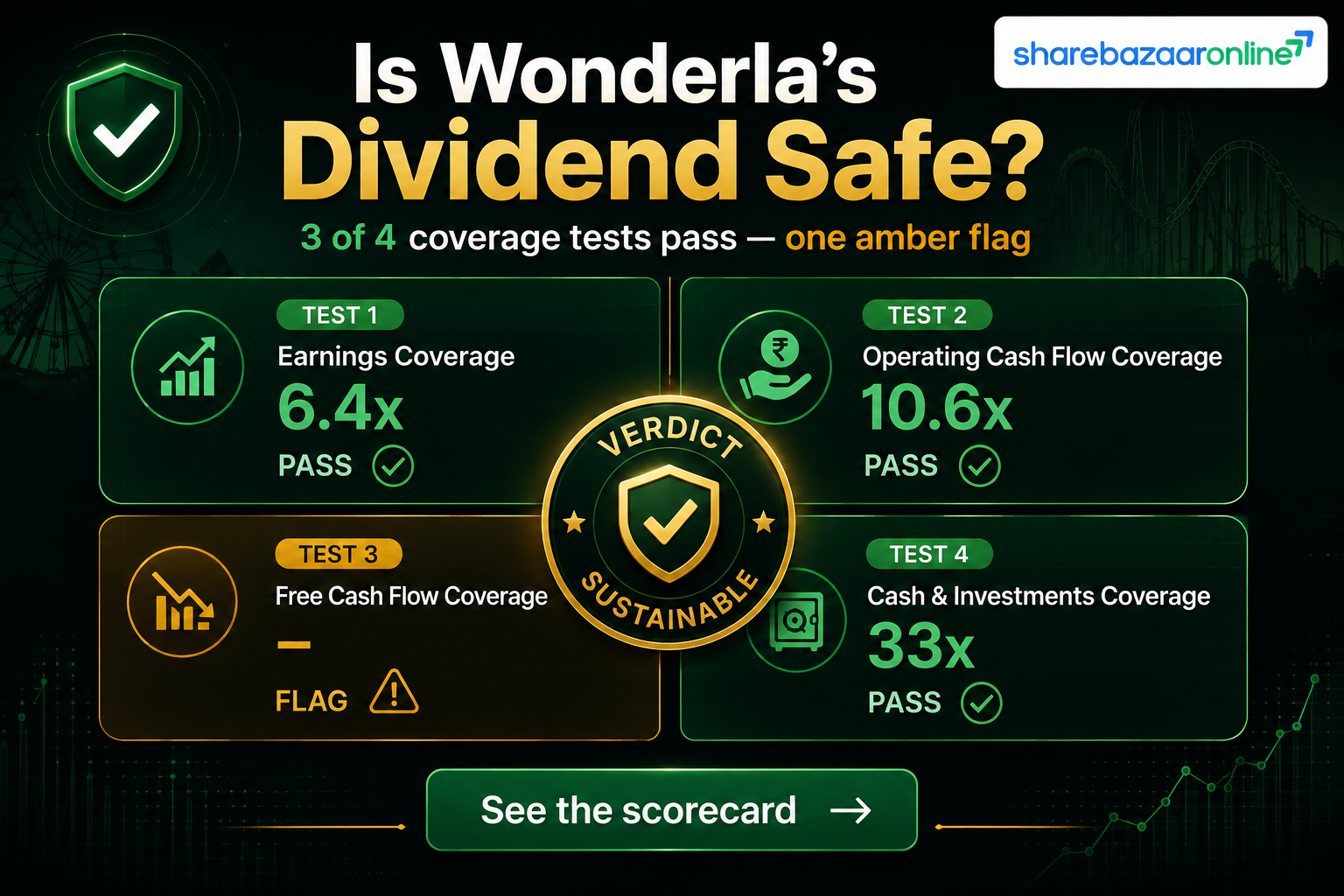
| Sustainability Test | Result | Verdict |
|---|---|---|
| 1. Earnings coverage (EPS ₹12.89 / DPS ₹2) | 6.4x | Comfortable |
| 2. Operating cash flow coverage | ~10.6x | Comfortable |
| 3. Free cash flow coverage | Negative | Not covered (capex year) |
| 4. Liquidity / cash coverage | ~33x | Very comfortable |
Overall verdict: Sustainable (but low by design)
Three of the four tests pass comfortably. The dividend costs only ₹12.68 crore — about 15.5% of FY26 profit — and is covered many times over by earnings, operating cash and the cash balance. The single amber flag is free cash flow: because the company is in a heavy build-out phase, FCF is negative and the dividend is effectively paid from reserves rather than the year’s surplus. That is affordable and low-risk given the balance sheet, but it is the reason the payout stays deliberately small. We classify the dividend as Sustainable, with the honest caveat that it is a token payout subordinate to growth spending, not a rising income stream.
Peer Comparison
| Company | Dividend Yield | Payout | Profitability |
|---|---|---|---|
| Wonderla Holidays | ~0.43% | ~15.5% | Profitable, ROE ~4.6% (soft) |
| Imagicaaworld Entertainment | Not a payer | — | Barely profitable (very high P/E) |
| Nicco Parks & Resorts | — | — | Loss-making (negative P/E) |
Peer cells left blank where the company does not pay a meaningful dividend or is loss-making; not estimated. Peer figures Not Independently Verified.
The honest peer story: Wonderla has almost no true listed peer. It is by far the largest, most profitable and only consistently dividend-paying pure-play amusement park operator in India. Imagicaaworld and Nicco Parks are much smaller and are effectively non-payers, so a like-for-like yield comparison is not meaningful. The takeaway is not that Wonderla’s yield beats peers — it is that the listed theme-park space in India is thin, and Wonderla’s modest payout still makes it the sector’s only real dividend name.
Promoter Impact Analysis
Promoter Holding (Jun 2026)
62.2%
Promoter dividend income
~₹7.89 Cr
Shareholding split (Jun 2026)
Promoter 62.2% · DII 11.3% · FII 4.2% · Public 22.3%.
Source figures vary slightly by provider; Not Independently Verified.
Of the total ₹12.68 crore dividend, the promoter group (the Chittilappilly family) receives about ₹7.89 crore by virtue of its 62.2% stake, leaving roughly ₹4.79 crore for all public, institutional and retail shareholders combined. Two nuances worth noting: (1) promoter holding has fallen by about 7.5 percentage points over three years, largely because the QIP issued fresh shares to institutions — a dilution, not a promoter sale; and (2) because the payout is so small, the dividend is not a meaningful cash-extraction channel for the promoter. This is consistent with a family that appears focused on reinvesting for growth rather than harvesting cash.
Taxation Analysis
How dividends are taxed in India
Since April 2020, dividends are taxed in the hands of the investor at their applicable income-tax slab rate (there is no separate Dividend Distribution Tax anymore). The company must deduct TDS at 10% under Section 194 if the total dividend paid to a resident shareholder in a financial year exceeds ₹5,000. Below that threshold, no TDS is deducted, though the income is still taxable.
Worked example — 1,000 shares, 30% slab
- Gross dividend: 1,000 × ₹2 = ₹2,000
- TDS under Section 194: ₹0 (payout is below the ₹5,000 threshold)
- Tax at 30% slab (plus applicable cess): ₹600
- Net dividend in hand: ₹1,400
- Effective post-tax yield on CMP ₹468: ~0.30%
Illustrative only; excludes surcharge/cess nuances. Not tax advice — consult a qualified advisor.
Key Risks
- New-park drag: Chennai and future parks depress profit and returns before footfalls mature; if ramp-up is slow, the ~25% profit fall in FY26 may not reverse quickly.
- Weather and seasonality: footfalls are highly sensitive to monsoon timing and school holidays. Q1 FY26 revenue actually fell about 3% partly due to an early monsoon — a reminder that a single bad season can dent earnings.
- Low, cyclical dividend: the payout has already been cut once (from ₹2.50 to ₹2.00) and was fully suspended during Covid. It is not a reliable income stream.
- Soft return ratios: ROE near 4.6% means the large capital raised is not yet earning well; a prolonged period of low returns can weigh on the share price (already down ~28% from its 52-week high).
- Discretionary spending exposure: amusement parks are a discretionary expense; any consumer slowdown hits ticket sales and ARPU directly.
- Execution & capex risk: continued expansion requires disciplined capital allocation; cost or timeline overruns on new parks would further pressure free cash flow.
What To Monitor
- Chennai park ramp-up: footfalls and profitability of the new Chennai park quarter-on-quarter — the swing factor for whether FY27 profit recovers.
- Consolidated footfalls and ARPU: FY26 footfalls were 32.19 lakh (+6%) with ARPU ₹1,530 (+6%). Watch whether both keep climbing.
- Free cash flow turning positive: the point at which capex slows and the business self-funds its dividend again is a key signal of maturing returns.
- Margin recovery (EBITDA): Q4 FY26 EBITDA already rose ~64% YoY; sustained margin improvement would confirm the profit dip was a launch-cost blip.
- Dividend trajectory: whether the company lifts the payout back toward ₹2.50 as new parks mature, or holds at ₹2.00 to keep funding growth.
- Resort/hospitality scale-up: the fast-growing Terrea/ISLE hospitality vertical — whether it becomes a material earnings contributor.
Conclusion
Wonderla Holidays’ FY26 final dividend of ₹2.00 per share is a small, deliberate token. The “20%” headline flatters it: the real market yield is only about 0.43%. Behind the announcement sits a more interesting story — revenue up 13% but profit down 25%, driven by depreciation and launch costs from the new Chennai park, and a negative free cash flow year in which the dividend is funded from a strong, near debt-free balance sheet rather than the year’s surplus.
Positives
- Almost debt-free with a large cash cushion
- Dividend covered 6x by earnings, 33x by cash
- Strong revenue growth and expanding footprint (5 parks)
- Rising ARPU and record resort performance
Negatives
- Profit fell ~25% in FY26
- Negative free cash flow; dividend paid from reserves
- Yield is tiny; dividend was cut and once suspended
- Soft ROE (~4.6%) while capital is deployed
In short: treat Wonderla as a growth-and-expansion stock that happens to pay a small dividend, not as an income holding. We present the positives, negatives, risks and monitoring points above so that you can weigh them for yourself.
Frequently Asked Questions
What dividend has Wonderla Holidays announced for FY26?
What is the Wonderla dividend yield?
What is the record date for the Wonderla dividend?
What is the ex-date for the Wonderla dividend?
When will the Wonderla dividend be paid?
Who is eligible for the Wonderla dividend?
How is the Wonderla dividend taxed?
Is the Wonderla dividend sustainable?
What is Wonderla’s dividend history?
What should investors monitor going forward?
Why did Wonderla’s profit fall even though revenue grew?
How much of the dividend goes to the promoters?
Disclaimer
This article is for informational and educational purposes only and does not constitute investment, financial, legal or tax advice, nor a recommendation to buy, sell or hold any security. ShareBazaar Online is not a SEBI-registered investment adviser or research analyst. Figures are compiled from the company’s exchange filings and publicly available third-party sources and may contain errors or be out of date; items marked “Not Independently Verified” or “Not Disclosed by Company” should be confirmed against original sources. Share prices, yields and financial data are subject to change. Dividends are subject to shareholder approval and applicable law. Please consult a SEBI-registered adviser and conduct your own due diligence before making any investment decision. Past performance is not indicative of future results.