
Dividend Snapshot
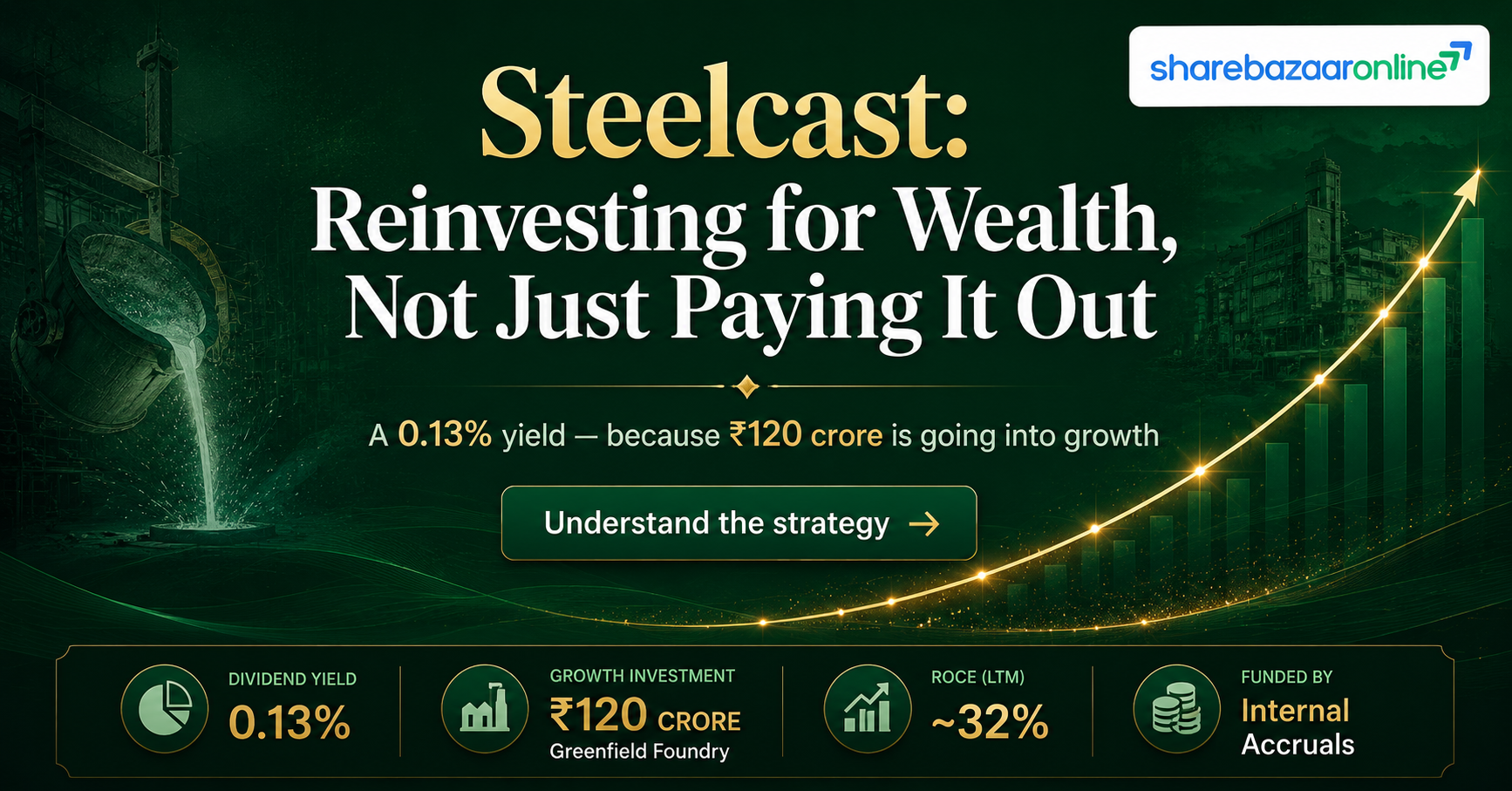
Steelcast Limited (NSE: STEELCAS, BSE: 513517) has declared its first interim dividend for FY 2026-27 of ₹0.45 per equity share of face value Re 1 each — a headline figure the company states as 45%. That percentage refers to face value, not to what an investor earns on the market price. On the current market price of about ₹351.85, the real Steelcast dividend yield on this payout works out to just 0.13%. This is the single most important reframing for any reader: a "45% dividend" here is ₹0.45 in cash, not 45% of your investment.
Key Numbers at a Glance
Dividend per share: ₹0.45
Dividend type: First Interim (FY 2026-27)
Face value: Re 1 (45% of face value)
Record date: 07 August 2026
Payment: on or before 28 August 2026
Yield at CMP: ~0.13%
Why This Matters
The total Steelcast dividend outflow is only about ₹4.55 crore — roughly 5.3% of the company's FY26 operating cash flow. The story is not the size of the cheque but the signal: a debt-free caster returning a token amount while committing ₹120 crore to a new foundry. Read alongside the capex, the modest dividend is a deliberate growth-first choice, not a yield play.
Dividend Announcement Summary
At its 296th Board meeting held on 29 July 2026 in Bhavnagar, the Board of Steelcast Limited declared the first interim dividend of ₹0.45 per share (45% of Re 1 face value) for the financial year 2026-27. Because this is an interim dividend declared by the Board, it does not require separate shareholder approval at an AGM and is payable directly — the company has committed to pay it within 30 days of declaration.
A Second, Bigger Announcement Sat in the Same Filing
The same Board meeting approved a greenfield foundry adding 8,500 tonnes of capacity to the existing 29,000 tonnes (a ~29% expansion), at an investment of ₹120 crore funded entirely through internal accruals, to be commissioned by 31 March 2028. For a dividend reader this is the more consequential item: the company is telling the market it would rather deploy cash into growth than distribute it. The tiny interim dividend is fully consistent with that priority.
Context: This Follows a Larger FY26 Final Dividend
Weeks earlier, shareholders approved a final dividend of ₹0.54 per share (54%) for FY 2025-26 (record date 24 July 2026). Some aggregators have added "54% + 45% = 99% payout" — this is misleading. Those two figures are face-value percentages from two different financial years, not an earnings payout ratio. Steelcast's actual dividend payout has stayed near 20% of profit (source: Screener.in).
Key Dates Timeline
| Event | Date | Notes |
|---|---|---|
| Board declaration / announcement | 29 July 2026 | 296th Board meeting, Bhavnagar |
| Record date | 07 August 2026 | Fixed by the Board for eligibility |
| Ex-dividend date | 07 August 2026 (expected) | Under T+1, ex-date typically equals record date; confirm against the exchange circular |
| Payment date | On or before 28 August 2026 | Within 30 days of declaration (statutory outer limit stated by company) |
Note: The company disclosed the record date and a payment window, not an exact payment date. The ex-date shown is the expected date under the T+1 settlement convention and should be verified from the NSE/BSE ex-date circular before publication.
Dividend Yield Analysis
The Steelcast dividend yield depends entirely on which price you divide by — and here the two prices tell a story. On the announcement-day close of ₹305.40 (29 July 2026), the ₹0.45 payout was a yield of 0.147%. By mid-August the share price had climbed to roughly ₹351.85, compressing the yield on this dividend to 0.128%.
Yield Reality Check
Steelcast's yield fell not because the dividend shrank but because the share price rose ~15% in about two weeks. A falling yield driven by a rising price is a very different signal from a rising yield driven by a falling price. This is a momentum-led, growth-priced stock (P/E ~38–39x), not an income instrument.
The Face-Value Trap
"45%" is 45% of the Re 1 face value — i.e. ₹0.45. It is not 45% of your invested capital. After the 5:1 stock split (effective August 2025), per-share dividend numbers look optically small, so investors should always convert the percentage to rupees and then to a market-price yield.
Dividend History Analysis
Payout Ratio Trend (Split-Neutral, Most Reliable)
| Financial Year | EPS (₹) | Dividend Payout |
|---|---|---|
| FY22 | 3.29 | 19% |
| FY23 | 6.97 | 28% |
| FY24 | 7.41 | 19% |
| FY25 | 7.13 | 20% |
| FY26 | 8.58 | 20% |
Source: Screener.in. Payout ratio is the cleanest way to read this history because it is unaffected by the 5:1 split.
Recent Per-Share Dividends (Split-Adjusted, Re 1 basis)
FY27 first interim: ₹0.45
FY26 final: ₹0.54
FY26 interim (Aug 2025): ₹0.36
FY25 interims: ₹0.36 + ₹0.27 (and others)
Pre-August-2025 figures must be divided by 5 to compare on today's Re 1 face value. Source: exchange filings / TipRanks; per-share amounts Not Independently Verified against each individual circular.
Classification: Consistent Payer
Steelcast has paid dividends every year for close to a decade, typically in multiple tranches per year, with a payout band of roughly 19–28%. There are no visible suspensions in recent years. The dividend is best described as a consistent but deliberately modest policy that scales with profit rather than a high-yield commitment.
Financial Performance Analysis
Q1 FY27 (Quarter ended 30 June 2026)
Steelcast reported net sales of ₹124.82 crore, up 17.0% year-on-year, and net profit of ₹23.71 crore, up 19.3%. Profit before tax rose 19.2% to ₹31.78 crore, and EPS came in at ₹2.34 (against ₹1.96 a year earlier). Note the results are standalone — and because the company has no subsidiary, associate or joint venture, standalone effectively equals consolidated.
Operating Leverage Is Positive
Sales grew 17.0% while profit grew 19.3% — profit is compounding faster than revenue, the signature of positive operating leverage. Exports contribute over 60% of sales, and management points to a widening parts pipeline. This is the operational backdrop that lets the company self-fund both a dividend and a ₹120 crore foundry.
Full-Year FY26 Backdrop
FY26 revenue was ₹423 crore (+13.3%) with net profit of ₹86.86 crore (+20.3%) and EPS of ₹8.58. Operating margin held around 27%. One watch-item: other income rose to ~₹15 crore in FY26 (from ~₹7 crore) as the company's growing investment book throws off yield — still a modest ~13% of PBT, but worth tracking for earnings quality.
Cash Flow Analysis
Reported profit is an opinion; cash is a fact — so the key test is whether earnings actually convert to cash. Steelcast passes it well. In FY26, operating cash flow was ₹86 crore against net profit of ₹87 crore, a cash conversion (CFO/operating profit) of about 101%. Free cash flow was ₹55 crore after capex.
Multi-Year Cash Generation (₹ Cr)
FY23: CFO 107, FCF 63
FY24: CFO 82, FCF 68
FY25: CFO 75, FCF 57
FY26: CFO 86, FCF 55
Source: Screener.in. FCF has stayed comfortably positive every year since FY23.
How Is This Dividend Funded?
Squarely out of current earnings and free cash flow — not borrowings (the company is debt-free) and not asset sales. The ₹4.55 crore outflow is a rounding error against ₹55 crore of FCF (a 12x cushion). The receivables/working-capital position bears watching (debtor days ~93, working-capital days have crept up), but nothing here strains the dividend.
Balance Sheet Strength
Debt-Free, Net-Cash
Steelcast carries effectively zero borrowings and sits on cash and investments of around ₹114 crore (Reuters), with a net-cash balance sheet. Reserves stood at about ₹385 crore at 31 March 2026 and book value is roughly ₹39 per share.
Return Ratios Are Strong
ROE ~24% and ROCE ~32% for FY26, with a 3-year ROE track record near 26% (Screener.in). High returns on capital are precisely why management prefers to reinvest rather than distribute — each retained rupee earns well above the cost of capital.
The cash coverage of this dividend is extreme: cash and investments cover the ₹4.55 crore outflow roughly 25 times over. Liquidity is a non-issue; the constraint on any future dividend is management's choice to fund growth, not the balance sheet's ability to pay.
Dividend Sustainability Analysis
Four-Test Framework
| Test | Result | Verdict |
|---|---|---|
| Earnings coverage (Q1 EPS ₹2.34 vs DPS ₹0.45) | 5.2x | Very comfortable |
| Operating cash flow coverage (FY26) | 18.9x | Very comfortable |
| Free cash flow coverage (FY26) | 12.1x | Very comfortable |
| Liquidity / cash coverage | 25.0x | Very comfortable |
Classification: Sustainable
On all four tests the interim dividend is comfortably sustainable. The nuance for readers: sustainability here is never in doubt precisely because the dividend is small. The open question is not "can they keep paying ₹0.45?" but "will the payout ratio stay near 20% while ₹120 crore of capex is absorbed over FY27–FY28?" Expect the modest-payout policy to persist through the build-out.
Peer Comparison
| Company | Dividend Yield | Payout | ROE | Debt |
|---|---|---|---|---|
| Steelcast | ~0.49% (trailing) | ~20% | ~24% | Nil (net cash) |
| Castings/forgings sector (broad) | — | — | — | — |
| Metals & Mining industry avg (yield) | ~2.5% | — | — | — |
Peer-specific cells are left blank rather than estimated. Industry yield reference: metals & mining average ~2.5% (Simply Wall St). The takeaway: Steelcast's yield sits well below the sector, consistent with a high-ROE reinvestment model rather than an income profile.
Promoter Impact Analysis
Who Receives the ₹4.55 Crore
Promoters hold 45.00% (stable for several quarters), so their share of this dividend is about ₹2.05 crore. Public shareholders (52.17%) receive about ₹2.38 crore, DIIs (2.55%) about ₹0.12 crore, and FIIs (0.29%) roughly ₹0.01 crore.
Interpretation
The dividend is too small to be a promoter cash-extraction mechanism — ₹2.05 crore is immaterial against a ₹3,500+ crore market cap. Notably, DII holding has climbed from ~0.30% to 2.55% over the past year, a quiet vote of institutional confidence far more meaningful than the dividend cheque itself.
Taxation Analysis
In India, dividends are taxable in the hands of the shareholder at their applicable income-tax slab rate (there is no separate dividend distribution tax). Under Section 194, the company deducts TDS at 10% if total dividend paid to a resident shareholder exceeds ₹5,000 in a financial year (a valid Form 15G/15H or PAN issues can change this).
Worked Example (Illustrative)
Investor owns 1,000 shares; dividend ₹10/share; tax slab 30%:
Gross dividend = ₹10,000
Tax at 30% = ₹3,000
Net in hand = ₹7,000
Because gross exceeds ₹5,000, 10% TDS (₹1,000) would be deducted and adjusted against the final ₹3,000 liability.
Applied to Steelcast (₹0.45/share)
A holder of 1,000 shares receives a gross Steelcast dividend of ₹450; at a 30% slab the net is about ₹315 — and no TDS applies because it is under ₹5,000. In fact, you would need to hold more than ~11,111 Steelcast shares for this single interim dividend to cross the ₹5,000 Section 194 TDS trigger.
Key Risks
1. Yield is negligible. At ~0.13%, this dividend is immaterial to total return; anyone buying Steelcast primarily for income will be disappointed.
2. Valuation risk. The stock trades at a P/E of ~38–39x and ~9x book value — a rich multiple that leaves little room for an earnings disappointment.
3. Capex execution. The ₹120 crore greenfield foundry must be built and then filled; current capacity utilisation is only ~63%, and demand must materialise to justify the ~29% expansion.
4. Cyclicality & concentration. Castings demand is tied to mining, earthmoving, railways and construction capex cycles; with exports >60% of sales, currency and global-demand swings matter.
5. Working-capital creep. Working-capital days and inventory days have risen versus a few years ago; if this continues it could pressure the strong cash conversion that currently underpins the dividend.
6. Rising other income. A growing share of profit from treasury/other income (rather than core operations) would be a lower-quality earnings mix — worth monitoring.
What To Monitor
1. Capacity utilisation trajectory — management targets ~90% by 31 March 2029 from ~63% today; the pace of this ramp is the core growth thesis.
2. Greenfield foundry milestones — spend cadence and commissioning progress toward the 31 March 2028 deadline.
3. Export share and order pipeline — exports are >60% of sales; watch the conversion of the new-parts pipeline into serial supply.
4. Payout ratio discipline — whether the ~20% payout holds while capex is funded, or whether the company leans further toward retention.
5. Operating margin — sustaining the ~27% OPM through raw-material (scrap/alloy) and power cost swings.
6. Cash conversion & working capital — whether CFO/PAT stays near 100% as debtor and inventory days evolve.
Conclusion
Steelcast's first interim dividend for FY 2026-27 of ₹0.45 per share is best understood by what it is not: it is not a 45% return, it is not an income opportunity (yield ~0.13%), and it is not a strain on the balance sheet. What it is, is a small, sustainable, consistent distribution from a debt-free, high-ROE caster that is clearly prioritising a ₹120 crore growth investment over cash payouts.
Positives
Debt-free with ~₹114 crore cash/investments; ROE ~24%, ROCE ~32%; cash conversion ~101%; dividend covered 12–25x on every test; positive operating leverage (PAT growing faster than sales); rising institutional interest.
Negatives
Negligible yield; rich valuation (~38–39x P/E, ~9x book); capex execution and demand-fill risk; working-capital creep; some earnings-quality drift from rising other income.
We present the positives, negatives, risks and monitoring factors; the decision is yours. This is analysis, not advice.
Frequently Asked Questions
What dividend has Steelcast announced for 2026?
What is the Steelcast dividend yield?
What is the Steelcast dividend record date?
What is the ex-date for the Steelcast dividend?
When will the Steelcast dividend be paid?
Who is eligible for the Steelcast interim dividend?
How is the Steelcast dividend taxed?
Is the Steelcast dividend sustainable?
What is Steelcast's dividend history?
Is the "99% payout" figure some sites show correct?
Why is the dividend so small if the company is doing well?
What should investors monitor after this dividend?
Disclaimer
This article is for informational and educational purposes only and does not constitute investment, financial, legal or tax advice, nor a recommendation to buy, sell or hold any security. ShareBazaar Online is not a SEBI-registered investment adviser or research analyst. Figures sourced from company exchange filings (NSE/BSE), Screener.in, Reuters and other public sources are believed to be accurate as of the date of writing but are not independently guaranteed; market prices and yields change continuously and must be re-verified live. Standalone financials are used because the company has no subsidiary, associate or joint venture. Dividend taxation depends on individual circumstances — consult a qualified tax professional. Investments in securities are subject to market risks; please do your own research or consult a SEBI-registered adviser before investing.