
Dividend Snapshot
United Breweries Limited (NSE: UBL, BSE: 532478) — the Kingfisher and Heineken beer maker — has declared a final dividend of ₹10 per equity share of face value ₹1 for the financial year ended March 31, 2026. On the ₹1 face value this reads as a headline 1000% dividend, but the real United Breweries dividend yield on the market price is only about 0.73%. This is the third year in a row that UBL has held its payout flat at ₹10 per share, even though full-year earnings actually declined.
Dividend per share: ₹10.00
Dividend type: Final Dividend (FY 2025-26)
Face value: ₹1 per share
Headline "dividend %": 1000% of face value
Real dividend yield (on CMP): ~0.73%
Total dividend outflow: ₹264.41 Crore
Shares outstanding: 26.44 Crore
Dividend payout ratio: ~64% of consolidated profit
CMP: ~₹1,377 (BSE/NSE, mid-Aug 2026)
AGM approval: Passed on August 12, 2026
The non-obvious finding: UBL's dividend is comfortably covered by reported profit, but it is not covered by free cash flow. In FY26 the company's free cash flow was effectively nil (about ₹2 Crore, and roughly negative ₹77 Crore before a one-off land sale), while it paid out ₹264 Crore and its borrowings more than doubled. That gap — between an earnings-covered dividend and a cash-flow-uncovered one — is the single most important thing wire and aggregator reports miss.
Dividend Announcement Summary
At its board meeting held on Tuesday, May 5, 2026, the Board of Directors of United Breweries Limited approved the audited financial results for FY 2025-26 and recommended a final dividend of ₹10 (Rupees Ten Only) per equity share of face value ₹1 each. The recommendation was made under Regulations 30, 33 and 43 of the SEBI (LODR) Regulations, 2015.
The dividend was recommended "subject to approval of the Members at the ensuing Annual General Meeting." That approval has since been obtained — UBL's 27th AGM was held on August 12, 2026, and the dividend resolution (along with a borrowing-limit increase) was passed. The proposed dividend of ₹26,441 Lakhs (₹264.41 Crore) was disclosed in the results notes and was not recognised as a liability at year-end, per standard accounting practice.
Management's own framing, from the FY26 results release, is that the Board "proposed maintaining a dividend of ₹10 per share for FY'26 (same as LY)." In other words, this was a hold, not a hike. The company simultaneously flagged an expected cost headwind of ₹400-500 Crore over the next two to three quarters from the Middle East conflict, raw-material and packaging inflation, and elevated competitive intensity.
Key Dates Timeline
The key dates for the United Breweries FY26 dividend are set out below. Investors evaluating the record date and ex-date should note that eligibility is now determined; these dates have already passed.
Announcement (board meeting): May 5, 2026
AGM approval date: August 12, 2026
Record date: August 7, 2026
Ex-dividend date: August 7, 2026 (aligned with the record date under India's T+1 settlement — investors should confirm against the official NSE/BSE corporate-action circular)
Payment date: On or before September 10, 2026 (per the company filing; some data providers list September 11, 2026)
Shareholders who held UBL shares as of the record date (August 7, 2026) were eligible to receive the ₹10 per share dividend. The payment date of "on or before September 10, 2026" is the statutory framing used by the company; the exact credit date should be confirmed against the registrar's advice.
Dividend Yield Analysis
This is where the "1000% dividend" headline can mislead a retail investor. That figure is calculated on the ₹1 face value — it simply means ₹10 is ten times the face value. What actually matters is the yield on the price you pay in the market.
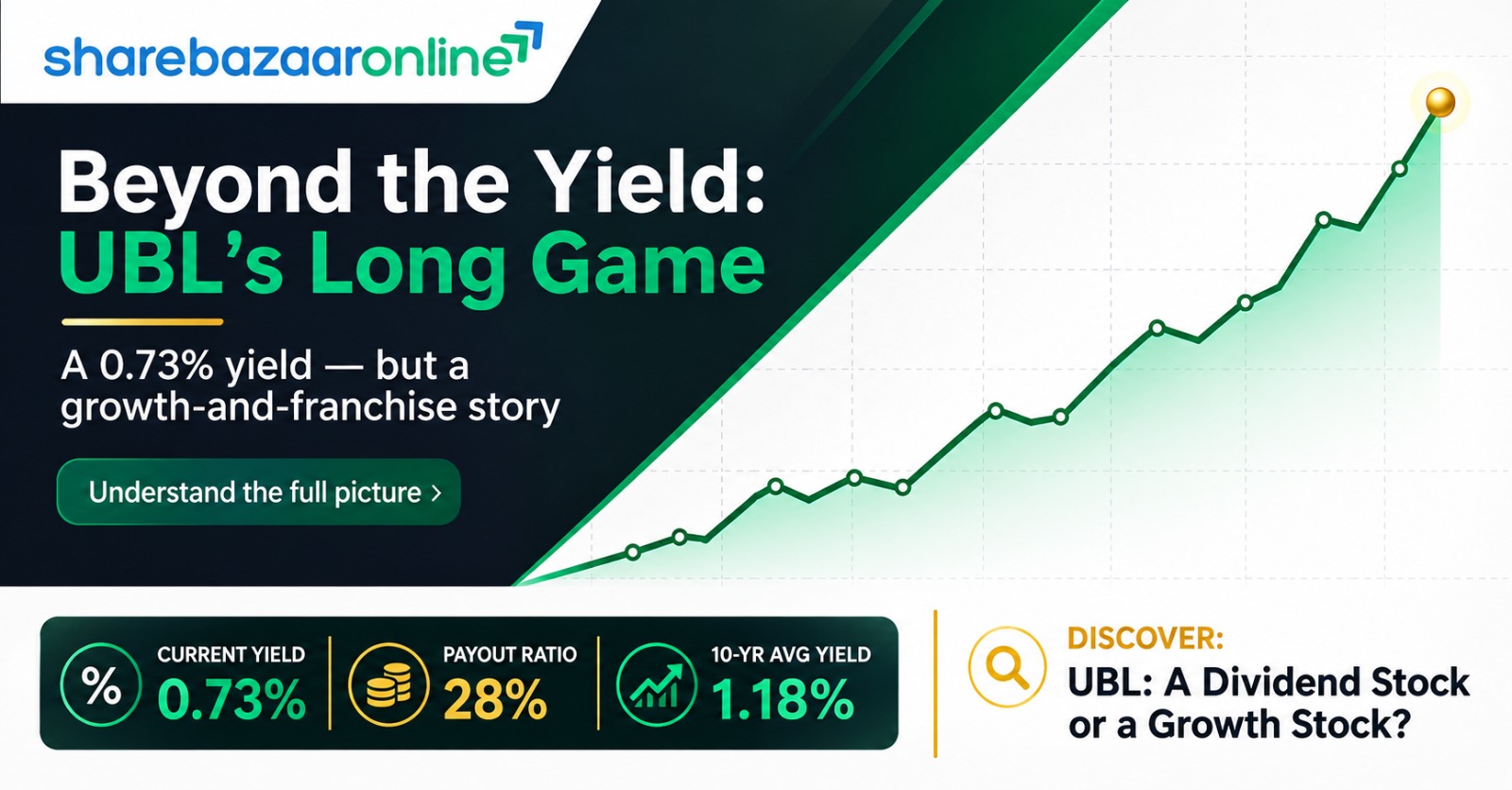
Yield on current market price: ₹10 ÷ ~₹1,377 = ~0.73%
Yield around announcement: ₹10 ÷ ~₹1,398 = ~0.72%
So a headline that shouts "1000%" translates into a real cash yield of under three-quarters of one percent — a reminder that on a low face-value stock, the percentage-of-face-value figure is close to meaningless.
In context, UBL's ~0.73% yield is above the beer/brewing peer average (broadly 0.3-0.4%) but well below the broader Indian dividend-payer median (roughly 1.2%). It is also below spirits peer United Spirits (~1.8%). Historically, UBL's ten-year average yield has been around 0.27%, so the current level is elevated versus its own history — largely because the share price has fallen ~26-29% over the past year while the dividend was held flat.
Yield reality check: A rising dividend yield can be a good sign (higher payout) or a warning sign (falling price). Here, the yield is up mainly because of a falling share price, not because the dividend grew. UBL is not a high-yield stock; the yield is a by-product of a de-rating, not a dividend-growth story. All yields quoted are price-dependent and should be re-verified against the live CMP before acting.
Dividend History Analysis
The United Breweries dividend history reveals two distinct eras. Before FY2022, UBL was a low-payout stock (dividend per share in the ₹1-2.50 range, payout ratio of only 10-15%). From FY2022 onward — coinciding with Heineken's controlling stake and a revised capital-return policy — the payout stepped up sharply to the ₹7.50-10.50 range and 60-76% of profit.
| Financial Year | Dividend / Share | EPS (₹) | Payout Ratio |
|---|---|---|---|
| FY2016 | ₹1.15 | 11.28 | 10% |
| FY2017 | ₹1.15 | 8.68 | 13% |
| FY2018 | ₹2.00 | 14.91 | 13% |
| FY2019 | ₹2.50 | 21.29 | 12% |
| FY2020 | ₹2.50 | 16.18 | 15% |
| FY2021 (COVID) | ₹0.50 | 4.28 | 12% |
| FY2022 | ₹10.50 | 13.82 | 76% |
| FY2023 | ₹7.50 | 11.50 | 65% |
| FY2024 | ₹10.00 | 15.51 | 64% |
| FY2025 | ₹10.00 | 16.71 | 60% |
| FY2026 | ₹10.00 | 15.63 | 64% |
Consistency: UBL is not a flawlessly consistent payer. The dividend was slashed to ₹0.50 in FY2021 (COVID) and cut from ₹10.50 to ₹7.50 in FY2023. Since FY2024, however, it has settled at a steady ₹10 for three straight years.
Classification: Cyclical Payer that has stabilised. The record shows sensitivity to earnings cycles (cuts in stress years), but a clear post-FY22 policy of a high, stable ₹10 payout. The flat ₹10 across FY24-FY26 came even as EPS peaked in FY25 and then fell in FY26.
Financial Performance Analysis
On a consolidated basis for FY26, United Breweries delivered revenue growth but a profit decline — a textbook operating-leverage warning sign. Net revenue (excluding excise duty) rose but core operating profit fell.
Net revenue (ex-excise): ₹9,239.94 Cr, up +3.6% (FY25: ₹8,915.09 Cr)
Profit before tax & exceptional items: ₹506.98 Cr, down −19.6% (FY25: ₹630.87 Cr)
Reported PAT: ₹413.39 Cr, down −6.6% (FY25: ₹442.41 Cr)
EPS: ₹15.63 (FY25: ₹16.71)
Why profits fell while sales rose: Finance costs exploded from ₹12.86 Cr to ₹71.72 Cr (+458%) as short-term borrowings ballooned; depreciation rose to ₹272 Cr; and cost inflation squeezed margins. Operating margin stayed stuck near 9%. The much smaller −6.6% fall in reported PAT (versus a −19.6% fall in core PBT) was cushioned by a one-off gain, discussed below.
Earnings-quality flag: FY26 PBT includes a net exceptional gain of ₹55.31 Cr, driven by a ₹74.04 Cr gain on transfer of freehold land (partly offset by a ₹18.73 Cr labour-code charge). Strip out this non-operating gain and underlying PAT is roughly ₹358 Cr — which pushes the "real" dividend payout ratio up to about 74% rather than the reported 64%. The Q4 numbers are even starker: standalone Q4 profit before exceptional items was just ₹42 Cr versus ₹131.55 Cr a year earlier, meaning the reported Q4 profit was largely propped up by the land-sale gain.
Cash Flow Analysis
Reported profits are an opinion; cash is a fact. And here the cash tells a harder story than the profit-and-loss statement. This is the core of what separates real analysis from a press-release rewrite.
Operating cash flow (FY26): ₹434.95 Cr
Capex (PP&E + CWIP + intangibles + advances): ₹511.72 Cr
Free cash flow (clean, before asset sales): −₹76.77 Cr
Free cash flow (including ₹79 Cr land-sale proceeds): ~₹2 Cr
Dividend outflow: ₹264.41 Cr (proposed); ₹248.94 Cr actually paid during FY26.
Put simply: FCF of roughly ₹2 Crore does not come close to funding a ₹264 Crore dividend. The dividend is not paid out of free cash flow — it is funded from a combination of cash reserves and fresh borrowings.
OCF vs profit: Operating cash flow of ₹435 Cr sits above reported PAT of ₹413 Cr, which looks healthy on the surface. But it is dragged down by a working-capital build-up — inventory days rose to 432 and trade receivables remain elevated (debtor days ~116). Meanwhile UBL's free cash flow has been negative or negligible for four consecutive years (FY23: −₹274 Cr; FY24: −₹121 Cr; FY25: −₹45 Cr; FY26: ~₹2 Cr). Funding source of the dividend: current earnings on paper, but cash reserves and borrowings in practice.
Balance Sheet Strength
United Breweries remains a fundamentally asset-backed business with a large reserve base, but its balance sheet has weakened over the past two years as debt has climbed to fund capex and distributions.
Equity share capital: ₹26.44 Cr
Other equity / reserves: ₹4,495.66 Cr
Book value per share: ~₹171
Cash & cash equivalents: ₹460.08 Cr
Total liquid (incl. other bank balances): ₹571.56 Cr
Current borrowings FY26: ₹1,175.26 Cr
Current borrowings FY25: ₹574.85 Cr
Change: +104% (more than doubled)
Net short-term borrowings raised during the year were ₹600.41 Cr. For context, gross borrowings were just ₹16 Cr as recently as FY2023 — the leverage build-up is recent and rapid.
Debt-and-dividend tension: The company is increasing borrowings and paying dividends at the same time. Cash coverage of the dividend from the liquid pool is about 2.16x, so a single year's payout is affordable from cash — but that cash cushion is shrinking as debt rises. A large contingent liability also sits off the balance sheet: a Competition Commission of India penalty of ₹751.83 Cr (of which ₹179.41 Cr has been deposited), currently stayed by the Supreme Court and not provided for.
Dividend Sustainability Analysis
We test dividend sustainability across four lenses — earnings, free cash flow, liquidity, and the earnings trend.
1. Earnings coverage — Adequate. EPS of ₹15.63 covers the ₹10 dividend 1.56x (payout ~64%). But adjust for the one-off land-sale gain and the underlying payout rises to ~74%, leaving a thinner cushion.
2. Free cash flow coverage — Not covered. FCF of ~₹2 Cr (and negative before asset sales) against a ₹264 Cr payout. The dividend is being funded by cash reserves and debt, not organic cash generation.
3. Liquidity — Adequate for now. ₹571.56 Cr of liquid resources gives ~2.16x cover on one year's dividend, but this buffer is eroding as borrowings climb.
4. Earnings trend — Declining. PAT fell 6.6% in FY26 and core PBT fell ~19.6%; management has guided to a further ₹400-500 Cr cost headwind over the next 2-3 quarters.
Verdict: Moderately Sustainable. The dividend is safe on an earnings and near-term liquidity basis, and UBL has a strong franchise and a committed Heineken parent. But it is not self-funding from cash flow, is running alongside rapidly rising debt and a large stayed penalty, and is being maintained through a period of falling profit. Continuing the ₹10 payout depends on an earnings and cash-flow recovery; if the guided cost pressures persist, the payout would increasingly lean on the balance sheet.
Peer Comparison
UBL is India's largest beer maker with no directly comparable listed pure-play brewer of similar scale, so the most relevant peers are the large alco-beverage names. Figures below are drawn from public aggregators as of mid-August 2026 and should be re-verified before publication; cells are left blank where a value could not be independently confirmed.
| Company | Dividend Yield | Payout Ratio | ROE | ROCE |
|---|---|---|---|---|
| United Breweries (UBL) | ~0.73% | ~64% | ~7.7% | ~10.7% |
| United Spirits (USL) | ~1.8% | ~56% | — | — |
| Radico Khaitan | — | — | ~18-27% | ~26-32% |
Takeaway: UBL screens as a higher-yield but lower-return name within alco-bev. Its ROE (~7.7%) and ROCE (~10.7%) are materially below spirits peers such as Radico Khaitan, and its dividend yield of ~0.73%, while above the brewing average, trails United Spirits' ~1.8%. The high payout ratio (~64%, or ~74% ex-exceptional) reflects a mature-franchise capital-return policy rather than superior profitability — UBL is returning a large share of a modest profit pool.
Promoter Impact Analysis
United Breweries is majority-owned by the HEINEKEN group. As of the latest shareholding pattern, promoters held 70.84%, DIIs ~18.08%, FIIs ~4.94% (falling), the government ~1.16%, and public shareholders ~4.99%.
Promoter dividend income: 70.84% × ₹264.41 Cr = ~₹187.31 Cr flowing to the Heineken-led promoter group.
Minority / public shareholder share: the remaining 29.16% = ~₹77.10 Cr across all non-promoter holders.
Distribution impact: With a debt-funded, high-payout policy, the majority of every dividend rupee flows to the controlling shareholder. This is legitimate and pro-rata, but retail investors should recognise that the decision to maintain a ₹10 payout despite negative free cash flow and rising debt is one that primarily benefits the largest holder — a capital-allocation choice worth watching, especially given independent commentary flagging UBL's capital-allocation trends as sub-optimal.
Taxation Analysis
Since the Finance Act 2020 abolished the Dividend Distribution Tax, dividends in India are taxable in the hands of the shareholder at their applicable income-tax slab rate. There is no separate concessional rate for dividends.
Key rules:
• Dividend added to "Income from Other Sources" and taxed at your slab rate.
• TDS at 10% is deducted by the company if total dividend paid to you in the year exceeds ₹5,000 (TDS is adjustable against final tax).
• TDS is 20% (plus surcharge/cess) for shareholders who have not furnished a valid PAN.
Worked example — 1,000 shares at ₹10/share, 30% slab:
• Gross dividend: ₹10,000
• TDS @10% (as > ₹5,000): ₹1,000 (adjustable)
• Final tax @30%: ₹3,000
• Net dividend in hand: ₹7,000
• Effective post-tax yield on CMP: ~0.51%
For a top-slab investor, the already-modest ~0.73% pre-tax yield shrinks to about 0.51% after tax — underlining that UBL is an equity held for growth and franchise value, not for dividend income. Tax outcomes vary by individual circumstances; consult a qualified tax adviser.
Key Risks
The following are business and dividend-relevant risks investors should weigh:
1. Cost inflation and margin pressure. Management has flagged a ₹400-500 Cr cost headwind over 2-3 quarters from the Middle East conflict, raw-material/packaging inflation and freight, which could keep EBIT under pressure.
2. Rising leverage. Current borrowings doubled to ₹1,175 Cr in one year while free cash flow was negligible; sustained debt-funded payouts would erode the balance sheet.
3. CCI penalty overhang. A ₹751.83 Cr Competition Commission penalty (stayed by the Supreme Court, ₹179.41 Cr deposited) is a material contingent liability that is not provided for.
4. State-level regulatory and taxation risk. Beer is heavily regulated and taxed at the state level; prohibition (as seen in Bihar), route-to-market changes and excise policy shifts directly hit volumes and pricing.
5. Earnings quality and one-offs. FY26 profit was flattered by a ₹74 Cr land-sale gain and higher other income; the underlying operating trend is weaker than headline PAT suggests, and Q4 operating profit fell sharply.
6. Rich valuation and de-rating risk. The stock trades at a very high P/E (~100x) and ~8x book value while earnings decline, leaving little valuation cushion — a key reason the yield rose was a ~26-29% price fall over the year.
What To Monitor
Forward-looking metrics that will determine whether the ₹10 dividend can be maintained and grown:
1. Free cash flow trajectory. Watch whether FCF turns durably positive; the dividend cannot lean on cash reserves and debt indefinitely.
2. Net debt and borrowing levels. Track quarterly borrowings and interest costs; a continued rise alongside dividends is a red flag.
3. Gross and EBIT margins. Monitor whether pricing actions and premiumisation offset the guided cost inflation and restore EBIT.
4. Volume and premium mix. Beer-category volume growth (guided 5-8%) and premium-segment growth (Kingfisher Ultra, Ultra Max, Heineken Silver) drive the top line.
5. CCI litigation outcome. Any Supreme Court development on the ₹751.83 Cr penalty could crystallise a large cash liability.
6. Working capital. Elevated inventory (432 days) and receivable days tie up cash; improvement here would directly support dividend-paying capacity.
Conclusion
United Breweries' FY26 dividend of ₹10 per share is a story of a flat payout on a declining profit, dressed up as a "1000%" headline that actually translates into a modest ~0.73% real yield. The dividend is comfortably covered by reported earnings (1.56x) and by one year's cash reserves (~2.16x), and it enjoys the backing of a committed Heineken parent.
Positives: India's #1 beer franchise; a stable ₹10 payout for three years; a strong reserve base and Heineken ownership; premiumisation and double-digit Q4 category volume recovery; yield above the brewing-peer average.
Negatives: Dividend not funded by free cash flow; borrowings doubled in a year; FY26 profit flattered by a one-off land gain (ex-exceptional payout ~74%); declining earnings and margins; a large stayed CCI penalty; a rich valuation on a falling share price.
On balance, the payout is best described as Moderately Sustainable: safe in the near term but reliant on a recovery in cash generation to avoid leaning further on debt. We present the positives, negatives, risks and monitoring factors above so readers can weigh them for themselves — this article does not offer any buy, sell or hold recommendation.
Frequently Asked Questions
What dividend has United Breweries announced for FY2026?
What is the United Breweries dividend yield?
What was the record date for the UBL dividend?
What is the ex-dividend date for United Breweries?
When will the United Breweries dividend be paid?
Who was eligible for the UBL dividend?
How is the United Breweries dividend taxed?
Is the United Breweries dividend sustainable?
Why is the dividend called "1000%" if the yield is under 1%?
What is United Breweries' dividend history?
Why did UBL's profit fall even though revenue rose in FY26?
How much of the dividend goes to the promoter, Heineken?
What should investors monitor going forward?
Is United Breweries a good dividend stock?
Disclaimer
This article is published by ShareBazaar Online for informational and educational purposes only and constitutes financial journalism, not investment advice. It does not contain any buy, sell or hold recommendation. ShareBazaar Online is not a SEBI-registered investment adviser or research analyst. All figures are compiled from the company's exchange filings and publicly available sources and are believed to be accurate as of the date of writing; the current market price and all price-dependent yields must be independently re-verified before any decision. Investing in equities involves risk, including possible loss of principal. Readers should conduct their own due diligence and consult a SEBI-registered financial adviser and a qualified tax professional before making any investment or tax decision. ShareBazaar Online and its authors accept no liability for any loss arising from the use of this information.