
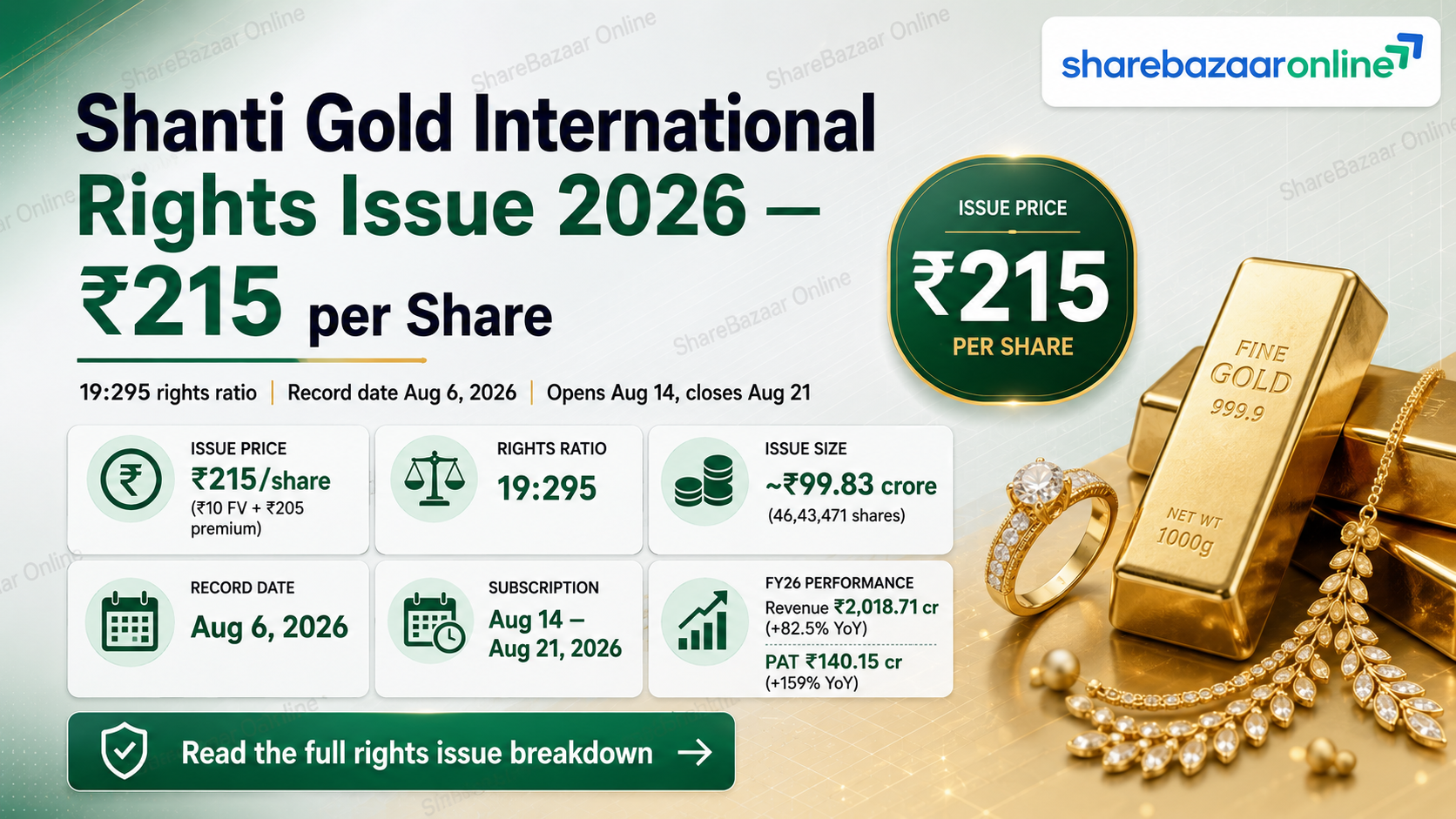
Shanti Gold International Rights Issue 2026 — Highlights
| Company | Shanti Gold International Limited |
| Exchanges | BSE: 544459 | NSE: SHANTIGOLD |
| Corporate Action | Rights Issue of fully paid-up equity shares |
| Issue Price | ₹215 per rights equity share (₹10 face value + ₹205 premium) |
| Rights Entitlement Ratio | 19:295 (19 rights shares for every 295 shares held) |
| Shares Offered | 46,43,471 equity shares |
| Issue Size | ₹99,83,46,265 (~₹99.83 crore, on full subscription) |
| Record Date | August 6, 2026 |
| Issue Opens / Closes | August 14, 2026 / August 21, 2026 |
| Reference Market Price | ₹231.90 (NSE close, Aug 13, 2026)* |
| Discount to Market | ~7.3% below reference price* |
| Registrar | Bigshare Services Pvt. Ltd. |
| Lead Manager | Aryaman Financial Services Ltd. |
| Equity ISIN / RE ISIN | INE06ZD01017 / INE06ZD20017 |
*Reference market price and discount are calculated figures derived from exchange trading data, not company-disclosed values. They change with the live market price.
About the Company
Shanti Gold International Limited traces its roots to a 2003 partnership and became a public company in 2013. It is a vertically integrated manufacturer of 22KT CZ casting gold jewellery, running an in-house design-to-dispatch model covering CAD design, casting, hallmarking, polishing and quality control. Its range spans bangles, rings, necklaces, earrings, pendants and bridal sets sold largely through wholesale and B2B channels to national and international retailers. The Mumbai unit carries a base capacity of 2,700 kg per annum, expanded during 2026, with additional capacity added in Jaipur. The company listed on NSE and BSE in August 2025 and is led by Chairman & Managing Director Pankajkumar H. Jagawat.
What Is This Rights Issue?
A rights issue lets a company raise fresh capital by offering new shares to its existing shareholders in a fixed proportion. Shanti Gold International is offering 19 rights equity shares for every 295 shares held on the record date, priced at ₹215 each. Only shareholders on the register as on August 6, 2026 are eligible. Participation is optional — investors may apply, apply for extra shares, sell (renounce) their entitlement, or let it lapse. It is a corporate action, not a recommendation to invest.
Important Dates
| Board Meeting | July 31, 2026 |
| Ex-Date | August 5, 2026 (calculated on T+1 convention; to be confirmed by the exchange) |
| Record Date | August 6, 2026 |
| Issue Opens | August 14, 2026 |
| On-Market Renunciation Ends | August 18, 2026 |
| Off-Market Renunciation Ends | August 20, 2026 |
| Issue Closes | August 21, 2026 |
| Expected Allotment / Listing | On/around August 25–26, 2026 (indicative; per issue schedule, subject to change) |
Rights Issue Timeline
Before the Issue
The board approved the terms on July 31, 2026. The record date of August 6, 2026 fixes who is eligible. Rights entitlements (RE) are credited to eligible demat accounts ahead of the opening, so holders can apply or renounce.
During and After
The window runs August 14–21, 2026. On-market renunciation ends August 18 and off-market August 20. After closing, shares are allotted and are expected to be credited and listed around August 25–26, 2026 (indicative).
Issue Structure
Issue price: ₹215, made up of ₹10 face value and ₹205 premium, payable in full on application.
Ratio: 19:295. Fractional entitlements are ignored, with preferential consideration for one extra share where applicable.
Issue size: 46,43,471 shares aggregating ₹99,83,46,265 on full subscription.
Capital increase: paid-up equity rises from 7,20,96,000 to 7,67,39,471 shares, a dilution of about 6% of the enlarged base.
Objects of the Issue
Working Capital
Per the company's earlier fund-raising approval, proceeds are intended mainly to strengthen working capital — relevant for a gold jewellery maker with high inventory and receivable needs.
General Corporate Purposes
A portion is earmarked for general corporate purposes. The exact object-wise break-up will be set out in the Letter of Offer. Detailed allocation: To be verified from the Letter of Offer.
Promoter Participation
Before
Promoter and promoter-group holding is around 74.9% (per latest available public data).
After & Implications
Post-issue promoter holding depends on actual subscription and any renunciation. Promoter intention and post-issue split: Not disclosed by the company in the board outcome; to be verified from the Letter of Offer. If all shareholders subscribe pro-rata, the percentage stays broadly unchanged.
Financial Performance
| Metric (₹ crore) | FY26 | FY25 |
|---|---|---|
| Revenue from operations | 2,018.71 | 1,106.41 |
| Profit before tax | 184.37 | 71.09 |
| Net profit | 140.15 | 54.11 |
| EPS (₹) | 21.22 | 10.02 |
| EBITDA (approx.) | ~199 | Not separately disclosed here |
Revenue rose about 82.5% and net profit about 159% year on year in FY26. Q1 FY27 momentum continued, with standalone sales up roughly 144% and profit up about 105% year on year. CARE Ratings assigned a CARE A- (stable) rating on bank facilities.
Ratios such as ROE, ROCE, book value, debt-equity, interest coverage, working-capital cycle and a full five-year series: To be verified from the annual report / Letter of Offer.
Financial Analysis
Growth has been the standout theme, powered by higher jewellery volumes, elevated gold prices and post-IPO scale-up. Because bullion is a large share of cost, absolute margins can look thin in percentage terms even as profit grows — typical of gold manufacturing. Management has favoured buying inventory outright over metal loans and switched to weighted-average costing, both of which affect reported margins and working-capital intensity. Rapid revenue expansion tends to lock up cash in inventory and receivables, which helps explain a fresh capital raise. Investors should read profit growth alongside cash conversion, gold-price sensitivity and the sustainability of volume gains rather than headline percentages alone.
Balance Sheet Analysis
The 2025 IPO added fresh equity, and this rights issue would further enlarge net worth. Inventory and receivables are the dominant assets in gold manufacturing, so the balance sheet is working-capital heavy. Line-item detail — net worth, borrowings, inventory days and gearing: To be verified from the audited balance sheet.
Cash Flow Analysis
Fast-growing jewellery businesses often report strong profit but modest operating cash flow, as sales growth ties up cash in stock and credit to buyers. A rights issue can ease that pressure by funding working capital without adding debt. Detailed operating, investing and financing cash flows: To be verified from the audited statements.
Shareholding Pattern
Before
Promoter and promoter group hold roughly 74.9%, with the balance held by public and institutional investors (per latest available data).
After & Impact
Because a rights issue is pro-rata, holdings stay similar if everyone subscribes equally. Shareholders who skip the issue see their percentage diluted. Exact post-issue category split: Not disclosed by the company; to be verified.
Industry Analysis
India's gold jewellery market is large and steadily formalising as organised players gain share from unorganised jewellers. Demand is driven by weddings, festivals and rising incomes, with hallmarking rules aiding trusted brands. Key threats are gold-price volatility, thin manufacturing margins, import and duty changes, and intense competition. Opportunities lie in exports, B2B supply to large retailers and capacity expansion.
Competitive Position
Shanti Gold competes as a vertically integrated, design-led manufacturer serving national and international retailers on a B2B basis. In-house CAD design, casting and hallmarking, plus added capacity in Mumbai and Jaipur, support scale. It operates in a crowded field alongside larger listed jewellers and many unorganised makers, so relationships, design speed and execution are its main differentiators.
Growth Drivers
Capacity expansion in Mumbai and Jaipur, plus planned international presence, supports volume growth.
Rising demand in the organised jewellery segment and strong festive/wedding cycles.
Deeper B2B relationships with retailers and expansion into new geographies.
Fresh capital to fund working capital, enabling larger order execution.
Risk Factors
Gold-price volatility
Sharp swings in bullion prices can affect demand, inventory value and margins.
Thin manufacturing margins
Gold is a large cost, so percentage margins are naturally slim and sensitive to costs.
Working-capital intensity
High inventory and receivables tie up cash; rapid growth can strain liquidity.
Competition & concentration
A crowded B2B market and reliance on key customers can pressure pricing and volumes.
Regulatory & execution risk
Duty, hallmarking and tax changes, plus expansion execution, can affect performance.
Subscription risk
If the issue is under-subscribed, fund-raising and plans may be affected.
Opportunities
Formalisation of the jewellery trade, export potential, new capacity, and stronger retailer partnerships give the company room to grow. Fresh equity that funds working capital rather than debt can support larger orders while keeping the balance sheet flexible.
Advantages (Pros)
Priced below recent market
At ₹215 versus a reference price near ₹232, the rights price sits modestly below market. It benefits eligible shareholders who choose to apply. It may not apply if the market price falls to or below ₹215 before/after listing.
Chance to add to holdings
Existing holders can raise their stake proportionally. This matters for those wanting to avoid dilution. It benefits committed long-term shareholders; it is irrelevant to non-shareholders.
Capital for growth
Proceeds mainly fund working capital. This matters because the business is inventory-heavy. It benefits the company and, indirectly, shareholders — provided funds are deployed well.
Equity, not debt
Raising equity avoids added interest cost and supports financial flexibility. This helps a company scaling rapidly. The trade-off is dilution for non-participating holders.
Renunciation flexibility
Those who do not wish to apply can sell their entitlement in the market. This offers optional value. It applies only where a shareholder has a valid, tradable entitlement.
Potential earnings support
If capital funds profitable growth, future earnings may rise. This matters for long-term value. The benefit is conditional and not guaranteed.
Disadvantages (Cons)
Equity dilution
The share count rises about 6%. Shareholders who do not apply see their ownership and per-share claims shrink. Investors should weigh whether they wish to participate to protect their stake.
Additional capital outlay
Applying requires fresh cash at ₹215 per share. This affects shareholders' liquidity and portfolio balance. Investors should assess affordability against other opportunities.
Market-price risk
If the market price falls below ₹215, the discount disappears. Existing holders could face notional losses. Investors should consider volatility and gold-price sensitivity.
Execution & deployment risk
Returns depend on effective use of funds. Poor deployment could weigh on future EPS. Investors should track how proceeds are used versus stated objects.
Increased share supply
More shares can pressure price in the short term. This affects all holders. Investors should separate short-term supply effects from long-term fundamentals.
Subscription uncertainty
Under-subscription could affect fund-raising. This is a business-level risk for shareholders. Investors should follow subscription updates during the window.
Should Existing Shareholders Apply? (Framework, Not Advice)
This is an educational framework, not a recommendation. Shareholders often weigh: the gap between the ₹215 rights price and the live market price; the company's fundamentals and the durability of its recent growth; how the proceeds will be used and whether that adds value; the balance-sheet and working-capital position; the outlook for organised jewellery and gold prices; and their own goals, time horizon, cash availability and risk appetite. Those who do not wish to invest can consider renouncing their entitlement. A financial adviser and the Letter of Offer are the right references before deciding.
Investor Insights
The raise is relatively small (~₹99.83 crore) against the company's scale, so dilution is limited at roughly 6% of the enlarged base. Funding working capital through equity fits a rapidly growing, inventory-heavy jewellery model and avoids added leverage. The key watch-items are cash conversion versus reported profit, gold-price sensitivity, customer concentration, and whether the proceeds translate into sustainable volume and earnings growth. The modest discount to market means the price incentive is small; the decision hinges more on conviction in fundamentals than on the discount alone.
Analyst Perspective (Neutral)
On the facts, Shanti Gold shows strong reported growth and a limited-size, equity-based raise for working capital, which is consistent with its expansion phase. Balanced against that are structurally thin jewellery margins, gold-price exposure and working-capital intensity. This is a factual overview, not a rating or a buy/sell/subscribe view. Investors should rely on the Letter of Offer and their own due diligence.
Conclusion
Shanti Gold International's rights issue offers 19 shares for every 295 held at ₹215 each, opening August 14 and closing August 21, 2026, with the record date on August 6, 2026. It aims to raise about ₹99.83 crore, chiefly for working capital, at a modest discount to the recent market price. The company has posted rapid revenue and profit growth since its 2025 listing, though the business carries the usual jewellery-sector risks of gold-price volatility, thin margins and heavy working-capital needs. For eligible shareholders, the choice is to apply, apply for extra shares, renounce, or let the entitlement lapse. This article is purely educational and does not recommend buying, selling or subscribing. Investors should read the Letter of Offer, verify all figures from official sources, and consult a registered financial adviser before acting.
Frequently Asked Questions
What is a rights issue?
Who is eligible for the Shanti Gold International rights issue?
What is the record date and why does it matter?
What is the ex-date for this rights issue?
What is the rights entitlement ratio?
What is a rights entitlement (RE) and can it be traded?
What is renunciation?
What is the rights issue price?
How large is the issue?
Is there a discount to the market price?
How can eligible shareholders apply?
Can I apply for additional shares beyond my entitlement?
What happens to fractional entitlements?
When will shares be credited and listed?
Is there a refund if shares are not allotted?
What are the benefits of participating?
What are the main risks?
How does a rights issue cause dilution?
What are the tax implications?
Will promoters participate?
How might the share price be affected?
What should retail and existing shareholders do?
Disclaimer
This article is for educational and informational purposes only and does not constitute investment, legal or tax advice, nor a recommendation to buy, sell, subscribe or renounce. Rights issue terms are sourced from the company's board-meeting outcome dated July 31, 2026 and exchange filings; company background, financials, market price, registrar and lead-manager details are compiled from public sources and may change. Figures marked as calculated or "to be verified" are not company-disclosed. Please verify all details from the Letter of Offer and official BSE/NSE/SEBI sources, and consult a SEBI-registered financial adviser before making any decision. ShareBazaar Online is not liable for any action taken based on this content.