
1. Rights Issue Highlights
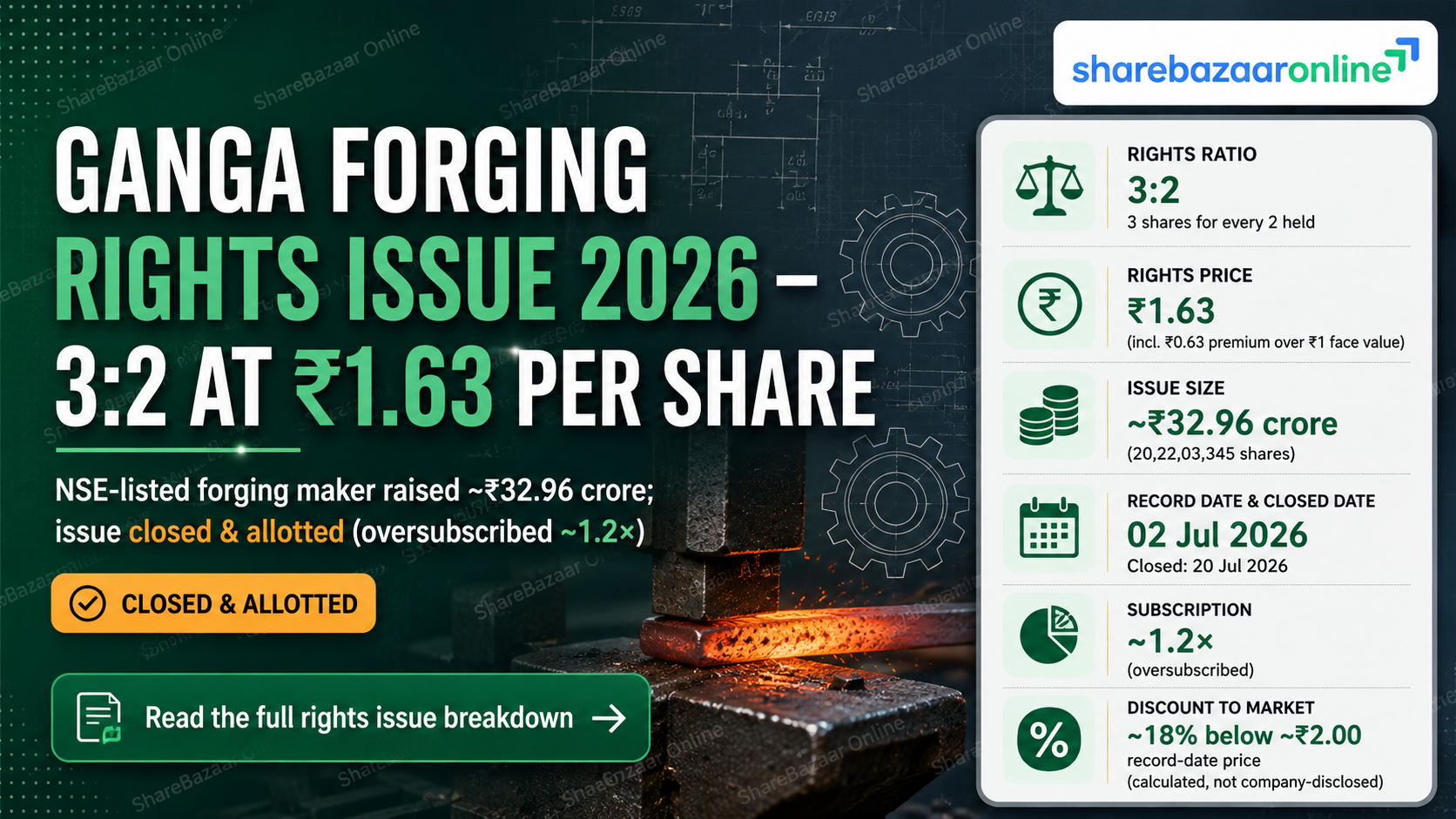
| Company | Ganga Forging Limited (NSE: GANGAFORGE) |
| Exchange | National Stock Exchange (NSE) |
| Industry | Industrials — Castings & Forgings |
| Issue Type | Rights Issue (renounceable), fully paid-up equity |
| Rights Entitlement Ratio | 3:2 (3 rights shares for every 2 held) |
| Rights Issue Price | ₹1.63 per share (incl. ₹0.63 premium) |
| Face Value | ₹1 per share |
| Issue Size | Up to ₹32,95,91,452 (~₹32.96 crore) |
| Shares Offered | 20,22,03,345 rights equity shares |
| Record Date | 02 July 2026 |
| Issue Open / Close | 10 July 2026 / 20 July 2026 |
| Market Price (reference) | ~₹2.00 around record date — calculated, not company-disclosed |
| Discount (reference) | ~18% vs ~₹2.00 — calculated, not company-disclosed |
| RE ISIN | INE691Z20015 (Equity ISIN: INE691Z01023) |
| Registrar | MUFG Intime India Pvt. Ltd. |
| Lead Manager | Not disclosed in board outcome (refer Letter of Offer) |
| Subscription | Oversubscribed ~1.2× (bids: 24,29,54,656 shares) |
| Allotment Date | 21 July 2026 (credit/listing ~22 July 2026) |
2. About the Company
Ganga Forging Limited, based in Rajkot, Gujarat, began in 1988 and became a public company in 2017. It makes closed-die forged and machined steel components — crankshafts, connecting rods, yokes, flanges and similar precision parts — supplied in raw, semi-finished or finished form. Its customers span automotive, railways, construction equipment, agriculture, mining, oil & gas and power transmission. Revenue comes from product sales, exports and job work. The promoter group (led by Hiralal Tilva and Rakesh Patel) holds about 35.5%. The company is diversifying into a solar power project and railway clip manufacturing, and has flagged a wholly owned UAE subsidiary. It pays no dividend and remains a small-cap manufacturer.
3. What Is This Rights Issue?
A rights issue lets a company raise fresh capital from its existing shareholders instead of new outside investors. Ganga Forging offered eligible shareholders the right to buy 3 new shares for every 2 held on the record date, at ₹1.63 each. Shareholders could apply, apply partly, sell their rights entitlement (renounce), or let it lapse. The company keeps the money; shareholders decide whether to participate.
4. Important Dates
| Board Meeting (terms approved) | 25 June 2026 |
| Record Date | 02 July 2026 |
| Ex-Rights Date (derived) | ~01 July 2026 (T-1; not company-disclosed) |
| Issue Opening Date | 10 July 2026 |
| On-market Renunciation | 10 July – 15 July 2026 |
| Issue Closing Date | 20 July 2026 (extendable up to 30 days) |
| Allotment / Credit / Listing | 21 July / ~22 July / ~22 July 2026 |
5. Rights Issue Timeline
The board first approved the issue on 06 January 2026 and finalised terms on 25 June 2026. The record date (02 July) fixed who was eligible; rights entitlements were then credited to demat accounts. The issue opened on 10 July, with on-market renunciation running to 15 July, before closing on 20 July. Allotment followed on 21 July, with credit and listing of new shares around 22 July 2026.
6. Issue Structure
Each rights share carries a face value of ₹1 and was priced at ₹1.63, meaning a premium of ₹0.63. The 3:2 ratio produced 20,22,03,345 new shares and a total issue size of about ₹32.96 crore on full subscription. Outstanding shares rose from 13,48,02,230 before the issue to 33,70,05,575 after — a large expansion of the equity base and paid-up capital (to ~₹33.70 crore).
7. Objects of the Issue
Loan repayment
Repaying loans taken for the solar power project and the core forging business, easing the interest burden.
Capital expenditure
Funding capex for the solar project and forging operations to support capacity and diversification.
Cash-credit repayment
Repaying part of the cash-credit facility to reduce short-term borrowing.
Working capital & GCP
Meeting working-capital needs (including railway clip production) and general corporate purposes. Exact split: refer Letter of Offer.
8. Promoter Participation
Promoter holding before the issue was around 35.5%. The board outcome did not state the promoters' subscription commitment, and the post-allotment promoter/public split is Not Disclosed by the Company / To be verified. In any rights issue, if promoters subscribe in proportion their stake holds; if they under-subscribe, their stake falls and public/institutional holding rises. This is a key figure to confirm from post-issue disclosures.
9. Financial Performance
Revenue grew steadily for several years to roughly ₹35–37 crore, but FY26 (year to March 2026) saw revenue slip and profitability turn negative, with a net loss of about ₹2.3 crore (per data aggregators; verify against audited results). Debt-to-equity is modest (~0.3), but interest coverage is low and FY26 return on equity was negative. The company pays no dividend. Some providers show a small profit in Q1 FY27 (June 2026) — treat quarterly figures cautiously. Precise five-year EPS, book value, ROCE and cash-flow lines vary by source and should be confirmed from filings.
10. Financial Analysis
The financial picture points to a company under margin pressure diversifying beyond its base forging business. A swing from thin profit to a loss in FY26, combined with low interest coverage, helps explain why fresh equity — rather than more debt — was chosen: it repays borrowings and funds capex without adding interest cost. The trade-off is dilution. Because the rights price (₹1.63) sat just above face value and near the 52-week low, the raise looks more like balance-sheet repair and diversification funding than an opportunistic capital raise from a position of strength.
11. Balance Sheet Analysis
Leverage appears manageable, with debt-to-equity around 0.3 and a current ratio comfortably above 1. The rights proceeds directly strengthen the balance sheet by repaying term loans and cash credit and lifting paid-up capital to ~₹33.70 crore. Detailed asset, inventory and receivables figures should be confirmed from audited statements.
12. Cash Flow Analysis
Operating cash flow has been inconsistent, with recent periods reportedly weak or negative — a common signal that a business is stretching working capital to fund growth. In that context, the rights money can ease cash strain and fund capex. Exact operating, investing and financing cash-flow figures are Not fully disclosed / To be verified from filings.
13. Shareholding Pattern
Before the issue
Promoters ~35.5%, with the balance held by FIIs and public/retail investors. Total shares: 13,48,02,230.
After the issue
Total shares rose to 33,70,05,575. The revised promoter/public split is Not Disclosed by the Company / To be verified.
Impact
The 3:2 ratio roughly 2.5x's the share count. Shareholders who applied broadly kept their ownership share; those who did not saw their stake diluted materially.
14. Industry Analysis
India's forging industry serves automotive, railways, infrastructure and capital goods, and is tied closely to the broader manufacturing and capex cycle. Demand is growing on the back of localisation, railway modernisation and infrastructure spending, but the sector is fragmented and highly competitive, with margins sensitive to steel prices, energy costs and client concentration. Small players face pricing pressure from larger, better-capitalised forgers.
15. Competitive Position
Ganga Forging is a small-cap, custom-order manufacturer competing against much larger listed forging companies. Its edge lies in flexible, specification-driven production, an integrated setup and multi-industry reach; its constraints are scale, thin recent profitability and reliance on job work and semi-finished sales. Diversification into solar and railway clips aims to widen its revenue base beyond traditional forging.
16. Growth Drivers
Potential drivers include railway clip manufacturing (linked to rail capex), a solar power project supporting energy diversification and cost control, capacity additions funded by the rights money, a lighter debt load after loan repayment, exports, and a planned UAE subsidiary. Realisation depends on execution and end-market demand.
17. Risk Factors
Profitability risk
FY26 turned loss-making; a return to sustained profit is not guaranteed.
Dilution risk
A 3:2 issue sharply increases share count, pressuring per-share metrics.
Execution risk
Solar and railway-clip diversification are new areas with delivery uncertainty.
Cyclical & input risk
Forging demand is cyclical; steel and energy costs can squeeze margins.
Liquidity & price risk
A low-priced small-cap can be volatile and thinly traded at times.
Fund-utilisation risk
Value creation depends on deploying proceeds effectively and on schedule.
18. Opportunities
If executed well, debt reduction plus capex could improve margins and cash flow over time. Railway clips and solar add new revenue streams beyond core forging, exports offer scale, and a cleaner balance sheet may improve financial flexibility. These are potential outcomes, not assured results.
19. Advantages (Pros)
Priced below market
At ₹1.63 vs a ~₹2.00 reference, participants added shares at a modest discount. Benefits applying shareholders; may not apply if the market price falls below ₹1.63.
Protects ownership
Applying lets existing holders avoid dilution and keep their proportional stake. Matters most to long-term holders; irrelevant to non-participants.
Debt reduction
Proceeds repay loans and cash credit, lowering interest cost. Benefits the company and all holders — but only if leverage doesn't rebuild.
Growth & diversification funding
Capex for solar and railway clips funds new revenue lines. Value accrues only if projects execute and generate returns.
Stronger balance sheet
Fresh equity improves financial flexibility versus more borrowing. Helpful given low interest coverage; less relevant once profits normalise.
No compulsion + renunciation
Holders could apply, renounce, or lapse — a flexible choice. Benefits those who don't wish to add capital; renunciation value depends on RE trading price.
20. Disadvantages (Cons)
Heavy equity dilution
Share count jumps ~2.5x. Non-applicants see ownership and per-share value diluted. Evaluate whether you can/should apply proportionally.
EPS pressure
With FY26 already loss-making, far more shares can worsen per-share metrics. Assess when profitability might recover before extrapolating.
Capital-loss & volatility risk
Low-priced small-caps can move sharply; the price already sat near its 52-week low. Weigh your risk tolerance and horizon.
Execution & fund-use risk
If proceeds are not deployed effectively, returns may lag. Track how capex and repayments actually progress.
Increased share supply & liquidity
More shares can weigh on price if selling exceeds demand. Consider float and trading depth.
Opportunity cost
Capital committed here is unavailable elsewhere. Compare against alternatives before adding to a turnaround situation.
21. Should Existing Shareholders Apply?
This is a decision for each shareholder — there is no one-size answer, and nothing here is a recommendation. Factors worth weighing include valuation relative to the ₹1.63 price and prevailing market price, the company's fundamentals and recent loss, the credibility of the fund-use plan (debt repayment, solar, railway clips), the balance sheet, the forging cycle and industry outlook, and your own horizon, risk appetite and conviction. Shareholders who did not wish to add capital could renounce or let the entitlement lapse. Reading the Letter of Offer and consulting a SEBI-registered adviser is prudent.
22. Investor Insights
The tell-tale detail is the pricing: ₹1.63 is only ₹0.63 above face value and near the 52-week low, so the "discount" to market was thin. That frames the raise as balance-sheet repair and diversification funding rather than a capital raise from strength. Key things to monitor now that it is allotted: post-issue promoter holding, how quickly debt falls, and whether solar and railway-clip projects convert into profitable revenue.
23. Analyst Perspective
On a neutral, fact-based view, the issue was fully taken up (oversubscribed ~1.2×), signalling adequate participation. The equity route sensibly avoids adding interest cost to a business with low coverage. The offset is meaningful dilution against weak FY26 earnings. Whether the capital ultimately creates value will hinge on execution and the forging demand cycle — outcomes that data does not yet confirm.
24. Conclusion
Ganga Forging Limited's 2026 rights issue was a 3:2 offer at ₹1.63 per share that raised roughly ₹32.96 crore from existing shareholders to repay loans and cash credit, fund solar and forging capex, and support working capital including railway clip production. It is now a completed corporate action: the issue closed on 20 July 2026, was oversubscribed about 1.2 times, and shares were allotted on 21 July 2026, lifting paid-up capital to about ₹33.70 crore. The core trade-off is clear — fresh equity strengthens a stretched balance sheet and funds diversification, but at the cost of substantial dilution against a year in which the company reported a loss. The pricing, near face value and close to the 52-week low, underlines that this was capital-raising for repair and growth rather than from a position of strength. Several important figures — post-issue promoter/public holding, exact fund-use split, and audited five-year financials — remain to be verified from official filings. Investors reviewing this action should read the Letter of Offer, track how proceeds are deployed, and seek advice from a SEBI-registered professional. This article is educational and neutral, and contains no buy, sell, or subscription recommendation.