
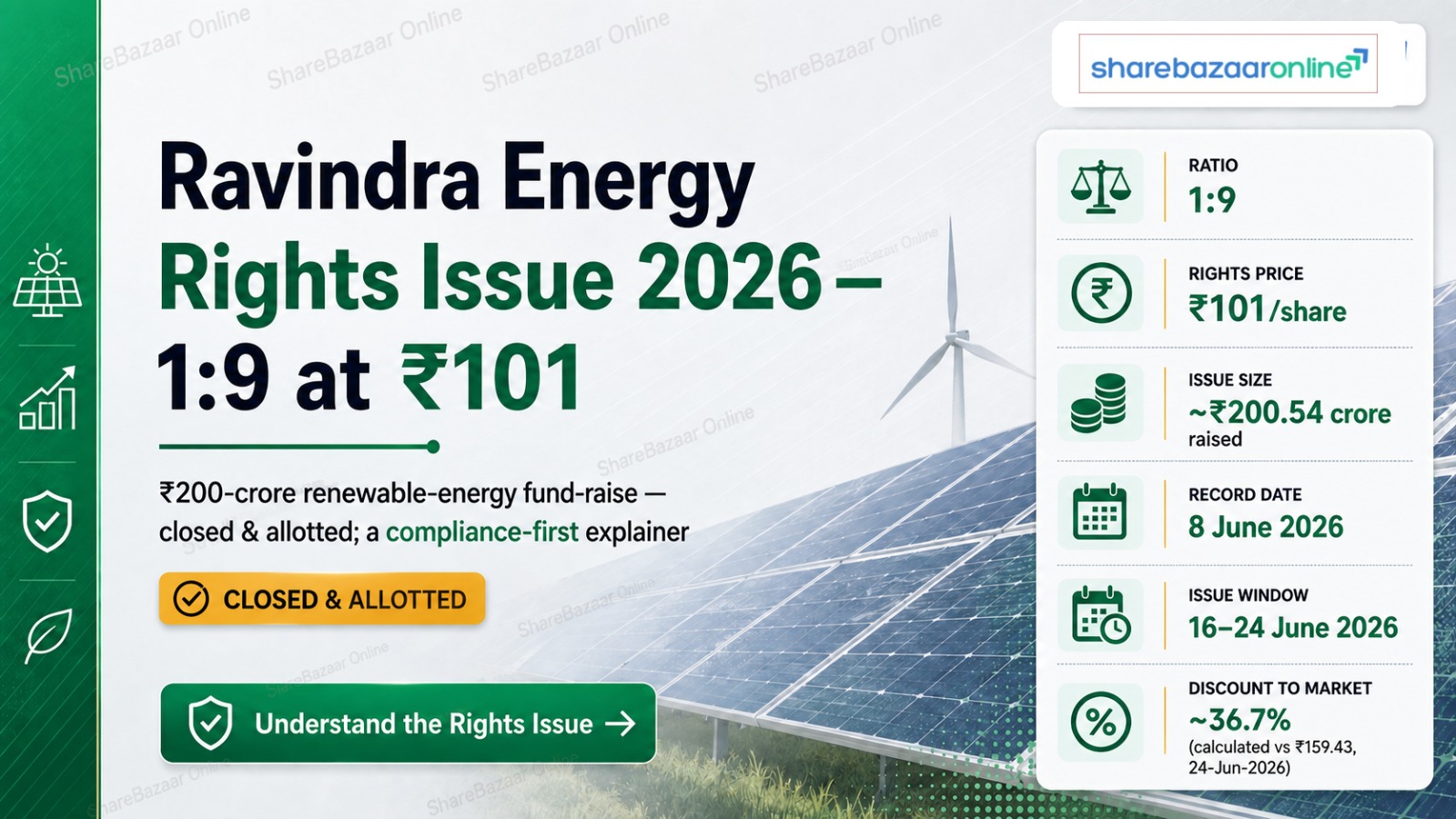
Ravindra Energy Rights Issue 2026 — Highlights
| Company | Ravindra Energy Limited |
| Exchanges | BSE: 504341 | NSE: RELTD |
| ISIN | INE206N01018 |
| Issue Type | Rights Issue (fully paid equity shares) |
| Rights Entitlement Ratio | 1:9 (1 rights share for every 9 held) |
| Issue Price | ₹101 per share |
| Face Value | ₹10 per share |
| Premium | ₹91 per share |
| Shares Offered | 1,98,32,834 (base terms; revised upward by corrigendum) |
| Issue Size | ₹200.31 crore (base); ₹200.54 crore raised per allotment |
| Record Date | 8 June 2026 |
| Ex-Date | 5 June 2026 (derived; consistent with reported buy cut-off) |
| Issue Open | 16 June 2026 |
| Issue Close | 24 June 2026 |
| On-Market Renunciation | 16 June to 19 June 2026 |
| Lead Managers | Hem Securities Ltd. & Share India Capital Services Pvt. Ltd. |
| Registrar | Purva Sharegistry (India) Pvt. Ltd. |
| Objects | Investment in associate Energy in Motion Limited & general corporate purposes |
About the Company
Ravindra Energy Limited, part of the Murkumbi Group, is a Karnataka-headquartered renewable energy company incorporated in 1980 and renamed to its present identity in 2009-10. It operates mainly as an Independent Power Producer (IPP), running ground-mounted and rooftop solar generation, agricultural solar water pumps, and an expanding electric-vehicle footprint through associate Energy in Motion Limited. As of FY26 it manages a renewable portfolio of about 486.3 MWp across roughly 113 sites in Maharashtra and Karnataka. Peers include KPI Green Energy, Sterling & Wilson Renewable and Borosil Renewables. Its strategy leans on capacity expansion, clean-mobility infrastructure and periodic capital raising to fund growth.
What Is This Rights Issue?
A rights issue lets a listed company raise fresh capital by offering new shares to existing shareholders in a fixed proportion, usually at a price below the market. Ravindra Energy offered eligible shareholders 1 rights share for every 9 held on the record date, priced at ₹101 each. Shareholders could subscribe, let their entitlement lapse, or sell (renounce) it during the trading window. The company used this corporate action to strengthen its equity base while giving existing investors first claim on the new shares.
Important Dates
| Initial Board Approval | 16 May 2026 |
| Board Meeting (Terms Approved) | 27 May 2026 |
| Letter of Offer | 3 June 2026 (corrigendum 12 June 2026) |
| Ex-Date (derived) | 5 June 2026 |
| Record Date | 8 June 2026 |
| Issue Opens | 16 June 2026 |
| On-Market Renunciation Closes | 19 June 2026 |
| Issue Closes | 24 June 2026 |
| Deemed Allotment | 25 June 2026 |
| Credit / Listing (approx.) | Around 1 July 2026 |
Rights Issue Timeline
The board first cleared the fund-raise on 16 May and finalised terms on 27 May 2026. The record date of 8 June fixed the list of eligible shareholders. Rights entitlements traded from 16 June, with on-market renunciation ending 19 June. Applications closed 24 June, deemed allotment fell on 25 June, and shares were expected to be credited and listed around 1 July 2026, completing the corporate action.
Issue Structure
Price & Face Value: New shares were priced at ₹101 against a face value of ₹10, implying a securities premium of ₹91 per share.
Ratio & Size: Offered at 1:9, the issue covered 1,98,32,834 shares (base terms) worth about ₹200.31 crore, within the board ceiling of ₹205 crore.
Capital Increase: Paid-up equity rose from 17,86,94,463 shares to about 19,85,27,297 shares (assuming full subscription), lifting capital to roughly ₹198.5 crore.
Final Raise: Per the allotment outcome, the company mobilised about ₹200.54 crore gross (net ₹198.94 crore), after a corrigendum revised the share count.
Objects of the Issue
Investment in Energy in Motion Limited: A portion of proceeds is earmarked for the company's associate, supporting its clean-mobility and electric-vehicle initiatives.
General Corporate Purposes: The balance is allocated to general corporate needs, subject to limits prescribed under SEBI regulations. Exact rupee splits appear in the Letter of Offer.
Promoter Participation
The promoter group (Murkumbi family and Khandepar Investments Pvt. Ltd.) held around 63.66% at the close of FY26. Following some promoter share sales in June 2026, promoters and related persons subscribed to rights shares at ₹101 on 30 June 2026, reaffirming participation. Current promoter holding is reported near 58.3%. The precise post-allotment promoter/public split is Not Disclosed by the Company / To be verified from the final shareholding filing.
Financial Performance
For FY26, Ravindra Energy reported consolidated revenue of about ₹543 crore and net profit near ₹80.8 crore. Q4 FY26 net profit was ₹12.62 crore on sales of ₹133.06 crore, softer sequentially. Interest costs rose to ₹11.74 crore, keeping interest coverage around 2.87x. The five-year sales trend has been roughly flat-to-negative. The company reports profits but pays no dividend. Detailed EPS, book value, ROE, ROCE and working-capital metrics should be read from the audited statements.
Financial Analysis
On an institutional read, Ravindra Energy shows the classic profile of a capital-intensive renewable developer: revenue that scales with commissioned capacity, but earnings sensitive to leverage and interest costs. Rising finance charges compressed Q4 profitability, and interest coverage near 2.87x with an elevated debt-to-EBITDA ratio signals limited headroom. Valuation multiples (a P/E in the high-20s and a price-to-book several times over) price in growth optimism, so execution on capacity additions and fund deployment will matter more than the reported topline. The rights issue improves equity cushioning against this leverage.
Balance Sheet Analysis
The balance sheet carries meaningful debt typical of solar IPPs, with a debt-to-EBITDA around 5.9x flagged by analysts. Fresh equity of roughly ₹200 crore from the rights issue strengthens net worth and can improve the debt-equity mix, aiding future borrowing capacity. Investors should track investment carrying values (auditor "emphasis of matter" notes referenced impairment) and promoter pledging. Full asset, liability and reserve details are in the audited FY26 balance sheet.
Cash Flow Analysis
As an asset-heavy developer, Ravindra Energy's operating cash flow funds ongoing generation while investing outflows track new capacity and its EV-linked associate. Financing activity has featured a 2024 preferential issue and now this rights issue. Line-item operating, investing and financing cash flows are Not Disclosed by the Company in the rights filing and should be read from the audited FY26 cash-flow statement.
Shareholding Pattern
Before: Promoter holding was about 63.66% at the end of FY26, with FIIs near 1.98% and the balance held by public and other investors.
After: Following June 2026 promoter sales and rights subscription, promoter holding is reported near 58.3%. The exact post-allotment split is To be verified.
Impact: Because entitlements are proportional, shareholders who fully subscribed broadly preserved their percentage; those who did not saw their stake diluted by the enlarged share count.
Industry Analysis
India's renewable energy sector is expanding rapidly on policy support, falling module costs and ambitious national clean-power targets, creating a large addressable market for solar developers and clean-mobility players. Competition is intense across EPC, IPP and equipment segments. Opportunities lie in rooftop solar, agri-solar pumps and EV infrastructure; threats include tariff pressure, financing costs, module price swings and execution/land risks. Scale and disciplined capital allocation increasingly separate winners from the pack.
Competitive Position
Ravindra Energy is a mid-sized regional player with a roughly 486 MWp portfolio concentrated in Maharashtra and Karnataka, plus a differentiated push into electric mobility via Energy in Motion Limited. It is smaller than peers such as KPI Green Energy, Sterling & Wilson Renewable and Borosil Renewables, so its edge rests on regional execution, diversified solar-plus-EV exposure and access to growth capital rather than sheer scale.
Growth Drivers
Key drivers include expansion of solar generation capacity, rising demand for agricultural solar pumps, and the electric-vehicle opportunity through its associate, including a reported MoU for electric trucks. Supportive clean-energy policy, fresh equity capital for reinvestment, and potential consolidation of the EIM business could add scale. Realising these depends on timely project execution and effective deployment of raised funds.
Risk Factors
Leverage & interest cost: Elevated debt and rising finance charges pressured Q4 margins and keep interest coverage modest.
Earnings volatility: Quarterly profit swings and a broadly flat multi-year sales trend point to inconsistent momentum.
Promoter pledging & selling: Reported pledging and promoter share sales in 2026 can weigh on sentiment.
Valuation: High P/E and price-to-book leave limited room for disappointment.
Sector risk: Tariff pressure, module price swings and execution/land delays are industry-wide.
Audit notes: "Emphasis of matter" observations on investment impairment warrant monitoring.
Opportunities
Fresh rights capital gives Ravindra Energy room to fund solar expansion, scale its EV associate and reduce reliance on debt. India's clean-energy transition, government incentives and growing rooftop and agri-solar demand widen the runway. A possible consolidation of Energy in Motion Limited could unlock synergies and cleaner reporting, while a stronger balance sheet may lower future funding costs.
Advantages (Pros)
Discounted entry: At ₹101 versus a market reference of ₹159.43 (24 Jun 2026), rights shares carried a calculated discount of about 36.7%, benefiting participating shareholders. This edge disappears if the market price falls to or below the issue price.
Preserve ownership: Full subscription lets existing shareholders avoid dilution and hold their stake. It matters only for those who actually applied; non-participants gain nothing here.
Growth capital: Around ₹200 crore funds expansion and the EV associate, potentially aiding long-term value creation for all shareholders, provided funds are deployed efficiently.
Stronger balance sheet: New equity improves financial flexibility and the debt-equity mix, helping a leveraged developer. The benefit weakens if leverage rises again.
Promoter alignment: Promoter subscription signals confidence and supports capital adequacy, benefiting minority holders. Its value is limited if leverage or pledging concerns persist.
Disadvantages (Cons)
Equity dilution: The enlarged share count reduces the stake of shareholders who did not subscribe, and can trim per-share metrics. Evaluate whether growth from the funds outpaces the dilution.
Capital-loss risk: A discounted price is no guarantee; if the stock falls below ₹101, subscribers face losses. Weigh valuation and fundamentals before committing more capital.
Execution risk: Value depends on deploying funds into projects on time; delays hurt returns. Track project commissioning and fund-utilisation disclosures.
Leverage & EPS pressure: High debt and rising interest can suppress future EPS despite fresh equity. Monitor interest coverage and margin trends.
Increased supply & volatility: More shares and market swings can pressure price near listing. Consider your liquidity needs and time horizon.
Opportunity cost: Capital locked here may earn more elsewhere. Compare against alternatives and your portfolio allocation.
Should Existing Shareholders Apply?
This is educational information, not investment advice. Since the issue has closed, the discussion is for understanding rather than action. Shareholders weighing a rights issue typically consider the discount to market, the company's valuation and fundamentals, how the funds will be used, the balance-sheet and leverage position, industry outlook, and their own goals and risk tolerance. Some also factor in whether promoters are participating. There is no single right answer; the appropriate choice depends on individual circumstances and independent research or professional advice.
Investor Insights
From an institutional lens, this rights issue is best viewed as balance-sheet repair for a leveraged renewable developer rather than a pure growth event. The steep discount to market rewarded participants optically, but the durable question is return on the ₹200 crore deployed into solar capacity and the EV associate. Watch fund-utilisation disclosures, interest-coverage trends, promoter pledging and the proposed EIM consolidation as the real signals of value creation over the coming quarters.
Analyst Perspective
Independent commentary on the FY26 numbers highlighted resilient revenue but softer profitability, rising interest costs and rich valuation multiples, alongside declining FII holdings. Views are mixed and not uniform. This coverage is presented neutrally for information only and should not be read as a recommendation to buy, sell or hold. Investors are encouraged to consult primary filings and, where needed, a registered advisor.
Conclusion
Ravindra Energy Limited's 2026 rights issue was a ₹200-crore-class corporate action offered at 1:9 and priced at ₹101 per share, a meaningful discount to the prevailing market reference. The issue opened on 16 June, closed on 24 June, and has since been allotted, with the company mobilising roughly ₹200.54 crore to invest in its associate Energy in Motion Limited and for general corporate purposes. For a capital-intensive renewable developer carrying notable debt, fresh equity strengthens the balance sheet and preserves proportional ownership for shareholders who subscribed. At the same time, dilution for non-participants, elevated leverage, rich valuation and execution risk temper the picture. The practical takeaway is that the long-term outcome hinges on disciplined deployment of the raised funds into revenue-generating capacity and the clean-mobility opportunity, and on the trajectory of interest costs and promoter conduct. This article is intended purely as educational, exchange-compliant information on the mechanics and implications of the rights issue, and not as advice to buy, sell or subscribe. Readers should verify all figures against official BSE/NSE filings and the Letter of Offer before drawing conclusions.