
1. Right Issue Highlights
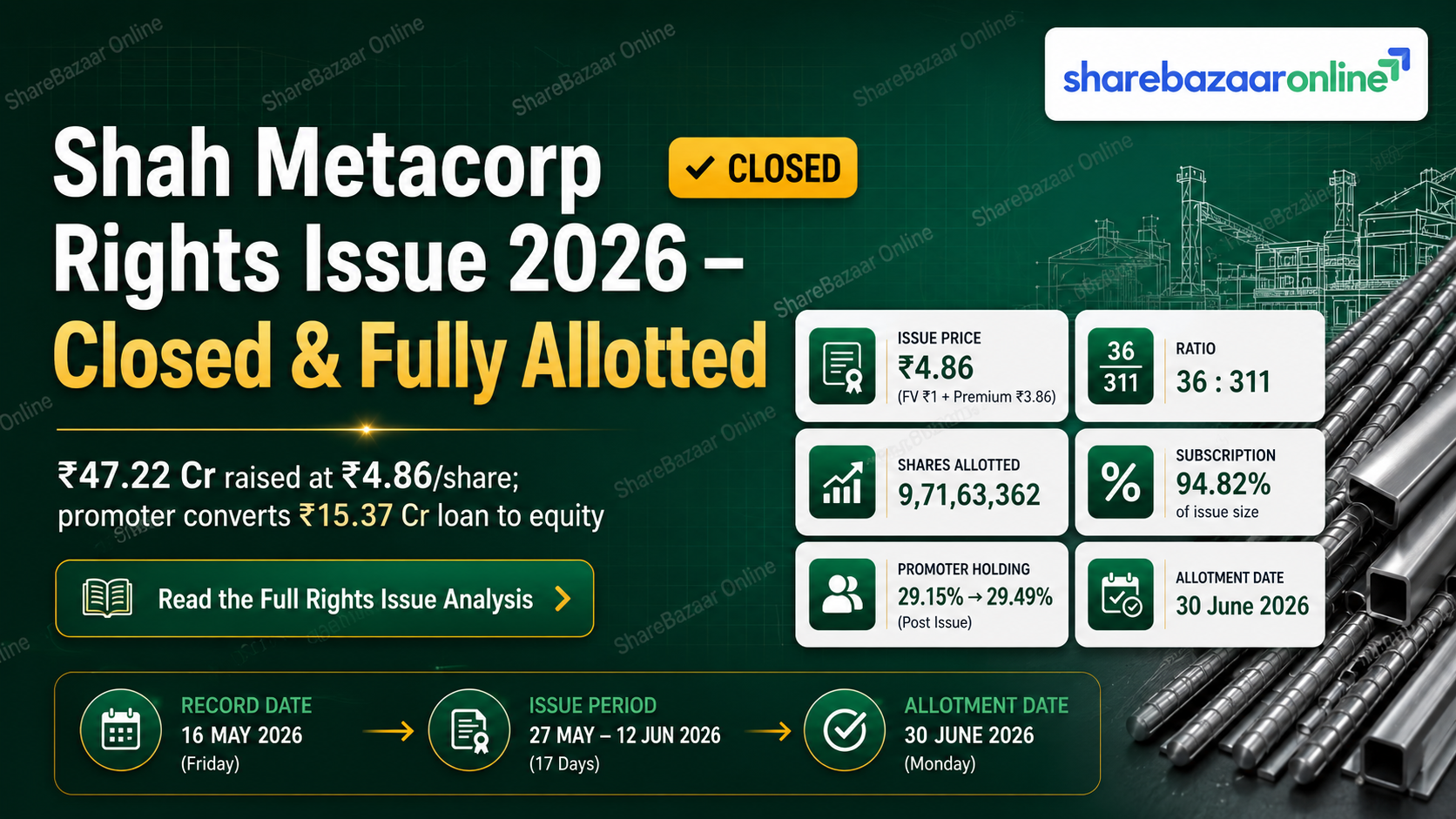
| Company | Shah Metacorp Limited (formerly Gyscoal Alloys Limited) |
| Exchanges | BSE: 533275 | NSE: SHAH |
| ISIN | INE482J01021 |
| Corporate Action | Rights Issue of fully paid-up equity shares |
| Rights Entitlement Ratio | 36 rights shares for every 311 shares held (36:311) |
| Issue Price | ₹4.86 per share (Face Value ₹1 + Premium ₹3.86) |
| Market Price (issue window) | ~₹4.65 (approx., mid-June 2026) — derived from exchange data, not company-disclosed |
| Discount / Premium | No discount — priced ~4.5% above market (calculated figure) |
| Record Date | Wednesday, May 27, 2026 |
| Issue Period | June 11, 2026 to June 25, 2026 |
| Date of Allotment | June 30, 2026 |
| Shares Offered | 10,24,68,139 (up to ₹4,980.00 Lakh) |
| Shares Allotted | 9,71,63,362 |
| Subscription Level | 94.82% of issue size (net of technical rejections) |
| Total Amount Raised | ₹47.22 Crore (incl. ₹15.37 Crore via promoter loan conversion) |
| Registrar | MUFG Intime India Pvt. Ltd. (formerly Link Intime) |
| Lead Manager | Not Disclosed in this filing / To be verified |
2. About the Company
Shah Metacorp Limited, formerly Gyscoal Alloys Limited (renamed in June 2023), is a Gujarat-based manufacturer, exporter and supplier of stainless steel and mild steel long products, including equal angle bars, bright bars, flats and ingots used across construction and infrastructure. Incorporated in 1999 and listed on both BSE and NSE, the company also carries limited agricultural and agro-chemical trading activity. It is promoter-led by Mona Viral Shah and Hemang Harshadbhai Shah. Revenue has scaled in recent years, while return ratios and cash generation remain modest. Insolvency-related matters were reported as settled and closed in FY2026.
3. What is this Right Issue?
A rights issue lets a listed company raise fresh capital by offering additional shares to its existing shareholders in a fixed proportion. Shah Metacorp offered 36 rights shares for every 311 shares held, at ₹4.86 per share. Only shareholders on record as of May 27, 2026 were eligible. Shareholders could subscribe, partly subscribe, renounce their rights entitlement, or let it lapse. The offer was a corporate action for capital raising and shareholder participation, not a public IPO.
4. Important Dates
| Board Approval (fund raising) | December 29, 2025 |
| Detailed Terms / Letter of Offer | May 21, 2026 |
| Record Date | May 27, 2026 |
| Ex-Rights Date | Not disclosed by the company; under T+1 convention typically on/around the record date (derived) |
| Issue Opening Date | June 11, 2026 |
| Issue Closing Date | June 25, 2026 |
| Last Date for Renunciation | Not Disclosed in this filing / To be verified from Letter of Offer |
| Date of Allotment | June 30, 2026 |
5. Right Issue Timeline
The Board first approved the fund raising on December 29, 2025 and finalised detailed terms on May 21, 2026 alongside the Letter of Offer. Eligibility was fixed on the record date of May 27, 2026. The subscription window opened on June 11, 2026 and closed on June 25, 2026, during which shareholders could apply or renounce. The Rights Issue Committee approved allotment on June 30, 2026, after which listing and trading approval was to be obtained from BSE and NSE.
6. Issue Structure
Pricing
Issue price ₹4.86 per share, comprising ₹1 face value and ₹3.86 premium. Ratio was 36:311. Because the market price during the issue window was near ₹4.65, the offer carried no discount and was priced slightly above the traded price (a calculated observation).
Size & Capital Impact
Up to 10,24,68,139 shares were offered (₹4,980.00 Lakh); 9,71,63,362 shares were allotted. Paid-up capital rose from ₹88.52 crore to ₹98.24 crore, an increase of roughly 11% in share count. New shares represent about 9.9% of post-issue capital.
7. Objects of the Issue
The allotment intimation does not itemise the objects, which are detailed in the Letter of Offer dated May 21, 2026. One verifiable object is the conversion of a promoter's unsecured loan into equity: ₹15,37,15,000 was regularised this way, strengthening the balance sheet without a cash outflow. The remaining subscription — roughly ₹31.85 crore of fresh cash (a derived figure) — was raised for purposes stated in the Letter of Offer, typically working capital and general corporate purposes. Specific object-wise deployment: Not Disclosed in this filing.
8. Promoter Participation
Before & After
Promoter and promoter group holding moved from 29.15% (25,80,37,226 shares) to 29.49% (28,96,65,826 shares). Promoter Mrs. Mona Viral Shah was allotted 3,16,28,600 shares through conversion of an unsecured loan.
Implications
Promoters subscribed slightly above their proportionate entitlement, lifting their stake by 0.34 percentage points. The loan-to-equity conversion signals promoter support for the balance sheet, though it also means part of the "amount raised" was non-cash.
9. Financial Performance
Figures below are approximate, sourced from public market databases (Screener, Simply Wall St) and are not company-disclosed within this filing. To be verified against audited results.
Recent consolidated revenue is around ₹208 crore with net profit near ₹12 crore and a net margin close to 5.7%. Return on equity is modest at roughly 3–5%, with ROCE near 4.8%. Book value per share is about ₹3.09, debt-to-equity around 0.2, and interest coverage comfortable at roughly 24x. Cash balances are low, other income is a meaningful share of earnings, debtor days are high (~208), and no dividend is paid. Revenue has grown sharply off a low base after prior losses.
10. Financial Analysis
The financial profile shows a turnaround story rather than a mature compounder. Top-line growth is strong, but profitability leans on a sizeable "other income" component, and core operating returns (ROE/ROCE in low-to-mid single digits) trail the cost of capital. Stretched debtor and working-capital days point to cash tied up in receivables, consistent with reported weak operating cash flow. A trailing P/E in the high-30s prices in continued recovery. The rights capital modestly deleverages and adds equity, but execution on margins and collections remains the key swing factor.
11. Balance Sheet Analysis
Shareholder equity is around ₹312 crore against total debt near ₹65 crore, keeping leverage low. Current assets comfortably exceed current liabilities. However, cash and short-term investments are minimal, and contingent liabilities of roughly ₹164 crore warrant monitoring. Because rights shares were issued at ₹4.86 — above the ~₹3.09 book value — the issue is mildly book-value accretive. (Balance-sheet figures are from public databases, to be verified against audited statements.)
12. Cash Flow Analysis
Public data indicates operating cash flow has been weak or negative, largely because rising sales are locked up in receivables and working capital. Low cash on hand reinforces why external funding, including this rights issue and the promoter loan conversion, was needed. Improving collections and converting reported profits into operating cash is the single most important watch-item. Detailed period-wise cash flow: to be verified against audited filings.
13. Shareholding Pattern
| Category | Before | After Allotment |
|---|---|---|
| Promoter & Promoter Group | 29.15% (25,80,37,226) | 29.49% (28,96,65,826) |
| Public & Others | 70.85% (balance) | 70.51% (balance) |
| Category-wise public split | Not Disclosed in this filing / To be verified from the post-issue shareholding pattern | |
Impact: Promoter stake rose marginally as they subscribed slightly above their entitlement; public holding edged down. A detailed post-allotment public breakdown is a standard disclosure to verify before publication.
14. Industry Analysis
India's stainless and mild steel long-products segment is tied to construction, infrastructure and capital-goods demand, supported by public capex. It is a large but fragmented and cyclical market where players compete on cost, quality and distribution. Opportunities come from infrastructure spending and import substitution; threats include volatile raw-material and scrap prices, thin conversion margins, and competition from far larger integrated producers.
15. Competitive Position
Shah Metacorp is a small-cap, promoter-led manufacturer competing against much larger and better-capitalised stainless steel producers. Its cited client relationships and export activity provide a niche footprint, but scale, pricing power and cash generation are limited relative to industry leaders. Its competitive standing rests on recovering operations, improving throughput and disciplined working-capital management rather than dominant market share.
16. Growth Drivers
Potential drivers include sustained infrastructure and construction demand, capacity utilisation gains as operations normalise post-insolvency, a strengthened balance sheet from the rights capital and promoter loan conversion, product-mix improvement toward higher-value stainless bars, and export opportunities. Realising these depends on stable input costs and better cash conversion.
17. Risk Factors
Profitability quality: Earnings lean on other income; core operating returns are low.
Working capital & cash: High debtor days, low cash and weak operating cash flow strain liquidity.
Cyclicality: Steel prices and demand are volatile, pressuring thin margins.
History & governance: Prior insolvency matters and a past SEBI penalty; contingent liabilities near ₹164 crore.
Under-subscription: The issue closed at 94.82%, signalling limited external appetite.
Valuation: A high trailing P/E leaves little room for execution slips.
18. Opportunities
Opportunities include deleveraging and balance-sheet repair from the fresh equity, operating leverage if utilisation and margins improve, demand tailwinds from India's infrastructure cycle, export growth, and value-added product expansion. Regularising the promoter loan into equity also reduces fixed obligations, giving management more flexibility to fund growth if operations stabilise.
19. Advantages (Pros)
Capital for the business: Fresh funds (~₹31.85 crore) support working capital and balance-sheet strength; benefits the company and, indirectly, long-term holders. May not help if funds are used inefficiently.
Debt/obligation reduction: Converting the promoter loan to equity removes a liability, improving financial flexibility. Benefits existing shareholders via a cleaner balance sheet. Less relevant if leverage was already low.
Ability to add ownership: Eligible shareholders could increase their stake through a single corporate action. Benefits those who chose to apply. Advantage is muted here because there was no price discount to market.
Promoter alignment: Promoters subscribed above their entitlement, signalling commitment. Benefits sentiment and confidence. Matters less if operational execution disappoints.
Book-value accretion: Shares issued above book value (₹4.86 vs ~₹3.09) modestly lift per-share book value. Benefits all holders slightly. Immaterial if earnings do not follow.
Turnaround optionality: Capital gives a recovering business room to grow. Benefits patient long-term investors. May not apply if the sector cycle turns down.
20. Disadvantages (Cons)
Equity dilution: Share count rose ~11%. Shareholders who did not apply saw their proportionate ownership fall. Evaluate by comparing your subscription against your entitlement.
No pricing cushion: Rights were priced above the market, so applicants got no discount. Existing holders paid up for shares available in the open market at similar or lower prices. Weigh price versus convenience.
EPS dilution: More shares can lower earnings per share until profits scale. Affects near-term per-share metrics. Assess whether incremental capital can lift earnings faster than share count.
Non-cash component: About a third of the amount raised was a promoter loan conversion, not new cash. Reduces actual liquidity added. Read the "amount raised" figure carefully.
Execution & sector risk: Weak cash conversion, cyclicality and small scale raise the risk that funds do not translate into returns. Affects all holders. Track quarterly cash flow and margins.
Subscription/liquidity: The 94.82% subscription and thin trading liquidity in a small-cap signal limited demand and higher volatility. Factor this into position sizing and exit ease.
21. Should Existing Shareholders Apply?
This issue is closed, so the discussion is educational. Shareholders assessing a comparable rights issue generally weigh: whether the issue price offers a discount to market (here it did not); the intended use of funds and whether it is cash or a non-cash conversion; balance-sheet strength and cash-flow quality; industry outlook and cyclicality; the company's track record and governance history; and their own goals, time horizon and risk appetite. When rights carry no discount, buying in the open market can be an alternative to subscribing. This is not investment advice; consider consulting a SEBI-registered adviser.
22. Investor Insights
The defining features of this rights issue are its non-discounted pricing, a large promoter loan-to-equity conversion (about a third of the total), and a sub-100% subscription. Together these suggest the raise was as much about balance-sheet regularisation and promoter support as about attracting fresh external capital. For analysts, the key forward metrics are operating cash flow conversion, debtor-day trends, margin durability, and whether reported profits are backed by cash rather than other income.
23. Analyst Perspective
On a neutral, fact-based reading, Shah Metacorp is a recovering small-cap steel maker that used a rights issue to add equity and convert promoter debt. The outcome — completed allotment, marginal promoter-stake increase, and near-full subscription — is consistent with a support-led raise rather than a demand-driven one. The investment question centres on execution: converting growth into cash and lifting core returns above the cost of capital. This is an educational assessment, not a recommendation.
24. Conclusion
Shah Metacorp Limited completed its Rights Issue on June 30, 2026, allotting 9,71,63,362 shares at ₹4.86 each and raising about ₹47.22 crore, of which ₹15.37 crore came from converting a promoter's unsecured loan into equity. Paid-up capital rose from ₹88.52 crore to ₹98.24 crore, and promoter holding edged up from 29.15% to 29.49%. Two features stand out for retail investors: the rights were priced above the prevailing market price, offering no discount, and the issue closed at 94.82% subscription. The raise strengthens the balance sheet of a recovering steel maker, but low cash generation, high working-capital intensity, cyclicality and a prior insolvency history keep the risk profile elevated. As always, corporate actions like a rights issue should be judged on fundamentals, use of funds and personal objectives. This report is educational and does not constitute investment advice; verify all figures against official BSE, NSE and company disclosures before acting.