
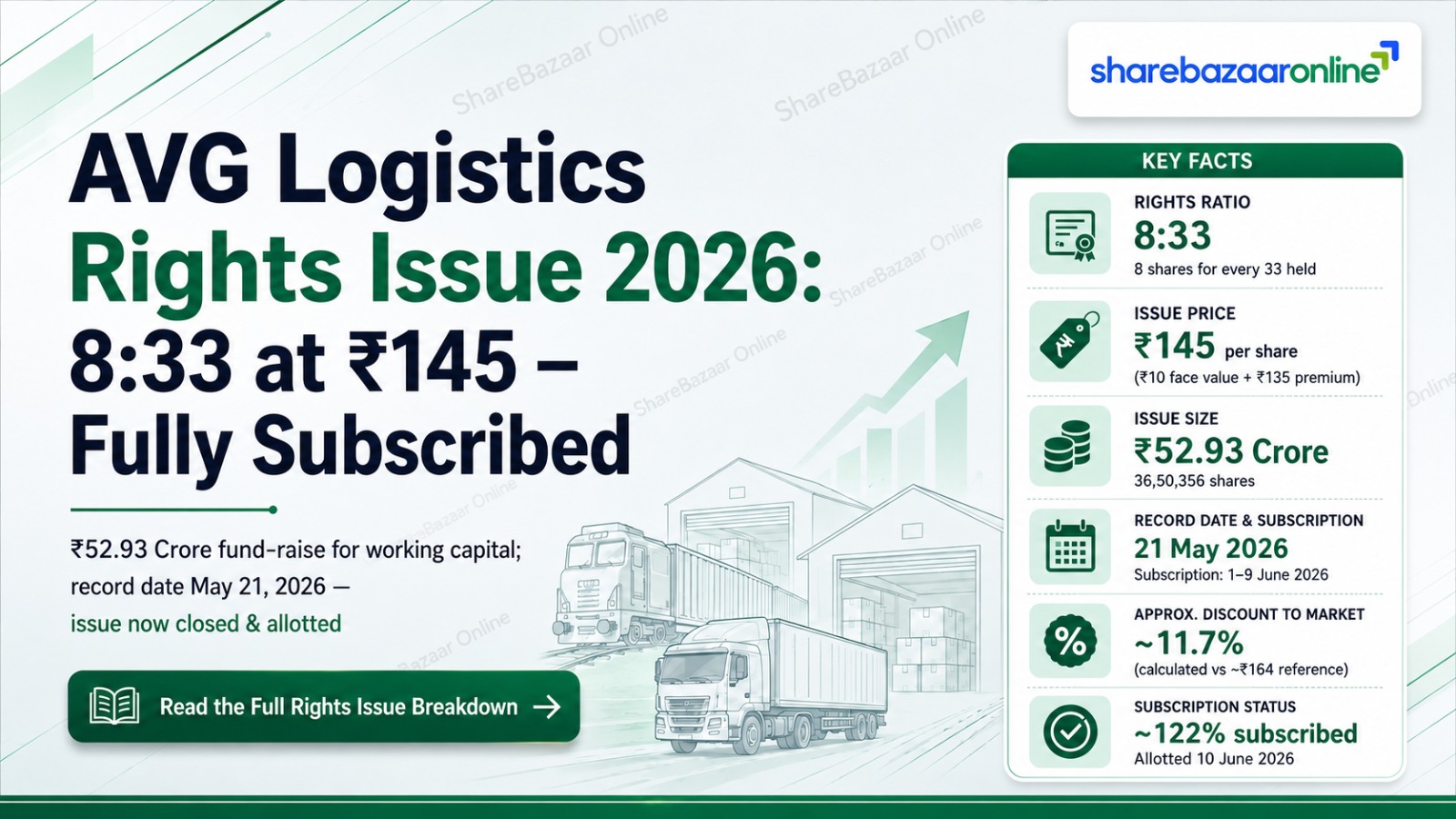
1. Right Issue Highlights
| Company | AVG Logistics Limited |
| Exchanges / Scrip | BSE: 543910 | NSE: AVG |
| ISIN | INE680Z01018 |
| Corporate Action | Rights Issue of fully paid-up equity shares |
| Rights Entitlement Ratio | 8:33 (8 rights shares for every 33 shares held) |
| Issue Price | Rs 145 per share (Face value Rs 10 + Premium Rs 135) |
| Shares Offered | 36,50,356 equity shares |
| Total Issue Size | Up to Rs 52.93 crore (Rs 5,293.02 lakh) |
| Reference Market Price | Approx. Rs 164.14 (as of 01-May-2026; calculated reference, not company-stated) |
| Approx. Discount | Around 11.7% (calculated vs reference price) |
| Record Date | Thursday, 21-May-2026 |
| Last Cum-Rights Day | 20-May-2026 |
| Issue Open / Close | 01-Jun-2026 to 09-Jun-2026 |
| Registrar | MUFG Intime India Private Limited |
| Objects | Working capital (Rs 40 cr) + General corporate purposes (Rs 11.83 cr) |
| Status | Closed & Allotted (approx. 122% subscribed) |
2. About the Company
AVG Logistics Limited, incorporated in 2010 and based in Delhi, is an integrated, multi-modal logistics and supply-chain company. Its network spans road and rail transport, full and part truckload movement, express and parcel delivery, freight forwarding, reverse logistics, cold-chain (reefer) services, and warehousing including bonded and multi-user facilities. The company operates a fleet of over 1,200 owned and hired vehicles and serves sectors such as FMCG, automotive, food and dairy, agro, paint, telecom and heavy engineering. Management's "Vision 2.0" targets roughly Rs 1,250 crore revenue by 2030, driven by high-margin supply-chain services, liquid and industrial logistics, and green fleets (LNG/EV). Sanjay Gupta serves as Managing Director and CEO.
3. What is this Right Issue?
A rights issue lets a listed company raise fresh equity capital from its existing shareholders. Here, AVG Logistics offered eligible shareholders the right to buy 8 new shares for every 33 they held on the record date, at Rs 145 each. Shareholders could apply, partly apply, let the right lapse, or sell (renounce) their rights entitlement to someone else. Participation was optional, not mandatory. The company used the money mainly for working capital.
4. Important Dates
| Board approval (rights issue) | 28-Apr-2026 |
| Terms finalised / intimation | 15-May-2026 |
| Letter of Offer date | 18-May-2026 |
| Last cum-rights day | 20-May-2026 |
| Record Date | 21-May-2026 |
| RE credit to demat | 22-May-2026 |
| RE renunciation trading | 01-Jun to 04-Jun-2026 |
| Issue open / close | 01-Jun to 09-Jun-2026 |
| Allotment | 10-Jun-2026 |
| Listing / trading of new shares | 12-Jun-2026 |
5. Right Issue Timeline
The board first approved the rights issue on April 28, 2026, then finalised the price, ratio and record date around May 15. The Letter of Offer was dated May 18. Shareholders holding stock up to May 20 (cum-rights) qualified; the record date fell on May 21, with entitlements credited to demat accounts on May 22. Entitlements could be traded on the exchange between June 1 and June 4. The subscription window opened June 1 and closed June 9. Allotment followed on June 10, and the new shares began trading on June 12, 2026.
6. Issue Structure
Price & Face Value
Issue price is Rs 145 per share, comprising a face value of Rs 10 and a premium of Rs 135. The premium reflects the amount charged above the nominal value of each share.
Ratio & Issue Size
The 8:33 ratio offered 8 new shares per 33 held. In total, 36,50,356 shares were offered, aggregating up to Rs 52.93 crore.
Capital Increase
Paid-up share count rose from 1,50,57,720 to about 1,87,08,076 on full subscription, taking paid-up equity capital to Rs 18,70,80,760.
Support Arrangements
Systematix Corporate Services acted as underwriter for the unsubscribed public portion (up to Rs 15 crore), and Brickwork Ratings was the monitoring agency for use of proceeds.
7. Objects of the Issue
Working Capital — Rs 40 crore
The bulk of net proceeds funds day-to-day operational needs. Logistics businesses carry significant receivables and running costs, so strengthening working capital supports execution of contracts and network growth.
General Corporate Purposes — Rs 11.83 crore
The balance is set aside for general corporate needs, giving management flexibility. Gross proceeds are up to Rs 52.93 crore; after issue expenses of Rs 1.10 crore, net proceeds are Rs 51.83 crore.
8. Promoter Participation
Before
Promoter and promoter-group holding stood at roughly 51.2% ahead of the issue (as reported for the March 2026 quarter).
After
Post-issue promoter holding is reported near 41.2%. Promoters Sanjay Gupta and Asha Gupta renounced their entitlements to identified investors, while other promoter-group members subscribed. Exact post-allotment split: To be verified from the latest shareholding filing.
Implications
Because promoters renounced part of their rights, an institutional investor (Sixth Sense India Opportunities IV) reportedly rose to about 18.36%. Full promoter take-up usually signals confidence; renunciation to a named investor introduces a new large shareholder and modestly reduces promoter concentration.
9. Financial Performance
For FY26, AVG Logistics reported total income of about Rs 582.48 crore (up ~5% year on year), EBITDA of Rs 112.45 crore (margin ~19.3%), and PAT of Rs 26.17 crore (up ~22.7% from Rs 21.33 crore in FY25). FY25 revenue was Rs 551.52 crore. Screener data cites revenue of around Rs 563 crore and profit near Rs 27 crore, with a flagged low interest-coverage ratio. Detailed five-year figures for book value, ROE, ROCE, debt-equity, working capital cycle and cash flows: To be verified from the annual report / Letter of Offer.
10. Financial Analysis
The FY26 profile shows revenue growth in mid-single digits paired with faster earnings growth, indicating operating leverage as EBITDA margin expanded by roughly 155 basis points. That said, an asset-heavy, fleet-and-warehouse model typically carries meaningful depreciation and interest costs, and the data source flags a low interest-coverage ratio — a signal to watch how comfortably operating profit covers finance charges. The rights issue's working-capital focus fits a business where receivables and running costs scale with contracts. Equity funding (versus more debt) can support the balance sheet, but it also dilutes existing holders. Overall: steady top line, improving margins, and a leverage-sensitivity worth monitoring.
11. Balance Sheet Analysis
The rights issue adds up to Rs 52.93 crore of equity, lifting paid-up capital to Rs 18.71 crore across ~1.87 crore shares. Fresh equity can strengthen net worth and fund working capital without adding fresh debt. Detailed balance-sheet lines — borrowings, reported net worth, fixed assets and leverage ratios: To be verified from the audited financials / Letter of Offer.
12. Cash Flow Analysis
Logistics operations are working-capital intensive, so operating cash flow can swing with receivables and contract cycles. The rights proceeds are aimed largely at working capital, which may ease near-term liquidity pressure. Segment-wise operating, investing and financing cash-flow figures for the last five years: To be verified from the company's cash-flow statements.
13. Shareholding Pattern
Before
Promoter holding around 51.2%; public and institutional holders made up the balance.
After
Promoter holding reported near 41.2% following renunciation; a named institutional investor rose to ~18.36%. Precise category-wise split: To be verified from the June 2026 shareholding pattern.
Impact
Total shares increased by about 24%, so holders who did not subscribe saw their percentage stake diluted. The entry of a large institutional holder changes the ownership mix and can influence float and future governance dynamics.
14. Industry Analysis
Size & Growth
India's logistics sector is large and expanding, aided by infrastructure spending, multimodal corridors, GST-led consolidation and e-commerce demand. Multimodal and warehousing niches are growing structurally.
Competition & Threats
The market is fragmented and competitive, with larger listed peers such as Delhivery, Blue Dart and CONCOR. Fuel costs, pricing pressure and capital intensity are ongoing threats.
Opportunities
Rail-based freight, cold-chain, bonded warehousing, liquid/industrial logistics and green fleets (LNG/EV) offer higher-margin, scalable avenues — areas AVG has publicly prioritised.
15. Competitive Position
AVG Logistics positions itself as an integrated, multimodal provider spanning road, rail, warehousing and cold-chain, serving diversified sectors. Its scale is smaller than marquee peers, but a diversified client base, rail contracts, and a stated push into higher-margin liquid and industrial logistics support differentiation. Its relative advantage rests on execution across modes and end-to-end supply-chain solutions rather than size alone.
16. Growth Drivers
Multimodal and rail expansion, plus higher-margin liquid and industrial logistics targeted under "Vision 2.0" (Rs 1,250 crore revenue goal by 2030).
New long-term contracts (for example, an FMCG contract worth ~Rs 35 crore a year), a JV in LNG, and green-fleet initiatives (LNG/EV) that can aid margins and sustainability positioning.
17. Risk Factors
Leverage / Interest Coverage
A data source flags a low interest-coverage ratio, meaning operating profit provides a thinner cushion over finance costs.
Promoter Pledging
Reports cite a high share of promoter holding pledged (~66.7% as of March 2026). Pledging can amplify risk during price stress. To be verified from the latest filing.
Equity Dilution
A ~24% rise in shares dilutes non-participating holders and can pressure per-share metrics.
Sector & Execution
Fuel-price swings, competitive pricing, capital intensity and dependence on timely contract execution are inherent to logistics.
Share-Price Volatility & Management Change
The stock has been volatile (52-week range roughly Rs 113 to Rs 340, ~30% down over a year), and a CFO change occurred in late 2025 — points investors typically monitor.
18. Opportunities
Fresh capital can support working-capital-heavy growth in rail freight, cold-chain and warehousing, and fund the shift toward higher-margin liquid and industrial logistics. Green-fleet adoption and multimodal corridors align with structural industry tailwinds, and new institutional ownership may broaden the shareholder base.
19. Advantages (Pros)
Discounted Entry (If Applicable)
At Rs 145 versus a ~Rs 164 reference, the issue price sat below market. What it means: subscribing holders could add shares below the recent traded price. Why it matters: it lowers average cost for participants. Who benefits: eligible existing shareholders. When it may not apply: if the market price falls to or below Rs 145, the discount disappears.
Maintain / Increase Ownership
What it means: subscribing avoids dilution of one's percentage stake. Why it matters: it preserves proportional ownership and voting weight. Who benefits: holders who apply fully. When it may not apply: if a holder does not subscribe or renounce, the benefit is lost.
Capital for Growth & Balance-Sheet Strength
What it means: equity funds working capital without new debt. Why it matters: it can improve financial flexibility in a capital-intensive sector. Who benefits: the company and, indirectly, long-term holders. When it may not apply: if funds are deployed inefficiently.
Potential Long-Term Value
What it means: capital may support future earnings from higher-margin services. Why it matters: successful execution could aid long-term value creation. Who benefits: patient shareholders. When it may not apply: if execution or industry conditions disappoint.
20. Disadvantages (Cons)
Equity Dilution & EPS Pressure
The risk: a ~24% larger share count spreads earnings across more shares. Effect on holders: non-participants see their stake and potential EPS diluted. How to evaluate: compare incremental earnings from deployed capital against the added shares.
Capital-Loss & Volatility Risk
The risk: additional capital committed can lose value if the share price falls below Rs 145. Effect on holders: participants bear market risk on new shares. How to evaluate: weigh conviction, valuation and personal risk tolerance.
Execution & Utilisation Risk
The risk: returns depend on effective fund use; poor deployment lowers future returns. Effect on holders: value creation may lag expectations. How to evaluate: track monitoring-agency reports and subsequent results.
Leverage, Pledging & Opportunity Cost
The risk: low interest coverage and high promoter pledging raise financial sensitivity; committing funds here has an opportunity cost. Effect on holders: heightened downside in stress scenarios. How to evaluate: assess coverage trends, pledge levels and alternative uses of capital.
21. Should Existing Shareholders Apply?
This is an educational framework, not advice, and the issue has in any case already closed. Shareholders evaluating a rights issue like this typically weigh several factors: valuation (the Rs 145 price versus the traded price and earnings multiples), company fundamentals (revenue growth, margin trend and the flagged low interest coverage), the intended use of funds (here, mostly working capital), financial position (leverage and promoter pledging), industry outlook (structural logistics growth against competitive and fuel-cost pressures), and their own goals, time horizon and risk appetite. Some also consider whether to subscribe, renounce, or let the entitlement lapse. There is no one-size-fits-all answer; reading the Letter of Offer and consulting a SEBI-registered adviser is the prudent path.
22. Investor Insights
The issue's ~122% subscription indicates demand was met, aided by promoter renunciation to a named institutional investor and an underwriting backstop for the public portion. From an institutional lens, the equity raise modestly de-risks working capital while adding dilution; the key follow-through is whether deployment lifts return ratios and whether interest coverage and pledging improve over subsequent quarters. Watch post-issue shareholding, margin trajectory in higher-value segments, and cash-flow conversion.
23. Analyst Perspective
On a neutral, fact-based reading, AVG Logistics used a rights issue — a common, shareholder-first funding route — to shore up working capital in a growing but competitive sector. Positives include improving FY26 margins and a diversified, multimodal model; watch-items include low interest coverage, high promoter pledging and share-price volatility. This is an observation of the facts, not a recommendation.
24. Conclusion
AVG Logistics Limited's 2026 rights issue offered eligible shareholders 8 shares for every 33 held at Rs 145 each, raising up to Rs 52.93 crore primarily for working capital and general corporate purposes. With a record date of May 21, 2026, the issue opened on June 1, closed on June 9, was allotted on June 10 at about 122% subscription, and the new shares listed on June 12. The company brings a diversified, multimodal logistics model with improving FY26 profitability and ambitious growth targets, balanced against leverage sensitivity, high promoter pledging, dilution and sector competition. Because the issue is now closed, this page serves as a complete reference on its structure, timeline, financial context and trade-offs. As always, the material is educational only; investors should rely on the Letter of Offer and official filings, and seek professional advice tailored to their circumstances before acting on any corporate action.
Frequently Asked Questions (FAQ)
What is a rights issue?
Who was eligible for the AVG Logistics rights issue?
What is the record date and why does it matter?
What is the ex-rights date?
What was the rights entitlement ratio?
Could rights entitlements be traded?
What is renunciation?
What was the issue price?
How is a rights issue taxed?
What are the benefits of a rights issue?
What are the risks of a rights issue?
What is equity dilution here?
How could investors apply?
When were the shares credited and allotted?
How does the refund process work?
When did the new shares list?
Did the promoters participate?
How can a rights issue affect the share price?
What should retail investors keep in mind?
What happened to existing shareholders who did nothing?
What was the money used for?
Where can investors verify these details?
Disclaimer: This content is for educational and informational purposes only and is not investment advice or a recommendation to buy, sell, subscribe to, or renounce any security. Figures are compiled from exchange filings and reputable data sources; derived figures (such as the discount and ex-date) are calculated, not company-stated, and may vary. Investments in securities are subject to market risk. Please read the Letter of Offer and consult a SEBI-registered investment adviser before acting. Last updated: 17-Aug-2026.