
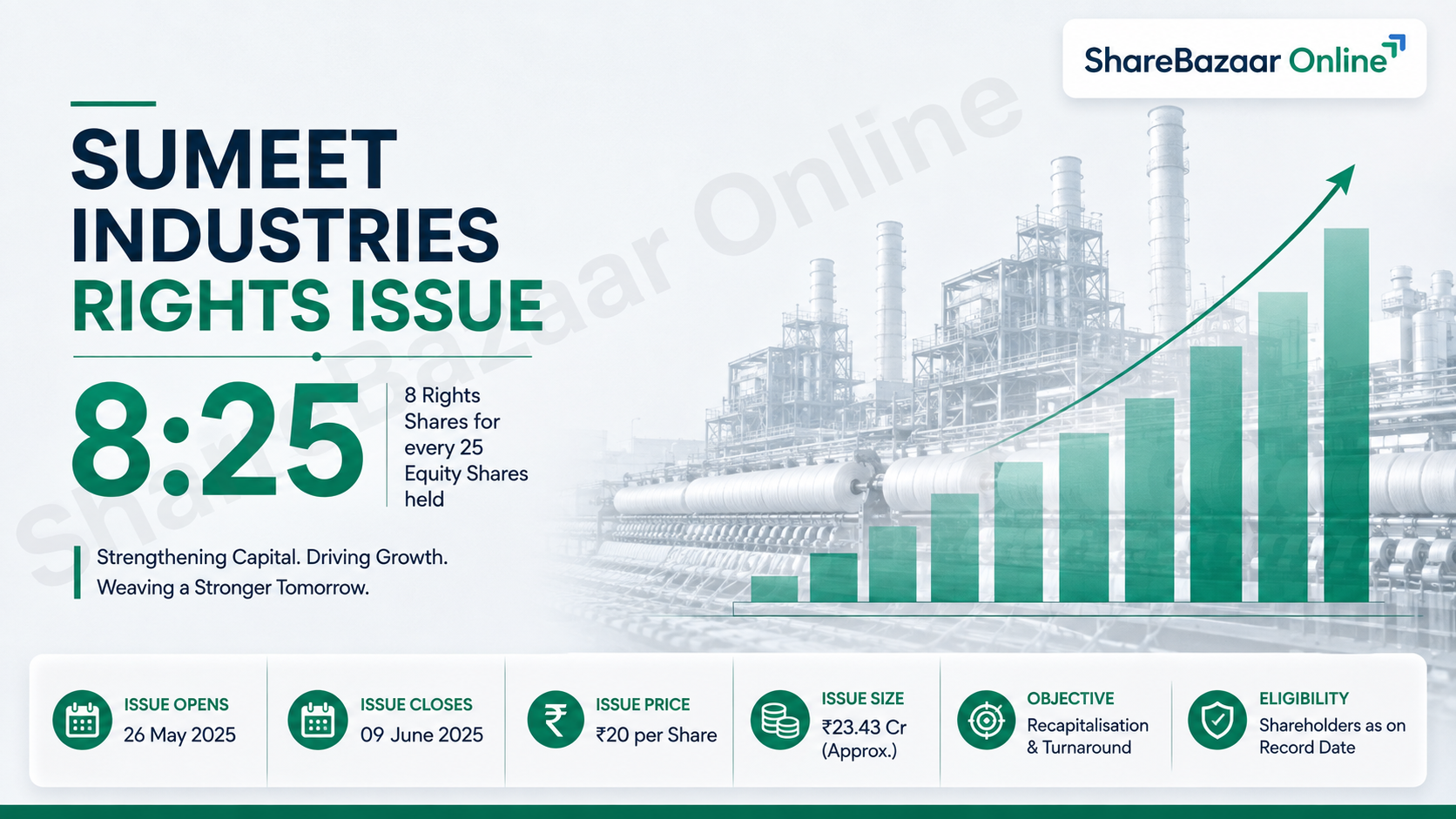
1. Right Issue Highlights
A quick, verified snapshot of the Sumeet Industries rights issue. This corporate action is complete — the rights shares were allotted and listed on 22 July 2026.
| Company | Sumeet Industries Limited |
|---|---|
| Exchanges / Codes | BSE: 514211 | NSE: SUMEETINDS |
| ISIN | INE235C01036 |
| Issue Type | Rights Issue (fully paid, cash) |
| Rights Price | Rs. 11.86 per share (Face Value Rs. 2 + Premium Rs. 9.86) |
| Entitlement Ratio | 8:25 (8 rights shares for every 25 shares held) |
| Issue Size | ~Rs. 199.75 crore |
| Shares Offered | 16,84,24,218 |
| Shares Allotted | 16,84,24,217 |
| Record Date | 12 June 2026 |
| Issue Open / Close | 22 June 2026 / 20 July 2026 |
| Listing Date | 22 July 2026 (BSE & NSE) |
| Registrar | Bigshare Services Private Limited |
| Lead Manager | Not Disclosed by the Company (confirm from Letter of Offer) |
2. About the Company
Incorporated in 1988 and based in Surat, Gujarat, Sumeet Industries is an integrated polyester yarn maker producing PET chips, POY, FDY, PTY and recycled yarn across polymerisation, spinning, texturising and recycling lines. It serves India's textile and apparel value chain. After financial distress, the company was revived through an NCLT-approved resolution plan and acquired by the Eagle Group in 2024. It re-listed in June 2025 and now operates under new ownership, focusing on backward integration, capacity utilisation and turnaround-led growth.
3. What is this Right Issue?
A rights issue lets a company raise fresh capital by offering new shares to existing shareholders in a fixed proportion, usually below the market price. Here, Sumeet Industries offered 8 rights shares for every 25 held on the record date, at Rs. 11.86 each. Shareholders could apply, sell their rights entitlement, or let it lapse. The company has already completed the issue and allotted the shares, using the proceeds to strengthen its balance sheet and fund its post-revival growth plan.
4. Important Dates
| Event | Date |
|---|---|
| Letter of Offer | 08 June 2026 |
| Record Date / Ex-Date | 12 June 2026 |
| RE Credit to Demat | ~16 June 2026 |
| Issue Opens | 22 June 2026 |
| Last Date for Market Renunciation | ~15 July 2026 |
| Issue Closes | 20 July 2026 |
| Allotment / Credit / Listing | 21–22 July 2026 |
Off-market renunciation last date: Not separately disclosed in the allotment filing — verify from the Letter of Offer.
5. Right Issue Timeline
The record date (12 June) fixed eligibility. Rights entitlements were then credited to demat accounts, tradable during the renunciation window. The issue opened on 22 June and closed on 20 July 2026. The board approved the allotment, shares were credited, and listing followed on 22 July 2026 on both exchanges. Each step is standard for a SEBI-governed rights issue.
6. Issue Structure
Price & Premium: Rs. 11.86 per share, comprising a Rs. 2 face value and a Rs. 9.86 premium. (The exchange filing's phrase "at par" appears to be boilerplate; the shares were issued at a premium.)
Ratio: 8:25 — eight rights shares for every twenty-five held.
Issue Size: ~Rs. 199.75 crore via 16,84,24,218 shares offered (16,84,24,217 allotted).
Capital Increase: Paid-up capital rose from Rs. 105.27 crore (52,63,25,680 shares) to Rs. 138.95 crore (69,47,49,897 shares).
7. Objects of the Issue
Working Capital: Fund day-to-day operations and support higher capacity utilisation post-revival.
Nakoda Asset Integration: Absorb acquired assets into the polyester operations to expand scale.
Debt Repayment: Reduce borrowings (reported at ~Rs. 23 crore) to lower interest burden.
Captive Solar Plant: A 6.5 MW captive solar facility to cut power costs and improve margins. General corporate purposes may also apply — refer to the Letter of Offer.
8. Promoter Participation
Before: Promoter (Eagle Group) holding stood at about 89.83% (as of March 2026). After: The issue was near-fully subscribed; the exact post-issue promoter stake depends on subscription and renunciation and is marked Not Disclosed by the Company here — verify against the updated shareholding pattern. Implications: Strong promoter backing signals commitment, but a very high promoter holding also limits public float and liquidity.
9. Financial Performance
FY26 revenue was ~Rs. 1,050.42 crore, up ~4.7% from ~Rs. 1,003.37 crore in FY25. FY26 net profit was ~Rs. 27.33 crore versus ~Rs. 170.26 crore in FY25. The sharp year-on-year drop largely reflects the absence of one-time restructuring gains booked in FY25, not an operational collapse. A clean five-year series for margins, EPS, book value, ROE, ROCE, debt-equity, interest coverage and working capital is limited by the insolvency period and is Not Disclosed by the Company on a comparable basis.
10. Financial Analysis
From an institutional lens, FY26 marks the first "normalised" year after revival: top-line growth is modest but the operating base is being rebuilt. Reported valuation ratios (P/E in the ~50–66 range, P/B roughly 4.7–9.7 across data sources) look elevated, but they are distorted by the recent capital restructuring and the low, restructuring-inflated FY25 base. Investors should weigh headline profit less than the trajectory of operating margins, capacity utilisation, debt reduction and the payback from the solar and Nakoda initiatives. Comparability with pre-insolvency years is weak and should be treated cautiously.
11. Balance Sheet Analysis
The resolution plan and capital reduction reset the balance sheet, cutting legacy liabilities and re-basing equity. The rights issue adds ~Rs. 199.75 crore of fresh equity, part of which repays debt — together improving net worth and lowering leverage. A detailed, line-item balance sheet for the current structure is Not Disclosed by the Company here and should be read from audited statements.
12. Cash Flow Analysis
Rights proceeds are a financing inflow that supports working capital and capital expenditure (solar, Nakoda integration). The key watch-point is whether operating cash flow turns consistently positive as capacity utilisation improves. Detailed operating, investing and financing cash-flow figures are Not Disclosed by the Company here and should be verified from the audited cash-flow statement.
13. Shareholding Pattern
Before: Promoter ~89.83%, public ~10.17% (March 2026). After: The share count rose from 52,63,25,680 to 69,47,49,897; the exact post-issue split is Not Disclosed by the Company here and should be checked against exchange data. Impact: If promoters subscribed pro-rata, the concentration stays high; either way, public float remains thin, which can affect liquidity and price discovery.
14. Industry Analysis
India's man-made fibre and polyester yarn industry is large, growing and central to the textile export ambition, with Surat a key hub. Growth is supported by rising synthetic-fibre demand, but the sector is competitive and fragmented, sensitive to crude-linked raw material (PTA/MEG) prices, cheap imports and power costs. Opportunities lie in integration and value-added yarns; threats include price volatility and margin pressure.
15. Competitive Position
Sumeet's edge lies in backward-integrated operations (chips-to-yarn), sizeable installed capacity and a recycling line, which can support cost control. However, it competes with larger, better-capitalised polyester players. Its competitive standing now hinges on execution of the revival plan, utilisation ramp-up and the cost benefits from captive power.
16. Growth Drivers
Key drivers include integration of the acquired Nakoda assets for scale, lower power costs from the 6.5 MW captive solar plant, debt reduction easing interest costs, improving capacity utilisation, and a cleaner post-CIRP balance sheet. New promoter ownership and fresh equity provide the capital to pursue these levers.
17. Risk Factors
Turnaround execution: Revival plans can slip; benefits from integration and solar may take time.
Raw material volatility: PTA/MEG and crude-linked input prices can squeeze margins.
Thin public float: Very high promoter holding limits liquidity and can amplify price swings.
Valuation risk: Elevated ratios leave little room for disappointment.
Dilution: The larger share count spreads earnings across more shares.
Sector & regulatory: Cheap imports, competition and compliance requirements persist.
18. Opportunities
A recapitalised balance sheet, growing synthetic-fibre demand, value-added yarn potential, cost savings from captive solar, and scale from Nakoda integration together create a runway for recovery — if the company executes and industry conditions stay supportive.
19. Advantages (Pros)
Discounted entry: The Rs. 11.86 price sat well below the ~Rs. 23 market price near the record date — a benefit to eligible holders who applied. It does not apply to those who did not hold on the record date.
Ownership top-up & balance-sheet strength: Existing holders could raise their stake; the fresh equity strengthens net worth. Matters most for long-term holders; less relevant to short-term traders.
Debt reduction & expansion capital: Repaying borrowings and funding solar/Nakoda can lift margins and scale — benefiting shareholders if execution succeeds. The advantage fades if funds are deployed slowly or poorly.
Improved financial flexibility: Lower leverage supports future earnings potential. This benefits the company and equity holders, but not if industry conditions deteriorate.
20. Disadvantages (Cons)
Equity dilution & EPS pressure: The share count rose ~32%; shareholders who did not apply saw their proportional stake fall, and per-share earnings are spread thinner. Evaluate against how effectively the capital is used.
Capital-loss & execution risk: Turnaround stories can disappoint; applying meant committing more money to a still-recovering business. Assess your risk tolerance and conviction in the plan.
Liquidity & supply: A thin float plus more shares can increase volatility and weigh on price discovery. Consider how easily you can enter or exit.
Valuation & opportunity cost: Elevated ratios and sector/regulatory risks mean returns may lag if funds underperform. Weigh against alternative uses of the same capital.
21. Should Existing Shareholders Apply?
This is an educational discussion, not advice — and the issue is already closed. Shareholders weighing such decisions typically consider valuation relative to peers, the credibility and pace of the turnaround, how proceeds are used (debt cut, expansion), the financial position after restructuring, the polyester industry outlook, and their own goals, horizon and risk appetite. A deeply discounted price can be attractive but does not, on its own, make an investment sound. Verifying fundamentals against official filings and consulting a SEBI-registered adviser are prudent steps.
22. Investor Insights
The core story is a recapitalisation, not a growth blowout: fresh equity resets leverage and funds efficiency projects. The signal to track is operating performance — margin trend, utilisation and free cash flow — rather than headline profit distorted by restructuring accounting. High promoter ownership aligns incentives but limits float. This remains a higher-risk, turnaround-stage situation.
23. Analyst Perspective
Neutrally viewed, the rights issue improves capital structure and gives the revived company resources to execute. The offsets are elevated valuation, thin liquidity and unproven post-CIRP earnings durability. The outcome will depend on execution over the next several quarters. This is fact-based commentary, not a recommendation.
24. Conclusion
Sumeet Industries' 2026 rights issue is a milestone in a broader revival. Having emerged from insolvency through an NCLT-approved resolution plan and Eagle Group ownership, the Surat-based polyester maker raised ~Rs. 199.75 crore by allotting 16,84,24,217 shares at Rs. 11.86 in an 8:25 ratio, lifting paid-up capital to Rs. 138.95 crore. The proceeds target working capital, Nakoda integration, debt repayment and captive solar power — all aimed at stronger, more efficient operations. For investors, the appeal of a discounted, recapitalised turnaround is balanced by dilution, elevated valuation, thin float and execution risk. The prudent path is to track operating results over coming quarters, verify every figure against BSE, NSE and the company's filings, and align any decision with personal objectives and professional advice. This article is educational and does not recommend buying, selling, subscribing or renouncing.