
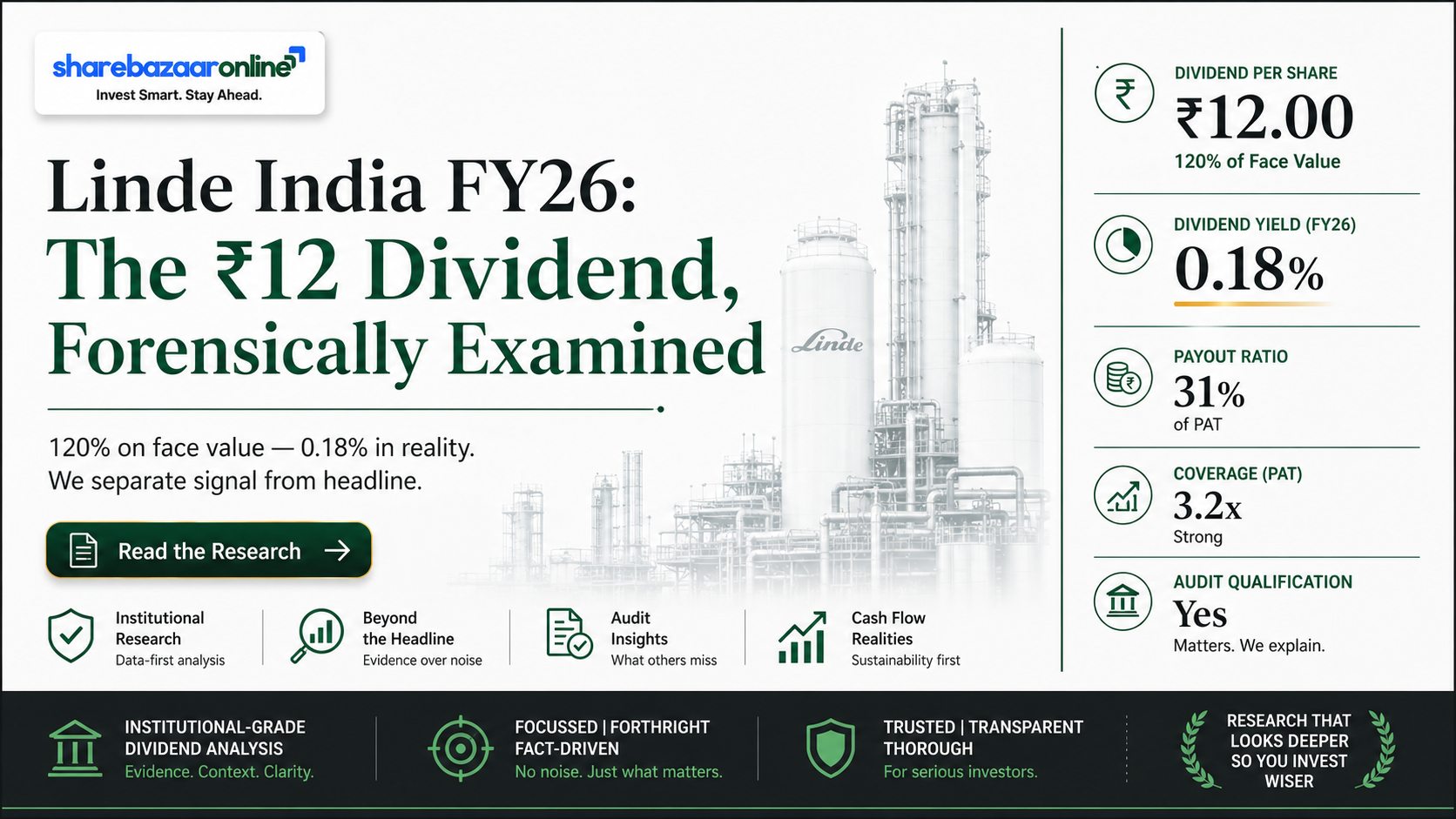
Dividend Snapshot
Latest market price ~₹6,820 (NSE/BSE, 12 Aug 2026, external market data). Yield and payout figures are computed by ShareBazaar Online; total dividend outflow = ₹12 × 8,52,84,223 shares.
Dividend Announcement Summary
At its Board meeting held on 30 May 2026, the Board of Directors of Linde India Limited recommended a total dividend of 120% (₹12 per equity share), inclusive of a special dividend of 80% (₹8 per equity share), on 8,52,84,223 fully paid-up equity shares of ₹10 each for the year ended 31 March 2026. The recommendation is subject to shareholder approval at the 90th Annual General Meeting.
The same Board meeting approved the audited standalone and consolidated financial results for FY2025-26. Investors should note that the statutory auditors, Price Waterhouse & Co Chartered Accountants LLP, issued a qualified (modified) opinion on both the standalone and consolidated results — a material governance point analysed later in this report.
Key Dates Timeline
| Event | Date | Source / Note |
|---|---|---|
| Board Meeting / Announcement | 30 May 2026 | Company filing |
| Ex-Dividend Date | 6 August 2026 | NSE/BSE corporate action (external) |
| Record Date / Book Closure begins | 7 August 2026 | Book closure 7–13 Aug (filing) |
| Book Closure ends | 13 August 2026 | Company filing (both days inclusive) |
| 90th Annual General Meeting | 13 August 2026 | Company filing |
| Dividend Payment Date | Not Disclosed by Company | Payable after AGM approval |
The company did not specify a discrete record date; the book-closure window of 7–13 August 2026 governs eligibility. The exact payment date is not disclosed in the filing; under the Companies Act, 2013, dividend must be paid within 30 days of declaration (i.e., within ~30 days of the 13 August 2026 AGM approval).
Dividend Yield Analysis
Yield Reality Check
The "120% dividend" is a percentage of the ₹10 face value, not of the market price. On a share trading near ₹6,820, the real cash yield is roughly 0.18%. Strip out the one-time special dividend and the recurring yield collapses to about 0.06%. Linde India is a capital-appreciation stock (5-year price CAGR above 30%), not a high-yield income stock.
The high face-value percentage is arithmetically real but economically misleading — a classic face-value yield illusion. Announcement-day price (~₹7,300) is an inferred approximation and is Not Independently Verified (NIV).
Dividend History Analysis
| Financial Year | Dividend / Share | % of Face Value |
|---|---|---|
| FY2025-26 (incl. ₹8 special) | ₹12.00 | 120% |
| FY2024-25 | ₹12.00 | 120% |
| FY2023-24 | ₹12.00 | 120% |
| FY2022-23 | ₹12.00 | 120% |
| FY2021-22 | ₹13.50 | 135% |
| FY2020-21 | ₹3.00 | 30% |
| FY2019-20 | ₹10.00 | 100% |
| FY2018-19 | ₹1.50 | 15% |
| FY2017-18 | ₹1.00 | 10% |
| FY2016-17 | ₹0.75 | 7.5% |
Linde India has paid a dividend in 9 of the last 10 years, and the headline total has been flat at ₹12 for four straight years (FY23–FY26). That qualifies it as a Consistent Payer. However, the composition matters: the payout has increasingly leaned on special dividends rather than a rising base dividend. The FY21 dip to ₹3 shows the payout is not rigidly formulaic. Dividend history (declaration amounts and dates) is sourced from public dividend databases; face-value percentages are computed.
Financial Performance Analysis
| Consolidated (₹ Crore) | FY2025-26 | FY2024-25 | Change |
|---|---|---|---|
| Revenue from Operations | 2,530.64 | 2,485.38 | +1.82% |
| EBITDA (computed) | ~909.1 | ~765.1 | +18.8% |
| Profit Before Tax | 733.48 | 613.50 | +19.6% |
| Net Profit (PAT) | 548.97 | 454.85 | +20.7% |
| EPS (₹) | 64.37 | 53.33 | +20.7% |
Operating Leverage — The Number Behind the Number
Reported PAT jumped +20.7%, but revenue grew only +1.82%. That gap is not driven by operations. Two items flatter FY26 profit: (1) a one-time ₹90 crore expense reversal (management reversed related liabilities per Note iv), and (2) share of joint-venture profit that surged from ₹7.03 crore to ₹55.49 crore. Adjust for the ₹90 crore reversal and the underlying pre-JV profit actually fell about 3%. Within the top line, the Project Engineering segment’s revenue dropped roughly 11% to ~₹980.6 crore, while the core Gases segment grew ~4.3%.
Standalone PAT was ₹550.87 crore (EPS ₹64.59). EBITDA is computed by ShareBazaar Online (PBT less other income and JV share, plus finance cost and depreciation); adjusting FY26 EBITDA for the ₹90 crore reversal gives ~₹819 crore (margin ~32.4% vs 30.8% in FY25).
Cash Flow Analysis
Where Is This Dividend Coming From?
Cash conversion is genuinely strong — OCF of ₹785 crore is 1.43x reported profit. But a heavy capex year (₹766 crore) left free cash flow of just ₹19.3 crore, well below the ₹102.3 crore dividend. In other words, FCF does not cover this dividend (0.19x). The payout is being funded from operating cash flow, existing reserves, and ₹49 crore of dividend income received from joint ventures — not from current-year free cash flow. Overall cash fell ₹34.9 crore during the year.
Reported profit is an accounting opinion; cash is fact. Here the operating cash is real and high-quality, but the growth capex programme means the special dividend leans on the balance sheet rather than on surplus free cash.
Balance Sheet Strength
Linde India is essentially debt-free / net-cash (the only debt-like items are lease liabilities of ₹78.9 crore against ₹112 crore of cash). Returns are healthy for a capital-intensive utility-like business. At a market price near ₹6,820, the stock trades at roughly 13.6x book value and ~106x earnings.
Dividend Sustainability Analysis
| Coverage Test | Metric | Rating |
|---|---|---|
| Earnings Coverage | EPS/DPS 5.36x; payout ~18.6% | PASS |
| Operating Cash Flow Coverage | OCF/Div ~7.7x | PASS |
| Free Cash Flow Coverage | FCF/Div 0.19x | FAIL |
| Cash / Liquidity | Cash/Div 1.10x; net cash | AMBER |
Overall Verdict: Moderately Sustainable
The dividend is comfortably covered by earnings and operating cash flow, and the balance sheet carries no conventional debt. The weakness is that in a heavy-capex year, free cash flow does not cover the payout, and the cash cushion over the dividend is thin. The recurring ₹4 final dividend is very safe; the ₹8 special component is discretionary and should not be modelled as a permanent, repeating cash flow.
Peer Comparison
| Company | Dividend Yield | Payout Ratio | ROCE (pre-tax) | Debt Profile |
|---|---|---|---|---|
| Linde India | ~0.18% | ~18.6% | ~15.5% | Net cash |
| Ellenbarrie Industrial Gases | — | — | — | — |
| Linde plc (global parent) | ~1.3% | ~75% | — | — |
India has very few listed pure-play industrial-gas companies, which limits a clean domestic peer set. Blank cells are left empty rather than populated with unverified figures. Note the structural contrast: the global parent, Linde plc, yields far more (~1.3%) on a ~75% payout, whereas the Indian arm retains most earnings to fund heavy capacity expansion. Peer yield/payout values are indicative and Not Independently Verified.
Promoter Impact Analysis
Who Benefits Most?
With a 75% promoter stake, roughly three-quarters of the ₹102.3 crore outflow — about ₹76.8 crore — flows to the foreign parent. The special dividend is one lawful route by which a cash-rich, debt-free subsidiary returns surplus to its majority owner. Minority shareholders receive the remaining ~₹25.6 crore. This is legal and common for MNC subsidiaries, but it explains why the special component is worth watching in the context of the ongoing related-party-transaction scrutiny.
Shareholding percentages are from the latest public shareholding disclosures (external) and are approximate; promoter/public dividend splits are computed by ShareBazaar Online.
Taxation Analysis
Since FY2020-21, dividends are taxable in the hands of the shareholder at their applicable income-tax slab rate. The company deducts TDS at 10% under Section 194 if total dividend paid to a resident individual exceeds ₹5,000 in a financial year (10% is a provisional deduction, not the final tax). NRIs face a higher TDS rate (typically 20% plus surcharge/cess, subject to treaty relief).
Worked Example — 1,000 Shares @ ₹12, 30% Slab
| Gross dividend (1,000 × ₹12) | ₹12,000 |
| TDS deducted at source @ 10% | ₹1,200 |
| Total tax @ 31.2% (30% + 4% cess) | ₹3,744 |
| Net dividend in hand | ₹8,256 |
| Post-tax effective yield (@ CMP ~₹6,820) | ~0.12% |
The ₹1,200 TDS is adjusted against the final ₹3,744 liability; the shareholder pays the balance ₹2,544 while filing returns. Surcharge may apply at higher income levels. This is illustrative, not tax advice.
Key Risks
- Qualified audit opinion (governance): Both standalone and consolidated FY26 results carry a qualified opinion tied to SEBI’s findings on related-party transactions with Praxair India. The matter is before the Supreme Court and the financial impact is stated as “not determinable.”
- Special-dividend dependence: Two-thirds of this year’s payout is a one-time special dividend; the recurring base dividend is only ₹4. Investors buying for “yield” may be disappointed if the special is not repeated.
- Earnings quality: FY26 profit was flattered by a ₹90 crore one-time expense reversal and a jump in JV profit share; underlying operating profit was roughly flat-to-down.
- Weak top-line growth: Revenue rose just 1.82%, and the Project Engineering segment’s revenue fell ~11%.
- Extreme valuation: A P/E near 106x and P/B near 13.6x leave little margin of safety; any earnings disappointment can hit the price hard.
- Free-cash-flow strain in capex years: Heavy expansion capex can push FCF below the dividend, as it did in FY26.
What To Monitor
- Resolution of the SEBI / Supreme Court RPT matter and any quantified financial impact or removal of the audit qualification.
- Whether the special dividend recurs next year or the base dividend is raised — the signal on capital-return policy.
- Capex-to-OCF ratio and the trajectory of free cash flow as new plants (semiconductor-linked and specialty-gas projects) commission.
- Project Engineering order book and segment revenue recovery after the FY26 decline.
- Gases-segment margins and volume growth, plus contribution from new specialty-gas facilities.
- JV profit contribution and dividend income sustainability from associates/joint ventures.
Conclusion
Linde India’s FY2025-26 dividend of ₹12 per share looks generous as a headline “120%” but delivers a real market yield of only about 0.18% — and roughly two-thirds of it is a discretionary special dividend. The underlying business is high-quality: debt-free, strong cash conversion, healthy returns, and a dominant industrial-gas franchise. Yet the reported 20.7% profit jump is inflated by a ₹90 crore one-time reversal and a JV-profit spike, revenue growth is muted, free cash flow did not cover the dividend this year, and the accounts carry a qualified audit opinion over an unresolved related-party dispute. The positives (payout comfortably covered by earnings and operating cash, net-cash balance sheet) sit alongside real negatives (special-dividend dependence, earnings quality, governance overhang, and a very rich valuation). We present the evidence; the decision is yours.
Frequently Asked Questions
What dividend has Linde India announced for FY2025-26?
What is the Linde India dividend yield?
What is the Linde India dividend record date?
What is the Linde India ex-dividend date?
When will the Linde India dividend be paid?
Who is eligible for the Linde India dividend?
How is the Linde India dividend taxed?
Is the Linde India dividend sustainable?
What is Linde India’s dividend history?
Why did the auditor give a qualified opinion?
How much of the dividend goes to the promoter?
What should investors monitor going forward?
Disclaimer
This article is published by ShareBazaar Online for informational and educational purposes only. It is not investment advice and does not constitute a recommendation to buy, sell, or hold any security. ShareBazaar Online is not a SEBI-registered investment adviser. Dividend approval is subject to the AGM; dates and market prices are drawn from company filings and public sources and may change — readers must independently verify the live market price, ex-date, record date, and payment date before acting. Figures labelled “inferred,” “NIV,” or “Not Disclosed by Company” are not primary-source confirmed. Please consult a qualified financial adviser and tax professional before making any investment decision.