
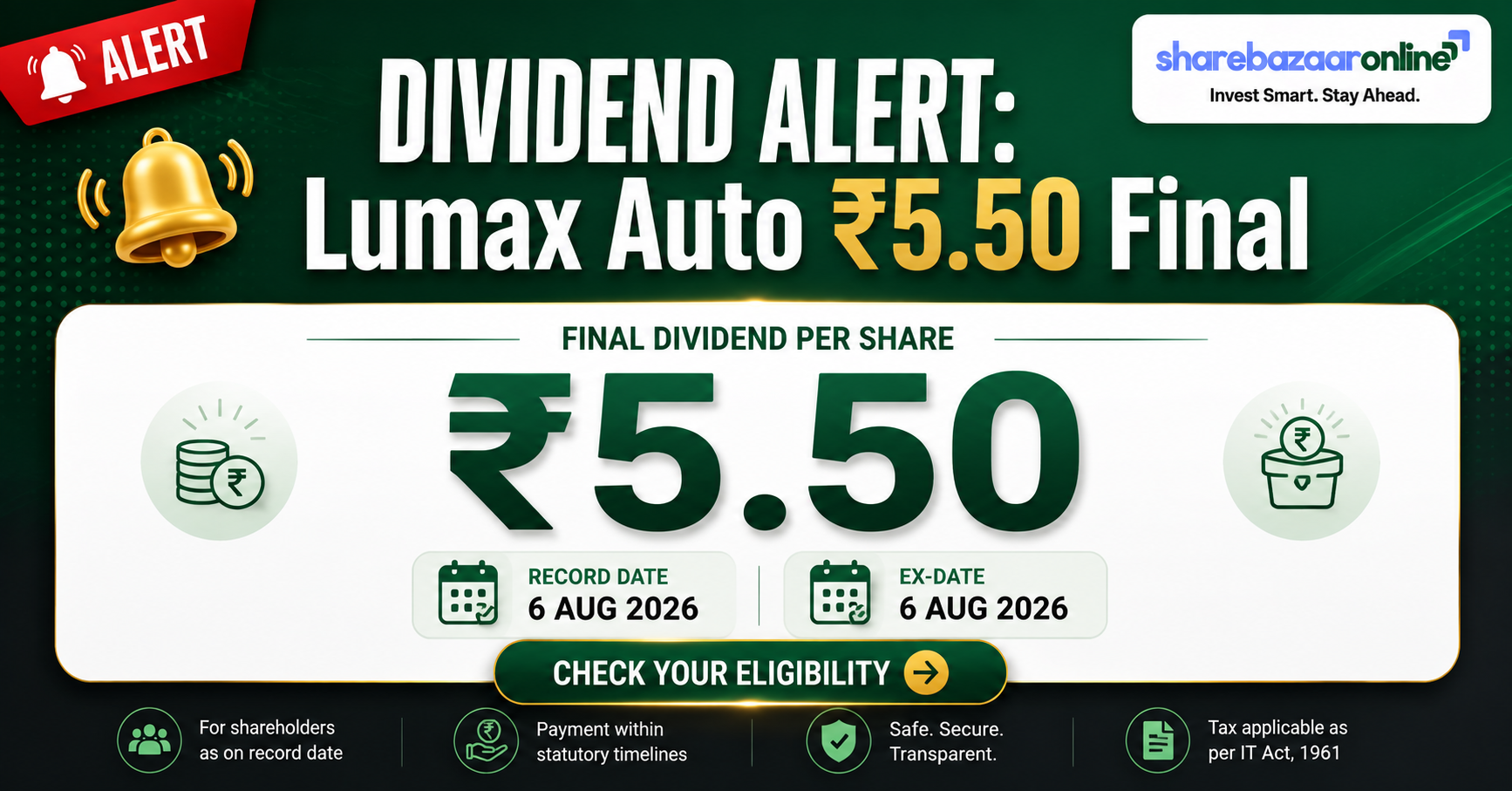
Dividend Snapshot
Dividend Per Share
₹5.50
Face value ₹2 — i.e. a 275% dividend
Dividend Type
Final Dividend
FY2025-26, subject to AGM approval
Dividend Yield (on latest price)
~0.27%
₹5.50 ÷ ~₹2,076 latest market price
Record Date
6 Aug 2026
Ex-date also 6 Aug 2026 (T+1 basis)
The one-line takeaway: A financially strong, cash-generative auto-component maker is paying a well-covered but token dividend. With earnings coverage of 7.4x and free-cash-flow coverage of 5.7x, the ₹5.50 payout is comfortably affordable — but at a yield of roughly 0.27%, LUMAXTECH is a growth/compounding story, not an income stock.
Dividend Announcement Summary
At its board meeting held on Friday, 29 May 2026 (which concluded at 3:35 PM, after market hours), the Board of Directors of Lumax Auto Technologies Limited recommended a final dividend of ₹5.50 per equity share — 275% of the ₹2 face value — for the financial year 2025-26. The dividend is subject to the approval of shareholders at the ensuing Annual General Meeting (AGM), and the company has stated it will be paid within 30 days of approval/declaration.
What the company disclosed
- Final dividend of ₹5.50 per share (275%) for FY2025-26
- Record date fixed at Thursday, 6 August 2026 under Regulation 42
- Cut-off date for AGM voting: 18 August 2026
- 45th AGM originally convened for 24 August 2026 via video conferencing
- Payment window: within 30 days of shareholder approval
What the wire coverage missed
- The ₹5.50 is unchanged for the third consecutive year (FY24, FY25, FY26)
- Consolidated EPS over that period rose from ₹19.1 to ₹40.9
- So the payout ratio has fallen from 29% to 13%
- FY26 profit was flattered by a one-time deferred-tax credit (effective tax just ~17%)
- Gross borrowings jumped ~36% as the group funded acquisitions
Note: The same 29 May 2026 board meeting also approved several corporate actions — the buyout of the residual stake in Lumax FAE Technologies, a proposed 50% stake sale in Lumax Jopp Allied Technologies, and the amalgamation of two wholly-owned subsidiaries (Lumax Ancillary and IAC International Automotive India). Prior-year figures have been restated for these mergers, so year-on-year comparisons use restated numbers.
Key Dates Timeline
| Event | Date | Status |
|---|---|---|
| Board meeting / announcement | Friday, 29 May 2026 | Completed |
| Ex-dividend date | Thursday, 6 Aug 2026 | On T+1 basis (ex = record) |
| Record date | Thursday, 6 Aug 2026 | Confirmed (Reg 42) |
| AGM voting cut-off | Tuesday, 18 Aug 2026 | Confirmed |
| Annual General Meeting | Monday, 24 Aug 2026 | Approval pending (verify date) |
| Dividend payment | Within 30 days of AGM approval | Not disclosed as a fixed date |
Who is eligible? To receive this dividend, you needed to be a registered shareholder as on the record date of 6 August 2026. Because Indian settlement is on a T+1 cycle, the ex-date and record date coincide — shares had to be bought on or before 5 August 2026 to qualify. Since the record date has now passed, eligibility is fixed; the outstanding milestone is AGM approval, after which payment follows within 30 days.
Dividend Yield Analysis
Yield on announcement-day price
0.32%
₹5.50 ÷ ₹1,724.80 (NSE close, 29 May 2026)
Yield on latest price
0.27%
₹5.50 ÷ ~₹2,076 (11 Aug 2026)
The 275% headline vs the real yield
This is the classic face-value illusion. "275% dividend" sounds enormous, but it is simply ₹5.50 expressed against a ₹2 face value. Measured against what an investor actually pays — the market price of roughly ₹2,076 — the yield is a negligible ~0.27%. A ₹1 lakh investment at the current price would fetch about ₹265 in gross dividend for the year.
Yield Reality Check — why the yield keeps shrinking
The low yield is not caused by a weak business or a dividend cut. It is the opposite problem: the share price has re-rated dramatically — up roughly 135% over the past year, including a ~20% single-day jump on 11 August 2026 after strong Q1 FY27 results. When the numerator (₹5.50) is frozen and the denominator (price) balloons, the yield mechanically shrinks. In short, shareholders have been rewarded through capital appreciation, not dividends.
Dividend History Analysis
| Financial Year | Dividend / Share | Dividend % | Consolidated EPS | Payout Ratio* |
|---|---|---|---|---|
| FY2021-22 | ₹3.50 | 175% | ₹10.18 | 34% |
| FY2022-23 | ₹4.50 | 225% | ₹13.63 | 33% |
| FY2023-24 | ₹5.50 | 275% | ₹19.10 | 29% |
| FY2024-25 | ₹5.50 | 275% | ₹26.08 | 21% |
| FY2025-26 | ₹5.50 | 275% | ₹40.91 | 13% |
*Payout ratio on consolidated earnings attributable to owners (source: Screener.in). In the FY2019–FY2021 window the dividend was around ₹3.00 per share (payout 31–43%). All figures are on the post-split ₹2 face value (5:1 split, ex-June 2018).
The story the table tells
Lumax Auto Technologies is a consistent payer — it has paid a dividend every year for over a decade, with no cuts or suspensions, and the absolute rupee dividend rose steadily from around ₹3.00 to ₹5.50 between FY19 and FY24. But the last three years reveal a clear conservative shift: the board has held the dividend flat at ₹5.50 while earnings surged. The result is a payout ratio that has more than halved — from 29% (FY24) to 21% (FY25) to just 13% (FY26). Management is prioritising reinvestment (acquisitions, new plants, deleveraging capacity) over cash distribution. For income seekers this is a negative; for growth investors it signals a company ploughing profits back into expansion.
Financial Performance Analysis
Consolidated Revenue (FY26)
₹4,870 cr
+33.9% YoY (from ₹3,637 cr)
Consolidated Net Profit (FY26)
₹337 cr
+47.2% YoY (EPS ₹40.91, +56.9%)
Operating Profit / EBITDA (FY26)
₹659 cr
+41.7% YoY; OPM 13.5% (vs 12.8%)
Standalone Net Profit (FY26)
₹207 cr
EPS ₹30.35
Operating Leverage — profits grew faster than sales (a good sign)
FY26 shows positive operating leverage: revenue grew 33.9%, EBITDA grew 41.7%, and net profit grew 47.2% — each layer faster than the one below it. Operating margin expanded from 12.8% to 13.5%. This is the healthy opposite of margin compression, and reflects scale benefits and a richer product mix (gear shifters, mechatronics and interior solutions, where the group claims 65%+ market share across passenger-vehicle customers).
Earnings quality flag — the tax line did some heavy lifting
Reported profit growth was flattered by an unusually low effective tax rate of ~17% (versus a normal ~26%). This was driven by a one-time deferred-tax credit of about ₹40 crore, linked to accounting for the Greenfuel/subsidiary scheme. Had FY26 been taxed at a normalised 26%, net profit would have been closer to ₹300 crore rather than ₹337 crore — roughly ₹37 crore lower. Separately, an exceptional charge of ~₹14.5 crore (labour-code provisioning and a subsidiary impairment) reduced pre-tax profit. Underlying growth remains strong, but investors should not extrapolate the 47% headline PAT growth uncritically, since the tax benefit is unlikely to repeat in FY27.
Cash Flow Analysis
Operating Cash Flow (FY26)
₹460 cr
1.36x reported net profit
Free Cash Flow (FY26)
₹214 cr
OCF ₹460 cr minus capex ₹248 cr
Reported profits are opinions; cash is fact
Here the cash confirms the profit. Consolidated operating cash flow of ₹460 crore comfortably exceeds net profit of ₹337 crore (a cash-conversion of ~136%), which is a strong signal of earnings quality — the profit is backed by real cash, not just accruals or receivables build-up. Even after a heavy capex year of ₹248 crore (new plants and capacity), the company generated ₹214 crore of free cash flow.
How is the dividend funded?
The ₹37.5 crore dividend outflow is funded comfortably from current earnings and operating cash flow — not from borrowings or asset sales. Free cash flow covers the dividend 5.7 times over, and operating cash flow covers it more than 12 times. On the cash-flow test, this dividend is unambiguously affordable.
Balance Sheet Strength
Cash + Current Investments
₹334 cr
Covers the dividend ~8.9x
Gross Borrowings (ex-lease)
₹1,001 cr
Up ~36% YoY (incl. leases ₹1,231 cr)
Debt is rising — the one blemish on a strong sheet
The balance sheet is solidly capitalised — net worth (owners') of about ₹1,210 crore, ROE of 26.4% and ROCE of 21.2% — but leverage is climbing. Gross borrowings (excluding leases) stand at ₹1,001 crore, up from ₹902 crore, giving a debt-to-equity of roughly 0.83x. Including lease liabilities, total debt is ~₹1,231 crore. Finance costs rose ~34% to ₹106 crore. The rising debt is being deployed into acquisitions and capacity (Greenfuel, IAC, the FAE stake buyout, a new ₹156 crore Chakan plant), not to fund the dividend — but it is a trend worth watching, since debt is expanding while the dividend is held flat.
A working-capital positive: the company runs a negative working-capital cycle (working-capital days of about −18), meaning suppliers effectively finance part of its operations — a structural cash-flow advantage that supports both capex and dividends.
Dividend Sustainability Analysis
| Sustainability Test | Metric | Verdict |
|---|---|---|
| Earnings coverage | EPS ₹40.91 vs DPS ₹5.50 = 7.4x | Pass |
| Operating cash coverage | OCF ₹460 cr = 12.3x outflow | Pass |
| Free cash flow coverage | FCF ₹214 cr = 5.7x outflow | Pass |
| Liquidity coverage | Cash+investments ₹334 cr = 8.9x | Pass |
| Debt trend | Borrowings +36% YoY | Watch |
Verdict: Sustainable
On every coverage test, the ₹5.50 dividend passes with a wide margin — it consumes only about 13% of earnings and a fraction of the cash the business throws off. Classified as a consistent payer, the dividend looks highly sustainable. The only caveat is a growth-mode balance sheet with rising debt; but with the payout absorbing so little of profits, there is ample headroom. The realistic risk is not that the dividend is cut — it is that it stays frozen and continues to lag earnings.
Peer Comparison
| Company (Auto Components) | Dividend Yield | Payout Ratio | ROE | P/E |
|---|---|---|---|---|
| Lumax Auto Technologies | ~0.27% | 13% | 26.4% | ~42x |
| Uno Minda | ~0.2% | ~14% | 17.7% | ~61x |
| Endurance Technologies | ~0.3% | ~17% | NIV | ~40x |
| Sundram Fasteners | ~1.5% | NIV | NIV | NIV |
| Lumax Industries (group) | ~0.7% | ~23% | NIV | NIV |
NIV = Not Independently Verified (cell left blank rather than filled with unconfirmed data). Yields and payout ratios are approximate and price-dependent; verify at publish. ROE/ROCE for Lumax Auto and Uno Minda sourced from Screener.in.
The auto-components space is uniformly low-yielding — these are growth companies, and almost none is bought for income. Within the peer set, Lumax Auto's ~0.27% yield and 13% payout sit at the low end, while its ROE of 26.4% is the highest in the group. Sundram Fasteners stands out as the relative income name (~1.5% yield). The read-through: Lumax Auto is choosing to compound capital internally at high returns rather than distribute it — a defensible strategy given its ROE, but one that leaves dividend investors underserved.
Promoter Impact Analysis
Promoter holding
55.98%
Stable across the year
Estimated promoter dividend income
~₹21.0 cr
55.98% of the ₹37.5 cr outflow
Of the ₹37.5 crore total dividend, the promoter group — primarily Deepak Jain (18.96%), Anmol Jain (18.95%) and Lumax Finance (17.77%) — will receive an estimated ₹21.0 crore, with the remaining ~₹16.5 crore flowing to public and institutional shareholders. Because the dividend is a flat per-share amount, promoters and minority investors are treated identically per share — there is no structural bias. The alignment cuts both ways: promoters also bear the low yield, which is consistent with a family-run group choosing reinvestment over cash extraction. Institutional interest is notable, with FIIs rebuilding their stake (from ~5.3% in Mar 2025 to ~8.7% by Jun 2026) and DIIs at ~16.5%.
Taxation Analysis
How dividends are taxed in India
Since April 2020, dividends are taxable in the hands of the shareholder at their applicable income-tax slab rate — there is no separate Dividend Distribution Tax. The company deducts TDS at 10% under Section 194, but only if your total dividend from that company in a financial year exceeds ₹10,000 (a threshold raised from ₹5,000 in Budget 2025). This dividend is received in FY2026-27, so it is taxed in that year.
Worked example — retail investor holding 1,000 shares
| Shares held | 1,000 |
| Dividend per share | ₹5.50 |
| Gross dividend | ₹5,500 |
| TDS (below ₹10,000 threshold) | ₹0 |
| Tax at 30% slab + 4% cess | ₹1,716 |
| Net dividend in hand | ₹3,784 |
| Effective post-tax yield (at ~₹2,076) | ~0.18% |
A 30%-slab investor keeps ₹3.78 of every ₹5.50. TDS at 10% would apply only once annual dividend from Lumax Auto crosses ₹10,000 — i.e. a holding above ~1,818 shares. Lower tax slabs retain proportionately more.
Key Risks
- Negligible yield & rich valuation: at ~0.27% yield and roughly 42x earnings / ~11.7x book value, total return depends almost entirely on capital appreciation. Any growth disappointment could trigger a sharp de-rating.
- Rising leverage: gross borrowings up ~36% to ₹1,001 crore and finance costs up ~34% to ₹106 crore, as the group funds acquisitions and capex while holding the dividend flat.
- Earnings-quality distortion: FY26 profit was boosted by a one-time deferred-tax credit (~₹40 crore); the ~17% effective tax rate is unlikely to repeat, so FY27 reported growth will face a higher tax base.
- Auto-sector cyclicality & OEM concentration: revenue is tied to Indian vehicle production (PV, 2W/3W); a demand slowdown at key OEM customers would pressure earnings.
- Acquisition & integration risk: multiple recent deals (Greenfuel, IAC buyout, FAE, subsidiary restructuring) carry execution risk, plus goodwill of ~₹177 crore that could face impairment.
- Minority-interest leakage: ~₹58 crore of consolidated profit belongs to JV partners; the parent's distributable pool depends on cash upstreamed from subsidiaries.
What To Monitor
- Dividend trajectory: will the board finally raise the DPS to keep pace with EPS, or let the payout ratio keep sliding below 13%?
- Debt & interest coverage: the trend in gross borrowings, net debt and finance costs as acquisitions and the new Chakan plant are funded.
- Tax-rate normalisation: FY27 effective tax reverting toward ~26% will compress reported profit growth — watch the underlying, tax-normalised trend.
- Margin durability: whether the 13.5% operating margin holds as new capacity ramps and product mix evolves toward premium mechatronics.
- Standalone cash & upstreaming: the parent's ability to fund dividends from its own operating cash rather than subsidiary distributions.
- Order book & OEM demand: Indian auto-production trends and new-order wins in EV/premiumisation segments (gear shifters, sensors, antennas).
Conclusion
Lumax Auto Technologies' ₹5.50 final dividend is best understood as a token of a growth company, not the reward of an income stock. The positives are real and well-documented: 34% revenue growth, expanding margins, strong operating cash flow of ₹460 crore, a best-in-class 26.4% ROE, and dividend coverage of more than 7x on earnings and nearly 6x on free cash flow — the payout is unquestionably sustainable. The negatives are equally clear: a yield of just ~0.27%, a dividend frozen at ₹5.50 for three years while EPS doubled, a payout ratio that has collapsed to 13%, rising debt, and an FY26 profit line flattered by a non-recurring tax credit. Whether that trade-off — minimal cash today in exchange for high-return reinvestment — suits you depends entirely on whether you are buying LUMAXTECH for income or for growth. We present the evidence; the decision is yours.
Frequently Asked Questions
What dividend has Lumax Auto Technologies announced for 2026?
What is the Lumax Auto Technologies dividend yield?
What is the record date for the Lumax Auto Technologies dividend?
What is the ex-dividend date?
When will the dividend be paid?
Who is eligible to receive this dividend?
How is the Lumax Auto Technologies dividend taxed?
Is the Lumax Auto Technologies dividend sustainable?
What is the Lumax Auto Technologies dividend history?
Why is the dividend so low relative to the profit?
Did a one-time item affect FY26 profit?
What should investors monitor going forward?
Disclaimer
This article is for informational and educational purposes only and does not constitute investment, financial, legal or tax advice, nor any buy, sell or hold recommendation. ShareBazaar Online is not a SEBI-registered investment adviser. Financial figures are drawn from Lumax Auto Technologies' audited FY2025-26 results, exchange filings and third-party sources (including Screener.in) and may contain errors or become outdated; all yield figures are price-dependent and change with the market price. The dividend of ₹5.50 is subject to shareholder approval at the AGM. Please verify all figures independently and consult a SEBI-registered adviser and a qualified tax professional before making any investment decision. Investments in securities are subject to market risks; read all related documents carefully.