
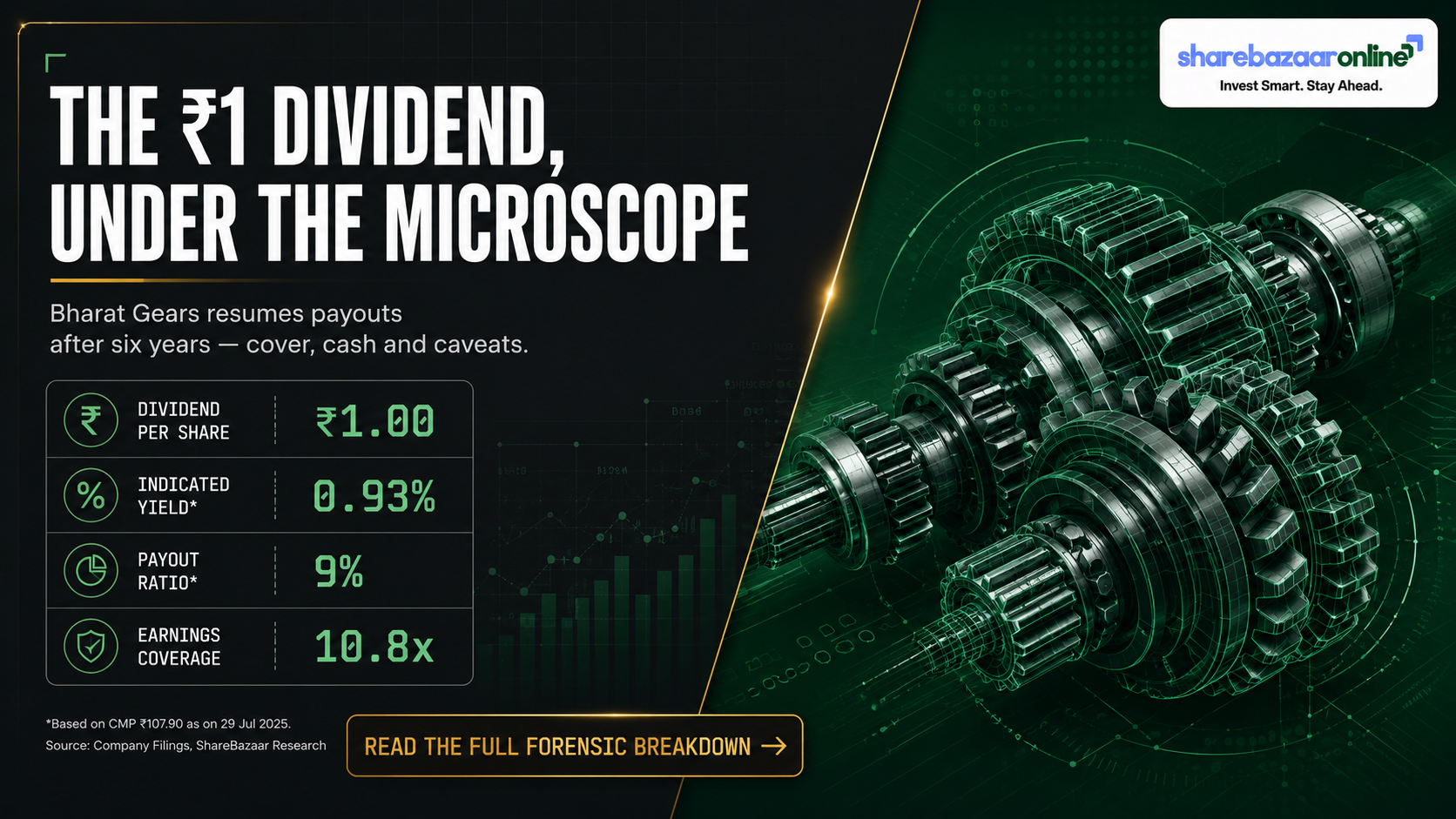
Dividend Snapshot
Dividend Per Share
₹1.00
Final Dividend · 10% of ₹10 face value
Dividend Yield (on CMP ₹108)
0.93%
Yield on 29-May announcement price (₹119.41): 0.84%
Financial Year
FY2025-26
Announced 30 May 2026
Payment Timeline
On or before 30 Sep 2026
Subject to AGM approval
Total Outflow
~₹1.54 Cr
Payout Ratio
9.3%
Earnings Cover
10.8x
Promoter Holding
55.33%
CMP ₹108 as of 10 Aug 2026 (Screener.in). Yield figures are price-dependent and will change with the market price — re-verify against the live quote before acting. Share count of ~1.536 crore triangulated across three methods.
Dividend Announcement Summary
At its board meeting on Saturday, 30 May 2026, the Board of Bharat Gears Limited recommended a final dividend of ₹1.00 per equity share (face value ₹10) for the financial year 2025-26. The company stated the dividend, subject to shareholder approval at the ensuing Annual General Meeting, will be paid on or before 30 September 2026.
The same board meeting carried several leadership and audit decisions that are relevant context for a dividend reader. The Board approved the appointment of Mr. Naresh Kumar Verma as Executive Director – Operations for five years (with effect from 1 June 2026, subject to member approval), appointed Ernst & Young LLP as internal auditors for FY2026-27 and M.K. Kulshrestha & Associates as cost auditors. The Board also decided not to extend the term of Mr. Sameer Kanwar, Joint Managing Director (son of the Chairman & Managing Director), whose tenure ended on 31 May 2026.
Why this matters
This is a dividend resumption, not a routine payout. Bharat Gears last paid a dividend for FY2018-19 (also ₹1 per share, record date around July 2019). It then went six straight years without any dividend (FY2019-20 through FY2024-25) as the business swung through losses and a weak commercial-vehicle and tractor cycle. The ₹1 payout signals the Board’s confidence that FY2025-26’s profit recovery is real — but the amount itself is deliberately conservative.
Key Dates Timeline
| Event | Date | Status |
|---|---|---|
| Board meeting & dividend recommendation | 30 May 2026 | Confirmed (filing) |
| AGM / shareholder approval | Not yet announced | Pending |
| Record date | Not disclosed by company | Awaited |
| Ex-dividend date | Not disclosed by company | Awaited |
| Payment date | On or before 30 Sep 2026 | Statutory outer limit |
The company has not yet notified a record date or ex-date. Both will be fixed by the Board/AGM and published via NSE/BSE corporate-action circulars. Eligibility is decided by the record date, so watch the exchange notices rather than assuming a date. “On or before 30 September 2026” is the outer limit disclosed by the company, not a specific payment date.
Dividend Yield Analysis
The face-value illusion
A “10% dividend” means 10% of the ₹10 face value — that is just ₹1 per share. It is not 10% of your investment. On the market price of ₹108, ₹1 is a yield of only 0.93%. Investors who anchor on the percentage headline routinely overestimate what they will actually receive.
Yield at different prices
- • On CMP ₹108 (10 Aug 2026): 0.93%
- • On announcement price ₹119.41 (29 May 2026): 0.84%
- • On post-announcement price ₹110.98 (1 Jun 2026): 0.90%
Every yield number is only as fresh as the price beneath it — re-check the live quote.
Yield reality check
Bharat Gears’ sub-1% yield is not the product of a falling share price — the stock is up roughly 25% over the past year. It is simply a small, conservative dividend on a recovering small-cap. This is a token “we’re back” distribution, not an income play. For comparison, the top quartile of Indian dividend payers yields above 1%, and Bharat Gears sits below that bar.
Dividend History Analysis
| Financial Year | Dividend / Share | Payout Ratio |
|---|---|---|
| FY2025-26 | ₹1.00 | 9% |
| FY2024-25 | Nil | 0% |
| FY2023-24 | Nil | 0% |
| FY2022-23 | Nil | 0% |
| FY2021-22 | Nil | 0% |
| FY2020-21 | Nil | 0% |
| FY2019-20 | Nil | 0% |
| FY2018-19 | ₹1.00 | 6% |
Payout ratios sourced from Screener.in. Face value ₹10 throughout the period.
Payer classification
Bharat Gears is an irregular / recently-resumed payer, not a consistent one. In the last decade it paid a dividend in exactly two years — FY2018-19 and now FY2025-26. The gap reflects a cyclical auto-component business tied to the commercial-vehicle, tractor and off-highway cycle, punctuated by loss years (FY2019-20, FY2020-21 and FY2023-24).
The pattern to note
Both dividends came after a strong profit year and were kept at ₹1. Management appears to treat the dividend as a signal of a good year rather than a running commitment. A reader should not assume FY2026-27 will automatically carry a dividend — the next payout is likely to depend on whether profitability holds.
Financial Performance Analysis
FY2025-26: a genuine operating recovery
Revenue rose to ₹784 crore in FY2025-26 from ₹648 crore a year earlier, a gain of +21%. Crucially, profit rose far faster than sales — classic positive operating leverage:
- • Operating profit (EBITDA): ₹25 Cr → ₹52 Cr (+108%)
- • Operating margin: 3.9% → 6.6%
- • Net profit: ~₹3.2 Cr → ₹16.5 Cr (EPS ₹2.08 → ₹10.75)
Earnings quality: better than last year
An important nuance: FY2024-25’s thin ₹3 crore profit was flattered by ~₹19 crore of other income (a large one-off booked in the September 2024 quarter). Without it, FY25 would have been a loss year. FY2025-26’s ₹16.5 crore profit relied on only ~₹6 crore of other income — so the latest recovery is far more operational and higher-quality.
The catch: momentum has cooled
The very first quarter after this dividend was declared — Q1 FY2026-27 (Jun 2026) — posted record revenue of ₹215.65 crore but net profit of just ₹0.15 crore. Operating margin slid to 3.77% from 6.37% in the prior quarter. Sales are growing; profitability, for now, is not. This is the single most important caveat to the “recovery” story.
Return ratios
On the back of the FY26 recovery, ROCE improved to ~18% and ROE to ~13.4%. But the three-year averages remain weak — roughly -3% ROE and low single-digit ROCE — because of the FY24 loss. Five-year sales growth is a modest ~9%. The company is climbing out of a trough, not compounding steadily.
Cash Flow Analysis
Reported profit is an opinion; cash is a fact. On the cash test, the ₹1 dividend is comfortably affordable. In FY2025-26 Bharat Gears generated operating cash flow of ~₹29 crore and free cash flow of ~₹19 crore. Against a total dividend outflow of only ~₹1.54 crore, that is roughly 19x operating-cash cover and 12x free-cash cover.
But cash generation fell sharply
Operating cash flow dropped from ~₹49 crore in FY25 to ~₹29 crore in FY26, and cash conversion (OCF ÷ operating profit) fell from ~189% to ~61%. As sales jumped 21%, more cash was tied up in working capital — inventory and receivables. The dividend is small enough that this doesn’t threaten it, but the trend is worth watching.
How the dividend is funded
The payout is funded from current earnings and operating cash — not from borrowings or asset sales. In fact, financing cash flow was negative ~₹31 crore in FY26 as the company repaid debt. The dividend itself will be a modest FY2026-27 cash event once paid.
Balance Sheet Strength
Deleveraging is the real story
Borrowings have fallen steadily: ₹113 Cr (FY24) → ₹80 Cr (FY25) → ₹73 Cr (FY26). Against a net worth of about ₹131 crore and a book value of ₹85.4 per share, leverage is now moderate. Interest costs are also easing (interest fell from ~₹17 Cr to ~₹14 Cr), which is part of why the bottom line recovered.
Dividend is a rounding error on the balance sheet
The ~₹1.54 crore outflow is about 1.2% of net worth and roughly 2% of borrowings. It has no meaningful impact on solvency. The more important balance-sheet question is whether debt reduction continues while working capital is rising.
Standalone basis (Bharat Gears had no material operating subsidiaries during FY2025-26; its only associate, a 29.55% stake in Hexa Energy for captive solar power, was acquired after year-end in June 2026). Exact cash & bank balance is Not Independently Verified from the summary financials; net debt is approximated by gross borrowings of ₹73 Cr.
Dividend Sustainability Analysis
| Coverage Test | Reading | Verdict |
|---|---|---|
| Earnings coverage (EPS ÷ DPS) | 10.8x | Pass |
| Operating-cash coverage | ~19x | Pass |
| Free-cash coverage | ~12x | Pass |
| Liquidity / balance-sheet cushion | Outflow ~1.2% of net worth | Pass |
Verdict: the amount is sustainable; the consistency is not guaranteed
On every affordability test, a ₹1 dividend passes with a wide margin — the company could pay it several times over from earnings or cash. The real question is repeatability. Given a six-year gap, a cyclical end-market, and a sharp Q1 FY27 profit drop, this is best read as a “sustainable this year, uncertain next year” payout. We classify it as affordable but not yet a reliable income stream.
Peer Comparison
| Company | Div. Yield | Payout | P/E | ROE | ROCE |
|---|---|---|---|---|---|
| Bharat Gears | 0.93% | 9% | ~11 | 13.4% | 18.1% |
| GNA Axles | ~0.6–0.8% | ~11–12% | ~13–15 | ~12–17% | ~18% |
| ZF Steering Gear (India) | Low / irregular | ~5.5% (3-yr avg) | High (~39+) | ~5.2% (3-yr) | Not Verified |
Peer figures are indicative and drawn from public sources (Screener.in, brokerage pages) on differing recent dates; yields are price-dependent. GNA Axles and ZF Steering Gear (India) are the closest listed gears/driveline comparators. Cells that could not be independently confirmed are marked accordingly.
The takeaway: low single-digit yields are the norm for this niche. Listed gear and driveline component makers are reinvestment-heavy, cyclical businesses that pay modest, sometimes irregular dividends. Bharat Gears’ 9% payout and ~0.93% yield are broadly in line with GNA Axles and better than the near-nil recent payout at ZF Steering Gear. None of these are income stocks.
Promoter Impact Analysis
Who gets the ₹1.54 crore
With promoters (the Kanwar family and associated entities) holding 55.33%, roughly ₹0.85 crore (~₹85 lakh) of the dividend flows to the promoter group. The remaining ~₹0.67 crore goes to public shareholders, who own 43.32%. FIIs hold just 1.35% and DIIs effectively nil, so this is a promoter- and retail-dominated register.
Alignment, not extraction
Because the payout is tiny relative to profit and cash, this is not a case of promoters draining the company via dividends. Both promoters and minority holders receive the same ₹1 per share. The distribution is symmetric and modest — the benefit to any single shareholder class is small.
Shareholding as of the June 2026 quarter (Screener.in). Bharat Gears has a historical technical collaboration with ZF Friedrichshafen (Germany); the exact classification of that stake within the current pattern is Not Independently Verified.
Taxation Analysis
How dividends are taxed in India
Since the abolition of the Dividend Distribution Tax (April 2020), dividends are taxable in the hands of the shareholder at their applicable income-tax slab rate. The company deducts TDS of 10% under Section 194 only if the total dividend paid to a resident shareholder exceeds ₹5,000 in a financial year (20% if PAN is not provided). Non-resident shareholders face TDS of 20% under Section 195, subject to treaty relief.
Worked example — 1,000 shares, 30% slab
- • Gross dividend: 1,000 × ₹1 = ₹1,000
- • TDS under Section 194: Nil (below the ₹5,000 threshold)
- • Tax at 30% + 4% cess: ₹312
- • Net dividend in hand: ₹688
- • Post-tax yield (on ₹108 cost): ~0.64% vs pre-tax 0.93%
Illustrative only; your actual liability depends on your total income and slab. This is general information, not tax advice.
Key Risks
- Profitability is already fading. Q1 FY2026-27 posted record sales of ₹215.65 crore but net profit of just ₹0.15 crore (margin 3.77% vs 6.37% the prior quarter). If margins stay compressed, the FY26 recovery could prove short-lived.
- Governance and leadership flux. Exchange filings disclose that the former Joint MD raised concerns, prompting the audit committee to appoint an external agency (June 2026); that a passport-related appeal of the Chairman & Managing Director was dismissed (July 2026), with the company seeking rectification; and that the auditor cited an ongoing assessment of CMD-related concerns at the August 2026 results. These are material governance developments to track.
- Cyclical, customer-concentrated demand. Revenue depends on the commercial-vehicle, tractor and off-highway cycle and on a concentrated customer base. A downturn hits margins quickly, as the loss years of FY2020, FY2021 and FY2024 showed.
- Working-capital pull on cash. Operating cash flow fell from ~₹49 Cr to ~₹29 Cr in FY26 as growth absorbed cash into inventory and receivables. Sustained working-capital build-up would pressure free cash flow.
- Dividend inconsistency. With only two payouts in ten years, there is no track record of a reliable or growing dividend. Income-focused investors cannot count on repetition.
- Input-cost and currency exposure. Steel and alloy prices, plus a meaningful export footprint (Europe, USA, Mexico, Brazil), expose margins to raw-material inflation and currency swings.
What To Monitor
- Record date & ex-date circulars on NSE/BSE — still unannounced; these decide eligibility.
- Operating margin trajectory — whether OPM recovers from the 3.77% Q1 FY27 low back toward the 6–7% seen in FY26.
- Outcome of the external agency review and the auditor’s assessment of CMD-related concerns — any qualification or adverse finding would be significant.
- Debt reduction vs working capital — whether borrowings keep falling without operating cash flow deteriorating further.
- Order flow from CV, tractor and off-highway OEMs and export demand — the true demand signal behind revenue.
- Leadership transition — how the new Executive Director (Operations) and the exit of the Joint MD affect execution and strategy.
Conclusion
Bharat Gears’ ₹1 final dividend for FY2025-26 is a symbolic return to the dividend list after six dry years, backed by a real operating recovery: revenue up 21%, EBITDA up 108%, and profit that is more operational and higher-quality than the year before. On every affordability test — earnings, operating cash, free cash and balance sheet — a payout this small is easily covered.
But the headline “10% dividend” masks a real yield of under 1%, the payout has no history of consistency, and it arrives amid a sharp Q1 FY27 profit drop and notable governance developments. The dividend is best read as a confidence signal, not an income opportunity. What happens to margins and to the ongoing audit-committee review over the coming quarters matters far more than the ₹1 cheque itself.
Frequently Asked Questions
What dividend has Bharat Gears announced for 2026?
What is the Bharat Gears dividend yield?
What is the record date for the Bharat Gears dividend?
What is the ex-dividend date?
When will the Bharat Gears dividend be paid?
Who is eligible to receive the dividend?
How is the dividend taxed?
Is the Bharat Gears dividend sustainable?
What is Bharat Gears’ dividend history?
What should investors monitor after this dividend?
Does the “10% dividend” mean 10% of my investment?
How much of the dividend goes to promoters?
Disclaimer
This article is for informational and educational purposes only and does not constitute investment, financial, legal or tax advice, nor a recommendation to buy, sell or hold any security. ShareBazaar Online is not a SEBI-registered investment adviser. Dividend details are based on the company’s exchange filing dated 30 May 2026; financial and price data are sourced from public providers including Screener.in, NSE/BSE and brokerage pages and may contain errors or become outdated. All yield figures are price-dependent and were computed on the prices stated. Record date, ex-date and payment date are subject to company and exchange confirmation. References to governance matters are drawn from the company’s own regulatory disclosures. Please verify all figures independently and consult a qualified professional before making any investment decision. Investments in securities are subject to market risks.