
Dividend Snapshot
Rane Holdings Limited (NSE: RANEHOLDIN | BSE: 505800) has recommended a final dividend of ₹47 per share for FY2025-26, equal to 470% of the ₹10 face value. The headline percentage looks dramatic, but the number that actually reaches your bank account is the yield. At the current market price of ₹1,783.90 (12 August 2026), the Rane Holdings dividend yield works out to roughly 2.63% — healthy for an auto-ancillary holding company, but a fraction of the "470%" figure. This is the classic face-value illusion, and understanding it is the first step to reading any dividend correctly.
The Payout at a Glance
- Dividend per share: ₹47.00
- Dividend rate: 470% on ₹10 face value
- Dividend type: Final Dividend (FY2025-26)
- Yield on CMP (₹1,783.90): 2.63%
- Yield on announcement price (₹1,438.10): 3.27%
- Total dividend outflow: ₹67.11 crore
Key Coverage Metrics
- Standalone payout ratio: 79.3% of standalone PAT
- Consolidated payout ratio: 68.6% of attributable PAT
- Standalone dividend cover: 1.26× earnings
- Standalone operating cash cover: 1.26×
- Consolidated free cash flow cover: Negative (see analysis)
- Dividend classification: Consistent payer, rapid recent growth
One-line verdict: This is a well-covered dividend when judged at the holding-company (standalone) level — the entity that actually writes the cheque — but it looks stretched if you mistakenly test it against consolidated free cash flow. All figures below are computed from the company's audited FY26 filing; the yield is price-dependent and should be re-checked against the live Rane Holdings share price before you act on it.
Dividend Announcement Summary
At its board meeting on 15 May 2026, the Board of Directors of Rane Holdings recommended a final dividend of ₹47 per equity share on 1,42,77,809 equity shares of ₹10 each, for the financial year ended 31 March 2026. The recommendation is subject to shareholder approval at the 90th Annual General Meeting scheduled for 13 August 2026. Because the AGM has not yet ratified the payout, the dividend remains a recommendation, not a confirmed liability, until members vote.
What Was Approved
The same board meeting also approved audited FY26 results, a ₹40 crore preferential issue of 3,38,030 convertible warrants to the promoter group at ₹1,183.32 per warrant, and several board changes. The dividend is the shareholder-facing headline, but the warrant issue is the more significant capital-structure event for existing minority holders.
Standalone vs Consolidated
Rane Holdings is a holding company: it earns brand-licensing, management, IT and investment income and holds stakes in the operating Rane companies. The dividend is funded from standalone cash flows. Its FY26 standalone profit was ₹84.6 crore; consolidated attributable profit was ₹97.9 crore. We test the dividend against both, but standalone is the correct affordability lens.
Key Dates Timeline
Corporate Action Calendar
- Announcement / board meeting: 15 May 2026
- Record date: 6 August 2026 (Thursday)
- Ex-dividend date: 6 August 2026
- 90th AGM (approval): 13 August 2026 (Thursday), 3:00 PM (VC/OAVM)
- Payment / dispatch date: 24 August 2026 (Monday)
What the Dates Mean
Under India's T+1 settlement cycle, the ex-date and record date fall on the same day. The Rane Holdings record date of 6 August 2026 has already passed, so eligibility is now fixed — only shareholders on the register as of that date will receive the payout. The company has stated the dividend, if declared by members, will be paid/dispatched on 24 August 2026. Note: some third-party aggregators list a September payment date; the company's own filing states 24 August, which we treat as authoritative.
Dividend Yield Analysis
The Rane Holdings dividend yield depends entirely on the price you pay. The ₹47 payout translates to 2.63% at the current price of ₹1,783.90, but was a richer 3.27% at the ₹1,438.10 close on the announcement date. The share has re-rated by roughly 24% between mid-May and mid-August 2026, and that price appreciation has compressed the forward yield — a good example of how a rising share price shrinks yield even when the rupee dividend rises.
Yield Reality Check
A "470% dividend" is not a 470% return — it is 470% of a ₹10 face value, i.e. ₹47 in cash. Against a market price near ₹1,784, the real yield is ~2.6%. The high yield here is driven by a genuinely strong and rising dividend, not by a collapsing share price or a one-time special payout, which is the healthier reason for an above-average yield.
Versus the Sector
The Indian auto-components industry average dividend yield is around 0.6% (Simply Wall St). Rane Holdings' ~2.6% sits well above that, a structural feature of its high-payout holding-company model. Screener's trailing yield reads 2.70%, broadly consistent with our forward calculation.
Dividend History Analysis
Rane Holdings Dividend History (Per Share)
| Financial Year | Total DPS (₹) | Type | Remark |
|---|---|---|---|
| FY18 | 14.50 | Interim + Final | Regular payer |
| FY19 | 19.00 | Interim + Final | Peak of old cycle |
| FY20 | 8.00 | Interim + Final | Pre-pandemic cut |
| FY21 | Nil | — | Suspended (COVID loss year) |
| FY22 | 12.00 | Final | Resumption |
| FY23 | 17.00 | Final | +42% |
| FY24 | 25.00 | Final | +47% |
| FY25 | 38.00 | Final | +52% |
| FY26 | 47.00 | Final | +24% (current) |
Per-share figures sourced from exchange corporate-action records (TipRanks/aggregators), cross-checked with the company's payout history. FY-wise totals combine interim and final where applicable.
Consistency & Trend
Rane Holdings paid a dividend in 8 of the last 10 years. The single gap was FY21, a pandemic-hit loss year — a defensible, not alarming, suspension. Since resuming in FY22, the dividend has climbed from ₹12 to ₹47, a compound growth rate of about 40.7% per year over four years.
Classification
On balance, Rane Holdings is best described as a Consistent Payer with one cyclical suspension. The recent trajectory is unusually steep, which is a positive for income seekers but also a reminder that a 40% growth rate is not indefinitely repeatable — future increases will more likely track standalone earnings growth.
Financial Performance Analysis
Here is where surface-level coverage gets Rane Holdings badly wrong. On a consolidated basis, reported attributable profit fell 52.8%, from ₹207.2 crore (FY25) to ₹97.9 crore (FY26), and consolidated EPS dropped from ₹145.13 to ₹68.54. Read literally, that looks like a business in trouble paying a bigger dividend. It is not.
The One-Time Distortion
FY25 profit was inflated by ₹201 crore of exceptional income, dominated by a ~₹214 crore one-time gain on the step-acquisition of Rane Steering Systems (formerly Rane NSK). FY26 exceptional income was just ₹20 crore. Strip out the one-off and the "collapse" disappears — the year-on-year fall is a base effect, not operational deterioration.
The Real Operating Picture
Consolidated revenue grew 34.9% to ₹5,883 crore and consolidated operating profit grew 25.3% to ₹426 crore. The operating business expanded strongly. Standalone (the dividend engine) grew revenue 17.7% and profit 24.2%, with EPS up from ₹47.70 to ₹59.25.
Operating Leverage & Margin Note
Consolidated operating margin slipped from about 8% to 7% as revenue (+35%) outpaced operating profit (+25%). Two drags below the operating line explain the reported profit optics: depreciation rose from ₹168 crore to ₹210 crore (RSSL now fully consolidated), and the share of profit from joint ventures/associates swung from +₹35 crore to ₹18.6 crore, dragged by a large warranty provision at the occupant-safety associate (discussed under Key Risks). Finance costs actually eased, from ₹85.6 crore to ₹75.1 crore.
Cash Flow Analysis
Reported profit is an opinion; cash is a fact. And on cash, Rane Holdings tells a two-level story that is easy to misread if you look only at the consolidated statement.
Standalone (Funds the Dividend)
- Operating cash flow: ₹84.7 crore
- Capex: ₹4.9 crore (asset-light holdco)
- Free cash flow: ₹79.8 crore
- Dividend outflow: ₹67.11 crore
- FCF cover of dividend: 1.19×
The holding company's own operations comfortably fund the dividend from current-year cash generation.
Consolidated (Includes Factories)
- Operating cash flow: ₹279.6 crore
- Capex: ₹315.6 crore
- Free cash flow (CFO − capex): −₹36 crore
At group level, heavy capex in the operating subsidiaries pushed free cash flow negative in FY26. This is why aggregators flag "no free cash flow." But that capex belongs to the factories, not the dividend-paying parent.
Receivables Watch
Consolidated trade receivables rose by ₹141 crore during FY26, a meaningful working-capital absorption that trimmed group operating cash flow (CFO/operating-profit conversion fell to about 78% from 154% in FY25). Debtor days nonetheless improved to 66 from 77, so the receivables growth is largely volume-driven rather than a collection breakdown — but it is worth monitoring.
Balance Sheet Strength
Holding Company (Standalone)
- Net worth: ₹651 crore
- Investments (group + liquid): ₹577 crore
- Total borrowings: ₹30.7 crore (very low)
- Cash on hand: ₹4.4 crore (kept lean)
- Net investments + cash minus debt: +₹551 crore
Group (Consolidated)
- Total equity: ₹1,426 crore
- Book value per share: ₹808
- Gross borrowings (ex-lease): ₹882 crore
- Net debt: ~₹829 crore (mostly subsidiary working-capital lines)
- P/B at CMP: 2.21×
The critical distinction: the parent is essentially debt-free with a ₹577 crore investment book, while the group's ₹882 crore of borrowings sit almost entirely in the operating subsidiaries (short-term working-capital debt of ₹812 crore). The dividend is not being funded by parent-level borrowing. That said, note the low return ratios — consolidated ROE of 7.0% and ROCE of 9.52% — a structural feature of the holding-company plus associate-losses mix, and the balance sheet's main weakness.
Dividend Sustainability Analysis
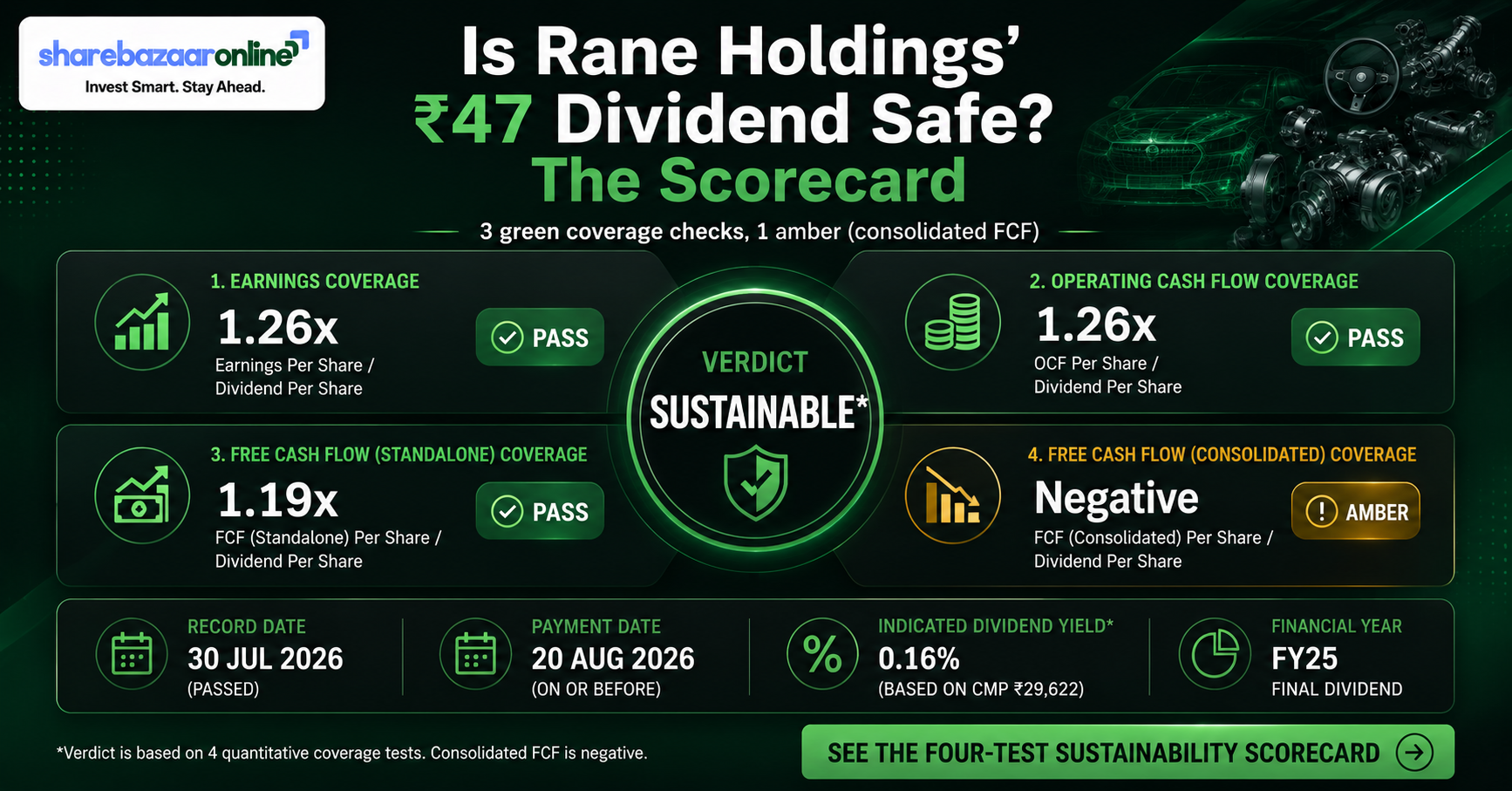
Four Coverage Tests
| Test | Result | Verdict |
|---|---|---|
| Earnings cover (standalone) | 1.26× | Pass |
| Operating-cash cover (standalone) | 1.26× | Pass |
| Free-cash cover (standalone) | 1.19× | Pass |
| Free-cash cover (consolidated) | Negative | Amber |
How the Dividend Is Funded
From current standalone earnings and operating cash, backed by a ₹577 crore investment portfolio — not from parent borrowings or asset sales. The holding company held only ₹4.4 crore of cash at year-end, so payment relies on receiving dividends/fees from subsidiaries plus its investment book, both of which are ample (investment cover of the outflow is roughly 8.6×).
Overall Verdict
Sustainable at the standalone level. The one caveat is the pace: dividend up 24% while standalone earnings up 24% is disciplined, but the consolidated free-cash shortfall means the group has little spare cash after capex — so a downturn in subsidiary profits or dividends upstreamed to the parent is the key sustainability risk, not the current payout itself.
Peer Comparison
| Company | Div. Yield | Payout | ROE | P/E |
|---|---|---|---|---|
| Rane Holdings | ~2.63% | 68.6% (consol) | 7.0% | 31.7 |
| Sundram Fasteners | ~0.75% | ~30% | Not Independently Verified | ~36 |
| Rane (Madras) Ltd | Not Independently Verified | Not Independently Verified | Not Independently Verified | 23.65 |
| Auto-components industry avg. | ~0.6% | — | — | ~28 |
Rane Holdings metrics from Screener/company filing; Sundram Fasteners yield/payout from Simply Wall St; Rane (Madras) P/E from Value Research; industry averages from Simply Wall St. Cells marked "Not Independently Verified" are left blank rather than filled with unconfirmed data.
Rane Holdings stands out as a high-yield, high-payout name in a sector where most auto-ancillaries yield well under 1% and retain most earnings for growth. That is the trade-off: you get a materially bigger income stream, but from a company with lower return ratios (ROE 7% vs the double-digit ROEs typical of leading operating ancillaries) because the holding-company structure and associate losses dilute returns. Income investors will value the yield; growth investors may prefer the operating names.
Promoter Impact Analysis
Who Gets the ₹67 Crore
- Promoter & group holding: 46.64%
- Promoter dividend income: ~₹31.3 crore
- Public / minority share: ~₹35.8 crore
- FII holding: 0.93% | DII: 3.39%
Alignment & the Warrant Angle
With nearly ₹31 crore flowing to the promoter family, incentives are aligned toward a healthy payout. Watch the parallel ₹40 crore preferential warrant issue to promoters at ₹1,183.32 (in-principle approvals received July 2026, allotment done 30 July 2026): on full conversion it modestly raises promoter stake and adds 3,38,030 shares, diluting minority holders slightly while injecting fresh capital.
Taxation Analysis
Since the abolition of the Dividend Distribution Tax in April 2020, dividends are taxed in the hands of the shareholder at their applicable income-tax slab rate. The company also deducts TDS at 10% under Section 194 if your total dividend from the company in a financial year exceeds ₹5,000 (20% if PAN is not furnished). The TDS is not an extra cost — it is adjusted against your final tax liability.
Worked Example — 1,000 Shares, 30% Slab
| Gross dividend (1,000 × ₹47) | ₹47,000 |
| TDS deducted at source @10% | ₹4,700 |
| Income tax @30% slab | ₹14,100 |
| Health & education cess @4% | ₹564 |
| Total tax | ₹14,664 |
| Net dividend in hand | ₹32,336 |
| Effective post-tax yield on CMP | 1.81% |
Illustrative only; surcharge may apply to high-income investors and rates differ by slab. Not tax advice — consult a qualified professional.
Key Risks
- Occupant-safety warranty / product-recall liability: the 49%-held associate ZF Lifetec Rane Automotive booked a warranty provision of ₹87 crore in FY26 tied to product-recall risk on safety products sold in prior periods; further provisioning would dent group profit and the dividends upstreamed to the parent.
- Consolidated free cash flow is negative: group capex (₹316 crore) exceeded operating cash flow (₹280 crore) in FY26, leaving little group-level buffer if subsidiary cash generation weakens.
- Low return ratios: consolidated ROE of 7.0% and ROCE of 9.52% lag the sector, limiting internal compounding and making the high payout partly a function of modest reinvestment opportunity.
- Subsidiary tax/regulatory exposure: subsidiary RSSL received GST orders and show-cause notices in July 2026 (₹7.46 crore for FY20 and ₹11.88 crore for FY23, including penalties) — small individually but a governance-watch item.
- Auto-cycle and OEM concentration: as a transportation-components group, revenue is tied to commercial-vehicle, passenger-vehicle and tractor demand; a downturn compresses subsidiary profits and, in turn, parent income.
- Promoter warrant dilution: the ₹40 crore convertible-warrant issue modestly dilutes minority holders on conversion and concentrates promoter economics.
What To Monitor
- Dividends upstreamed from subsidiaries and associates: the parent's dividend capacity depends on cash received from Rane (Madras), RSSL and the ZF joint ventures — track these in the standalone cash flow.
- Warranty-provision movement at ZF Lifetec Rane Automotive: whether the ₹87 crore recall provision is topped up, released or settled will swing the associate contribution materially.
- Group free cash flow recovery: watch whether FY27 operating cash flow re-covers capex; the ₹145 crore land-sale advance (Velachery) should aid cash conversion when it completes.
- Return-ratio trend: any move in ROE/ROCE back toward double digits would materially improve the quality of the payout.
- Warrant conversion and promoter holding: track the conversion timeline of the 3,38,030 warrants and its effect on the share count and per-share dividend.
- Standalone payout discipline: whether management keeps the payout near 79% of standalone earnings or pushes it higher, which would reduce the safety margin.
Conclusion
The Rane Holdings dividend of ₹47 per share (470%) for FY2025-26 is a genuinely strong payout that yields about 2.63% at the current Rane Holdings share price — comfortably above the auto-components sector norm. Judged where it should be judged, at the standalone holding-company level, the dividend is well covered: 1.26× by earnings and operating cash, 1.19× by free cash flow, and backstopped by a ₹577 crore investment book with almost no parent debt.
Positives
- Above-sector yield of ~2.6%, driven by a rising dividend
- Dividend well covered at standalone level (1.2×+)
- Underlying operating profit grew 25%; revenue up 35%
- Near debt-free parent with large investment cushion
- 8-of-10-year payment record; disciplined 24% growth in step with earnings
Negatives & Watch-Items
- Consolidated free cash flow was negative in FY26
- Low return ratios (ROE 7%, ROCE 9.5%)
- Occupant-safety recall/warranty provision at associate
- Reported EPS optically fell (base effect of FY25 one-off)
- Promoter warrant dilution; AGM approval still pending
We present the evidence; the decision is yours. The single most important thing to remember is that the "470%" headline is a face-value figure — the real, price-dependent yield is what matters, and it should be re-checked against the live share price before you act.
Frequently Asked Questions
What dividend has Rane Holdings announced for 2026?
What is the Rane Holdings dividend yield?
What is the Rane Holdings dividend record date?
What is the ex-dividend date?
When will the Rane Holdings dividend be paid?
Who is eligible for the dividend?
How is the Rane Holdings dividend taxed?
Is the Rane Holdings dividend sustainable?
Why did Rane Holdings' EPS fall while the dividend rose?
What is Rane Holdings' dividend history?
Why is standalone rather than consolidated the right lens for the dividend?
What should investors monitor going forward?
How much of the dividend goes to promoters?
Disclaimer
This article is for informational and educational purposes only and does not constitute investment, financial, legal or tax advice, nor a recommendation to buy, sell or hold any security. ShareBazaar Online is not a SEBI-registered investment adviser. All figures are derived from Rane Holdings Limited's audited FY26 exchange filing and publicly available third-party sources believed to be reliable but not independently guaranteed; the dividend remains subject to shareholder approval at the AGM. Dividend yields are price-dependent and change with the market price — verify the live share price and official corporate-action notices on the NSE/BSE before making any decision. Investments in securities are subject to market risks; please read all related documents carefully and consult a qualified, registered financial adviser and tax professional before investing.