
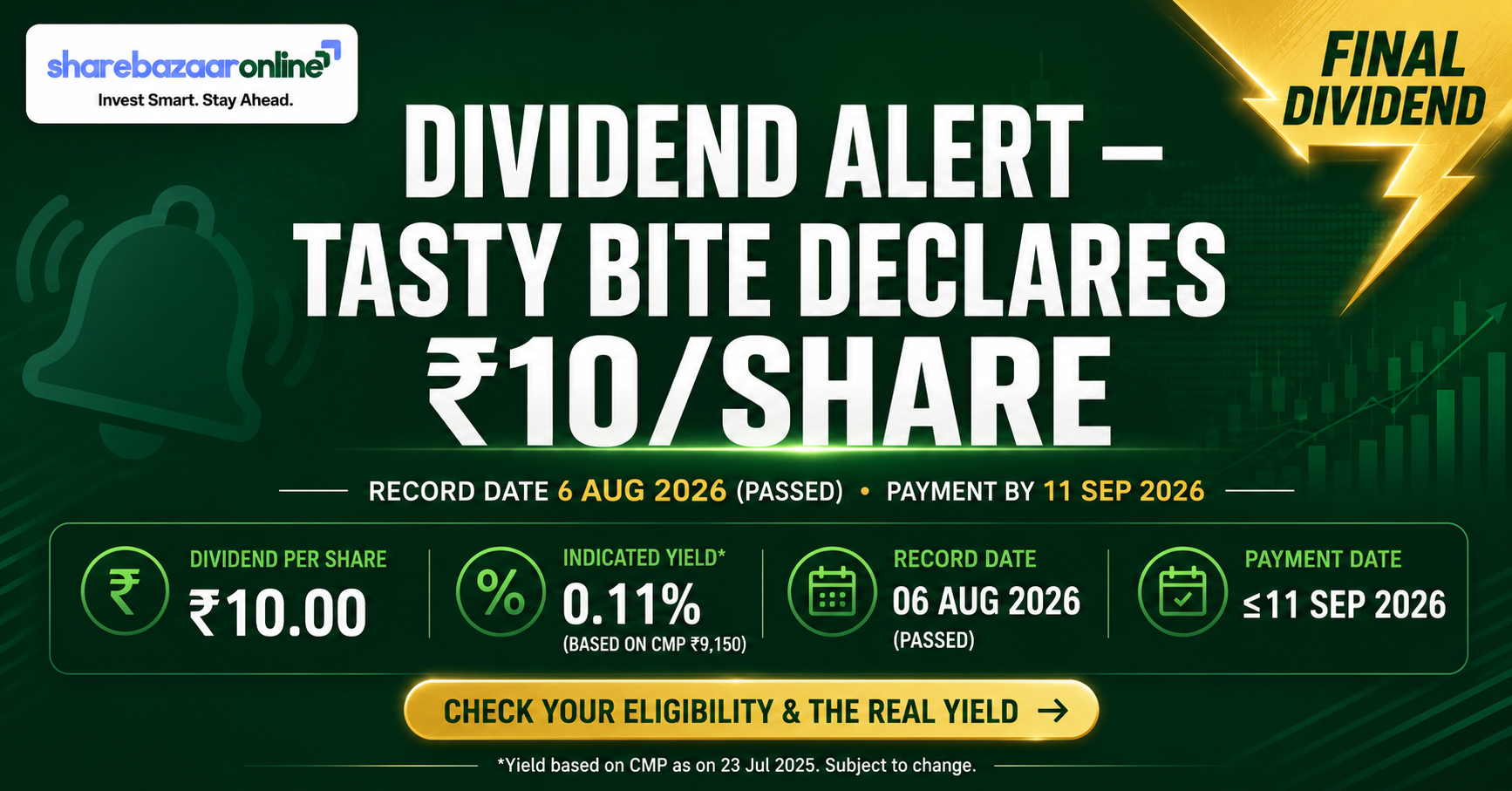
Dividend Snapshot
Tasty Bite Eatables Limited (NSE: TASTYBITE, BSE: 519091) has recommended a final dividend of ₹10 per equity share for the financial year ended 31 March 2026 (FY26). On a face value of ₹10, that is a 100% dividend in percentage terms — but the headline percentage and the actual cash return an investor earns are two very different things, as this analysis explains.
Financials are standalone (the company has no subsidiary, associate or joint venture, so standalone equals consolidated). Dividend, share count, face value and record date are confirmed from the exchange filing and the company's record-date intimation. Market price and yield are price-dependent and must be re-verified at the time of reading.
Dividend Announcement Summary
At its board meeting held on Friday, 29 May 2026 (pursuant to Regulation 30 and Regulation 33 of SEBI LODR), the Board of Directors of Tasty Bite Eatables approved the audited results for the quarter and year ended 31 March 2026 and recommended a final dividend of ₹10 per share on 25,66,000 equity shares of ₹10 face value each. The dividend is subject to shareholder approval at the 42nd Annual General Meeting.
The 5× step-up nobody flagged
For at least a decade Tasty Bite paid a flat ₹2 per share almost every year (with ₹1 in FY22). The FY26 payout of ₹10 is a five-fold jump — the largest dividend in the company's recent history. Wire coverage reports "₹10 dividend"; the story is that a chronically low payer has abruptly stepped up its cash distribution.
A qualified audit opinion sits alongside it
The FY26 results carry a modified (qualified) audit opinion from Kalyaniwalla & Mistry LLP. The company did not obtain prior Audit Committee approval for related-party transactions of ₹48.92 million with Mars Food UK Limited, and material RPTs exceeded the Schedule XII threshold by ₹94.47 million without prior shareholder approval. A post-facto approval ballot was rejected by shareholders. This is a governance flag that accompanies the dividend and is covered in the Risks section below.
Key Dates Timeline
| Event | Date | Status / Source |
|---|---|---|
| Board Meeting / Announcement | 29 May 2026 | Confirmed — exchange filing |
| Record Date | 06 Aug 2026 | Confirmed — record-date intimation (passed) |
| Ex-Dividend Date | 06 Aug 2026 | Inferred (T+1: ex-date aligns with record date) |
| Remote e-Voting Window | 10–12 Aug 2026 | Confirmed — AGM notice |
| 42nd AGM (approval) | 13 Aug 2026 | Approval pending — via video conferencing |
| Dividend Payment | On/before 11 Sep 2026 | Pending AGM approval |
Because the dividend is a final dividend, it must be approved by shareholders at the AGM before payment. The record date of 6 August 2026 has already passed; eligibility is therefore fixed, but the cash payout still depends on AGM ratification.
Dividend Yield Analysis
The face-value illusion: "100%" is really 0.11%
A "100% dividend" sounds enormous, but it only means ₹10 on a ₹10 face value. What matters to an investor buying today is the yield on the market price, not the face value. Tasty Bite trades near ₹9,357 (NSE close, 11 August 2026), so the cash return is tiny:
Put plainly: even after quintupling the dividend to ₹10, an investor buying at today's price earns roughly ₹11 of dividend for every ₹10,000 invested. Tasty Bite is not, and has never been, a yield stock — it is a high-priced small-cap where the dividend is symbolic rather than income-generating.
Dividend History Analysis
| Financial Year | Dividend / Share | Type |
|---|---|---|
| FY26 | ₹10.00 | Final (proposed) |
| FY25 | ₹2.00 | Final |
| FY24 | ₹2.00 | Final |
| FY23 | ₹2.00 | Final |
| FY22 | ₹1.00 | Final |
| FY21 | ₹2.00 | Final |
| FY20 | ₹2.00 | Final |
| FY19 | ₹2.00 | Final |
| FY18 | ₹2.00 | Final |
| FY17 | ₹2.00 | Final |
Per-share history compiled from dividend aggregators (INDmoney, TipRanks) and cross-referenced. No stock splits or bonus issues have distorted comparability — the face value has stayed at ₹10 throughout.
Classification: Consistent (but token) payer that has just re-based higher
Tasty Bite is a consistent payer in the sense that it has paid a dividend every year — but the amount was a token ₹2 that translated into a payout ratio of just 1–2% of profits. FY26 breaks that pattern: ₹10 is a 5× step-up. The open question is whether this is a new base or a one-off gesture; the payout ratio at 7.3% is still low enough that the company can comfortably repeat or exceed it, but management has given no explicit forward dividend policy.
Financial Performance Analysis
| Metric (₹ Crore) | FY26 | FY25 | Change |
|---|---|---|---|
| Revenue from operations | 548.7 | 554.4 | −1.0% |
| Operating profit (ex other income) | 61.8 | 51.8 | +19.5% |
| Other income | 22.97 | 18.61 | +23.4% |
| Profit before tax | 47.5 | 34.4 | +38.2% |
| Net profit (PAT) | 35.3 | 25.6 | +37.9% |
| EPS (₹) | 137.57 | 99.80 | +37.9% |
Operating leverage: flat sales, fatter margins
This is the key financial signal. Revenue actually fell 1%, yet net profit rose 38%. The profit growth came from margins, not sales. Cost of materials fell 0.9%, other expenses fell 2.9%, while employee cost rose only 3.8%. The operating margin expanded from 9.3% to 11.3%. Sales growth has been weak for years (a ~7% five-year revenue CAGR), so FY26's profit jump is an efficiency and base-effect story, not a demand-led one.
Earnings-quality flag: other income is ~48% of PBT
Of the ₹47.5 crore pre-tax profit, ₹22.97 crore — about 48% — is "other income" (largely interest on the company's deposits and cash). For a cash-rich business this is legitimate, but it means the reported profit growth leans heavily on treasury income rather than the core prepared-foods operation. Strip it out and the operating story is steadier but far more modest.
Cash Flow Analysis
Reported profit is an accounting opinion; cash is a fact. Here the two agree, which is reassuring. FY26 operating cash flow of ₹59.0 crore comfortably exceeded net profit of ₹35.3 crore (a cash conversion of ~116%), and free cash flow was strong.
How is the dividend funded? Entirely from current operations. The ₹2.57 crore payout is a rounding error against ₹50.6 crore of free cash flow — there is no reliance on cash reserves, asset sales or borrowings. One watch item on the operating side: inventory days rose to ~115 (from ~91), and the cash-conversion cycle stretched to ~90 days, so working capital is absorbing more cash even as headline cash flow stays healthy.
Balance Sheet Strength
Tasty Bite fully repaid its interest-bearing debt during FY26 — both current and non-current borrowings are now zero, versus ₹26.7 crore a year earlier. The only remaining "borrowing-like" item on aggregator screens is ₹41.9 crore of Ind AS 116 lease liabilities, which are not conventional debt. With zero borrowings and ₹27.3 crore of cash, the company is net cash, and the modest dividend poses no strain on the balance sheet whatsoever.
Dividend Sustainability Analysis
| Coverage Test | Result | Verdict |
|---|---|---|
| Earnings coverage (EPS ÷ DPS) | 13.76× | Pass |
| Operating cash flow coverage | 23.0× | Pass |
| Free cash flow coverage | 19.7× | Pass |
| Cash / liquidity coverage | 10.6× | Pass |
Verdict: Sustainable
On every test — earnings, operating cash flow, free cash flow and liquidity — the ₹10 dividend is covered many times over. At a 7.3% payout ratio, the company distributes less than a tenth of its profit; it could pay this dividend even in a materially weaker year. Financial sustainability is not the concern here; the concerns are strategic (stagnant revenue) and governance-related (the audit qualification), not affordability.
Peer Comparison
| Company (Packaged / Prepared Foods) | Div. Yield | Payout | ROE |
|---|---|---|---|
| Tasty Bite Eatables | ~0.11% | 7.3% | 10.9% |
| ADF Foods | ~0.5% | ~25% | NIV |
| Mrs Bector's Food Specialities | ~0.45% | ~37% | NIV |
| Nestlé India | ~0.9% | ~74% | ~92% (3Y) |
| Britannia Industries | ~1.3% | ~82% | NIV |
The comparison makes the point starkly: Tasty Bite has the lowest yield and by far the lowest payout ratio in this peer set. Established FMCG dividend names such as Nestlé India and Britannia return the bulk of their earnings to shareholders (74%–82% payouts); even the smaller ethnic-foods peer ADF Foods pays out roughly a quarter. Tasty Bite, despite its 5× increase, still retains ~93% of profit. Its appeal has historically been growth/scarcity, not dividends.
Peer yields and payouts sourced from dividend aggregators and cross-checked. "NIV" = Not Independently Verified for this publication; cells are left flagged rather than filled with unconfirmed figures. Nestlé ROE is a 3-year figure per Screener.
Promoter Impact Analysis
The promoter — Preferred Brands Foods (India), part of the global Mars group — owns 74.23% and therefore collects roughly ₹1.91 crore of the ₹2.57 crore payout. Minority shareholders share the remaining ~₹0.66 crore. A dividend is one of the few pro-rata mechanisms through which minority holders receive the same per-share cash as the promoter, so a step-up is directionally positive for the free float.
The nuance: cash also flows to Mars group entities through related-party transactions, which is precisely where the FY26 audit qualification arose. Minority shareholders had earlier voted down a post-facto approval of certain FY26 related-party dealings, though a subsequent postal ballot (concluded 3 July 2026) passed forward-year RPT resolutions. The dividend rewards all holders equally; the RPT question is about whether related-party pricing is on arm's-length terms — a separate governance debate.
Taxation Analysis
How dividends are taxed in India
Since April 2020, dividends are taxed in the hands of the shareholder, not the company. The dividend is added to your total income and taxed at your applicable slab rate. The company deducts TDS at 10% under Section 194 if your total dividend from that company in a financial year exceeds ₹10,000 (the threshold was raised from ₹5,000 with effect from FY2025-26). This TDS is not an extra cost — it is adjusted against your final tax liability. Non-PAN or invalid-PAN holders face 20% TDS.
Worked example: 1,000 shares at a 30% slab
*At exactly ₹10,000 the Section 194 TDS threshold is not crossed, so no TDS is deducted in this example; a holder of 1,001+ shares would trigger 10% TDS, which remains adjustable at filing. A 30% slab is assumed for illustration; your actual tax depends on your own slab. This is a simplified example, not tax advice.
Key Risks
1. Qualified audit opinion & related-party governance. FY26 carries a modified opinion because prior approvals for related-party transactions with Mars Food UK were not obtained, and a shareholder ballot rejected the post-facto approval of certain FY26 dealings. Related-party pricing and approval discipline is an ongoing governance risk given the large FY27–28 RPT limits (up to ~₹850 crore) sought with Mars group entities.
2. Revenue stagnation. Sales fell ~1% in FY26 and have compounded at only ~7% over five years; FY26 profit growth came from margins and treasury income, not top-line demand. A prepared-foods business that is not growing revenue is vulnerable if margin tailwinds reverse.
3. Earnings dependence on other income. Nearly half of pre-tax profit is "other income" (interest on deposits). If interest rates fall or cash is deployed, reported profit quality weakens even if operations are unchanged.
4. Rich valuation. The stock trades at ~67× earnings and ~7× book — a steep premium to packaged-foods peers — against low-single-digit revenue growth and an ~11% ROE. Any de-rating dwarfs the ~0.11% dividend yield.
5. Thin float & low liquidity. With 74.23% held by the promoter and only ~2.57 million shares outstanding, daily traded volumes are very low (often a few hundred to a couple of thousand shares). Prices can be volatile, and exiting a position can be difficult at a fair price.
6. Working-capital drift & input costs. Inventory days rose to ~115 and the cash-conversion cycle to ~90 days; agricultural input-cost inflation could compress the very margins that drove FY26 profit.
What To Monitor
1. AGM outcome (13 Aug 2026). Whether the ₹10 dividend and the FY27–28 related-party resolutions are approved, and the level of minority dissent recorded in the voting results.
2. Resolution of the audit qualification. Whether the qualification recurs in FY27 and how the company regularises the earlier RPT approvals.
3. A stated dividend policy. Whether ₹10 becomes the new base or reverts to ₹2 — the single biggest question for income-minded holders.
4. Revenue re-acceleration. Whether the foodservice/export mix and domestic RTE demand can push the top line back to double-digit growth.
5. Operating-margin durability. Whether the 11.3% margin holds if raw-material costs rise, since FY26 profit growth rested on margin expansion.
6. Working-capital trend. Whether inventory days and the cash-conversion cycle normalise or continue to lengthen.
Conclusion
Tasty Bite Eatables' FY26 final dividend of ₹10 per share is a genuine 5× step-up from its long-standing ₹2, and it is fully sustainable — covered ~14× by earnings, ~20× by free cash flow, and backed by a zero-debt, net-cash balance sheet. On the numbers alone, the payout is unimpeachable.
But the two things that matter most are easy to miss in the headline. First, the "100% dividend" is a ~0.11% cash yield at the current market price — the classic face-value illusion; this is not an income stock. Second, the dividend arrives alongside a qualified audit opinion over related-party transactions with the Mars parent group that minority shareholders had earlier rejected. Add stagnant revenue, an ~48%-of-PBT reliance on other income, and a ~67× valuation, and the picture is of a cash-rich, well-run but slow-growing small-cap with a live governance question.
The positives (cash generation, debt-free balance sheet, a real dividend increase) and the negatives (token yield, qualified opinion, flat sales, rich valuation) are laid out above so you can weigh them yourself. We do not offer buy, sell or hold guidance.
Frequently Asked Questions
What dividend has Tasty Bite Eatables announced for FY26?
What is the dividend yield on Tasty Bite shares?
What is the record date for the Tasty Bite dividend?
What is the ex-dividend date?
When will the Tasty Bite dividend be paid?
Who is eligible for the dividend?
How is this dividend taxed?
Is the Tasty Bite dividend sustainable?
What is Tasty Bite's dividend history?
Why does the FY26 result carry a qualified audit opinion?
Why did profit rise 38% when revenue fell?
How much of the dividend goes to the promoter?
What should investors monitor from here?
Disclaimer
This article is for informational and educational purposes only and does not constitute investment, financial, legal or tax advice or any recommendation to buy, sell or hold any security. ShareBazaar Online is not a SEBI-registered investment adviser. Figures on the dividend, share count, face value, record date and financial results are drawn from Tasty Bite Eatables' exchange filings; market prices, yields, peer data and shareholding are sourced from third-party data providers and are subject to change — the market price and all yield figures are price-dependent and must be independently re-verified before any decision. Dividend payment remains subject to shareholder approval at the AGM. Past dividends are not indicative of future payouts. Please consult a SEBI-registered adviser and a qualified tax professional before acting. The author and publisher accept no liability for any loss arising from the use of this information.