
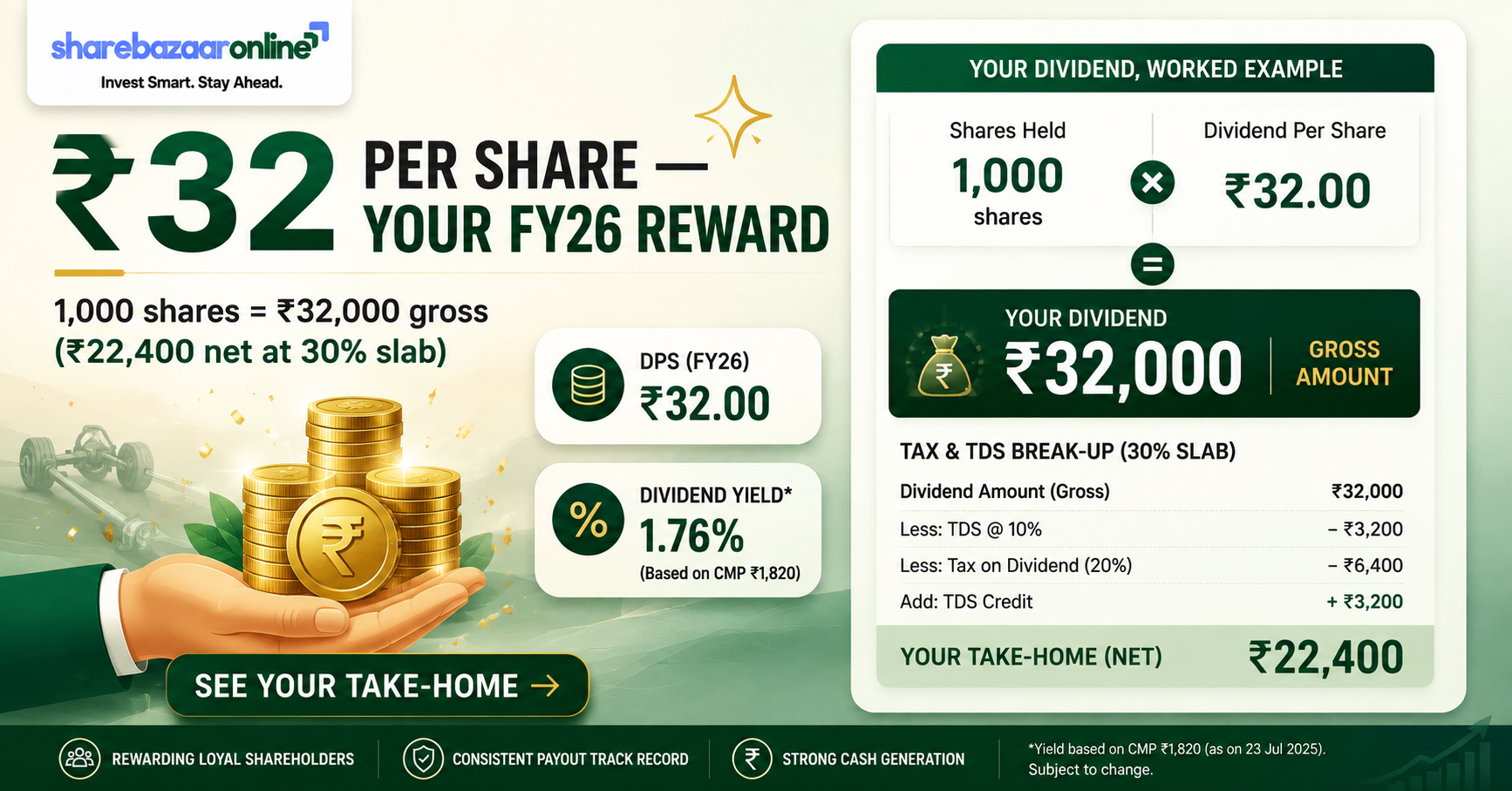
Dividend Snapshot
Automotive Axles Limited (NSE: AUTOAXLES, BSE: 505010) has declared a final dividend of ₹32 per share for FY2025-26 — a headline payout of 320% on the ₹10 face value. The dividend was recommended at the board meeting on 19 May 2026 and is subject to shareholder approval at the 45th Annual General Meeting.
Dividend Per Share
₹32.00
Final dividend • 320% of ₹10 face value
Dividend Yield (on CMP ₹1,804)
1.77%
Verify against the live price on your publish date
Record Date
5 Aug 2026
Eligibility cut-off (now passed)
Payment Date
On or before 11 Sep 2026
Net of TDS, post-AGM approval
The one number that matters: the “320%” you see in wire headlines is a percentage of face value, not of what you pay for the share. On a market price near ₹1,804 the real cash return is roughly 1.77%. The rest of this analysis focuses on whether that modest but well-covered payout is durable through the commercial-vehicle cycle.
Dividend Announcement Summary
At its meeting on 19 May 2026, the Board of Automotive Axles approved the audited results for the year ended 31 March 2026 and recommended a final dividend of ₹32 per equity share (320%). The auditor, S.R. Batliboi & Associates LLP, issued an unmodified (clean) opinion on the FY26 financials. The company confirmed it has no subsidiary, associate or joint venture, so the standalone results are effectively the consolidated picture.
What was declared: A single annual final dividend of ₹32/share for FY26. Automotive Axles typically pays one dividend a year rather than interim instalments.
Conditionality: The payout is subject to member approval at the 45th AGM. Until that resolution passes, the dividend remains a recommendation, not a confirmed entitlement.
Editorial note on the FY26 profit: Reported profit before tax of ₹219.8 crore includes a one-time exceptional charge of ₹11.99 crore tied to the new Labour Codes (higher gratuity and leave provisioning on past service). Stripping that out, pre-exceptional PBT was ₹231.8 crore. This is a non-cash, non-recurring item — it depresses headline FY26 profit but does not reflect operating deterioration.
Key Dates Timeline
| Event | Date | Status |
|---|---|---|
| Board Meeting / Announcement | 19 May 2026 | Completed |
| Record Date | 5 Aug 2026 (Wed) | Passed |
| Ex-Dividend Date | 5 Aug 2026 (inferred) | Under T+1, ex-date coincides with record date |
| 45th Annual General Meeting | 12 Aug 2026 (Wed) | Approval of dividend |
| Payment Date | On or before 11 Sep 2026 | Pending (net of TDS) |
How to read the dates: Only shareholders on the register as of the record date (5 Aug 2026) qualify. The ex-date is inferred as the same day under the T+1 settlement regime and should be confirmed against the NSE/BSE corporate-action circular. The company has committed to pay on or before 11 September 2026; it has not published a specific credit date, so treat 11 Sep as the statutory outer limit.
Dividend Yield Analysis
Yield on latest CMP (₹1,804)
1.77%
Yield on announcement-day price (~₹1,698)
1.88%
The face-value illusion. A “320% dividend” sounds enormous, but it means ₹32 on a ₹10 face value. Because the share trades near ₹1,804, the yield an investor actually earns is about 1.77% — a world away from 320%. This is the single most common misreading of Indian dividend announcements, and it is exactly where wire coverage stops and analysis should begin.
Yield reality check — why is the yield ~1.77% and not higher? It is a function of a moderate dividend meeting a fully-valued price, not a distressed one. The stock trades on a P/E of roughly 14.9x with a book value near ₹727. The yield sits above the auto-components sector average (broadly ~0.6%) and in the top quartile of Indian dividend payers, but it is a growth-cum-income profile, not a deep-value yield play. The higher yield is driven by a genuine, earnings-backed payout — not by a collapsing share price.
Dividend History Analysis
| Financial Year | Dividend / Share | Notes |
|---|---|---|
| FY2025-26 | ₹32.00 | Current declaration; back to prior peak |
| FY2024-25 | ₹30.50 | Trimmed from ₹32 as CV cycle softened |
| FY2023-24 | ₹32.00 | Peak-cycle payout |
| FY2022-23 | ₹32.00 | Peak-cycle payout |
| FY2021-22 | ₹15.00 | Recovery from pandemic trough |
| FY2020-21 | ₹4.50 | Cycle bottom |
| FY2019-20 | ₹6.80 | ₹6.00 interim + ₹0.80 final (COVID cut) |
| FY2018-19 | ₹19.50 | Prior up-cycle |
| FY2017-18 | ₹13.50 | — |
| FY2016-17 | ₹8.00 | — |
| FY2014-15 | ₹2.50 | Down-cycle low |
History sourced from exchange corporate-action records and dividend aggregators (TipRanks, INDmoney); cross-referenced. Face value unchanged at ₹10 throughout — no stock split or bonus, so figures are directly comparable.
Classification: Cyclical Payer. The dividend clearly tracks the medium & heavy commercial vehicle (M&HCV) cycle — ₹19.50 at the previous peak, cut hard to ₹4.50–₹6.80 through the downturn/COVID, then rebuilt to ₹32. This is not a steady-eddy compounder; it is a well-managed cyclical distribution.
Trend read: The FY26 ₹32 is a +4.9% increase over FY25’s ₹30.50, restoring the payout to its FY23–FY24 peak rather than exceeding it. Over nine years the per-share dividend has compounded at roughly 16.7% (₹8 in FY17 to ₹32 now) — strong, but with visible cuts along the way.
Financial Performance Analysis
| Metric (FY, ₹ crore) | FY2025-26 | FY2024-25 | Change |
|---|---|---|---|
| Revenue from operations | 2,177.7 | 2,077.5 | +4.8% |
| EBITDA (operating profit) | ~237 | ~220 | +7.7% |
| Profit before tax (reported) | 219.8 | 210.6 | +4.4% |
| Net profit (PAT) | 164.4 | 155.5 | +5.7% |
| EPS (₹) | 108.77 | 102.92 | +5.7% |
Operating leverage worked in the company’s favour this year. Revenue rose +4.8% while EBITDA rose faster at +7.7% — a sign of mild margin expansion, with operating margin holding around 11%. This is the opposite of the “sales up, profit down” trap: cost of raw materials was broadly contained and the operating engine converted higher volumes into slightly higher margins.
Cyclical context: FY26 revenue of ₹2,178 crore is a recovery, but still below the FY23 peak of ~₹2,324 crore. The three-year revenue trend is slightly negative, underscoring the cyclical nature of the M&HCV business. Encouragingly, the recovery has continued into Q1 FY27 (quarter ended June 2026), where the company reported PAT of ~₹45.6 crore, up meaningfully year-on-year.
Cash Flow Analysis
Reported profit is an accounting opinion; cash is a fact. For FY26 the two line up well. The company generated operating cash flow of ₹172.6 crore against net profit of ₹164.4 crore — an OCF-to-PAT conversion above 100%, which is a mark of clean earnings quality.
Operating Cash Flow (FY26)
₹172.6 cr
Free Cash Flow (OCF − Capex)
₹99.2 cr
Is the dividend funded from operations? Yes. After capex of ~₹73.3 crore (a step-up as the company invests for its stated growth ambition), free cash flow was ₹99.2 crore — comfortably above the FY26 dividend outflow of ₹48.4 crore. The dividend is paid out of current earnings and operating cash, not from borrowings or asset sales. Note that the ₹46.1 crore of dividend shown in the FY26 cash-flow statement relates to last year’s ₹30.50 payout; the new ₹32 dividend will appear in the FY27 statement.
Working-capital watch: Trade receivables rose ~₹53.6 crore during the year and debtor days sit around 82 — a normal feature of an OEM-supplier model with concentrated customers, but a line item to monitor because it ties up cash as volumes scale.
Balance Sheet Strength
Total Equity (net worth)
₹1,098.8 cr
Book value ~₹727 per share
Liquid Resources
~₹399 cr
Cash + current investments + bank balances
Effectively debt-free. Borrowings are negligible (~₹14 crore) and lease liabilities are small, against liquid resources of roughly ₹399 crore. On a net basis the company holds close to ₹384 crore of net cash. Return ratios are healthy: ROE ~16.2% and ROCE ~21.6% (per Screener), both indicating efficient use of a conservative, cash-rich balance sheet. Working-capital intensity has actually improved, with working-capital days falling from ~88 to ~66.
Dividend Sustainability Analysis
| Coverage Test | Metric | Verdict |
|---|---|---|
| Earnings coverage | 3.40x (EPS ₹108.77 / DPS ₹32) | Pass |
| Payout ratio | 29.4% of PAT | Pass (conservative) |
| OCF coverage | 3.57x (OCF ₹172.6cr / outflow ₹48.4cr) | Pass |
| FCF coverage | 2.05x (FCF ₹99.2cr / outflow ₹48.4cr) | Pass |
| Cash / liquidity coverage | 8.25x (liquid ₹399cr / outflow ₹48.4cr) | Pass |
Overall verdict: Sustainable at current earnings. Every coverage test passes with room to spare — the dividend consumes under 30% of profit, is covered twice over by free cash flow, and eight times over by the liquid balance sheet. The caveat is cyclicality, not affordability: history shows the company cuts the dividend when the M&HCV cycle turns down (as in FY20–FY21). So the payout is safe at this level of earnings, but the rupee amount can and does move with the cycle.
Peer Comparison
| Company | Div. Yield | Payout | ROE | ROCE | Balance Sheet |
|---|---|---|---|---|---|
| Automotive Axles | ~1.77% | 29.4% | 16.2% | 21.6% | Net cash |
| Jamna Auto | ~1.6–2.0% | ~36–46% | NA | NA | Low debt |
| ZF Commercial (ex-WABCO) | ~0.15% | ~8% | NA | NA | Net cash |
Peer figures sourced from exchange filings and aggregators; cells marked NA are not independently verified and are deliberately left blank rather than estimated. Auto-components sector average dividend yield is broadly ~0.6%.
Where Automotive Axles sits: Among commercial-vehicle ancillaries it is one of the more generous, high-payout dividend distributors. Jamna Auto (leaf springs) pays a comparable yield but at a higher payout ratio; ZF Commercial (braking systems), the market leader, deliberately runs a very low ~8% payout because it reinvests aggressively and recently issued bonus shares. Automotive Axles’ combination of a ~29% payout, a top-quartile yield and strong return ratios on a net-cash balance sheet is a differentiated income-plus-quality profile within the peer set.
Promoter Impact Analysis
Promoter dividend income (71.04%)
~₹34.4 cr
of the ~₹48.4 cr total outflow
Public / institutional income (28.96%)
~₹14.0 cr
FII 0.75% • DII 15.44% • Public 12.78%
Who benefits. Automotive Axles is a 50:50 promoter joint venture: the Kalyani Group (via BF Investment, ~35.52%) and Cummins Inc. (which inherited Meritor’s ~35.52% stake after acquiring Meritor globally). Of the ~₹48.4 crore dividend, roughly ₹34.4 crore flows to the two promoters — about ₹17.2 crore each. The remaining ~₹14 crore is shared by DIIs (mutual funds ~15.4%), a small FII holding and retail investors.
Alignment read: Because promoters take the majority of every rupee distributed, a healthy dividend is directly in their interest — which tends to keep the policy shareholder-friendly. Both minority and majority holders receive the same ₹32 per share; there is no differential class. The structural point to note is high promoter concentration (71%), which means a relatively thin public float.
Taxation Analysis
Since April 2020, dividends in India are taxed in the hands of the shareholder at their applicable income-tax slab rate — there is no separate Dividend Distribution Tax. The company must also deduct TDS under Section 194 at 10% if a resident shareholder’s total dividend from the company exceeds ₹5,000 in the financial year (20% if PAN is not furnished). The TDS is not an extra cost — it is adjusted against your final tax liability when you file your return.
Worked example — investor holding 1,000 shares, 30% tax slab
| Gross dividend (1,000 × ₹32) | ₹32,000 |
| TDS deducted at source @10% (u/s 194) | ₹3,200 |
| Total tax at 30% slab (+ applicable cess) | ₹9,600 |
| Net dividend in hand (after full tax) | ₹22,400 |
| Effective post-tax yield (on ₹1,804) | ~1.24% |
Illustrative only; excludes surcharge/cess nuances and assumes the 30% slab. A lower-slab investor keeps more; a 0% / 5% slab investor can claim a refund of TDS. This is not tax advice — consult a qualified professional.
Key Risks
- Commercial-vehicle cyclicality. Earnings and the dividend are tied to the M&HCV cycle. A downturn in truck and bus demand directly compresses volumes, profit and the payout — the FY20–FY21 cuts are the template.
- Customer concentration. Ashok Leyland has historically contributed ~50–60% of revenue. Any loss of share, pricing pressure or a slowdown at a single large OEM would have an outsized impact.
- Receivables / working-capital build-up. Trade receivables (~82 debtor days) rose during FY26; as volumes scale, cash can get increasingly locked in working capital.
- Regulatory & input-cost pressures. The FY26 exceptional charge came from new Labour Codes (higher gratuity/leave provisioning); steel and other raw-material inflation can squeeze the ~11% operating margin.
- Technology transition risk. Electrification and evolving axle/driveline architectures for commercial EVs could require sustained R&D and capex to stay relevant.
- Environmental compliance flag. In August 2026 the Karnataka State Pollution Control Board issued a notice over an effluent-parameter exceedance at the Mysuru facility; the company states it corrected the issue and responded. Minor and reportedly remediated, but worth tracking.
What To Monitor
- M&HCV production & sales volumes. The single biggest driver — track monthly SIAM truck/bus data and OEM order books as the lead indicator for next year’s dividend.
- Operating margin trajectory. Watch whether the ~11% OPM holds or expands; margin is the swing factor between a maintained and a raised dividend.
- Revenue diversification. Progress on reducing Ashok Leyland dependence and growing exports, aftermarket and off-highway/defence axles.
- Capex vs. free cash flow. The company has flagged capacity expansion toward a ₹4,500–5,000 crore revenue ambition; monitor whether rising capex keeps FCF comfortably above the dividend.
- Working-capital discipline. Debtor days and the cash-conversion cycle — a deterioration would be an early warning on cash-backed dividend capacity.
- AGM outcome & payment credit. Confirm the 12 Aug 2026 AGM approves the ₹32 dividend and that payment is credited on or before 11 Sep 2026.
Conclusion
Automotive Axles’ FY26 final dividend of ₹32 per share is a genuine, earnings-backed payout that restores the distribution to its prior-cycle peak after a modest FY25 trim. Behind the eye-catching “320%” headline sits a real yield of about 1.77% — above the sector norm and firmly in the top quartile of Indian payers.
Positives
- Payout only ~29% of profit; covered 3.4x by earnings and 2.0x by FCF
- Effectively debt-free with ~₹384 crore net cash
- Strong return ratios (ROE ~16%, ROCE ~22%) and clean audit opinion
- Clean earnings quality — OCF exceeds reported PAT
Negatives / Watch-points
- Cyclical payer — the rupee dividend moves with the CV cycle and has been cut before
- High customer concentration (Ashok Leyland ~50–60%)
- Modest absolute yield; a growth-cum-income, not deep-value, profile
- Rising receivables and capex to watch against FCF
The facts point to a well-run, cash-generative cyclical that rewards shareholders sensibly. Whether that suits a given portfolio depends on each investor’s income needs, risk appetite and view on the commercial-vehicle cycle. We present the evidence; the decision is yours.
Frequently Asked Questions
What dividend has Automotive Axles announced for FY2025-26?
What is the Automotive Axles dividend yield?
What was the record date for the Automotive Axles dividend?
What is the ex-dividend date?
When will the Automotive Axles dividend be paid?
Who is eligible to receive this dividend?
How is the dividend taxed in India?
Is the Automotive Axles dividend sustainable?
What is the Automotive Axles dividend history?
Is Automotive Axles a debt-free company?
Who are the promoters of Automotive Axles?
What should investors monitor going forward?
Disclaimer
This article is for informational and educational purposes only and does not constitute investment, financial, legal or tax advice, nor a recommendation to buy, sell or hold any security. ShareBazaar Online is not a SEBI-registered investment adviser. Dividend figures, dates and financial data are drawn from the company’s exchange filings and publicly available sources believed to be reliable, but accuracy is not guaranteed; the final dividend remains subject to shareholder approval at the AGM. Share prices, yields and ratios are price-dependent and change continuously — verify the current market price before acting. Securities investments are subject to market risks; read all related documents carefully. Please consult a SEBI-registered adviser and a qualified tax professional before making any investment decision. ShareBazaar Online and its authors accept no liability for any loss arising from the use of this content.