
Dividend Snapshot
Fermenta Biotech Limited (NSE: FERMENTA, BSE: 506414, ISIN INE225B01021) has paid a final dividend of ₹3.75 per equity share for FY2025-26 — a 75% payout on the ₹5 face value. The dividend was recommended by the Board on 26 May 2026 and approved by shareholders at the 74th Annual General Meeting on 11 August 2026 with 99.9999% of votes polled in favour.
Dividend Per Share
₹3.75
Final dividend, FY2025-26
Dividend Yield (latest price)
0.79%
On ₹474 close (12 Aug 2026)
Face-Value Coupon
75%
Headline % is on ₹5 face value, not market price
Total Dividend Outflow
₹11.04 cr
On 2,94,30,987 shares
The one number to remember: the "75% dividend" headline is a coupon on the ₹5 face value. On the actual market price of ₹474, the real cash yield is just 0.79%. Face-value percentages and market yields are two very different things — we separate them throughout this analysis.
Dividend Announcement Summary
On 26 May 2026, the Board of Directors of Fermenta Biotech, alongside the audited FY26 results, recommended a final dividend of ₹3.75 per share (75% of the ₹5 face value), subject to shareholder approval. The company simultaneously reported record consolidated revenue of about ₹548 crore for FY26 and a profit after tax of roughly ₹70 crore.
What was approved
At the 74th AGM on 11 August 2026, members approved the ₹3.75 dividend and adopted the FY26 standalone and consolidated financial statements. The audited results carried an unmodified (clean) audit opinion from S R B C & Co. LLP.
Watch this alongside
The same AGM approved material related-party transactions of up to ₹100 crore with its US step-down subsidiary Fermenta USA LLC — a unit that reported a loss and negative net worth in FY26. That governance item sits directly next to the dividend and is covered in our Key Risks section.
Key Dates Timeline
| Event | Date | Status |
|---|---|---|
| Board recommendation (announcement) | 26 May 2026 | Completed |
| Record date | 05 August 2026 (Wed) | Passed |
| Ex-dividend date | 05 August 2026 (aligned with record date under T+1; confirm against exchange circular) | Passed |
| AGM approval | 11 August 2026 | Approved |
| Payment date | On or before 21 August 2026 | Scheduled |
Because the record date of 5 August 2026 has already passed, eligibility for this dividend is settled. Shareholders on the register as on that date qualify; the payout is scheduled to be credited on or before 21 August 2026 by electronic transfer.
Dividend Yield Analysis
A dividend yield is simply the cash dividend divided by the share price. Fermenta's yield looks very different depending on which price you use — and that difference is itself the story.
Yield on announcement price
1.29%
₹3.75 ÷ ₹291.85 (26 May 2026)
Yield on latest price
0.79%
₹3.75 ÷ ₹474 (12 Aug 2026)
Yield reality check
Fermenta's yield did not fall because the dividend shrank — the dividend actually grew from ₹2.50 to ₹3.75. The yield compressed because the share price rose about 62% between the 26 May 2026 announcement (₹291.85) and the 12 August 2026 close (₹474). This is the opposite of the classic "yield trap," where a falling price artificially inflates yield. Here, a re-rating of the stock — driven by strong core Vitamin D3 human-nutrition growth — has pulled the yield down. For an income-focused buyer, the practical takeaway is blunt: at ₹474, this is a growth-and-recovery stock that happens to pay a small dividend, not a high-yield income stock.
Dividend History Analysis
| Financial Year | Dividend Per Share | Payout % of PAT | Context |
|---|---|---|---|
| FY26 | ₹3.75 | ~15% | Final; DPS up 50% YoY |
| FY25 | ₹2.50 | ~9% | Dividend resumed at scale |
| FY24 | Not independently verified | negative | Net loss year (~₹24 cr) |
| FY23 | Not independently verified | negative | Net loss year (~₹53 cr) |
| FY22 | Not independently verified | ~23% | Profitable year |
| FY20–FY21 | Not independently verified | ~16–24% | Profitable years |
Payout ratios are sourced from Screener.in consolidated data. Per-share DPS for years before FY25 is labelled "Not independently verified" and should be confirmed against annual reports before any per-share history is quoted.
Classification: Irregular / recovery-led payer
Fermenta is not a steady, decade-long compounding dividend payer. The consolidated payout ratio was negative in FY23 and FY24 because the company reported net losses in those years. The meaningful dividend story is recent: the company resumed a clear cash dividend of ₹2.50 in FY25 and grew it 50% to ₹3.75 in FY26 as profits recovered. The trend is encouraging, but it is short. Investors should treat the ₹3.75 as part of an early-stage recovery in shareholder returns rather than a long, unbroken record.
Financial Performance Analysis
FY26 headline (consolidated)
- Revenue: ₹547.8 cr (up ~14% from ₹481 cr)
- EBITDA: ₹122.2 cr (up ~0.5%)
- Net profit: ₹70.3 cr (down ~8% from ₹76 cr)
- EPS: ₹24.39
Why profit fell while revenue rose
This is the single most important nuance in the FY26 numbers. FY25 profit was flattered by a one-off real-estate value-unlocking gain of about ₹44.6 crore. In FY26 that real-estate income was only about ₹1.6 crore. Strip out real estate and core operating revenue actually grew about 27%, driven by Vitamin D3 human nutrition. So the ~8% headline profit "decline" is a high-base optical effect, not core deterioration.
Operating leverage & earnings quality
Because FY26 profit contains almost no real-estate windfall, it is higher-quality, more repeatable earnings than FY25. That matters for a dividend: the ₹3.75 is being paid largely out of operating profit rather than a one-time asset sale. The caution flag is forward momentum — in Q1 FY27 (quarter ended June 2026), consolidated net profit fell about 56% year-on-year to roughly ₹9.5 crore, hit by a ~40% drop in Vitamin D3 animal-nutrition realisations. The dividend is comfortably covered by FY26 earnings, but the near-term earnings trend has softened.
Cash Flow Analysis
Reported profit is an accounting opinion; cash is a fact. On the cash test, FY26 is genuinely strong.
Operating Cash Flow FY26
₹93 cr
Up ~127% from ₹41 cr in FY25
Free Cash Flow FY26
₹62 cr
Roughly tripled year-on-year
Is the dividend cash-funded?
Yes. Operating cash flow of ₹93 crore was about 132% of reported net profit — the company converted more than 100% of its accounting profit into cash. Free cash flow of ₹62 crore covers the entire ₹11.04 crore dividend outflow more than five times over. The dividend is being paid from current-year cash generation, not from borrowings or reserves. One item to keep an eye on: working-capital days have stretched (working-capital days up from ~49 to ~96, inventory days near 290), which can absorb cash if it continues.
Balance Sheet Strength
Leverage
Consolidated borrowings stood at about ₹113 crore against net worth (equity) of about ₹401 crore. The debt-to-equity ratio improved to 0.27 from 0.30, and management indicated net debt roughly halved. This is a deleveraging balance sheet, not a stretched one.
Returns & book value
FY26 return on equity was about 16.4% and return on capital employed about 20.6% — healthy for a specialty chemicals / API business. Book value is about ₹138 per share, so at ₹474 the stock trades around 3.4x book.
The honest nuance
Fermenta carries net debt while distributing a dividend. That is not unusual and, given the outflow is only ₹11 crore against ₹62 crore of free cash flow, it is not a red flag. But it is worth naming plainly: the company is choosing to pay shareholders and continue investing (a ₹110 crore Dahej capex was approved) while still holding roughly ₹113 crore of borrowings, rather than clearing debt first. That is a legitimate capital-allocation choice, discussed further below.
Dividend Sustainability Analysis
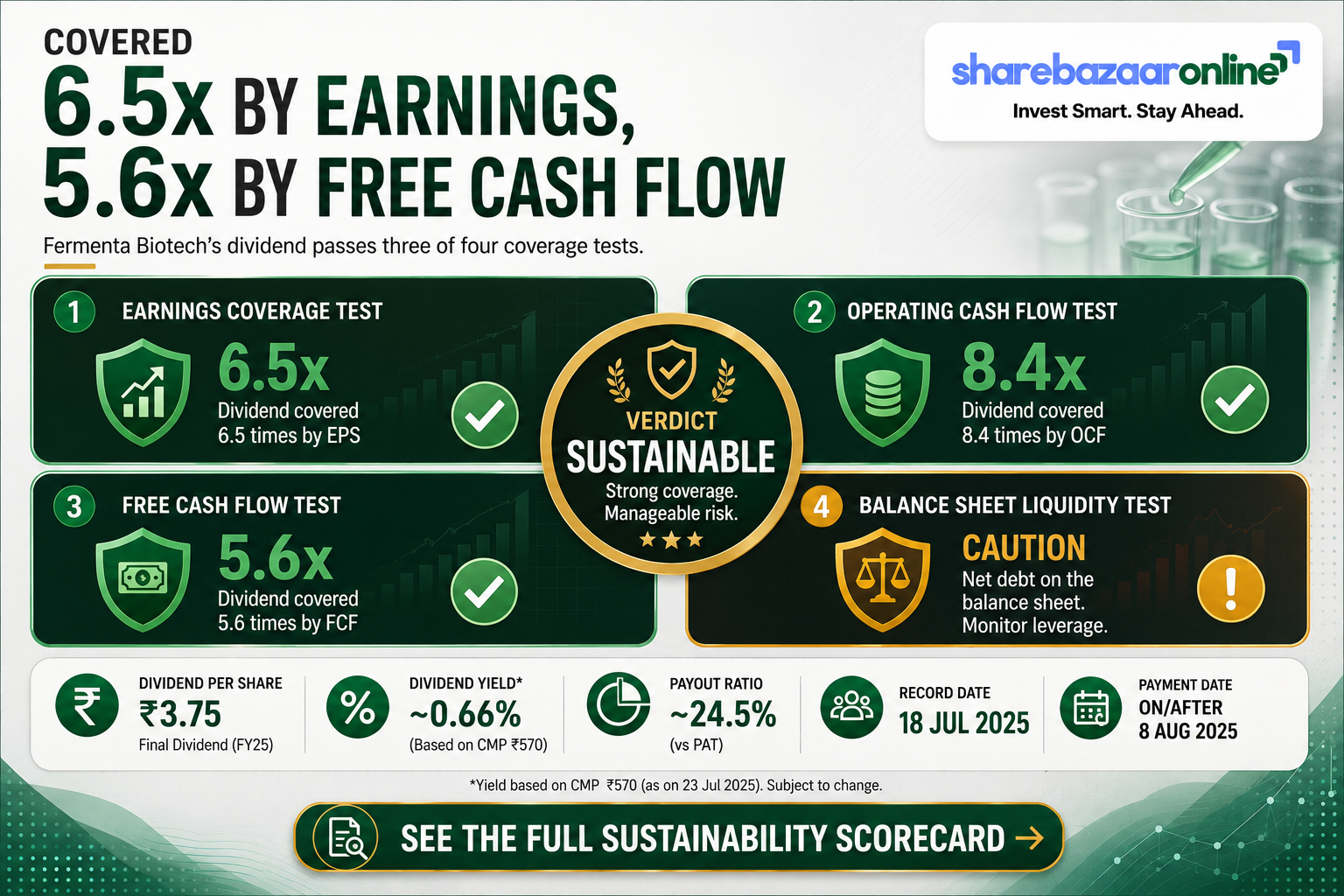
Four coverage tests
| Test | Metric | Result |
|---|---|---|
| Earnings coverage | EPS ₹24.39 ÷ DPS ₹3.75 = 6.5x | Pass |
| Operating cash flow coverage | ₹93 cr ÷ ₹11.04 cr = 8.4x | Pass |
| Free cash flow coverage | ₹62 cr ÷ ₹11.04 cr = 5.6x | Pass |
| Cash / liquidity coverage | Small outflow, but net debt (~₹113 cr borrowings) present | Moderate |
Verdict: Sustainable
Three of four tests pass comfortably; the fourth is only "moderate" because the company carries net debt rather than net cash. With a payout ratio near 15% and free cash flow covering the dividend more than five times, there is ample headroom — the current ₹11 crore outflow is easily affordable. The genuine risk to future dividend growth is not affordability but earnings direction: if the Q1 FY27 profit softness (down ~56% YoY) persists, the pace of DPS increases could slow even though the base dividend remains well covered.
Peer Comparison
| Company | Div. Yield | Payout % | ROE | ROCE |
|---|---|---|---|---|
| Fermenta Biotech | 0.79% | ~15% | 16.4% | 20.6% |
| API / specialty-chem peer set | Not independently verified | — | — | — |
Fermenta is unusual: it is one of the world's largest Vitamin D3 API makers with a non-China-dependent supply chain, so there is no clean, like-for-like listed peer. Rather than populate a peer table with unverified numbers, we leave those cells blank by policy. What can be said with confidence: small-cap Indian pharma / API names typically pay modest yields (well under 1%), and Fermenta's 0.79% sits squarely in that range. Its return metrics (ROE 16.4%, ROCE 20.6%) are above what a low single-digit-yield stock would usually offer, which is consistent with the market pricing it as a growth stock, not an income stock.
Promoter Impact Analysis
Goes to promoters (64.08%)
₹7.07 cr
Of the ₹11.04 cr total
Goes to non-promoters (35.92%)
₹3.96 cr
Public 33.19% + others/FII/DII
The promoter group holds 64.08% of Fermenta, so roughly two-thirds of every rupee distributed — about ₹7.07 crore — flows to the promoter family. That is normal for a founder-controlled company and does not, by itself, raise a concern; promoters and minority holders receive the same ₹3.75 per share. What is worth noting is the very thin institutional presence (FII 0.13%, DII 0.04%): there is little institutional oversight of capital-allocation decisions, which places more weight on retail investors reading disclosures carefully — especially the related-party transactions with the loss-making US subsidiary.
Taxation Analysis
Since April 2020, dividends in India are taxed in the hands of the shareholder at their applicable income-tax slab rate. The company also deducts TDS at 10% under Section 194 if a resident individual's total dividend from that company in a financial year exceeds ₹5,000 (10% only if PAN is provided; otherwise 20%).
Worked example: retail investor with 1,000 shares
| Shares held | 1,000 |
| Dividend per share | ₹3.75 |
| Gross dividend | ₹3,750 |
| TDS at 10% (only if > ₹5,000) | ₹0 (below threshold) |
| Tax at 30% slab + 4% cess (31.2%) | ₹1,170 |
| Net dividend in hand | ₹2,580 |
In this example the ₹3,750 gross dividend is below the ₹5,000 TDS threshold, so no TDS is deducted at source — but the investor still owes tax at their slab when filing. For a 30% bracket investor, the ₹3,750 becomes about ₹2,580 after tax, an effective post-tax yield of roughly 0.54% on the ₹474 price. Investors in lower slabs keep more. This is an illustration, not tax advice — consult a qualified tax professional for your situation.
Key Risks
- 1. Loss-making US subsidiary & related-party exposure. Shareholders approved related-party transactions of up to ₹100 crore with Fermenta USA LLC, which reported a turnover of ₹45.24 crore, a loss after tax of about ₹2.65 crore and negative net worth of about ₹12.60 crore in FY26. Continued funding of a loss-making, negative-net-worth affiliate is a real capital-allocation and governance risk.
- 2. Product concentration in Vitamin D3. Fermenta's core earnings lean heavily on Vitamin D3. In Q1 FY27, Vitamin D3 animal-nutrition realisations fell about 40%, driving a ~56% drop in quarterly profit. Commodity-like price swings in a concentrated product line can hit earnings quickly.
- 3. Near-term earnings momentum has weakened. After a record FY26, Q1 FY27 consolidated profit fell to roughly ₹9.5 crore. If this softness continues, dividend growth may stall even if the base payout stays covered.
- 4. Net debt while distributing and investing. The company carries about ₹113 crore of borrowings and has committed ₹110 crore of Dahej capex, while also paying dividends. If cash flows weaken, these three competing calls on cash could pressure the balance sheet.
- 5. Working-capital stretch. Working-capital days have roughly doubled (to ~96) and inventory days are near 290. Rising working capital can quietly absorb the very free cash flow that funds the dividend.
- 6. Thin institutional ownership / low float validation. FIIs and DIIs together hold well under 1%. Limited institutional scrutiny and a thin free float can amplify price volatility — a factor behind the sharp swing from ₹249 to ₹580 over the past year.
What To Monitor
- 1. Vitamin D3 realisations and volumes — both human and animal nutrition. This is the swing factor for quarterly profit and therefore for future dividend growth.
- 2. Quarterly profit recovery through FY27 — whether the Q1 FY27 dip was a one-quarter realisation issue or the start of a longer trend.
- 3. Fermenta USA LLC performance — any move toward positive net worth and profitability, and the actual utilisation of the ₹100 crore related-party limit.
- 4. Dahej capex execution — whether the ₹110 crore plant-source Vitamin D3, Calcifediol and enzyme expansion is delivered on time and on budget, and whether it stays funded by internal cash.
- 5. Working-capital and net-debt trend — whether inventory and working-capital days normalise, and whether net debt keeps falling.
- 6. Dividend payout trajectory — whether management continues raising the payout ratio (9% → 15% over two years) or holds cash for growth.
Conclusion
Fermenta Biotech's FY26 final dividend of ₹3.75 per share is a well-covered, cash-funded payout that continues a two-year rebuild in shareholder returns (up from ₹2.50 in FY25). On the strength tests it scores well: earnings cover it 6.5 times, free cash flow covers it 5.6 times, and operating cash flow of ₹93 crore came in above reported profit — a sign of clean, cash-backed earnings.
The counterweights are equally clear. The real "yield" on the ₹474 market price is only 0.79%, because the stock has re-rated about 62% since the announcement; the company funds a loss-making, negative-net-worth US subsidiary; product concentration in Vitamin D3 makes earnings choppy (Q1 FY27 profit fell ~56%); and it pays dividends while still carrying net debt and a ₹110 crore capex commitment.
Net: this is a recovering, growth-oriented specialty-chemicals business that pays a small, secure dividend — not a high-yield income stock. We present the positives, negatives and risks in parallel and leave the decision entirely to you.
Frequently Asked Questions
What dividend has Fermenta Biotech announced for FY2025-26?
What is the Fermenta Biotech dividend yield?
What was the record date for the Fermenta Biotech dividend?
What is the ex-dividend date?
When will the Fermenta Biotech dividend be paid?
Who is eligible for the dividend?
How is the Fermenta Biotech dividend taxed?
Is the Fermenta Biotech dividend sustainable?
What is Fermenta Biotech's dividend history?
What should investors monitor after this dividend?
Why did Fermenta's profit fall in FY26 even though revenue rose?
How much of the dividend goes to the promoters?
Is Fermenta Biotech a high-dividend stock?
Disclaimer
ShareBazaar Online is not a SEBI-registered investment adviser or research analyst. This article is for informational and educational purposes only and does not constitute investment, financial, legal or tax advice, or any buy, sell or hold recommendation. Figures are compiled from company filings and third-party sources including Screener.in, exchange disclosures and financial data aggregators, and some (such as the exact ex-date, per-share dividend history before FY25, and standalone cash balances) are labelled as inferred or not independently verified — these must be confirmed against primary sources such as BSE/NSE circulars and the company's annual report before use. Share prices and yields are price-dependent and change continuously; the live market price must be re-verified before relying on any yield figure. Investors should conduct their own due diligence and consult a SEBI-registered adviser and a qualified tax professional before making any decision. ShareBazaar Online accepts no liability for actions taken based on this content.