
Dividend Snapshot
IRB Infrastructure Developers Limited (NSE: IRB | BSE: 532947) has declared an interim dividend of ₹0.05 per equity share for financial year 2026–27, on a face value of ₹1. The headline reads “5% dividend,” but that 5% is measured against the ₹1 face value, not against the market price. Measured against the traded price of roughly ₹19.5, the actual cash yield on this specific payout works out to only about 0.26%. This is the first interim dividend paid on IRB’s expanded post-bonus share base of 1,207.80 crore shares.
The Payout At A Glance
- Dividend per share: ₹0.05
- Rate on face value (₹1): 5%
- Dividend type: Interim (FY2026–27)
- Record date: 5 August 2026
- Payment on or before: 28 August 2026
What It Costs The Company
- Total dividend outflow: ₹60.39 crore
- Cash yield on price (₹19.5): ~0.26%
- Reported trailing dividend yield: ~0.79% (Screener)
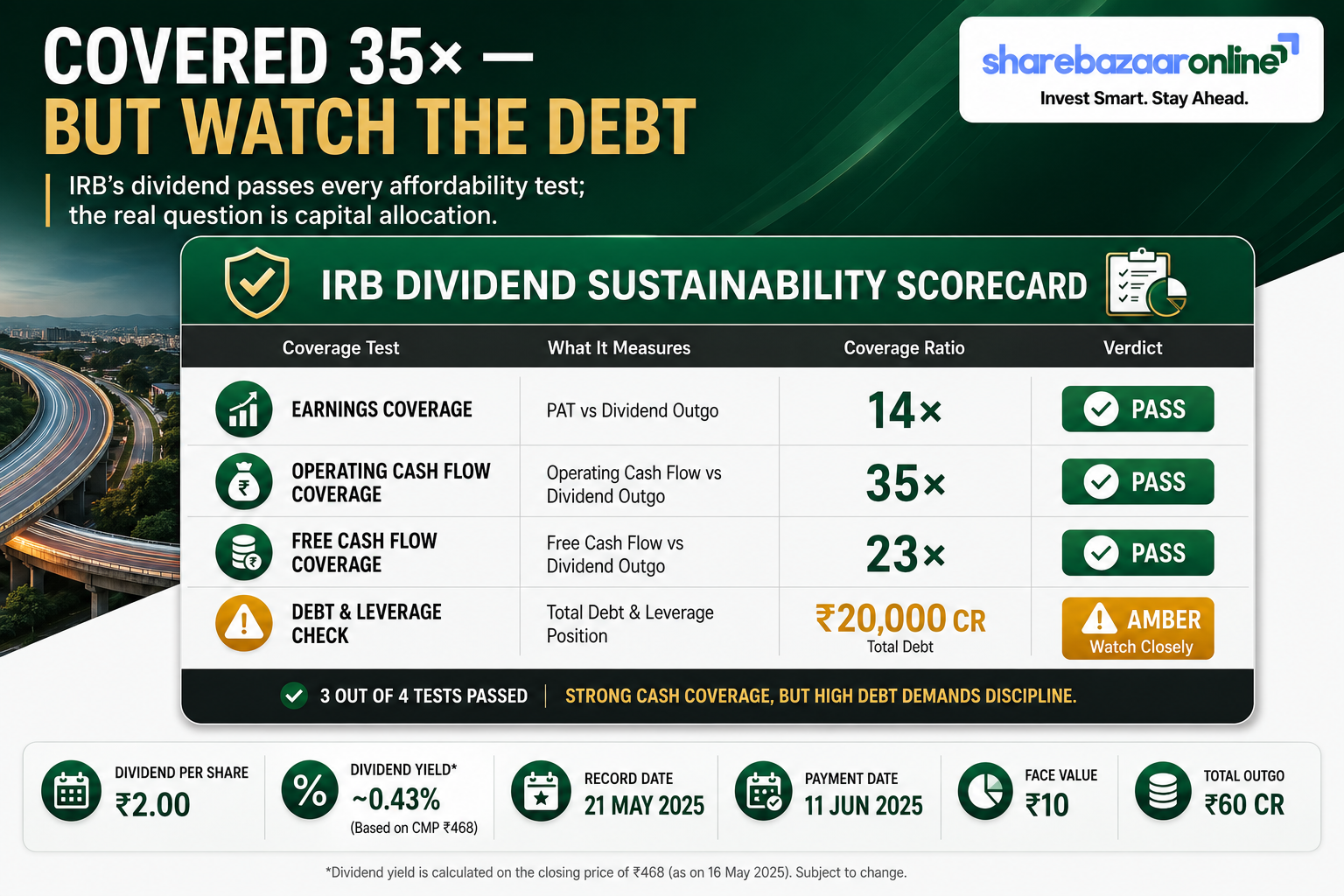
- Earnings coverage (FY26 EPS): 14x
- Cash-flow coverage (FY26 CFO): ~35x
Market price and yield figures are price-dependent and change intraday. Prices sourced from public aggregators (Screener.in, exchange data); the live traded price should be re-verified before relying on any yield figure.
Dividend Announcement Summary
The Board of Directors of IRB Infrastructure Developers Limited met on 30 July 2026 and, alongside the unaudited results for the quarter ended 30 June 2026, declared an interim dividend of ₹0.05 per share. The company fixed 5 August 2026 as the record date and stated that the dividend will be paid or dispatched to eligible shareholders on or before 28 August 2026.
Declared With A Strong Quarter
The dividend accompanied a robust Q1FY27: consolidated net profit rose 51% year-on-year to ₹306 crore (from ₹202 crore), while total income was broadly flat at ₹2,173 crore. Toll revenue climbed 14% to ₹733 crore. Because the dividend does not need shareholder ratification at an AGM (interim dividends are declared by the Board), the record date is firm.
The Bonus Context You Won’t See In Wire Copy
In April 2026 IRB issued a 1:1 bonus, doubling its share count from about 603.9 crore to 1,207.80 crore shares. So ₹0.05 on the new, doubled base delivers the same ₹60.39 crore of cash that a ₹0.10 dividend delivered on the old base. In per-share terms this looks like a cut; in cash terms, it is a continuation.
Key Dates Timeline
| Event | Date | Status / Note |
|---|---|---|
| Board meeting & declaration | 30 July 2026 | Confirmed by exchange filing |
| Ex-dividend date | 5 August 2026 | Inferred — under T+1 settlement the ex-date typically coincides with the record date; verify against the NSE/BSE corporate-action circular |
| Record date | 5 August 2026 | Confirmed by company |
| Payment / dispatch | On or before 28 August 2026 | Outer limit stated by company |
To have qualified for this dividend, an investor needed to hold IRB shares as of the record date of 5 August 2026. Buyers on or after the ex-date do not receive this particular payout.
Dividend Yield Analysis
The 5% Illusion
A “5% dividend” sounds generous, but it is 5% of the ₹1 face value — not 5% of your investment. What actually matters to a shareholder is yield on the market price:
- Yield on price of ~₹19.5: ₹0.05 ÷ ₹19.5 = 0.26%
- Yield at the announcement-date price (~₹20): 0.25%
- Illustrative full-year yield if IRB repeats ₹0.05 each quarter (₹0.20 run-rate): ~1.0%
Why The Reported Yield Looks Higher
Aggregators show a trailing yield near 0.79% because they sum up multiple quarterly payouts over twelve months. That is a fair way to view a serial quarterly payer, but no single ₹0.05 tranche — including this one — is a high-yield event on its own. IRB is not a yield stock; the dividend is a token distribution rather than a core reason to own it.
Yield Reality Check
IRB’s share price has fallen sharply over the past year — the stock is down roughly 11% over one year and trades near its 52-week low band of ₹19–20 (post-bonus adjusted). A falling price would normally inflate a yield, yet even after that decline the event yield stays near a quarter of a percent. That tells you the payout is genuinely small, not that the yield is being propped up by a price crash.
Dividend History Analysis
IRB’s dividend record is best described as irregular and cyclical, not consistent. The company paid steadily through the late 2010s, then suspended dividends entirely in FY2021 and FY2022 during a period of heavy leverage and pandemic-hit toll traffic, before resuming in FY2023. The per-share history below is on the reported (unadjusted) basis; the April 2026 bonus means recent per-share figures are not directly comparable to older ones.
| Financial Year | Dividend Payout Ratio | Signal |
|---|---|---|
| FY2019 | 10% | Paying |
| FY2020 | 24% | Paying |
| FY2021 | 0% | Suspended |
| FY2022 | 0% | Suspended |
| FY2023 | 17% | Resumed |
| FY2024 | 30% | Paying |
| FY2025 | 3% | Low (profit inflated by one-time gain — see below) |
| FY2026 | 18% | Paying |
Payout ratios sourced from Screener.in (consolidated).
Classification: Irregular / Recently Normalised Payer
Because of the two-year suspension and the swing in payout ratios, IRB should not be treated as a dependable dividend compounder. The FY2025 payout of just 3% is misleadingly low: that year’s reported profit was inflated by a large one-time gain, so the ratio understates the real distribution. The steadier reads are FY2024 (30%) and FY2026 (18%).
Financial Performance Analysis
Q1FY27: Profit Up 51% On Flat Revenue
The stand-out feature of the quarter is operating leverage. Consolidated revenue rose only 1.8% (₹2,137 crore vs ₹2,099 crore), yet operating profit jumped ~21% and net profit 51%. The engine was margin: operating margin expanded from about 45% to 54%. Crucially, this was not driven by other income, which actually fell (₹35 crore vs ₹66 crore) — making the profit growth high quality.
The Mix Shift Behind The Margin
IRB is transitioning from lower-margin construction to higher-margin tolling. In Q1FY27, BOT/TOT toll revenue rose +14% and InvIT & related income surged +87%, while construction revenue fell ~21%. Less construction and more tolling mechanically lifts the blended margin. Management describes this as a shift into a “cash-harvesting phase.”
Earnings-Quality Flag: The FY2025 Base Effect
Any five-year growth figure for IRB needs a health warning. Reported FY2025 net profit of about ₹6,481 crore included roughly ₹6,000 crore of one-time other income booked in Q3FY25, tied to asset monetisation into the InvIT. That single event flatters the headline five-year profit CAGR (shown as ~50% on Screener) to a level the underlying business does not sustain. Normalised, IRB’s recurring annual profit runs closer to ₹700–950 crore. Judging the dividend against the ₹6,481 crore figure would be a mistake.
Cash Flow Analysis
Reported profit is an accounting opinion; cash is fact. On the cash test, this tiny dividend is comfortably affordable, though the trend in cash conversion is worth watching.
Operating Cash & Free Cash Flow (FY26)
- Cash from operations (CFO): ₹2,098 crore
- Free cash flow (FCF): ₹1,417 crore
- Dividend outflow this tranche: ₹60.39 crore
- CFO coverage of the payout: ~35x
- FCF coverage of the payout: ~23x
The One Caution: Cash Conversion Slipped
IRB’s CFO-to-operating-profit ratio dropped to about 55% in FY2026, down from 142% in FY2024. In other words, a smaller share of operating profit is turning into cash. For a toll operator with predictable collections this is not alarming, but it signals that reported margins are running ahead of realised cash. The dividend itself is so small that this does not threaten it — but it matters for the bigger question of debt reduction.
How Is The Dividend Funded?
On these numbers the ₹60 crore is funded comfortably from current operating cash flow, not from fresh borrowings or asset sales. That is the correct, sustainable source. The debate at IRB is never whether it can afford a ₹60 crore dividend — it obviously can — but whether cash is best used for dividends versus cutting its ₹20,000 crore-plus debt.
Balance Sheet Strength
A Highly Leveraged, Asset-Heavy Model
- Consolidated borrowings: ~₹20,027 crore
- Net worth (equity + reserves): ~₹20,949 crore
- Debt-to-equity: ~0.96x
- Book value per share: ~₹17.3
- Investments (largely InvIT units): ~₹19,328 crore
Interpreting The Leverage
High debt is structurally normal for a Build-Operate-Transfer road developer — concessions are built with borrowed money and repaid from decades of tolls. The concern is not the existence of debt but its cost: interest of about ₹1,755 crore in FY2026 consumes a large slice of operating profit and is the single biggest drag on returns. A big chunk of the ₹19,328 crore “investments” line is holdings in the IRB InvIT rather than liquid cash, so it is not freely available to retire debt overnight.
Dividend Sustainability Analysis
Four Coverage Tests
| Test | Reading | Verdict |
|---|---|---|
| Earnings coverage | FY26 EPS ₹0.70 vs DPS ₹0.05 → 14x | Pass |
| Operating cash coverage | CFO ₹2,098 cr vs outflow ₹60 cr → ~35x | Pass |
| Free cash flow coverage | FCF ₹1,417 cr vs outflow ₹60 cr → ~23x | Pass |
| Liquidity / balance-sheet | Large investment book, but heavy debt & interest | Amber |
Verdict: Sustainable, But Small By Design
On every affordability test the ₹60 crore payout is comfortably sustainable — it is a rounding error against IRB’s cash flows. The amber flag is not about this dividend surviving; it is about the opportunity cost. With debt above ₹20,000 crore and returns compressed by interest, IRB has deliberately kept the dividend a token gesture. The risk to watch is not a cut, but the history of outright suspension (FY21–FY22) if the leverage or toll cycle turns.
Peer Comparison
A direct peer comparison must carry a caveat: IRB is an asset-heavy BOT/toll operator, while most listed “road” peers (KNR, PNC, GR Infra) are asset-light EPC contractors. EPC players carry less debt and post higher returns because they build and hand over rather than own and toll. That structural difference — not managerial quality alone — explains most of the gap below.
| Company | Model | Div. Yield | ROE | ROCE |
|---|---|---|---|---|
| IRB Infrastructure | BOT / Toll | ~0.79% | ~4.3% | ~7.5% |
| KNR Constructions | EPC (asset-light) | ~0.1% | High* | ~24%* |
| Ashoka Buildcon | EPC + BOT | ~1.3% | High* | Not independently verified |
| GR Infraprojects | EPC (asset-light) | Not independently verified | Not independently verified | Not independently verified |
Peer metrics sourced from public aggregators and are indicative only. *EPC-peer ROE/ROCE figures are frequently inflated by one-time HAM/BOT asset-sale gains and should be normalised before comparison. Cells that could not be independently verified are labelled accordingly.
The Takeaway
IRB posts the lowest return ratios in the group precisely because it owns the assets and carries the debt. What it offers instead is scale and annuity visibility — a portfolio management pegs at roughly ₹94,000 crore with a long weighted-average residual concession life. Its dividend yield sits mid-pack among peers, but none of these companies is a genuine high-yield stock.
Promoter Impact Analysis
Where The ₹60 Crore Goes
- Promoter group (30.81%): ~₹18.6 crore
- FIIs (43.87%): ~₹26.5 crore
- DIIs (10.14%): ~₹6.1 crore
- Public / retail (15.17%): ~₹9.2 crore
Shareholding as of June 2026 (Screener/exchange data).
Reading The Ownership Signal
The largest single beneficiary is actually foreign institutional investors, not the promoter — a reminder that IRB is a heavily institutionally owned name. The promoter’s ₹18.6 crore is modest, and promoter holding has in fact declined by about 3.4 percentage points over three years. This is not a company where a large dividend is being used to funnel cash to a dominant family holder; the payout is spread across a broad, largely institutional register.
Taxation Analysis
How Dividends Are Taxed In India
Since April 2020, dividends are taxed in the hands of the shareholder, not the company. The dividend is added to your total income and taxed at your applicable slab rate. Companies deduct TDS at 10% under Section 194 only when total dividends paid by that company to you in a financial year exceed ₹10,000 (the threshold was raised from ₹5,000 in Budget 2025). Below that, no TDS is deducted — but the income remains taxable and must be declared.
Worked Example (30% Slab Investor)
| Shares Held | Gross Dividend | Tax @30% | Net In Hand | TDS? |
|---|---|---|---|---|
| 1,000 | ₹50 | ₹15 | ₹35 | No |
| 10,000 | ₹500 | ₹150 | ₹350 | No |
| 1,00,000 | ₹5,000 | ₹1,500 | ₹3,500 | No (below ₹10,000) |
Because ₹0.05 per share is so small, even a shareholder holding one lakh shares receives only ₹5,000 gross from this tranche — still under the ₹10,000 TDS trigger. The effective post-tax yield for a top-slab investor is negligible. This is a distribution that matters as a signal of policy, not as income.
Tax treatment is general information, not tax advice. Rules differ for NRIs (typically 20% TDS plus surcharge/cess, subject to treaty relief). Confirm your position with a qualified tax professional.
Key Risks
- High leverage and interest burden. Debt above ₹20,000 crore and interest of ~₹1,755 crore a year are the biggest drag on profitability and the reason the dividend is kept small.
- Structurally low returns. ROE of ~4.3% and ROCE of ~7.5% are modest, and ROCE has drifted down from ~14% (FY2020) to ~7% (FY2026).
- Dividend suspension precedent. IRB paid no dividend in FY2021 and FY2022; a leverage or traffic shock could see the token payout paused again.
- Toll policy and traffic risk. Revenue depends on government tariff revisions, traffic growth, and concession terms — all outside the company’s control.
- InvIT and monetisation dependence. Earnings and cash increasingly rely on asset churn into the IRB InvIT; the pace and pricing of future monetisation is a swing factor, and part of the “investments” book is InvIT units, not cash.
- Cash-conversion slippage. CFO-to-operating-profit fell to ~55% (FY26) from ~142% (FY24), meaning less profit is converting to cash.
What To Monitor
- Monthly toll revenue momentum. July 2026 toll collection rose ~26% year-on-year to ~₹798 crore — sustaining this pace is central to the “cash-harvesting” thesis.
- Debt trajectory. Whether IRB uses rising cash flow to reduce the ₹20,000 crore-plus borrowings, which would lift ROE/ROCE.
- ROCE recovery. Any reversal of the multi-year decline in return on capital.
- Dividend run-rate on the new share base. Whether IRB settles into a steady ₹0.05-per-quarter cadence post-bonus, and the resulting full-year payout.
- InvIT monetisation pipeline. Timing, size and pricing of further asset transfers to the IRB InvIT and their effect on recurring versus one-time earnings.
- Order book and new BOT/TOT wins. Progress toward the stated ₹1,40,000 crore asset-base goal by 2030.
Conclusion
IRB Infrastructure’s ₹0.05 interim dividend is best read as a policy signal, not a payday. The “5% dividend” headline flatters a payout that yields only about 0.26% on the market price, and the ₹60 crore cash cost is trivially covered by operating cash flow.
On the positive side: genuine, high-quality operating leverage (51% profit growth on flat revenue, margin up to 54%), strong toll momentum, and a payout that is bonus-adjusted continuity rather than a cut. On the cautionary side: structurally low returns, ₹20,000 crore-plus of debt, a ₹1,755 crore annual interest bill, weakening cash conversion, and a dividend track record that includes a two-year suspension.
The core question for a shareholder is not this small dividend but the bigger capital-allocation trade-off — distributions versus deleveraging — and whether IRB’s shift into a cash-harvesting, InvIT-led model can lift its historically low return ratios. We present the positives, negatives, risks and monitoring points; the decision is yours.
Frequently Asked Questions
What dividend has IRB Infrastructure announced?
What is the IRB Infrastructure dividend yield?
What is the record date for the IRB dividend?
What is the ex-dividend date?
When will the IRB dividend be paid?
Who is eligible for the dividend?
Why is the dividend ₹0.05 now when IRB used to pay ₹0.10?
How is the IRB dividend taxed?
Is the IRB dividend sustainable?
What is IRB Infrastructure’s dividend history?
Did IRB’s profit really grow 51%?
What should investors monitor going forward?
Is IRB Infrastructure a good dividend stock?
Disclaimer
This article is for informational and educational purposes only and does not constitute investment, financial, legal or tax advice, nor a recommendation to buy, sell or hold any security. ShareBazaar Online is not a SEBI-registered investment adviser. Dividend figures, dates and financial data are based on the company’s exchange filings dated 30 July 2026 and publicly available third-party sources (Screener.in, exchange data and aggregators) believed to be reliable but not independently guaranteed. Market prices and all price-dependent yields change continuously and must be re-verified against live data before use. Financial figures are consolidated unless stated otherwise. Readers should conduct their own due diligence and consult a qualified, registered financial adviser before making any investment decision. ShareBazaar Online accepts no liability for any loss arising from reliance on this content.