
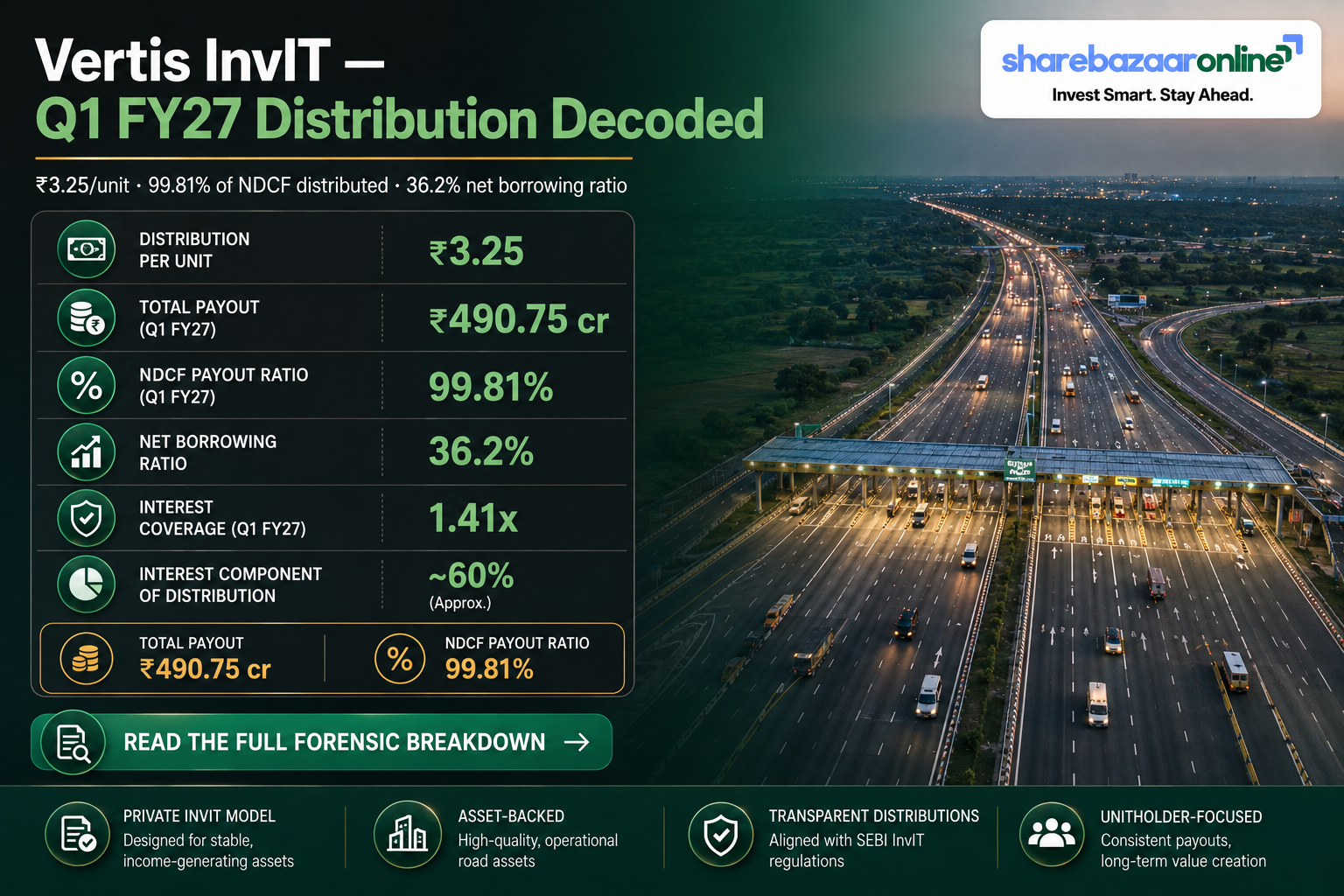
Distribution Snapshot
Total Distribution Per Unit
₹3.2500
Quarter ended June 30, 2026 (Q1 FY27). Declared by the Board of Vertis Fund Advisors Pvt Ltd (Investment Manager) on July 31, 2026.
What The ₹3.25 Actually Contains
- Interest: ₹1.9491 (60.0%) · taxed at your slab
- Dividend: ₹0.8706 (26.8%) · part exempt, part taxable
- Return of capital: ₹0.4264 (13.1%) · your own capital back
- Other income: ₹0.0039 (0.1%)
Instrument
Vertis Infrastructure Trust (Road InvIT)
NSE Symbol
VERTIS
ISIN (units)
INE0KXY23015
Distribution Type
Quarterly (Interim)
Record Date
August 5, 2026
Payment By
On/before August 12, 2026
Total Payout
₹490.75 crore
Units Outstanding
150.998 crore
NAV / Unit (30-Jun-26)
₹107.39
Trailing-12M Yield*
~11.9%
Sponsor
KKR (via Galaxy Investments II)
Portfolio
27 road assets, ~8,088 lane-km
*Yield is price-dependent. Computed on last available close of ~₹108 (early June 2026 reference); re-verify against the live unit price before relying on it.
Distribution Announcement Summary
On July 31, 2026, the Board of Directors of Vertis Fund Advisors Private Limited — the Investment Manager acting for Vertis Infrastructure Trust (formerly Highways Infrastructure Trust) — approved a total distribution of ₹3.2500 per unit for the quarter ended June 30, 2026. Across the trust’s 150.998 crore units, that is an aggregate payout of ₹490.75 crore.
An InvIT distribution is not a company “dividend.” Under SEBI InvIT rules the trust must pay out at least 90% of its Net Distributable Cash Flow (NDCF), and each rupee is split into legally distinct buckets that are taxed differently. For this payout the split is: interest ₹1.9491, return of capital ₹0.4264, dividend (old-regime SPVs) ₹0.2143, dividend (new-regime SPVs) ₹0.6563 and other income ₹0.0039.
The number the wire misses
Only about ₹0.87 of the ₹3.25 (26.8%) is technically “dividend,” and only ₹0.6563 of that is taxable dividend. The largest single component is interest (60%), taxed at your slab. A further 13.1% is return of capital — the trust handing back part of your invested capital as its toll concessions run down.
Structure at a glance
Vertis is a KKR-sponsored road InvIT holding 27 operational toll and hybrid-annuity (HAM) assets across 10 states via 28 special purpose vehicles (SPVs). Investment Manager: Vertis Fund Advisors. Project Manager: Vertis Project Manager. Trustee: Axis Trustee Services. AUM crossed ₹250 billion in FY25 after the PNC Infratech 10-asset acquisition (May 2025) and TOT-16 (North Telangana).
Key Dates Timeline
- Board meeting / declarationJuly 31, 2026
- Ex-date (NSE/BSE)August 5, 2026
- Record dateAugust 5, 2026
- Payment on or beforeAugust 12, 2026
Under the T+1 settlement regime, the ex-date and record date coincide on August 5, 2026. Unitholders on the register at the close of the record date qualify for the payout. Because this article publishes after the record date, the eligibility window has closed — the payout is a completed corporate action with settlement due on or before August 12, 2026.
Ex-date/record-date confirmed against exchange corporate-action data (aggregator). Payment date is the statutory outer limit disclosed by the trust, not necessarily the exact credit date.
Distribution Yield Analysis
Yields at a reference price of ~₹108
- This quarter (event)3.01%
- Annualised run-rate (₹3.25 × 4)~12.0%
- Trailing 12 months (₹12.88)~11.9%
- FY26 full year (₹12.00)~11.1%
Reference price = last available close ~₹108 (early June 2026). 52-week range ₹98.20–₹111.00. Re-verify against live price before use.
Yield reality check
A headline ~12% looks generous against a ~7% government bond, but two adjustments matter. First, 13.1% of every payout is return of capital — not income, but your own money coming back as toll assets depreciate. Second, the interest and taxable-dividend portions are taxed at your slab, so a 30%-bracket investor keeps materially less. The post-tax single-quarter yield for a 30%-slab holder is roughly 2.26% (about 9% annualised), before counting the deferred tax on return of capital.
The trust trades at roughly 1.0× NAV (unit price ~₹108 vs NAV ₹107.39), so the yield here is not being flattered by a distressed or falling price — it reflects the genuine cash-generating profile of a mature road portfolio, not a value trap.
Distribution History Analysis
| Quarter | Declared | Per Unit (₹) | Total (₹ cr) |
|---|---|---|---|
| Q1 FY26 (Jun’25) | Aug 13, 2025 | 2.3711 | 358.03 |
| Q2 FY26 (Sep’25) | Nov 7, 2025 | 3.0000 | 452.99 |
| Q3 FY26 (Dec’25) | Jan 30, 2026 | 3.0000 | 452.99 |
| Q4 FY26 (Mar’26) | May 20, 2026 | 3.6289 | 547.96 |
| Q1 FY27 (Jun’26) | Jul 31, 2026 | 3.2500 | 490.75 |
Is ₹3.25 a “cut”? No.
The payout fell from ₹3.6289 in Q4 FY26 to ₹3.25 (−10.4%), which a headline reader could mistake for a reduction. It is seasonal: the March quarter carries a year-end true-up and is typically the highest of the year. Measured like-for-like against the same quarter a year earlier, the payout is up 37.1% (₹2.3711 → ₹3.2500).
Payer classification
Vertis reads as a consistent, growing quarterly payer: five uninterrupted quarterly distributions, a rising per-unit trend driven by the FY25–26 portfolio expansion (PNC assets, TOT-16), and FY26 aggregating to ₹12.00 per unit. The trailing four quarters total ₹12.88. As a listed InvIT the 90%-of-NDCF pass-through is a regulatory obligation, not a discretionary board decision.
Financial Performance Analysis
| Consolidated (Q1 FY27) | ₹ crore | YoY vs Q1 FY26 |
|---|---|---|
| Revenue from operations | 1,030.9 | +27.8% |
| Total income & gains | 1,064.3 | +25.6% |
| Profit after tax (total) | 342.5 | +134.3% |
| PAT attributable to unitholders | 306.1 | +186.1% |
| Amortisation of toll rights (non-cash) | 273.5 | — |
| EPU (basic, ₹) | 2.03 | +185.9% |
EBITDA margin 84.82% · Net profit margin 33.22% (consolidated).
Operating leverage
Revenue rose ~28% year-on-year while attributable profit nearly tripled (+186%). The gearing is real but flattered by the base: Q1 FY26 profit was depressed and the acquired PNC/TOT-16 assets only became full-quarter contributors from FY27. The 84.82% EBITDA margin is characteristic of toll/annuity roads, where operating cost is low relative to revenue.
Why profit understates cash
Reported profit carries ₹273.5 crore of non-cash amortisation of toll-collection rights each quarter. That is an accounting charge, not a cash cost. It is the core reason the ₹490.75 crore distribution exceeds the ₹306 crore attributable profit — the payout is funded from cash flow (NDCF), not accounting earnings.
Cash Flow Analysis
For an InvIT, reported profit is an opinion; NDCF is the fact that funds distributions. In Q1 FY27 the Trust computed NDCF of ₹491.68 crore and distributed ₹490.75 crore — 99.81% of NDCF, retaining just ₹0.93 crore. The SEBI floor is 90%, so Vertis is distributing close to the maximum.
How the cash is funded
Cash flows up from the operating SPVs (toll collections and NHAI annuities) to the Trust, which distributes them. The payout is funded from current operating cash generation of the road portfolio, supplemented by the return-of-capital mechanism — not from fresh borrowing at the Trust level and not from asset sales.
Trapped cash — a real flag
₹280.8 crore is effectively trapped at two SPVs — BETPL (₹199.6 cr) and UEPL (₹81.2 cr) — because they lack distributable profits under the Companies Act, 2013. Both have filed NCLT petitions for capital reduction to free the cash. Separately, GRICL could not upstream cash this quarter due to semi-annual debenture-covenant testing (₹85.1 cr reserved), making its NDCF nil for the period.
Receivables note: the Trust reports no trade receivables (debtor turnover N/A), consistent with a holding structure that receives interest and distributions from SPVs rather than billing customers directly. Working-capital risk sits inside the SPVs, chiefly in the timing of NHAI annuity receipts for the HAM assets.
Balance Sheet Strength
- Value of InvIT assets₹27,775 cr
- Total borrowings (consolidated)₹11,460 cr
- Cash & equivalents₹1,501 cr
- Net worth₹6,175 cr
- Debt / equity1.85×
Leverage headroom is the key test
For an InvIT, the regulatory gauge is the net borrowing ratio: 36.20% against the SEBI cap of 70% — roughly 34 percentage points of headroom. Interest service coverage is 3.82× and debt service coverage 2.25×, so cash comfortably covers debt obligations. A debt/equity of 1.85× looks high in isolation but is normal for a capital-intensive, cash-generative road platform, and the asset cover on listed debentures stands at ~2.0×.
Distribution Sustainability Analysis
| Sustainability test | Reading | Verdict |
|---|---|---|
| NDCF coverage | 99.81% of NDCF paid (SEBI min 90%) | Pass |
| Leverage headroom | Net borrowing 36.2% vs 70% cap | Pass |
| Interest cover | 3.82× (DSCR 2.25×) | Pass |
| Liquidity / trapped cash | ₹280.8 cr trapped at 2 SPVs | Amber |
| Earnings quality | Recurring SPV impairments; RoC in payout | Amber |
Overall reading: sustainable in the near term, with structural caveats. The distribution is well covered by cash flow and leverage is conservative by InvIT standards. The caveats are inherent to toll-road InvITs: a portion of the payout is return of capital (a finite-life asset returning your money), some SPV cash is trapped pending NCLT relief, and the trust recorded impairments of ~₹42.8 crore this quarter (standalone) and ~₹133 crore in FY26, indicating a few assets are tracking below their carried valuation. This is not a buy, sell or hold view — it is a read of whether the cash exists to sustain payouts, which it currently does.
Peer Comparison
| Listed InvIT | Asset class | Approx TTM yield | Profile |
|---|---|---|---|
| Vertis (VERTIS) | Toll + HAM roads | ~11.9% | KKR-sponsored, ~72% promoter-held |
| IRB InvIT (IRBINVIT) | Toll (BOT) roads | ~10–11% | India’s first listed InvIT; high yield, higher risk |
| Indus Infra / Bharat Highways | HAM roads | Blank* | NHAI annuity-backed, lower traffic risk |
| IndiGrid (INDIGRID) | Power transmission + solar | ~8–10% | Diversified, active acquirer |
| PowerGrid InvIT (PGINVIT) | Power transmission | ~6–7% | Lowest-risk, tariff-backed, stable |
Peer yields are approximate market figures and move with unit prices. *Left blank rather than filled with an unconfirmed number. Confirm each figure from the respective InvIT’s latest investor update before relying on the comparison.
Vertis sits at the higher-yield, toll-road end of the peer set — closer to IRB InvIT than to the lower-yielding, tariff-backed power InvITs. The trade-off is standard: toll-road InvITs carry traffic-volume risk and a larger return-of-capital element, whereas HAM (annuity) and power-transmission InvITs offer steadier, contract-backed cash but lower headline yields. A distinctive Vertis feature is its concentrated ownership — the KKR sponsor group holds the large majority, so the public free float is small relative to the peer group.
Sponsor & Unitholder Impact
Who receives the ₹490.75 crore
- Sponsor group (KKR) ~71.66%~₹351.7 cr
- Public / other unitholders ~28.34%~₹139.1 cr
Promoter/public split per latest available shareholding pattern (aggregator). Verify against the trust’s filed unitholding disclosure.
What this means
Roughly ₹7 of every ₹10 distributed accrues to KKR-affiliated sponsor entities (chiefly Galaxy Investments II and Nebula Asia Holdings II). Minority public unitholders share the remaining ~₹139 crore. Interests are aligned — the sponsor is paid on the same per-unit terms as the public — but the small free float means secondary-market liquidity is thinner than for widely-held peers, which can widen bid-ask spreads and amplify price moves around events.
Taxation Analysis
InvIT distributions are taxed component-by-component under Section 115UA, with TDS under Section 194LBA. This is where the “₹3.25” headline is most misleading — the four buckets are taxed on four different bases.
| Component | Per unit (₹) | Tax treatment (resident individual) |
|---|---|---|
| Interest | 1.9491 | Taxable at slab; 10% TDS (194LBA) |
| Dividend (old-regime SPVs) | 0.2143 | Exempt (SPV not under 115BAA) |
| Dividend (new-regime SPVs) | 0.6563 | Taxable at slab; 10% TDS |
| Return of capital | 0.4264 | Not taxed now; reduces cost of acquisition |
| Other income | 0.0039 | Taxable at slab |
Worked example — 1,000 units, 30% slab
- Gross distribution: ₹3,250.00
- Slab-taxable (interest ₹1,949.10 + taxable dividend ₹656.30 + other ₹3.90): ₹2,609.30
- Exempt dividend: ₹214.30 · Return of capital: ₹426.40 (defers tax, cuts your cost base)
- Tax @31.2% (30% + 4% cess): ₹814.10
- TDS @10% under 194LBA on interest + taxable dividend: ₹260.54 (creditable in your return)
- Net in hand after tax: ₹2,435.90 → effective tax on the distribution ~25%
Illustrative for a resident individual in the 30% bracket; excludes surcharge. Return of capital is not taxed on receipt but lowers your cost of acquisition, so tax is deferred to the point of sale (and any return of capital beyond your cost is taxed as income from other sources). No PAN raises TDS to 20% (206AA). Not tax advice — consult a qualified professional for your situation.
Key Risks
- Traffic-volume risk on toll assets. Toll roads depend on vehicle volumes and negotiated rate revisions; a slowdown or a competing corridor directly hits toll SPV cash flows and future distributions.
- Return-of-capital erosion. ~13% of each payout is return of capital from finite-life concessions. As assets approach concession end, distributions can decline unless replaced by acquisitions.
- Trapped cash & SPV solvency. ₹280.8 crore is trapped at BETPL and UEPL pending NCLT capital-reduction approval; delays or adverse rulings would keep that cash locked.
- Interest-rate and refinancing risk. With ~₹11,460 crore of borrowings, higher rates raise finance costs and squeeze distributable cash, even though current interest cover (3.82×) is comfortable.
- Recurring impairments / valuation risk. Impairments of ~₹42.8 crore this quarter and ~₹133 crore in FY26 suggest some assets are underperforming carried value; NAV of ₹107.39 depends on valuer assumptions that can move.
- Thin free float & concentrated ownership. With ~72% held by the KKR sponsor group, secondary-market liquidity is limited and unit prices can be volatile around events.
- Regulatory / covenant timing. Debenture covenants (e.g., GRICL’s semi-annual test) and SEBI rules can defer cash upstreaming and reshape quarterly payouts.
What To Monitor
- NDCF trend and the distribution mix. Watch whether NDCF grows and whether the return-of-capital share of each payout rises — a rising RoC share signals more of your “yield” is capital coming back.
- NCLT outcomes at BETPL and UEPL. Approval of the capital-reduction schemes would release ~₹280.8 crore of trapped cash into distributable flows.
- Net borrowing ratio vs the 70% cap. Acquisitions are debt-funded; track how much of the 34-point headroom is consumed.
- Toll revenue and traffic growth across the core toll SPVs, plus timeliness of NHAI annuity receipts on the HAM assets.
- Acquisition pipeline and cost of debt. New assets (like the earlier PNC and TOT-16 deals) drive per-unit growth; refinancing at the 7.40% sustainability-linked bond level or better protects distributions.
- Quarterly impairment charges and NAV revisions as a read on asset health.
- Free-float and sponsor-stake changes — any sponsor sell-down would improve liquidity but could pressure the unit price.
Conclusion
Vertis Infrastructure Trust’s ₹3.25 per unit Q1 FY27 distribution — ₹490.75 crore in aggregate — is a well-covered payout from a large, mature KKR-backed road platform. On the metrics that actually govern an InvIT, it screens healthily: 99.81% of NDCF distributed, a conservative 36.2% net borrowing ratio, and 3.82× interest cover. Measured correctly, the sequential dip from ₹3.63 is seasonal, and the payout is up 37% year-on-year.
The nuance the wire reports skip is what the ₹3.25 is: 60% interest, 13% return of your own capital, and under 27% dividend — taxed on three different bases. The genuine watch-items are the ₹280.8 crore of trapped SPV cash, recurring impairments, the return-of-capital drag inherent to finite-life toll roads, and a thin public float behind ~72% sponsor ownership. This analysis presents positives, negatives, risks and monitoring factors so you can weigh them yourself; it contains no buy, sell or hold recommendation.
Frequently Asked Questions
What distribution has Vertis Infrastructure Trust announced?
What is the Vertis InvIT distribution yield?
What is the record date for the Vertis distribution?
What is the ex-date?
When will the distribution be paid?
Who is eligible to receive it?
How is an InvIT distribution taxed?
Is the distribution sustainable?
What is the distribution history?
Why is the ₹3.25 lower than last quarter’s ₹3.63?
Why does the ₹490.75 crore payout exceed reported profit?
What should investors monitor going forward?
Disclaimer
This article is for information and educational purposes only and is prepared from publicly available exchange filings and third-party data sources. ShareBazaar Online is not a SEBI-registered investment adviser and this content is not investment, legal or tax advice, nor a recommendation to buy, sell or hold any security or unit. Figures for market price, yield, shareholding and peer comparison are drawn from external aggregators and may be stale or subject to revision — all yield figures are price-dependent and must be re-verified against the live unit price before use. Tax outcomes depend on individual circumstances; consult a qualified professional. Investments in InvITs carry market, traffic, interest-rate, valuation and liquidity risks, and past distributions are not indicative of future payouts. Readers should conduct their own due diligence and consult a registered adviser before making any decision.