
Dividend Snapshot
Vedanta Aluminium Metal Limited (NSE: VAML | BSE: 544780) has declared its first-ever interim dividend of ₹8 per equity share for the financial year 2026-27. On a face value of just ₹1, this works out to an eye-catching 800% dividend — but as this analysis shows, the headline percentage and the real cash yield are two very different things.
Dividend Details
- Dividend Per Share: ₹8.00
- Dividend Type: First Interim Dividend (FY2026-27)
- Face Value: ₹1.00
- Rate on Face Value: 800%
- Total Dividend Outflow: ₹3,128.55 Crore
- Shares Outstanding: ~391.07 Crore (triangulated)
Yield & Key Dates
- Dividend Yield (latest CMP ₹464): ~1.72%
- Yield on Announcement Price (₹457.05): ~1.75%
- Announcement Date: 30-07-2026
- Record Date: 05-08-2026
- Ex-Date: 05-08-2026 (inferred under T+1; confirm via exchange circular)
- Payment Date: Not disclosed by company
The one-line takeaway: A newly demerged, cash-generative aluminium major is rewarding shareholders early with a well-covered maiden payout — but the “800%” label flatters a real cash yield of under 2%, and the dominant beneficiary is the promoter group, consistent with the Vedanta group’s long-running high-distribution DNA. (All price-linked figures are as of the dates cited and must be re-verified against the live market price before publication.)
Dividend Announcement Summary
At its board meeting held on Thursday, 30 July 2026 (commenced 1:20 p.m., concluded 2:18 p.m. IST), the Board of Directors of Vedanta Aluminium Metal Limited approved the company’s first interim dividend of ₹8 per equity share on a face value of ₹1, for FY2026-27. The aggregate payout is stated in the exchange filing at approximately ₹3,128.55 crore. The record date is 5 August 2026, and the company stated the dividend will be paid within the statutory timelines prescribed under law.
Why This Announcement Matters
VAML is one of the entities created by the demerger of Vedanta Limited’s aluminium undertaking, which became effective on 1 May 2026; its shares were listed and admitted to trading on the NSE and BSE from 15 June 2026. This is therefore the very first dividend the company has paid as an independently listed entity — a maiden payout, not part of an established track record.
Also Approved At The Same Meeting
The Board also cleared two employee schemes — VAML ESOP 2026 and VAML ESPP 2026 — together covering up to 5% of paid-up share capital, to be run through the VAML ESOS Trust via secondary (open-market) acquisition rather than fresh issuance. The ESOP pool alone is 16,62,04,184 shares (4.25% of capital); the ESPP pool is 2,93,30,150 shares (0.75%). Because these are secondary-acquisition trusts, they are non-dilutive to existing shareholders. Both schemes are subject to member approval.
Key Dates Timeline
Announcement
Thursday, 30 July 2026 — Board approves the first interim dividend of ₹8/share.
Record Date
Wednesday, 5 August 2026 — shareholders on the register on this date are eligible to receive the dividend.
Ex-Dividend Date
Wednesday, 5 August 2026 (inferred). Under India’s T+1 settlement, the ex-date typically coincides with the record date. This should be confirmed against the official NSE/BSE corporate-action circular.
Payment Date
Not disclosed by company. An interim dividend must statutorily be paid within 30 days of declaration, implying an outer limit of on or around 29 August 2026.
Eligibility in plain terms: To receive this dividend you needed to hold VAML shares in your demat account as of the record date, 5 August 2026. Because of T+1 settlement, a purchase had to be made in time to settle by that date. Buying on or after the ex-date does not carry dividend entitlement.
Dividend Yield Analysis
The Face-Value Illusion
A “800% dividend” sounds enormous, but that number is simply the dividend expressed against the tiny ₹1 face value (₹8 ÷ ₹1). What actually lands in your account depends on the market price you pay, not the face value. At the latest reference price of ₹464, the real cash yield is only about 1.72%. On the announcement-day close of ₹457.05 (30 July 2026), the yield was ~1.75%. This gap between headline percentage and real yield is one of the most common ways retail investors misjudge a dividend.
Yield Maths
- Yield on latest CMP (₹464) = 8 ÷ 464 = 1.72%
- Yield on announcement CMP (₹457.05) = 8 ÷ 457.05 = 1.75%
- Headline rate on face value = 8 ÷ 1 = 800%
Yield Reality Check
Is this yield “high” because of a generous payout or a weak share price? Neither. VAML’s stock has been firm since listing (52-week range roughly ₹422–₹538), so the ~1.72% yield reflects a modest maiden payout on a fully valued, rising stock — not distress. This is a coverage-driven, deliberately conservative first distribution rather than a high-yield income play.
Dividend History Analysis
A Genuine First-Ever Dividend
VAML was incorporated on 6 October 2023 and only became an operating, listed entity after the demerger took effect on 1 May 2026. As a result, there is no multi-year standalone dividend track record to analyse — this ₹8 payout is the company’s maiden dividend. Any “10-year history” you may see elsewhere would belong to the erstwhile parent, not to VAML itself.
Classification
Payer type: First-Ever Payer. With only one data point, consistency cannot yet be judged. Investors should treat future dividends as unproven until a second and third payout establish a pattern.
Inherited DNA (Context, Not History)
VAML’s shareholders were issued shares 1:1 from Vedanta Limited, a company known for very large dividends (Vedanta Ltd paid ₹34/share in FY26). That group culture of high distribution is useful context for what VAML’s policy might look like — but it is not a promise, and it is not VAML’s own record.
Financial Performance Analysis
A Strong Backdrop To The Payout
The dividend arrives on the back of a powerful set of numbers. For Q1FY27 (quarter ended June 2026), VAML reported consolidated revenue from operations of ₹21,393 crore (up ~46% year-on-year), record EBITDA of ₹10,499 crore (up ~134% YoY) at a best-ever EBITDA margin of about 50%, and consolidated net profit of ₹6,597 crore (up ~205% YoY). Profit attributable to VAML’s own shareholders was ₹5,629 crore, giving a reported EPS of ₹14.39.
FY26 Consolidated (Carve-out)
- Revenue: ₹66,891 Cr
- EBITDA / Operating Profit: ₹25,163 Cr (OPM ~38%)
- Profit Before Tax: ₹19,061 Cr
- Net Profit (incl. minority): ₹14,153 Cr
- Dividend Payout (FY26): 0% — no dividend paid last year
Source: consolidated financials via Screener.in.
Operating Leverage Working In Its Favour
Revenue rose ~46% YoY in Q1 while EBITDA jumped ~134% — a textbook case of positive operating leverage. The drivers were higher aluminium (LME) realisations, record production of 632 KT, best-ever value-added product output of 389 KT, and a FY26 cost of production of about USD 1,752/tonne (its lowest in five years). Profit grew far faster than sales because costs stayed broadly flat while prices and volumes rose.
The Minority-Interest Nuance Most Reports Miss
There is a subtle but important distinction in VAML’s consolidated profit. Q1FY27 total consolidated PAT was ₹6,597 crore, but the portion attributable to VAML’s own shareholders was ₹5,629 crore — the difference of roughly ₹968 crore belongs to non-controlling (minority) interests, principally in subsidiary Bharat Aluminium Company (BALCO), which is partly government-owned. When judging what earnings actually back the dividend, the owners’ profit figure is the more accurate base.
Cash Flow Analysis
Reported profits are an opinion; cash is a fact. Because VAML’s first post-demerger annual report is not yet published, a line-by-line standalone operating and free cash flow statement for the new entity is Not Disclosed by Company at the time of writing. However, the debt movement gives a strong, verifiable read on cash generation.
Cash Signal From Deleveraging
In a single quarter (Q1FY27), VAML cut net debt by ₹3,481 crore, from ~₹33,013 crore to ₹29,532 crore. Reducing debt at that pace while funding heavy growth capex is only possible with robust operating cash conversion. This is indirect but powerful evidence that the EBITDA is translating into real cash, not just accounting profit.
How Is The Dividend Funded?
On the evidence available, the ₹3,128.55 crore payout appears fundable from current operating cash generation rather than from asset sales. That said, VAML is a holding-and-operating structure: dividends can legally be paid only from the parent’s distributable reserves, which were established through the demerger scheme and are replenished by up-streaming from operating subsidiaries. The absence of a published cash flow statement means the precise operating and free cash flow coverage remains Not Independently Verified.
Balance Sheet Strength
Debt & Liquidity (Q1FY27)
- Net Debt: ₹29,532 Cr
- Gross Debt: ₹35,600 Cr (term ₹33,300 Cr + working capital ₹2,300 Cr)
- Cash & Equivalents: ₹6,068 Cr
- Net Debt / EBITDA: 0.9x (improved from 1.3x)
- Credit Rating: AA+ (Stable) — CRISIL & ICRA (upgraded)
The Two-Sided Picture
On leverage relative to earnings, VAML looks comfortable: a net-debt/EBITDA of 0.9x is healthy for a heavy-industry business, and the rating upgrade reinforces this. But in absolute terms, net debt of nearly ₹29,500 crore is large — reported to be the highest among all the demerged Vedanta entities. The dividend is therefore being paid by a company that still carries meaningful debt, so debt trajectory is worth watching (see “What To Monitor”).
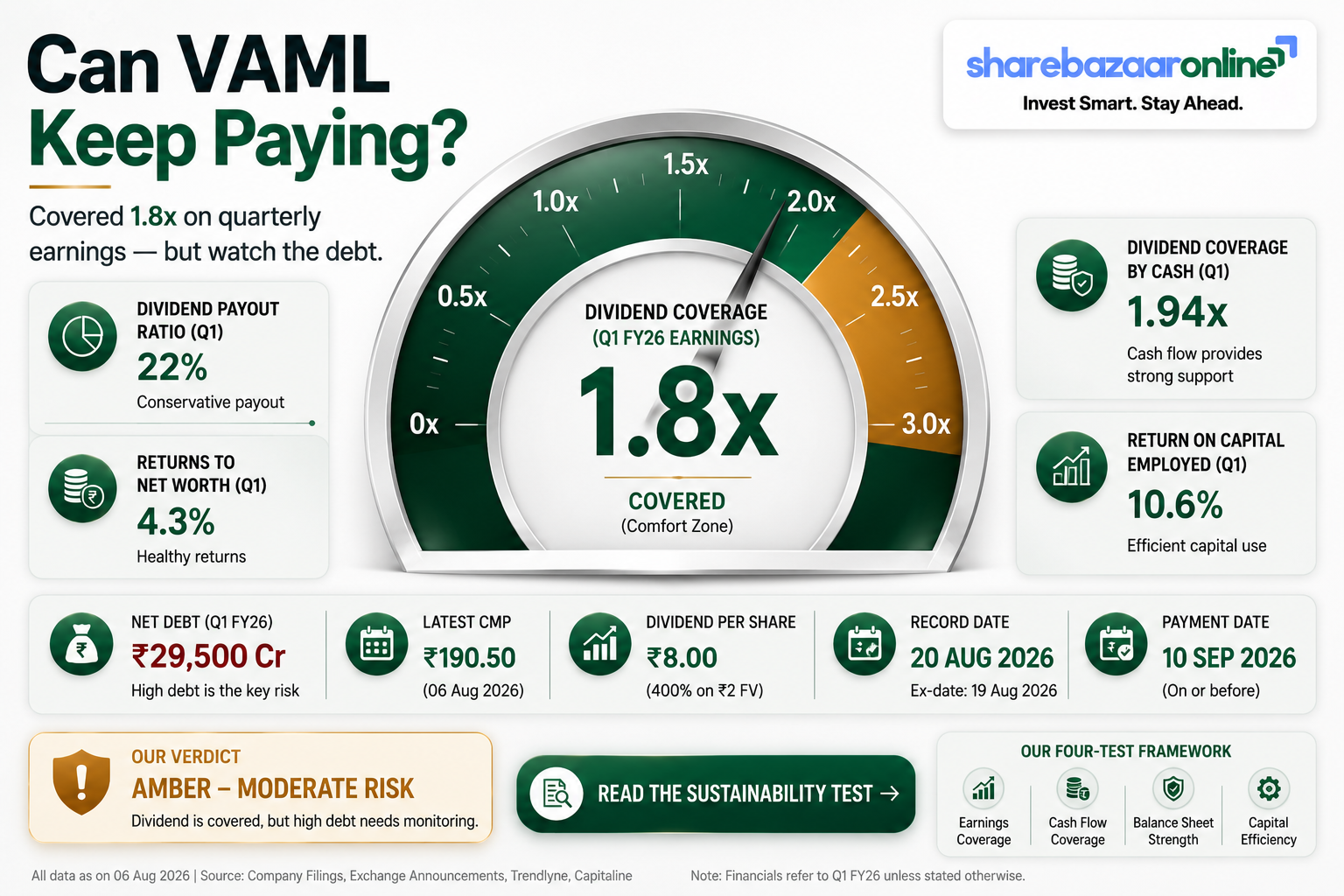
Cash coverage of the dividend: cash & equivalents of ₹6,068 crore cover the ₹3,128.55 crore payout roughly 1.94x. The company is not draining its cash buffer to pay this dividend, though the buffer is not enormous relative to the outflow.
Dividend Sustainability Analysis
We test sustainability against four coverage lenses — earnings, cash, balance sheet, and the trend in the business itself.
Earnings Coverage — Pass
Even against a single quarter’s owners’ EPS of ₹14.39, the ₹8 dividend is covered 1.80x. Measured against likely full-year FY27 earnings (annualising Q1 gives ~₹57.6 EPS), the payout ratio is only about 13.9% and coverage jumps to ~7.2x. On FY26’s consolidated profit the payout is ~22.1%. All comfortably conservative.
Cash & Balance-Sheet Coverage — Amber/Pass
Cash covers the outflow ~1.94x and net debt is falling, both supportive. The amber flag is absolute debt of ~₹29,500 crore plus ongoing large capex — the dividend competes with deleveraging and reinvestment for the same cash.
Earnings Trend — Cyclical Caveat
The recent surge in profit is real, but it is substantially driven by high LME aluminium prices. Aluminium is a global commodity; earnings can fall as sharply as they rose. A first dividend struck near a cyclical high should not be extrapolated as a fixed run-rate.
Verdict
Moderately Sustainable to Sustainable. The maiden payout is small relative to earnings and well covered today. The main risks to future dividends are commodity-price cyclicality and the competing pull of debt reduction and capex — not affordability of this particular payout.
Peer Comparison
| Metric | VAML | Hindalco | Vedanta Ltd | NALCO |
|---|---|---|---|---|
| Latest Dividend / Share | ₹8 (1st interim FY27) | ₹5 (FY26) | ₹34 (FY26) | — |
| Approx. Dividend Yield | ~1.72% | ~0.5–0.6% | ~7.4% | — |
| Approx. Payout Ratio | ~22% (FY26 PAT basis) | ~8% (of FY26 EPS ₹60.31) | >100% (historically) | — |
| Net Debt / EBITDA | 0.9x | ~1.83x | — | Net cash (typical) |
| Net Debt (FY26) | ~₹29,532 Cr | ~₹6,484 Cr | — | — |
Blank cells (—) indicate figures not independently confirmed at the time of writing and deliberately left unpopulated rather than estimated. Yields are price-dependent and approximate.
Reading The Table
Two peers frame VAML from opposite ends. Hindalco is the conservative, low-payout, reinvestment-focused aluminium major (payout ~8%). Vedanta Limited — VAML’s former parent — sits at the opposite extreme with very high yields and payouts often exceeding profits. VAML’s maiden ~22% payout currently sits closer to Hindalco’s conservatism than to Vedanta’s aggression. Whether it drifts toward the group’s traditional high-distribution model is a key open question.
Promoter Impact Analysis
Where The ₹3,128.55 Crore Goes
Based on the June 2026 shareholding pattern, the total dividend outflow splits across ownership groups as follows. The promoter group is by far the largest single beneficiary.
Dividend By Shareholder Group
- Promoters (56.38%): ~₹1,763.88 Cr
- DIIs (13.90%): ~₹434.87 Cr
- FIIs (12.55%): ~₹392.63 Cr
- Public / Retail (16.93%): ~₹529.66 Cr
- Government (0.07%) & Others (0.16%): remainder
Number of shareholders: 21,15,856 (Jun 2026).
The Structural Point To Understand
More than half of every dividend rupee flows to the promoter group. Across the Vedanta group, large dividends have historically been an important channel for up-streaming cash toward the ultimate holding company. A maiden dividend that is well within earnings but disproportionately benefits the majority owner is consistent with that pattern. Minority and retail shareholders benefit proportionally — roughly ₹530 crore in aggregate to the public category — but the distribution’s primary logic sits with the controlling shareholder. We present this as fact for readers to weigh; it is neither an endorsement nor a criticism.
Taxation Analysis
How Dividends Are Taxed In India
Since the abolition of Dividend Distribution Tax (April 2020), dividends are taxed in the hands of the investor at their applicable income-tax slab rate. For resident shareholders, the company deducts TDS at 10% under Section 194 if the total dividend paid to that shareholder in a financial year exceeds ₹5,000 (a valid PAN is assumed; without PAN, TDS is 20%). The TDS is only a prepayment — the final liability is settled at your slab rate when you file your return.
Worked Example — 1,000 Shares, 30% Slab
- Shares held: 1,000
- Dividend: ₹8 × 1,000 = ₹8,000 (gross)
- TDS @10% (as > ₹5,000): ₹800 deducted at source
- Amount credited now: ₹7,200
- Total tax @31.2% (30% + 4% cess): ₹2,496
- Balance tax payable at filing: ₹1,696
- Net dividend after full tax: ₹5,504
Effective Post-Tax Yield
For a 30%-slab investor, the after-tax dividend is about ₹5.50 per share. Against a market price of ₹464, that is a post-tax cash yield of only about 1.19%. The lesson: for high-slab investors, a headline “800% dividend” delivers a very modest net return — another reason to look past the face-value figure. Surcharge on dividend income is capped at 15% for high earners; investors in lower slabs pay correspondingly less. This is general information, not tax advice.
Key Risks
1. Commodity-Price Cyclicality
Earnings are tightly linked to LME aluminium prices. At least one brokerage (InCred) has flagged 25–37% downside risk to peers on a bearish metals view. A price reversal would compress the very EBITDA that funds dividends and deleveraging.
2. Absolute Debt Load
Net debt of ~₹29,532 crore — the largest among the demerged entities — leaves less room to absorb a downcycle while simultaneously paying dividends and investing.
3. Promoter-Led Distribution Culture
The Vedanta group’s history of large dividends used for holding-company deleveraging means future payouts could be driven by promoter cash needs rather than VAML’s standalone reinvestment priorities.
4. Newly Listed, Short Track Record
Listed only since 15 June 2026, VAML has no seasoned public financial history, no published post-demerger annual report yet, and an unproven dividend policy. Valuation multiples on data aggregators are still settling.
5. Capital-Raising & Capex Intensity
The company confirmed (6 Aug 2026) it is evaluating financing options following a media report of a possible ~₹13,500 crore raise. Alongside a large aluminium expansion programme, funding needs could compete with dividend capacity.
6. Input & Regulatory Exposure
Power, coal, bauxite and alumina costs, plus mining/environmental approvals (e.g., bauxite block auctions), can swing margins. Aluminium is energy-intensive, so any power-cost or carbon-policy shift is material.
What To Monitor
1. LME Aluminium Price & Cost Curve
Track LME price trends and VAML’s cost of production per tonne (USD 1,752/t in FY26). The gap between the two is the profit engine that funds dividends.
2. Net-Debt Trajectory
Watch whether net debt keeps falling (as in Q1’s ₹3,481 crore reduction) or reverses if a large fundraise or capex cycle begins.
3. The Second Dividend
A single payout proves nothing. A second and third dividend will reveal whether VAML is a consistent, cyclical, or promoter-driven payer.
4. First Post-Demerger Annual Report
Its audited cash flow statement will finally allow direct OCF and FCF coverage checks that are currently not disclosed.
5. Production & VAP Mix
Volume growth (632 KT in Q1) and rising value-added product share (389 KT) support margin resilience even if base metal prices soften.
6. Capital Allocation Signals
Watch how management balances dividends vs debt reduction vs capex — and any change in stated dividend policy or promoter distribution intent.
Conclusion
Vedanta Aluminium Metal’s maiden ₹8 interim dividend is a confident debut from a business firing on all cylinders — record Q1 EBITDA of ₹10,499 crore, a best-ever ~50% margin, falling net debt and a fresh AA+ rating. The payout is well covered (roughly 1.8x on a single quarter’s earnings, ~13.9% of likely full-year FY27 earnings) and does not stress the balance sheet.
The Positives
Strong, cash-backed earnings; conservative payout ratio; improving leverage; low-cost, high-volume, integrated operations; and a rating upgrade. The dividend is affordable and prudent as struck.
The Watch-Outs
A ~1.72% real yield despite the “800%” label; commodity cyclicality; large absolute debt; a promoter that receives the majority of the payout; and no dividend track record to lean on.
Bottom line: a healthy, well-covered first dividend from a strong operator — but one to read for what it signals about future policy, not for its modest current cash yield. We present the positives, negatives, risks and monitoring factors; the decision rests with each reader.
Frequently Asked Questions
What dividend has Vedanta Aluminium Metal (VAML) announced?
What is the VAML dividend yield?
What is the record date for the VAML dividend?
What is the ex-dividend date?
When will the dividend be paid?
Who is eligible for the VAML dividend?
How is this dividend taxed?
Is the VAML dividend sustainable?
What is VAML’s dividend history?
How does the payout affect the promoter?
How does VAML’s dividend compare with Hindalco and Vedanta Ltd?
What should investors monitor going forward?
Why does a "800% dividend" translate to under 2% yield?
Disclaimer
This article is for informational and educational purposes only and does not constitute investment, financial, legal or tax advice, nor a recommendation to buy, sell or hold any security. ShareBazaar Online is not a SEBI-registered investment adviser or research analyst. Dividend figures, dates and financial data are sourced from the company’s exchange filings and publicly available data (including Screener.in, exchange disclosures and media reports) and may contain errors or become outdated; several price-linked figures (yield, market price) are time-sensitive and must be independently re-verified against the live market price and the official NSE/BSE corporate-action circular before any decision. The ex-date shown is inferred under T+1 convention and the payment date is not disclosed by the company. Certain figures (e.g., standalone cash flow, some peer metrics) are marked as not disclosed or not independently verified. Past performance and one-time events are not indicative of future results. Aluminium is a cyclical commodity business and results can vary sharply. Please consult a SEBI-registered adviser and conduct your own due diligence before investing. The author and ShareBazaar Online accept no liability for any loss arising from the use of this content.