
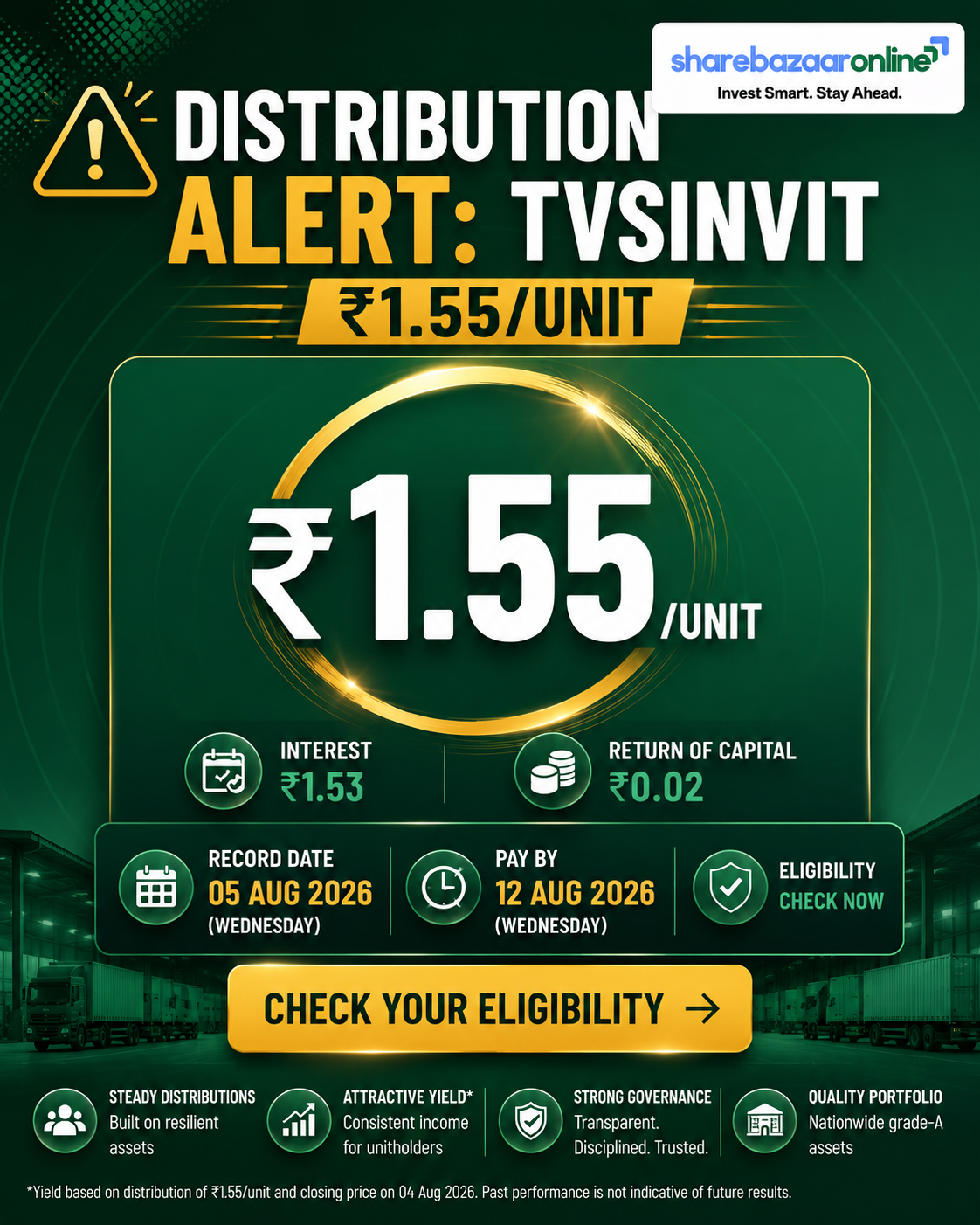
Distribution Snapshot
TVS Infrastructure Trust (NSE: TVSINVIT) is an Infrastructure Investment Trust (InvIT), not an ordinary company. What it has declared is a quarterly distribution of ₹1.55 per unit for Q1 FY2026–27 — and unlike a company dividend, this payout is split into ₹1.53 as interest and ₹0.02 as return of capital. That split changes how the money is taxed and how "yield" should be read, which we unpack below.
Distribution Per Unit
₹1.55
₹1.53 interest + ₹0.02 return of capital
Distribution Type
Interim (Quarterly)
InvIT distribution for Q1 FY27
Total Distribution Outflow
₹30.57 Cr
on 19.72 crore units
Annualised Yield (approx.)
~5.3%
on CMP ₹116.05 (15-Jul-2026)
Record Date
5 Aug 2026
Ex-Date (inferred)
5 Aug 2026
Payment
On/before 12 Aug 2026
Face / Issue Value
₹100 per unit
Distribution Announcement Summary
On Saturday, 1 August 2026, the Board of Directors of TVS Infrastructure Investment Manager Private Limited — the Investment Manager to the Trust — approved the Q1 FY27 unaudited results and declared a distribution of ₹1.55 per unit. The total payout works out to ₹30,56,60,000 (₹30.57 crore) across 19,72,00,000 units.
What was declared
A quarterly InvIT distribution comprising ₹1.53 interest (income the Trust earns on loans it has advanced to its warehousing SPVs) and ₹0.02 return of capital. There is no equity dividend component here — a point that matters for tax.
Approval status
InvIT distributions do not require AGM approval — they are approved directly by the Board of the Investment Manager under the SEBI InvIT Regulations. The payout is scheduled within five working days of the record date, i.e. on or before 12 August 2026.
About the Trust
TVSINVIT is a Grade-A warehousing and logistics InvIT sponsored by TVS Industrial & Logistics Parks Private Limited (part of the TVS Mobility Group). It listed on the NSE on 8 July 2025 after a ₹1,050 crore private placement, and owns nine warehousing SPVs plus one holding company. Its assets sit in Tamil Nadu, Odisha and Andhra Pradesh (Cuttack, Sullurpet, Redhills and others).
Key Dates Timeline
12 Aug 2026
Note: The company disclosed the record date and an outer payment date but did not separately state an ex-date. The ex-date above is inferred, not confirmed.
Distribution Yield Analysis
Here is the yield reality check most wire coverage misses. A headline of "₹1.55 per unit" or "1.55%" is only this single quarter, and the "1.55%" figure is measured against the ₹100 issue price — not the market price you actually pay.
This distribution only
₹1.55 on CMP ₹116.05 = 1.34% for the quarter. On the ₹100 issue price it is 1.55% — the "face-value" number that flatters the headline.
Annualised (the number that matters)
Trailing 12-month payout is ₹6.08 per unit and the forward run-rate (₹1.55 × 4) is ₹6.20. On CMP that is a yield of roughly 5.2%–5.3%; on issue price, 6.1%–6.2%.
Why the yield looks low for an InvIT
TVSINVIT trades at ₹116 versus its ₹100 issue price, so the market is paying a 16% premium to par. A younger, growth-stage warehousing trust that the market re-rates upward will show a lower distribution yield than a mature road or power InvIT — because part of those higher yields is the return of a depreciating asset base. TVSINVIT's ~₹0.02 return-of-capital slice is tiny, so almost all of its payout is genuine income.
Distribution History Analysis
| Quarter | Distribution / Unit | Split | Notes |
|---|---|---|---|
| Q2 FY26 | ₹1.51 | Interest + RoC | First payout after 8 Jul 2025 listing |
| Q3 FY26 | ₹1.51 | Interest + RoC | Held flat |
| Q4 FY26 | ₹1.51 | Interest + RoC | FY26 total ₹4.53 |
| Q1 FY27 | ₹1.55 | ₹1.53 + ₹0.02 | First step-up (+2.6%) |
Pattern
The Trust has paid every quarter since listing and has now delivered its first increase, from ₹1.51 to ₹1.55. Given only about a year of listed history, it is best classified as a consistent but early-stage payer — a track record is still being built.
Comparability caveat
There have been no unit splits or bonus issues, so the ₹1.51 → ₹1.55 comparison is clean. But with fewer than five quarters on record, the "consistency" verdict carries less weight than it would for a decade-old payer.
Financial Performance Analysis
The Q1 FY27 headline — consolidated net profit of ₹17.74 crore, up a striking +213% from ₹5.66 crore the prior quarter — needs a caveat before anyone celebrates. This is consolidated (SPV-inclusive) data, the correct lens for the operating business.
The profit jump is largely a tax credit
Consolidated profit before tax was ₹12.33 crore, but the tax line was a net credit of ₹5.41 crore (a deferred-tax credit), which lifted after-tax profit above pre-tax profit. Strip that out and the underlying operating trend is far tamer than "+213%" suggests. Reported profit is an opinion; the tax credit flatters it.
Standalone vs consolidated
At the standalone Trust level, profit was ₹42.19 crore (EPU ₹2.14), driven by ₹57.90 crore of interest income on loans to SPVs. Consolidated EPU is only ₹0.90, because depreciation of ₹17.44 crore on the warehouses sits inside the consolidated numbers.
Margins and operating leverage
Revenue from operations was ₹62.95 crore with a reported EBITDA margin of 78.45% — high, as expected for a rental-asset model with low variable costs. The two biggest below-EBITDA drags are finance cost ₹19.62 crore and depreciation ₹17.44 crore, which together explain why a high-margin business still reports a modest consolidated bottom line.
Cash Flow Analysis
For an InvIT, the number that pays your distribution is not accounting profit — it is Net Distributable Cash Flow (NDCF). And here the analysis surfaces a genuine nuance.
The distribution exceeds one quarter's Trust NDCF
Trust-level NDCF for Q1 was ₹20.25 crore (about ₹1.03 per unit), yet the declared payout is ₹30.57 crore — roughly 151% of the quarter's Trust-level NDCF. In other words, this quarter's distribution is not fully covered by the Trust's own quarterly NDCF (cover of 0.66×).
but SPV cash and reserves bridge it
The Trust received ₹38.44 crore of cash upstreamed from its SPVs during the quarter — comfortably above the payout (1.26× cover). The Trust-level NDCF is lower than this because it is struck after the Trust's own NCD interest of about ₹15.3 crore. The shortfall is bridged by SPV cash timing and the Trust's large liquidity buffer.
How this distribution is funded
Predominantly from current rental income upstreamed by the SPVs as interest, with a small ₹0.02 per unit return-of-capital component and support from cash reserves. It is not funded by fresh borrowing or asset sales. A warehousing InvIT in build-out will typically show thin or negative free cash flow while it invests in new projects (about ₹60 crore of NCD proceeds went into Cuttack, Sullurpet and Redhills capex) — so, as with lending or infrastructure entities, manufacturing-style free-cash-flow tests are the wrong yardstick. NDCF coverage, DSCR and FACR are the correct affordability tests.
Balance Sheet Strength
Net Worth (Unitholders' funds)
₹1,867 Cr
Total Borrowings
₹1,038.7 Cr
Cash & Investments
₹134.7 Cr
SEBI Net Borrowing Ratio
0.33
Leverage is well inside limits
The SEBI net borrowing ratio of 0.33 sits comfortably below the regulatory ceiling (0.49, rising to 0.70 only with an investment-grade rating and track record). Debt-to-equity is 0.56, the current ratio is 3.49, and the asset cover on the debentures is 2.92×. The auditor certified a security cover of 3.05× (book) / 3.53× (market) against a 1.20× requirement.
The debt profile
The Trust's principal debt is ₹830 crore of listed NCDs at a 7.42% coupon with a 20-year tenor (put option at year 10). Cash and investments of ₹134.7 crore plus a funded Debt Service Reserve Account give the payout a 4.4× cash cushion. Cover ratios DSCR 2.15×, Interest Service Coverage 2.73× and FACR 3.51× all clear their 1.20× covenants with room to spare.
Distribution Sustainability Analysis
| Test | Result | Verdict |
|---|---|---|
| Trust-level NDCF cover | 0.66× (payout = 151% of Q1 NDCF) | Amber — not covered by single-quarter Trust NDCF |
| SPV cash-received cover | 1.26× (₹38.44 Cr received) | Pass |
| Cash / liquidity cover | 4.41× (₹134.7 Cr cash) | Pass |
| Standalone earnings cover | 1.38× (EPU ₹2.14) | Pass |
| Consolidated earnings cover | 0.58× (EPU ₹0.90) | N/A — wrong test (depreciation-heavy; InvITs distribute cash, not accounting profit) |
Overall verdict: Moderately Sustainable
The payout is supported by rental cash upstreamed from SPVs, strong liquidity and covenant-beating coverage ratios. The one honest flag is that the ₹1.55 distribution modestly outran the Trust's own quarterly NDCF and leaned on SPV cash timing and reserves. That is not unusual for a young InvIT and is well cushioned today — but it is a line worth watching if quarterly NDCF does not grow into the distribution over the next few quarters.
Peer Comparison
| InvIT | Sector | Indicative Yield* | Distribution character |
|---|---|---|---|
| TVSINVIT | Warehousing / logistics | ~5.2%–5.3% | Mostly interest; tiny RoC; trades above par |
| IndiGrid | Power transmission | ~7%–9% | Interest + income; acquisitive |
| IRB InvIT | Toll roads | ~10%–11% | Includes return of depreciating capital |
| PowerGrid InvIT | Power transmission | high double-digit** | Payout on a depreciating asset base |
* Peer yields are indicative ranges sourced from third-party aggregators and are Not Independently Verified against primary filings; they should be re-populated from primary sources at the editorial desk before publishing. ** One aggregator quoted a ~15% trailing yield for PowerGrid InvIT; road and mature-transmission InvITs carry structurally higher yields partly because they return depreciating capital. TVSINVIT is India's first pure warehousing InvIT, so there is no direct like-for-like listed peer. Its lower yield reflects a growth-stage, appreciating asset base trading at a premium to par — a different proposition from the high-yield road/power InvITs.
Sponsor (Promoter) Impact Analysis
Sponsor's share of the payout
On a sponsor holding of about 34.9% (per aggregator data), the sponsor group receives roughly ₹10.67 crore of the ₹30.57 crore distribution. Public and institutional unitholders (~65.1%) receive the balance of about ₹19.90 crore.
Alignment
Because the distribution is equal per unit, the sponsor and minority unitholders are paid on identical terms — there is no preferential class here. The sponsor is required to retain its minimum unitholding and control of the Investment Manager under the InvIT Regulations, which keeps incentives aligned.
Data note: A full unit-holding pattern (sponsor / FII / DII split) is not currently published on standard portals. The ~34.9% sponsor figure is sourced from an aggregator and is flagged for primary-source verification; FII/DII splits are Not Disclosed.
Taxation Analysis
This is where InvIT distributions differ most sharply from company dividends — and where aggregators frequently get it wrong (one portal even labelled this a "final dividend"). InvIT distributions are taxed component by component under Section 115UA, not as a single dividend.
Interest component (₹1.53)
Fully taxable in the unitholder's hands at their slab rate. The Trust deducts TDS at 10% for resident unitholders (Section 194LBA); non-residents face a higher rate.
Return of capital (₹0.02)
Not taxed on receipt. It reduces the cost of acquisition of your units, so it effectively defers tax to when you eventually sell (via a slightly higher capital gain). Amounts returned in excess of the issue price are taxed as other income.
Worked example — 1,000 units
| Line | 30% slab | 20% slab | 5% slab |
|---|---|---|---|
| Gross distribution (₹1.55 × 1,000) | ₹1,550 | ₹1,550 | ₹1,550 |
| Taxable interest (₹1.53 × 1,000) | ₹1,530 | ₹1,530 | ₹1,530 |
| Return of capital (not taxed now) | ₹20 | ₹20 | ₹20 |
| Tax on interest (at slab) | ₹459 | ₹306 | ₹76 |
| TDS deducted at source (10%) | ₹153 | ₹153 | ₹153 |
| Net in-hand after tax | ₹1,091 | ₹1,244 | ₹1,474 |
On ₹1,16,050 invested (1,000 units at CMP), the net event yield is roughly 0.94% for the quarter at a 30% slab — about 3.8% annualised. TDS is only an advance; the final liability depends on your own slab, and the return-of-capital ₹20 lowers your cost base for later.
Key Risks
1. Large disputed GST input tax credit
The group carries an ₹139.55 crore input tax credit under dispute with the tax authorities on warehouse construction, following the Safari Retreats litigation and the retrospective 2025 amendment to Section 17(5)(d) of the CGST Act. It has already received show-cause notices of ₹38.84 crore and demand orders of ₹28.46 crore. The disputed sum is about 7.5% of net worth and roughly 4.6× a single quarter's distribution — the single biggest quantifiable overhang.
2. Distribution running ahead of Trust NDCF
This quarter's payout was about 151% of Trust-level NDCF, bridged by SPV cash and reserves. If quarterly NDCF does not grow into the distribution, future step-ups may depend on new acquisitions or on drawing down the liquidity buffer.
3. Tenant concentration and occupancy
Rental income depends on warehouse occupancy and lease renewals across a concentrated set of Grade-A parks. Any vacancy, tenant default or re-leasing at lower rates would flow straight through to SPV cash and, ultimately, to distributions.
4. Interest-rate and refinancing risk
Finance cost of ₹19.62 crore is the largest single charge below EBITDA. The NCDs carry a put option at year 10; a higher-rate environment at refinancing, or SPV-level bank loan resets, would compress distributable cash.
5. Reliance on non-cash tax credits and thin disclosure
Q1's profit surge was driven by a ₹5.41 crore deferred-tax credit, not operations — earnings quality is lower than the headline. A full unit-holding pattern is also not yet published on standard portals, limiting transparency for retail investors.
6. Minor governance housekeeping
The auditor's security-cover certificate noted that a few current accounts (at the InvIT, JGILP and RSIPPL) outside the permitted Escrow structure were still in the process of being closed — a small covenant-hygiene item rather than a breach, but worth tracking.
What To Monitor
1. NDCF trajectory vs the distribution
Watch whether Trust-level quarterly NDCF grows toward the ₹30 crore payout. Consistent 1.0×-plus NDCF cover would upgrade the sustainability verdict from Moderate to firm.
2. GST ITC dispute resolution
Track the outcome of the ₹139.55 crore input-credit litigation and any further demand orders or appeal decisions — the most material contingent item on the books.
3. Occupancy, rent roll and lease renewals
The Trust files a semi-annual rent roll; monitor occupancy, weighted average lease expiry and re-leasing spreads across the warehousing SPVs.
4. New acquisitions and capex deployment
Roughly ₹26.75 crore of NCD proceeds remains unutilised. Track how capex at Cuttack, Sullurpet and Redhills converts into rent-generating area, and any inorganic SPV additions that could lift NDCF.
5. Leverage, coupon and credit rating
Keep an eye on the net borrowing ratio (currently 0.33), DSCR/FACR trends, and any change in the NCD rating — all of which gate the Trust's ability to grow both assets and distributions.
6. Interest vs return-of-capital mix
Watch whether the return-of-capital slice grows in future distributions — a rising RoC share would signal that a larger part of the payout is your own capital coming back rather than fresh income.
Conclusion
TVS Infrastructure Trust's Q1 FY27 distribution of ₹1.55 per unit is its first step-up since listing and lands on a business with genuinely strong balance-sheet metrics: leverage well inside SEBI limits (net borrowing ratio 0.33), covenant-beating coverage (DSCR 2.15×, FACR 3.51×, security cover 3.05×) and a ₹134.7 crore liquidity cushion that covers the payout 4.4×.
The positives
Consistent quarterly payments since listing, a first increase, a mostly-income (not return-of-capital) distribution, low leverage, and India's first pure warehousing InvIT riding a structurally under-supplied sector.
The watch-items
A profit surge flattered by a deferred-tax credit, a payout that ran ~151% of one quarter's Trust NDCF, a ₹139.55 crore disputed GST credit, and a yield (~5.3%) that is lower than mature road/power InvITs — reflecting a growth, not high-income, profile.
Net-net, this is a moderately sustainable, income-plus-growth InvIT distribution from a well-capitalised trust, with the tax mechanics and the NDCF-coverage nuance being the two things a retail unitholder should understand before reading the "1.55%" headline at face value. The positives, negatives, risks and monitoring points are laid out above for you to weigh — this article does not offer any buy, sell or hold view.
Frequently Asked Questions
What distribution has TVS Infrastructure Trust announced?
What is the distribution yield?
What is the record date?
What is the ex-date?
When will the distribution be paid?
Who is eligible to receive it?
How is an InvIT distribution taxed?
Is the distribution sustainable?
What is TVSINVIT's distribution history?
Why did net profit jump 213% but the distribution barely moved?
What is the biggest risk unitholders should watch?
Why is TVSINVIT's yield lower than IRB or PowerGrid InvIT?
Does this distribution need AGM approval?
Disclaimer
This article is for informational and educational purposes only and does not constitute investment, financial, tax or legal advice, nor any recommendation to buy, sell or hold any security or unit. ShareBazaar Online is not a SEBI-registered investment adviser. Figures are drawn from TVS Infrastructure Trust's exchange filing dated 1 August 2026 and its Q1 FY27 unaudited results; market price, yield, sponsor-holding and peer figures are sourced from third-party providers, are dated where stated, and may be stale — all price-dependent figures (especially yields) must be re-verified against the live market price before acting. Peer yields and the unit-holding pattern are indicative and Not Independently Verified. InvIT distributions carry different tax treatment from company dividends; consult a qualified tax adviser for your specific situation. Investments in InvITs are subject to market and business risks, including possible loss of capital. Readers should do their own research and consult a licensed financial adviser before making any investment decision.