
Dividend Snapshot
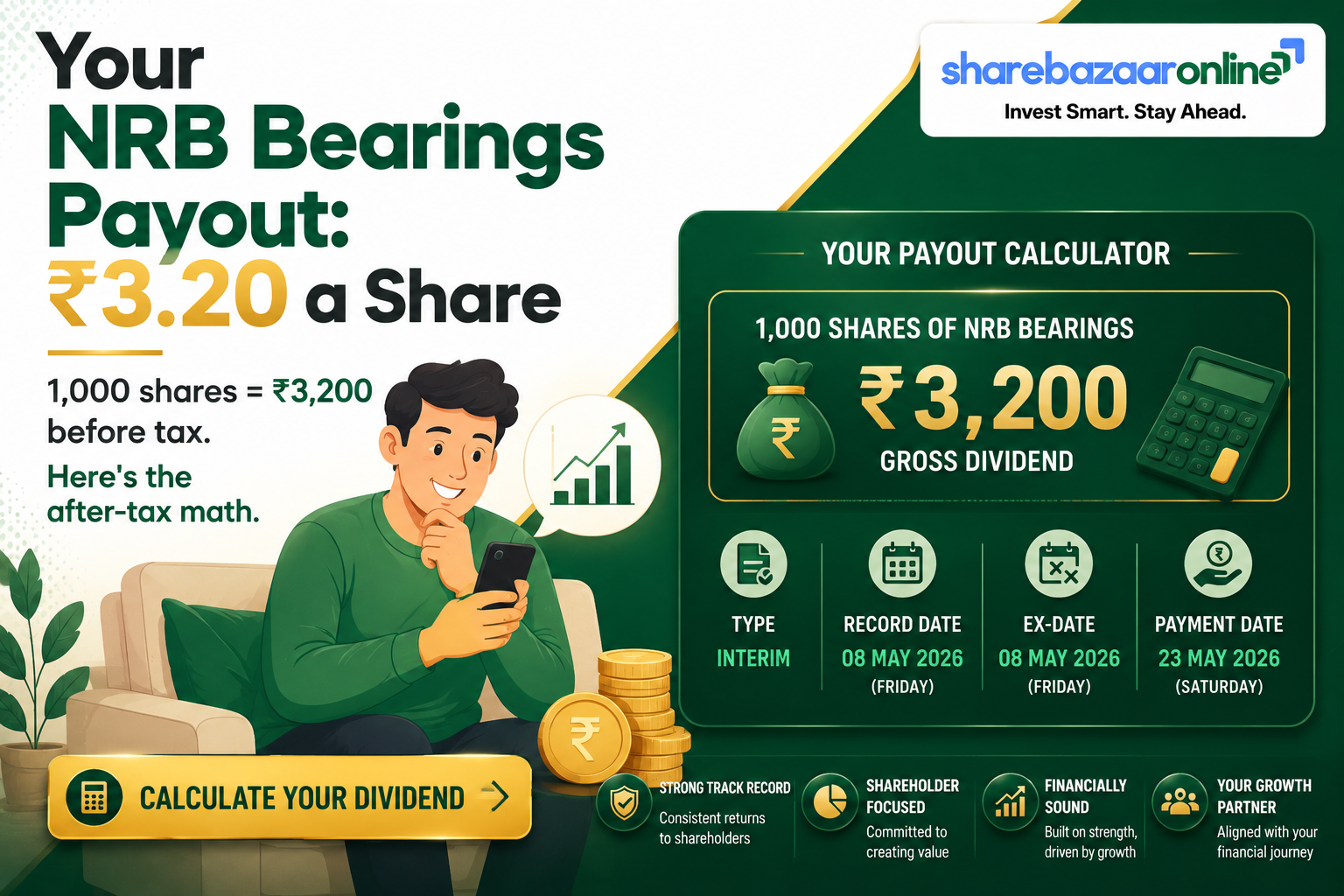
Dividend Per Share
₹3.20
160% of face value (2nd interim, FY2025-26)
Face Value
₹2.00
Per equity share
Record Date
13 Feb 2026
Friday
Estimated Total Outflow
₹31.01 Cr
On ~9.69 crore shares
NRB Bearings Limited (NSE: NRBBEARING | BSE: 530367 | ISIN: INE349A01021) declared a second interim dividend of ₹3.20 per share for FY2025-26 at its board meeting on 9 February 2026. This follows a first interim dividend of ₹2.50 paid in November 2025, taking interim payouts for the year to ₹5.70 per share at the time of this announcement. The company later declared a ₹2.25 final dividend (May 2026), lifting the full-year FY26 payout to ₹7.95 per share. The non-obvious point for readers: the headline profit that this dividend is measured against was depressed by a one-time, largely non-cash labour-code provision, while the company simultaneously committed heavy capital to expansion — details in the sections below.
Dividend Announcement Summary
The board approved a second interim dividend of ₹3.20 per equity share (160%) on a face value of ₹2, alongside unaudited standalone and consolidated results for the quarter and nine months ended 31 December 2025. Because this is an interim dividend declared by the board, it does not require shareholder approval at the AGM — a common misconception that applies only to final dividends.
What was decided
- • ₹3.20/share 2nd interim dividend, payable within 30 days of declaration
- • Q3 & 9M FY26 unaudited results (standalone and consolidated)
- • ₹70 crore capacity-expansion capex approved
- • New JV with Italy's Unitec Group for cylindrical roller bearings
- • Board and CFO/KMP changes
Why it matters
This is the third cash return of FY26 (two interims here, a final later). The dividend arrives in the same board meeting where the company committed to a multi-pronged expansion — capex, an aerospace acquisition (Mahant Tool Room) and a bearings JV — so the cash-return story cannot be read in isolation from the capital-spending story.
Key Dates Timeline
Announcement Date
9 February 2026 (Monday)
Record Date
13 February 2026 (Friday)
Ex-Dividend Date
13 February 2026
Under T+1 settlement, ex-date aligns with record date. Confirm against the exchange corporate-action circular.
Payment Date
On or before ~11 March 2026
Statutory outer limit (within 30 days of declaration). Exact date not separately disclosed by the company.
To be eligible, an investor had to hold shares as of the record date, 13 February 2026. Buyers on or after the ex-date do not receive this dividend. The eligibility window has already closed for this specific interim payout.
Dividend Yield Analysis
Yield on this ₹3.20 (at announcement)
~1.12%
At an approximate NSE price of ~₹285 around 9 Feb 2026. Exact close not independently verified to the tick.
Yield on this ₹3.20 (recent price)
~0.69%
At ₹462 (NSE, 7 Aug 2026, per exchange data).
FY26 interim yield (₹5.70)
~2.0%
At ~₹285.
Trailing FY26 yield (₹7.95)
~1.72%
At ₹462. Full-year FY26 dividend of ₹7.95 including the May-2026 final.
Yield reality check
NRB's headline yield has fallen even as the rupee dividend rose. The reason is price, not policy: the stock re-rated roughly +64% over the year to ~₹462, moving from a 52-week low near ₹213 to a high near ₹468. A rising denominator compresses yield. So the low current yield reflects strong price appreciation and optimism around the aerospace/JV expansion, not a weak dividend. Income-focused readers should note NRB is a growth-plus-modest-yield name rather than a high-yield play.
Dividend History Analysis
| Financial Year | Dividend/Share | EPS (approx) | Payout |
|---|---|---|---|
| FY21 | ₹0.50 | 5.58 | ~9% |
| FY22 | ₹2.00 | 7.56 | ~26% |
| FY23 | ~₹1.00 | 9.70 | ~10% |
| FY24 | ~₹4.20 | 24.71* | ~17% |
| FY25 | ₹6.80 | 8.20 | ~83% |
| FY26 | ₹7.95 | 14.73 | ~54% |
*FY24 EPS was inflated by a large one-off other income; payout ratios sourced from consolidated data on Screener.in. Per-share figures for FY23-FY24 are derived from payout ratios and should be treated as approximate.
Consistency & classification
NRB has paid a dividend every year for two decades, but the amount is not steady: it was effectively cut to ~₹1.00 in FY23 before rebuilding to ₹6.80 (FY25) and ₹7.95 (FY26). This makes NRB a consistent but cyclical/variable payer — the payout tracks the earnings cycle rather than a fixed rupee commitment. The unusually high ~83% payout in FY25 is a warning flag worth understanding: it was not generosity but a depressed-profit year (see Financial Performance), which mechanically pushed the ratio up.
Financial Performance Analysis
9M FY26 (Standalone)
- Revenue: ₹865.7 Cr (+10.6% YoY)
- PAT: ₹86.8 Cr (+36.1% YoY)
- EPS (after exceptional): ₹8.96
- EPS (before exceptional): ₹9.84
FY26 Full Year (Consolidated)
- Revenue: ₹1,335 Cr (+11.3% YoY)
- PAT: ₹146 Cr (+78% YoY)
- EPS: ₹14.73
- Operating margin: ~17%
The base-effect and the non-cash charge — read the profit carefully
Two distortions matter. First, the growth is flattered by a weak base. FY25 consolidated PAT was only ₹82 Cr because that year absorbed a ₹55 crore inter-company exceptional payment (to NRB Industrial Bearings). So the +78% FY26 profit jump is real but partly a recovery from a dented FY25, not pure operating acceleration — operating profit itself grew a steadier ~17% (₹199 Cr to ₹232 Cr).
Second, 9M FY26 profit is understated by a one-off provision. The nine-month numbers carry a net exceptional loss of ₹7.03 crore, made up of a ₹13.24 crore charge for the new Labour Codes (₹10.18 Cr gratuity + ₹3.06 Cr compensated absences) partly offset by a ₹6.21 crore insurance gain. The labour-code charge is a non-cash accounting provision — it lowers reported PAT and EPS but does not drain cash available for dividends. That is why the pre-exceptional EPS (₹9.84) is a better gauge of the earnings actually backing this payout than the after-exceptional EPS (₹8.96).
Cash Flow Analysis
Operating Cash Flow (FY26, cons)
₹241 Cr
CFO/Operating Profit = 126%
Free Cash Flow (FY26, cons)
₹136 Cr
Covers ₹77 Cr total dividend ~1.8x
The finding wire services miss: FY26 cash is fine — but FY25 was not
Reported profit is an opinion; cash is a fact. In FY26 the cash facts are reassuring: operating cash flow of ₹241 crore converted at 126% of operating profit, and free cash flow rebounded to ₹136 crore — comfortably funding the full-year ₹77 crore dividend.
The contrast with the prior year is the story. In FY25, free cash flow was just ₹2 crore against a dividend outflow of nearly ₹66 crore. That year the payout was not funded by current free cash flow at all — it leaned on the balance sheet. NRB's heavy inventory (over 300 inventory days) and long cash-conversion cycle mean cash generation is lumpy. FY26 shows the working capital unwinding favourably; investors should watch whether that persists rather than assume ₹136 crore FCF is the new normal.
Balance Sheet Strength
Net Worth (FY26, cons)
~₹962 Cr
Book value ~₹99.3/share
Borrowings (FY26, cons)
₹154 Cr
Down from ₹187 Cr in FY25
Debt-to-Equity
~0.16x
Conservatively geared
Return Ratios (FY26, cons)
ROCE 18.4% | ROE 15.6%
Healthy for an auto-components maker
The balance sheet is a supportive backdrop for the dividend: debt actually fell in FY26 even as capex ramped, gearing is a modest ~0.16x, and returns on capital sit in healthy high-teens. The one structural watch-item is working capital — inventory of ~300 days keeps the cash-conversion cycle long, which is why cash generation swings year to year. The exact cash-and-equivalents balance at year-end is Not Independently Verified here; the investment book stood at ~₹74 Cr.
Dividend Sustainability Analysis
| Test | Metric (FY26, cons) | Result |
|---|---|---|
| Earnings coverage | EPS ₹14.73 vs DPS ₹7.95 | 1.85x (payout ~54%) |
| Operating cash coverage | CFO ₹241 Cr vs ₹77 Cr | 3.1x |
| Free cash coverage | FCF ₹136 Cr vs ₹77 Cr | 1.8x |
| Balance-sheet buffer | D/E ~0.16x, debt falling | Comfortable |
Verdict: Sustainable — with a cyclicality caveat
On FY26 numbers, the ₹7.95 payout is covered on all four tests — earnings (1.85x), operating cash (3.1x), free cash (1.8x) and a lightly-geared balance sheet. We classify the dividend as Sustainable. The caveat is that NRB's sustainability is earnings-cycle dependent: FY25 showed how a single weak year can drive the payout ratio to 83% and leave free cash flow barely positive. The rupee dividend has grown, but investors should size expectations to a variable payout that follows profits, not a fixed and ever-rising one. A watch flag: management is funding a large capex-and-acquisition program partly with debt, which competes with dividends for the same cash.
Peer Comparison
| Company | Div Yield | Payout | ROE | P/E |
|---|---|---|---|---|
| NRB Bearings | ~1.7% | ~54% | ~15.6% | ~30 |
| SKF India | ~2.4-2.8% | ~68-116% | ~22% | ~26-41 |
| Schaeffler India | ~0.8-1.8% | ~47% | ~68 | |
| Timken India | low | ~55 | ||
| Menon Bearings | ~1.6% | ~41% |
Peer figures approximate, drawn from public sources (Screener.in, Simply Wall St, TipRanks) around mid-2026 and move with price. Blank cells are left empty rather than filled with unconfirmed numbers.
Within listed bearings names, NRB sits mid-pack on yield — below SKF India (a higher, but at times stretched, payer whose FY payout has run above 100%) and above the very-low-yield multinationals Schaeffler and Timken, which trade on richer P/E multiples. NRB's payout discipline (~54%) is more conservative than SKF's, leaving more retained cash for its expansion. Its ROE (~16%) trails SKF's (~22%) but is respectable given NRB's heavier working-capital model.
Promoter Impact Analysis
Promoter holding at record date
51.20%
As of the Dec-2025 shareholding pattern
Promoter share of this ₹3.20
~₹15.88 Cr
51.20% of the ₹31.01 Cr outflow
A promoter change that reframes the payout
Of the ₹31.01 crore second-interim outflow, roughly ₹15.9 crore flowed to the promoter group and the balance ₹15.1 crore to public and institutional shareholders. On the full-year ₹77 crore, the promoter share was about ₹39 crore at the record-date holding. The non-obvious wrinkle: promoter holding dropped sharply to 44.73% by June 2026 after the Trilochan Singh Sahney Trust pared its direct stake to ~0.53% in a June 2026 market sale. So the beneficiaries of NRB's dividends are shifting — a reminder that promoter economics here are in flux, alongside a family settlement and a Sahney Bearings acquisition already flagged by the board. This dividend, at the 51.2% holding, still overwhelmingly rewarded a controlling family group.
Taxation Analysis
Since April 2020, dividends are taxable in the hands of the shareholder at their applicable income-tax slab rate (there is no separate Dividend Distribution Tax). The company deducts TDS at 10% if total dividend paid to a resident shareholder in a financial year exceeds ₹5,000 (20% if PAN is not furnished). The TDS is adjustable against final tax liability.
Worked example — investor holding 1,000 NRB shares
- Gross dividend on this 2nd interim: 1,000 × ₹3.20 = ₹3,200
- Gross dividend for full FY26: 1,000 × ₹7.95 = ₹7,950 (exceeds ₹5,000, so TDS applies over the year)
- TDS at 10% on FY26 dividend: ₹795
- Tax at 30% slab (incl. 4% cess) on ₹7,950: ~₹2,480 → net in hand ~₹5,470
- Tax at 20% slab: ~₹1,654 → net ~₹6,296
- Tax at 5% slab: ~₹413 → net ~₹7,537
Effective post-tax yield is therefore lower than the headline yield, especially for higher slabs. Surcharge may apply to very high incomes. This is general information, not tax advice.
Key Risks
- 1. Capital-allocation competition. A ₹70 crore capex, a ~₹27.5 crore Mahant Tool Room (aerospace) acquisition, a new Unitec JV and an in-principle Sahney Bearings buy all draw on the same cash pool as dividends. Management has said capex will be funded by debt and internal accruals.
- 2. Cyclical, lumpy cash flow. Inventory of ~300 days and a long cash-conversion cycle make free cash flow volatile — FY25 FCF was just ₹2 crore. A weak working-capital year could pressure the payout again.
- 3. Auto-demand dependence. Over 90% of Indian vehicles use NRB parts; a slowdown in automotive production (its core end-market) directly hits volumes and margins.
- 4. Earnings-quality distortions. Recent profits have been swung by exceptional items (labour-code provisions, insurance claims, inter-company payments), making trend-reading harder for non-specialist investors.
- 5. Ownership and governance transition. Promoter holding fell from 51.2% to 44.7% in mid-2026 amid a family settlement, and the board saw chairman and CFO changes — a period of leadership transition.
- 6. Valuation risk. A ~30x P/E after a ~64% one-year run leaves little room for execution disappointment; the low yield offers thin downside cushion.
What To Monitor
- 1. Free cash flow durability. Whether FY26's ₹136 crore FCF holds as capex ramps, or reverts toward the thin FY25 level.
- 2. Capex execution and returns. Delivery of the 17-25% capacity addition (from Q1 FY27) and whether the aerospace/CRB-JV bets earn their cost of capital.
- 3. Working-capital cycle. Inventory and debtor days — the single biggest driver of NRB's cash swings.
- 4. Payout policy signalling. Whether management moves toward a stated dividend policy or continues a variable, profit-linked payout.
- 5. Promoter shareholding trajectory. Further changes after the mid-2026 drop to 44.7%, and completion of the Sahney Bearings and family-settlement steps.
- 6. Margin trend. Operating margin around 17-18% amid raw-material and labour-cost movement, and the recurring run-rate once exceptional items normalise.
Conclusion
NRB Bearings' ₹3.20 second interim dividend is a well-covered payout from a financially conservative, cash-generative franchise — the market leader in Indian needle roller bearings, with debt falling and returns in the high-teens. On FY26 numbers the full-year ₹7.95 dividend is covered nearly 1.9x by earnings and 1.8x by free cash flow.
But the analytical nuance that a headline report misses is this: the profit backing the dividend was optically depressed by a non-cash labour-code provision, the strong YoY growth is partly a low-base rebound from a distorted FY25, and the company is simultaneously committing sizeable capital to expansion that competes with cash returns. Add a re-rated stock that has thinned the yield and a promoter base that shifted materially in mid-2026, and NRB reads as a growth-led, modest-yield name rather than an income staple. The dividend looks sustainable — provided the working-capital cycle and capex program behave. Positives, negatives, risks and monitoring points are laid out above for readers to weigh for themselves.
Frequently Asked Questions
What dividend has NRB Bearings announced?
What is the dividend yield?
What is the record date?
What is the ex-date?
When will the dividend be paid?
Who is eligible for the dividend?
Does an interim dividend need AGM approval?
How is this dividend taxed?
Is the dividend sustainable?
Why did reported profit look weak despite a strong dividend?
What is NRB Bearings' dividend history?
How much of the dividend goes to promoters?
What should investors monitor going forward?
Is this a buy recommendation?
Disclaimer
This article is published by ShareBazaar Online for informational and educational purposes only. It is not investment advice and does not constitute a buy, sell or hold recommendation. ShareBazaar Online is not a SEBI-registered investment adviser or research analyst. All figures are compiled from the company's exchange filings and publicly available secondary sources (including Screener.in, exchange data, and financial data aggregators) believed to be reliable but not independently guaranteed; several market-price, peer and derived figures are approximate and move over time. Live market price, ex-date and record-date details should be re-verified against NSE/BSE corporate-action circulars before acting. Dividend, tax and financial outcomes depend on individual circumstances. Readers should consult a qualified financial adviser and conduct their own due diligence. Investments in securities are subject to market risks; past performance and past dividends do not guarantee future results. The author and publisher accept no liability for decisions taken on the basis of this content.