
Dividend Snapshot
The Headline
Kothari Petrochemicals Limited (NSE: KOTHARIPET | BSE: 532096) has declared an interim dividend of ₹1.00 per share on a face value of ₹10 — a payout of 10%. The dividend was declared by the Board on 5 May 2026 alongside the audited results for the year ended 31 March 2026.
At the last independently verified market price of ₹133.89 (NSE close, 6 July 2026), the single dividend translates to a yield of about 0.75%. Counting both ₹1 interim dividends paid in the trailing twelve months, the trailing yield is roughly 1.49%.
Key Numbers
Dividend / Share
₹1.00
Dividend %
10%
Record Date
11 May 2026
Dividend Type
Interim
EPS (FY26)
₹12.32
Payout Ratio
8.1%
Yield figures depend on the live price and must be re-checked at publication. Face value ₹10; ISIN INE720A01015.
Dividend Announcement Summary
Kothari Petrochemicals (KPL) is the largest domestic manufacturer of Polyisobutylene (PIB) in India, part of the Chennai-based H.C. Kothari Group. PIB is a liquid polymer used in lubricants, fuel additives, adhesives, sealants, rubber and personal care. The company exports to customers across 20 countries.
Along with its FY2025-26 audited accounts, the Board declared a ₹1.00 per share interim dividend and fixed 11 May 2026 as the record date. This continues a run of small but steady payouts — the company has now rewarded shareholders in every recent financial year rather than paying out a large one-time sum.
What the board decided
Declared an interim dividend of ₹1.00 per equity share of ₹10 face value. As an interim dividend it does not require a separate shareholder vote — it is paid on the strength of the Board's resolution, unlike a final dividend which must be ratified at the AGM.
The non-obvious backdrop
Two weeks after the dividend, on 19 May 2026, the KPL board approved a scheme to amalgamate Kothari Sugars & Chemicals Ltd (KSCL) into KPL at a 1:5 share-exchange ratio, subject to approvals. This will change the share count and capital base — a factor most wire reports on the dividend leave out.
Key Dates Timeline
Why ex-date and record date are the same: under India's T+1 settlement cycle, the ex-date and record date fall on the same trading day. To be eligible, an investor had to hold the shares by the end of the trading day before — i.e. buy on or before 8 May 2026.
The payment date is inferred from third-party records and the statutory rule that a declared dividend must be paid within 30 days of declaration. Payment date: Not formally disclosed in the primary filing — verify against the company's bank-transfer intimation.
Dividend Yield Analysis
The maths
Announcement-date price is Not Independently Verified for the exact date; treated as an approximation.
Yield reality check
A sub-1% yield here is not a sign of a weak dividend. KPL earns roughly ₹12.3 of EPS and pays out only ₹1 — it is a growth-and-retention stock, not an income stock. The low yield reflects years of share-price re-rating rather than a shrinking dividend, even though the price is down about 24% over the past year.
For context, the broad Basic Materials sector average yield is around 1.6%. KPL's dividend, at ~0.75% on a single interim payout, sits below the sector — a deliberate choice, since the company retains over 90% of its earnings to fund growth, feedstock investments and the pending KSCL merger.
Dividend History Analysis
| Record / Ex Date | Payment Date | Type | Amount (₹) |
|---|---|---|---|
| 11 May 2026 | ~3 Jun 2026 | Interim | 1.00 |
| 19 Aug 2025 | 10 Sep 2025 | Interim | 1.00 |
| 18 Jul 2024 | 24 Aug 2024 | Interim/Final | 1.00 |
| 19 Feb 2024 | 9 Mar 2024 | Interim | 0.75 |
| 2 Aug 2023 | Aug 2023 | Interim/Final | 0.75 |
| 15 Feb 2023 | 6 Mar 2023 | Interim | 0.50 |
| 30 Jul 2019 | 5 Sep 2019 | Final | 0.50 |
| 23 Jul 2018 | 29 Aug 2018 | Final | 0.75 |
| 2017 (two payouts) | 2017 | Interim + Final | 0.25 + 0.25 |
Dividend records for FY2020–FY2022 (COVID years) are not clearly documented in aggregator sources — Not Independently Verified. Dates reconciled from TipRanks; verify each against exchange corporate-action circulars.
Classification: Consistent Payer (small & rising)
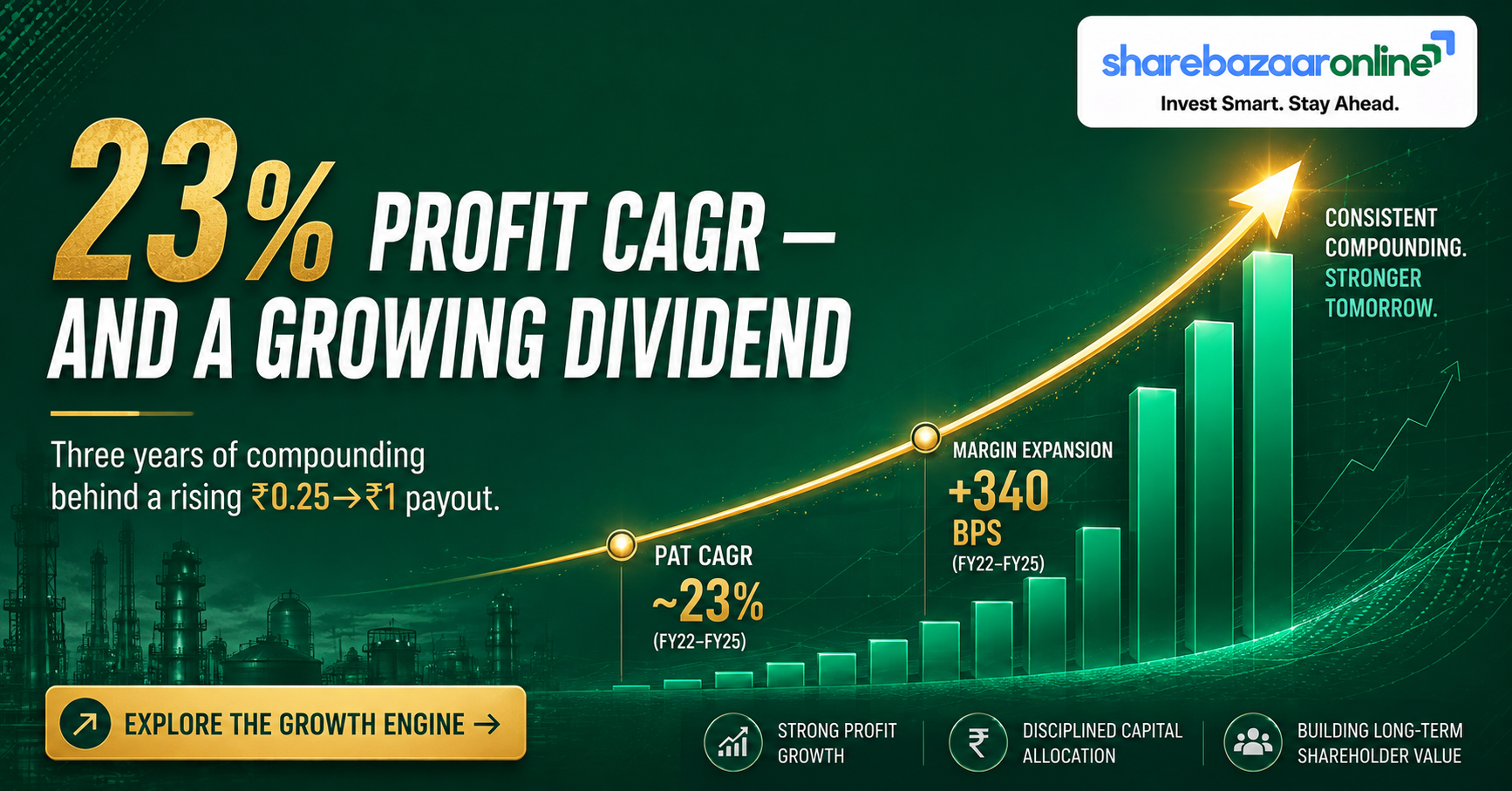
The dividend per share has climbed steadily from ₹0.25 (2017) to ₹1.00 (2024–2026) — roughly a 4x rise over eight years. There are no visible dividend suspensions in the recent record and no dependence on one-off special dividends.
What to read into it
The pattern is a token, symbolic distribution that grows with the business rather than a formula-based payout. Investors should not expect a step-change in the dividend; capital is being reinvested and, increasingly, directed at the KSCL amalgamation.
Financial Performance Analysis
| Year (standalone) | Revenue (₹ Cr) | Net Profit (₹ Cr) | Net Margin |
|---|---|---|---|
| FY2026 | 591 | 72.5 | 12.3% |
| FY2025 | 577.3 | 65.8 | 11.4% |
| FY2024 | 603.1 | 63.8 | 10.6% |
| FY2023 | 482.2 | 39.2 | 8.1% |
Profit is outgrowing revenue
Over FY2023–FY2026, revenue grew at about 7% CAGR while net profit compounded at roughly 23% CAGR. Net margin has expanded from 8.1% to 12.3%. In FY2026, revenue rose just 2.4% but profit rose 10.1% — margin-led, not volume-led, growth.
The caution flag
A March 2026 force majeure on Middle East gas supply disrupted feedstock and pressured Q4 volumes; management said constraints eased only in early July 2026 after government intervention. Margin gains that lean on input-cost timing rather than pricing power can reverse.
Cash Flow Analysis
Reported profit vs. cash: the key question
This is where KPL deserves closer scrutiny than a standard dividend note gives. Independent screeners have flagged that the company's operating profit has not been fully converting into operating cash flow, with receivables reportedly rising faster than sales. One analysis went so far as to note the dividend was being paid in a period of weak-to-negative free cash flow.
Why it still isn't alarming
The interim outflow is only about ₹5.88 crore — roughly 8% of FY26 profit and under 2% of reserves. Even a soft cash year comfortably covers a payout this small from an almost debt-free balance sheet.
Where the dividend is funded from
Given the cash-conversion softness, the ₹5.88 crore is best described as funded from accumulated reserves and current earnings rather than clean current-year free cash flow. There is no evidence it is debt-funded. Exact FY26 OCF and FCF figures: Not fully disclosed in interim data — confirm from the annual report.
Balance Sheet Strength
Net Worth (approx)
₹372 Cr
Reserves (implied)
₹313 Cr
Debt-to-Equity
<0.01
Current Ratio
~2.3x
KPL is effectively debt-free, with a debt-to-equity ratio near zero and a comfortable current ratio. Book value per share is about ₹63. The one caveat: ICRA placed the company's ₹47.5 crore bank facilities "on watch with developing implications" on 13 July 2026, most likely linked to the pending KSCL merger rather than to any operating stress.
Dividend Sustainability Analysis
Earnings coverage
EPS ₹12.32 vs DPS ₹1.00 → 12.3x cover. Extremely comfortable.
Cash-flow coverage
Adequate in size, but cash-conversion quality is soft — a watch item, not a red flag.
Balance-sheet coverage
Outflow <2% of reserves; near debt-free. Very strong.
Earnings trend
PAT compounding ~23% over three years. Growing.
Verdict: Sustainable
On every affordability test the ₹1 dividend is trivially sustainable. The only nuance is quality of cash generation and the capital demands of the KSCL merger, either of which could keep the payout small rather than threaten it.
Peer Comparison
| Company | Div Yield | Payout | ROE | Debt |
|---|---|---|---|---|
| Kothari Petrochemicals | ~0.75% | ~8% | ~19.5% | Near nil |
| Chemical sector (avg) | ~1.6% | — | — | — |
| Transpek Industry | — | — | — | — |
| Indo Amines | — | — | ~22% | — |
Blank cells could not be verified from primary sources and are left empty by design. KPL is India's only listed pure-play PIB manufacturer, so no exact competitor exists — comparisons are to the broader specialty/commodity chemicals set.
Read the table for what it says about strategy, not income: KPL pairs a below-sector yield with a healthy ROE and a fortress balance sheet. It is choosing reinvestment over distribution — the opposite of a high-payout mature chemical name.
Promoter Impact Analysis
Promoter Holding
72.22%
Public Holding
27.68%
FII / DII
0.01% / 0.09%
Total Outflow
₹5.88 Cr
Of the ₹5.88 crore interim payout, roughly ₹4.25 crore (72.22%) flows to the promoter group and about ₹1.63 crore to public shareholders. Note that promoter holding rose from 70.98% to 72.22% around Sep 2025, and institutional ownership is negligible — so the float is thin and price moves can be sharp. With the KSCL merger set to issue new shares, watch how the promoter stake shifts post-amalgamation.
Taxation Analysis
Since April 2020, dividends are taxed in the hands of the investor at their applicable income-tax slab rate. The company deducts TDS at 10% under Section 194 only if the total dividend paid to a resident shareholder in a financial year exceeds ₹5,000. A shareholder with income below the taxable limit can file Form 15G/15H to avoid TDS.
Worked example — investor holding 1,000 shares
Post-tax yield for a 30%-slab investor at ₹133.89 works out to roughly 0.52%. Add applicable cess/surcharge to the tax figure. This is illustrative, not tax advice.
Key Risks
1. Feedstock & energy supply
A March 2026 Middle East gas force majeure disrupted raw material supply; constraints eased only in July 2026. PIB economics hinge on isobutylene/gas availability and pricing.
2. Merger execution
The KSCL amalgamation (1:5 ratio) is subject to approvals and will reshape KPL's share count, earnings mix and rating profile. ICRA has flagged "developing implications."
3. Cash-conversion quality
Operating profit has not fully translated into cash, with receivables reportedly outpacing sales — a classic earnings-quality watch point.
4. Concentration & low float
Single-product (PIB) dependence and ~72% promoter holding leave a thin public float; the stock is volatile (down ~24% in a year, 52-week range ₹94.75–₹185.81).
5. Cyclicality & forex
As a commodity-linked exporter to 20 countries, earnings are exposed to global chemical cycles, destocking and currency swings.
6. Income-investor mismatch
With yield under 1%, the stock is unsuitable for investors buying it primarily for dividend income.
What To Monitor
KSCL merger milestones
NCLT/creditor/shareholder approvals, the final swap mechanics, and the post-merger share count and promoter stake.
Operating cash flow vs. profit
Whether OCF catches up with reported PAT and whether receivable days stabilise.
Feedstock normalisation
Confirmation that gas/isobutylene supply and pricing have fully normalised after the force majeure.
ICRA rating action
Resolution of the "on watch" status on the ₹47.5 crore facilities once the merger view is clear.
Capacity & utilisation
PIB volume, capacity-utilisation trends and any expansion beyond the 37,995 TPA base.
Dividend cadence
Whether the next payout keeps to the ₹1 rhythm or steps up as merged earnings flow in.
Conclusion
The positives: a well-covered, steadily rising dividend (12.3x earnings cover); ~23% three-year profit CAGR with expanding margins; an almost debt-free balance sheet; and market leadership in domestic PIB.
The negatives & risks: a sub-1% yield unsuited to income seekers; soft cash conversion and rising receivables; single-product and feedstock concentration; and meaningful uncertainty around the KSCL merger and the ICRA watch.
In short: the ₹1 interim dividend is a symbolic, easily affordable gesture from a growth-focused, cash-rich business in the middle of a corporate restructuring. It rewards holders modestly while the real story — margins, cash quality and the merger — plays out elsewhere. We present the facts; the decision is yours.
Frequently Asked Questions
What dividend has Kothari Petrochemicals announced?
What is the dividend yield?
What is the record date?
What is the ex-date?
When will the dividend be paid?
Who is eligible for the dividend?
How is the dividend taxed?
Is the dividend sustainable?
What is Kothari Petrochemicals' dividend history?
Why is the yield so low if the company is profitable?
What is the KSCL merger and why does it matter for the dividend?
What should investors monitor from here?
Disclaimer
This article is for informational and educational purposes only and does not constitute investment, financial, legal or tax advice. ShareBazaar Online is not a SEBI-registered investment adviser and does not offer buy, sell or hold recommendations. Figures are compiled from public sources including exchange filings, Screener, TipRanks and company disclosures, and some data points are inferred or approximate (clearly labelled where applicable). Dividend dates, the market price and yield must be independently re-verified against NSE/BSE corporate-action circulars and the company's filings before any decision. Securities markets carry risk, including loss of principal. Consult a SEBI-registered adviser and your tax professional before investing.