
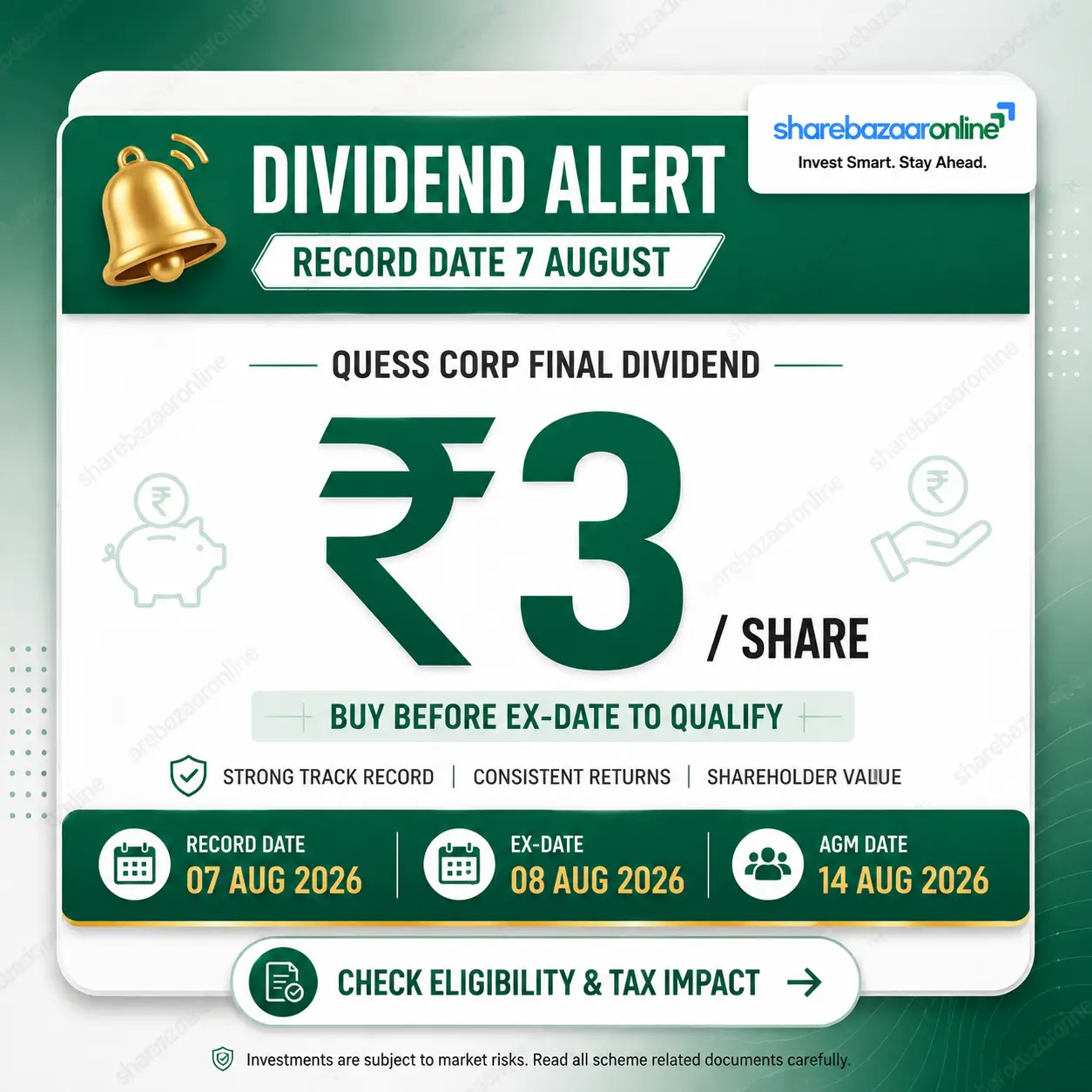
Dividend Snapshot
The Announcement
- Company: Quess Corp Limited
- Dividend Type: Final Dividend (FY2025-26)
- Dividend Per Share: ₹3.00 (30% of ₹10 face value)
- Record Date: Friday, 07 August 2026
- Board Recommendation: 04 May 2026
- Status: Subject to shareholder approval at 19th AGM (25 Aug 2026)
The Numbers
- NSE: QUESS | BSE: 539978
- ISIN: INE615P01015
- Sector: Workforce Management / Staffing
- CMP: ₹323 (NSE close, 04 Aug 2026 — re-verify at publish)
- Final Dividend Yield: 0.93% at current price
- Market Cap: ₹4,815 Cr | Promoter Holding: 56.82%
The one-line story: Quess Corp's ₹3 final dividend is the third and smallest of three FY26 payouts totalling ₹11 per share. But the headline yields you will see quoted elsewhere (2.5%–5.5%) are stale — they use trailing dividends against a much lower share price. Against the current ₹323 price, the final dividend alone yields just 0.93%, because the stock has climbed roughly 53% since the May announcement. This is also a post-demerger Quess — a leaner staffing-focused entity that is not comparable to the pre-May-2025 company.
Dividend Announcement Summary
On 04 May 2026, the Board of Quess Corp recommended a final dividend of ₹3 per equity share (30%) of the ₹10 face value for the financial year ended 31 March 2026. Under Regulation 42 of SEBI LODR, the company later fixed Friday, 07 August 2026 as the record date (intimation dated 24 July 2026). The dividend is subject to shareholder approval at the 19th Annual General Meeting on 25 August 2026 and will be paid "within the statutory timelines."
This final dividend is best understood as the last of three tranches that make up Quess's FY26 shareholder payout:
Tranche 1 · Interim
₹5.00
Declared 28 Jan 2026 · Record 06 Feb 2026 · Paid by 16 Feb 2026
Tranche 2 · Special Interim
₹3.00
10-year IPO anniversary · Record 08 May 2026 · Paid by 21 May 2026
Tranche 3 · Final (this event)
₹3.00
Record 07 Aug 2026 · Pending AGM approval 25 Aug 2026
FY26 total: ₹11 per share — a payout ratio of about 74% of earnings. Management operates a stated policy of returning roughly 75% of free cash flow to shareholders over a rolling three-year block.
Key Dates Timeline
| Event | Date | Source / Note |
|---|---|---|
| Board recommendation | 04 May 2026 | Company filing (Reg. 30) |
| Record-date intimation filed | 24 Jul 2026 | Company filing (Reg. 42) |
| Ex-Date | 07 Aug 2026 | Coincides with record date under T+1 settlement — confirm vs exchange circular |
| Record Date | 07 Aug 2026 (Fri) | Company disclosed |
| TDS document deadline | 14 Aug 2026 | RTA (KFin) portal — per company communication |
| 19th AGM (approval) | 25 Aug 2026 | VC/OAVM, 3:30 PM IST |
| Payment Date | Not Disclosed by Company | Statutory outer limit: within 30 days of AGM (i.e. by ~24 Sep 2026) |
Eligibility rule of thumb: to receive the final dividend you must hold shares as of the record date (07 Aug 2026). Because the final dividend needs AGM approval, it is technically not yet confirmed until 25 Aug 2026.
Dividend Yield Analysis
Yield at a glance
- Final ₹3 at CMP ₹323: 0.93%
- Final ₹3 at announcement price (₹211): 1.42%
- Special + Final (₹6) at CMP: 1.86%
- FY26 total (₹11) at CMP: 3.41%
- FY26 total (₹11) at ₹211: 5.21%
Yield reality check
You will see aggregator sites quote a Quess yield of 2.5%–5.5%. That is a trailing figure — it divides last year's total dividends by an older, lower price. The share has risen from about ₹211 in early May to ₹323 in early August (roughly +53%). As the price rises, the forward yield falls. On the specific dividend that this record date entitles you to — the ₹3 final — the real yield is under 1%.
Why the high trailing yield is not "free money": a chunk of the FY26 ₹11 came from a one-off ₹3 special dividend marking 10 years of listing. Special dividends are, by definition, not repeatable. Strip it out and the recurring FY26 payout is closer to ₹8, or about a 2.5% yield at CMP. Quess is a low-yield-at-current-price stock today, whatever the trailing tables show.
Dividend History Analysis
| Financial Year | Total DPS (₹) | EPS (₹) | Payout Ratio |
|---|---|---|---|
| FY21 | ~7.00 | 3.92 | 179% |
| FY22 | ~4.00 | 16.30 | 25% |
| FY23 | ~8.00 | 15.14 | 53% |
| FY24 | ~10.00 | 18.71 | 53% |
| FY25 | ~10.00 | 3.08 | 325% |
| FY26 | 11.00 (5+3+3) | 14.84 | 74% |
Per-share figures rounded and, for years pre-FY25, are on a pre-demerger basis. Sources: Screener.in (payout %), TipRanks (per-share history). Individual year DPS marked "~" where reconstructed from ex-date records.
Two red flags in the record
FY25's 325% payout was not generosity — earnings had collapsed to ₹3.08 EPS on demerger-related one-off charges, while the company kept distributing ~₹10. A payout far above 100% means the dividend was funded from reserves/cash, not that year's profit. FY26's normalisation back to 74% is the more reassuring signal.
Classification: Consistent, but variable
Quess has paid a dividend every year since FY21 (its first post-IPO payout), so it qualifies as a Consistent Payer. But the amount swings year to year with cash flows, one-offs and special dividends — it is not a fixed, steadily-growing dividend. Treat it as consistent in frequency, cyclical in size.
Financial Performance Analysis
| Metric (Consolidated) | FY26 | FY25 | Change |
|---|---|---|---|
| Revenue (₹ Cr) | 15,305 | 14,967 | +2.3% |
| Operating Profit (₹ Cr) | 325 | 321 | +1.2% |
| Operating Margin | 2.1% | 2.1% | flat |
| Net Profit (₹ Cr) | 222 | 46 | +384% (see note) |
| EPS (₹) | 14.84 | 3.08 | — |
| ROE | 21.3% | — | — |
| ROCE | 24.0% | — | — |
The 384% profit "jump" is a base effect
FY25 net profit of just ₹46 Cr was depressed by demerger-related one-off charges (a large negative "other income" line). Comparing FY26's ₹222 Cr against that low base makes growth look explosive. The company's own adjusted PAT growth was ~10%. Revenue grew only 2.3% and operating margin was flat at 2.1% — so this is a story of a low, stable-margin business, not a turnaround surge.
Razor-thin margins & a low tax rate
Net margin is just 1.45% — typical of high-volume staffing, where a 10 bps margin move swings profit materially. FY26's effective tax rate was only ~3%, thanks to employment-linked deductions under Section 80JJAA. Those very deductions are the subject of a qualified ("modified") audit opinion from Deloitte — a genuine risk to reported profit if disputed.
Recent momentum is real, though: in Q1 FY27 (Jun 2026), Quess reported net profit of ₹81.9 Cr (up ~61% YoY) on revenue of ₹4,182 Cr (up ~14.5%), with margins inching up. The market has rewarded this, which is why the yield has compressed.
Cash Flow Analysis
Reported profit is an accounting opinion; cash is a fact. Here the two diverge in an important way. Even as reported PAT tripled, cash generation fell sharply:
Operating Cash Flow
₹230 Cr
down 39.5% vs ₹380 Cr (FY25)
Free Cash Flow
₹221 Cr
down 41.7% vs ₹379 Cr (FY25)
Cash Conversion (OCF/PAT)
104%
FCF/PAT ~100% — quality remains good
How the final dividend is funded
The full FY26 dividend outflow of about ₹164 Cr is covered 1.35x by FY26 free cash flow (₹221 Cr). The final ₹3 tranche alone (~₹45 Cr) is covered 4.9x by FCF. So the dividend is being paid out of current cash generation, not by drawing down reserves or raising debt.
The caution
A 1.35x FCF cover on the total payout is a modest cushion. If FCF stays near ₹220 Cr while the company continues distributing ~₹11/share, the buffer is thin. The FY26 fall in OCF/FCF partly reflects the smaller post-demerger business, but it is worth watching whether cash generation re-builds toward the pre-demerger ₹380 Cr level.
Balance Sheet Strength
Key balance-sheet items (Mar 2026)
- Net Worth: ₹1,166 Cr (Equity ₹149 Cr + Reserves ₹1,017 Cr)
- Book Value per share: ₹78.1
- Borrowings: ₹124 Cr (very low)
- Net Cash (company-stated): ₹271 Cr
- Investments: ₹51 Cr
A leaner, net-cash balance sheet
Post-demerger, Quess shed the capital-heavy facility-management and BPM businesses. Reserves fell from ₹2,650 Cr (Mar 2024) to ~₹936 Cr (Mar 2025) and fixed assets from ₹1,695 Cr to ₹341 Cr as those units left. What remains is a capital-light, net-cash staffing business that carries almost no debt. Net cash of ₹271 Cr covers the full FY26 dividend 1.65x and the final tranche 6x over.
Valuation context: the stock trades at ~4.1x book value and a P/E near 18.6x — not cheap for a 1.5% net-margin business, reflecting the market's optimism on the staffing cycle and the Labour Codes tailwind.
Dividend Sustainability Analysis
| Coverage Test (FY26 total ₹11) | Metric | Read |
|---|---|---|
| Earnings coverage (EPS / DPS) | 1.35x | Covered |
| Operating-cash coverage (OCF / outflow) | 1.40x | Covered |
| Free-cash coverage (FCF / outflow) | 1.35x | Thin buffer |
| Balance-sheet coverage (Net cash / outflow) | 1.65x | Cushion available |
The final ₹3 alone is very safe
Looked at in isolation, the final dividend is comfortably covered: 4.95x by earnings, 4.9x by FCF and 6x by net cash. There is no question the company can pay it.
Verdict: Moderately Sustainable
Every test on the full ₹11 payout passes, but the FCF cushion (1.35x) is slim for a thin-margin business, and part of FY26's payout was a non-repeatable special dividend. The recurring, ordinary dividend looks sustainable; investors should not, however, extrapolate the ₹11 total as a permanent run-rate. Watch flags: FCF trend, the 80JJAA tax dispute, and any margin pressure from minimum-wage hikes.
Peer Comparison
| Metric | Quess Corp | SIS Limited | TeamLease |
|---|---|---|---|
| Revenue (FY26, ₹ Cr) | 15,305 | ~15,982 | ~11,982 |
| Net Profit (₹ Cr) | 222 | ~400 (approx.) | ~151 |
| ROE | 21.3% | 15.8% | 13.0% |
| ROCE | 24.0% | 16.5% | 14.5% |
| Dividend policy | Regular dividend (FCF-linked) | Dividend + buyback | Buyback only, no dividend |
| Div yield (final ₹3, at CMP) | 0.93% | Not Independently Verified | Nil |
| Net debt | Net cash | Net Debt/EBITDA ~0.99x | D/E ~0.05 |
Peer figures from public sources (Screener.in, company results, TipRanks); some cells left as "Not Independently Verified" where a primary-source figure could not be confirmed. SIS PAT is approximate.
The stand-out point: among India's three large listed staffing/workforce peers, Quess is the one that leans hardest on dividends. TeamLease pays no dividend at all (returning cash via a ₹238 Cr buyback), and SIS blends a modest dividend with buybacks (about ₹250 Cr total returned in FY26). Quess also posts the highest ROE and ROCE of the three post-demerger, helped by its now capital-light structure — but on a much thinner net margin.
Promoter Impact Analysis
Who gets what
- Promoter holding: 56.82% (Jun 2026)
- Promoter share of final ₹3 (₹44.8 Cr): ₹25.4 Cr
- Promoter share of FY26 ₹11 (₹164 Cr): ₹93.3 Cr
- Minority (~43.18%) share of FY26: ₹70.9 Cr
Aligned, but note the FII exit
The promoter group (Fairfax-linked entities and founder Ajit Isaac) receives the majority of each payout, so its interests are broadly aligned with minority shareholders on dividends. Separately, though, foreign investors have been leaving: FII holding dropped from 14.11% (Sep 2025) to 8.58% (Jun 2026). Domestic institutions (~11.9%) and retail (~21.7%) have absorbed the selling.
Taxation Analysis
Since April 2020, dividends in India are taxed in the hands of the investor at their applicable income-tax slab rate (there is no separate Dividend Distribution Tax). Under Section 194, the company deducts TDS at 10% before paying, but only if a resident shareholder's total dividend from that company in the year exceeds ₹10,000. Investors can file Form 15G/15H to avoid TDS if their income is below the taxable limit.
Worked example — final ₹3 dividend
Investor holds 1,000 shares; 30% tax slab
- Gross dividend (1,000 × ₹3): ₹3,000
- TDS u/s 194 @10%: ₹0 (below ₹10,000 threshold)
- Tax @30% + 4% cess (31.2%): ₹936
- Net in hand: ₹2,064
- Effective post-tax yield at ₹323: 0.64%
A TDS trap to watch across the full year
Add up all three FY26 tranches and a 1,000-share holder received about ₹11,000 in dividends — which crosses the ₹10,000 threshold, so 10% TDS (₹1,100) would apply. This is why the company set a 14 Aug 2026 deadline to submit tax documents (PAN, Form 15G/15H, etc.) via the RTA (KFin) portal; miss it and TDS can default to a higher 20%. A 30%-slab investor still owes the balance tax when filing returns; a 0%-slab investor can claim a refund.
This is general information, not tax advice. NRIs face different (typically 20% + surcharge) TDS rates, subject to DTAA relief. Consult a tax professional for your situation.
Key Risks
1. Qualified audit opinion & tax dispute
Deloitte issued a modified opinion tied to Section 80JJAA deductions under litigation. An adverse ruling could raise the tax rate (currently ~3%) and cut reported profit.
2. Wafer-thin margins
At ~1.5% net margin, small cost shocks (minimum-wage hikes in several states, employee-cost inflation) can disproportionately hit profit and, in turn, dividend capacity.
3. Falling cash generation
OCF fell ~40% and FCF ~42% in FY26. With FCF cover on the total payout at just 1.35x, a further decline would squeeze the ordinary dividend.
4. AGM-approval & timing risk
The final dividend is not confirmed until the 25 Aug 2026 AGM, and the exact payment date is undisclosed — only a statutory outer limit applies.
5. Client concentration & cyclicality
Staffing demand tracks the hiring cycle (IT/BFSI/manufacturing). A slowdown, or loss of large clients, directly reduces the headcount-linked revenue base.
6. Valuation & FII outflows
At ~4.1x book and after a ~53% run-up, expectations are high. Continued FII selling (14.1% → 8.6%) could pressure the price, which would raise yield but for the wrong reason.
What To Monitor
1. Free cash flow trajectory
Does FCF rebuild toward the pre-demerger ₹350–380 Cr, or stay near ₹220 Cr? This is the single biggest driver of the ordinary dividend's sustainability.
2. Resolution of the 80JJAA tax dispute
Any update on the contested deductions will move both the effective tax rate and the audit-opinion status.
3. Operating margin trend
Watch OPM ticking up from 2.1% (Q1 FY27 showed early improvement). Margin, not revenue, is the profit lever in staffing.
4. Headcount & segment mix
Growth in higher-margin professional/overseas staffing versus general staffing, and total associate headcount, signal earnings quality.
5. Labour Codes implementation
New labour codes could reformalise the sector and improve working-capital cycles — a potential structural tailwind for organised staffing players.
6. Institutional flows & payout policy
Whether FII selling stabilises, and whether management sticks to its ~75%-of-FCF payout framework in future declarations.
Conclusion
Quess Corp's ₹3 final dividend is affordable and well-covered — 4.9x by free cash flow and 6x by net cash on its own. The company is a capital-light, net-cash, high-ROE staffing leader after its 2025 demerger, and it has paid a dividend every year since FY21.
But the framing matters. The eye-catching trailing yields are stale: at the current ₹323 price the final dividend yields under 1%, and a third of FY26's ₹11 total came from a non-repeatable special dividend. Cash generation actually fell ~40% in FY26 even as reported profit "tripled" on a depressed base, and the low tax rate that flatters profit is itself under audit dispute.
Net read: a genuinely consistent payer with a sound balance sheet, but one whose dividend is moderately — not bullet-proof — sustainable, and whose current income appeal is far lower than the headline tables suggest. The positives (cash cover, net-cash B/S, ROE lead over peers) and the negatives (thin FCF cushion, tax dispute, thin margins, high valuation) are laid out above for you to weigh.
Frequently Asked Questions
What dividend has Quess Corp announced?
What is the dividend yield?
What is the record date for the Quess Corp final dividend?
What is the ex-date?
When will the dividend be paid?
Who is eligible for the dividend?
How is the dividend taxed?
Is the dividend sustainable?
What is Quess Corp's dividend history?
What should investors monitor going forward?
Why is Quess a "post-demerger" company, and does it matter for dividends?
How does Quess compare with SIS and TeamLease on dividends?
Why did reported profit jump while cash flow fell in FY26?
Disclaimer
This article is published by ShareBazaar Online for informational and educational purposes only and does not constitute investment, financial, legal or tax advice, nor a recommendation to buy, sell or hold any security. ShareBazaar Online is not a SEBI-registered investment adviser or research analyst. Figures are compiled from company filings and third-party sources (including Screener.in, TipRanks, NSE/BSE) believed to be reliable but not independently guaranteed; some data is inferred or marked "Not Disclosed by Company" and should be verified against primary sources. The current market price and derived yields are time-sensitive and must be re-verified before acting. The final dividend is subject to shareholder approval at the 19th AGM. Investing in equities carries risk, including loss of principal. Please consult a SEBI-registered adviser and a qualified tax professional before making any decision. Past performance is not indicative of future results.