
Dividend Snapshot
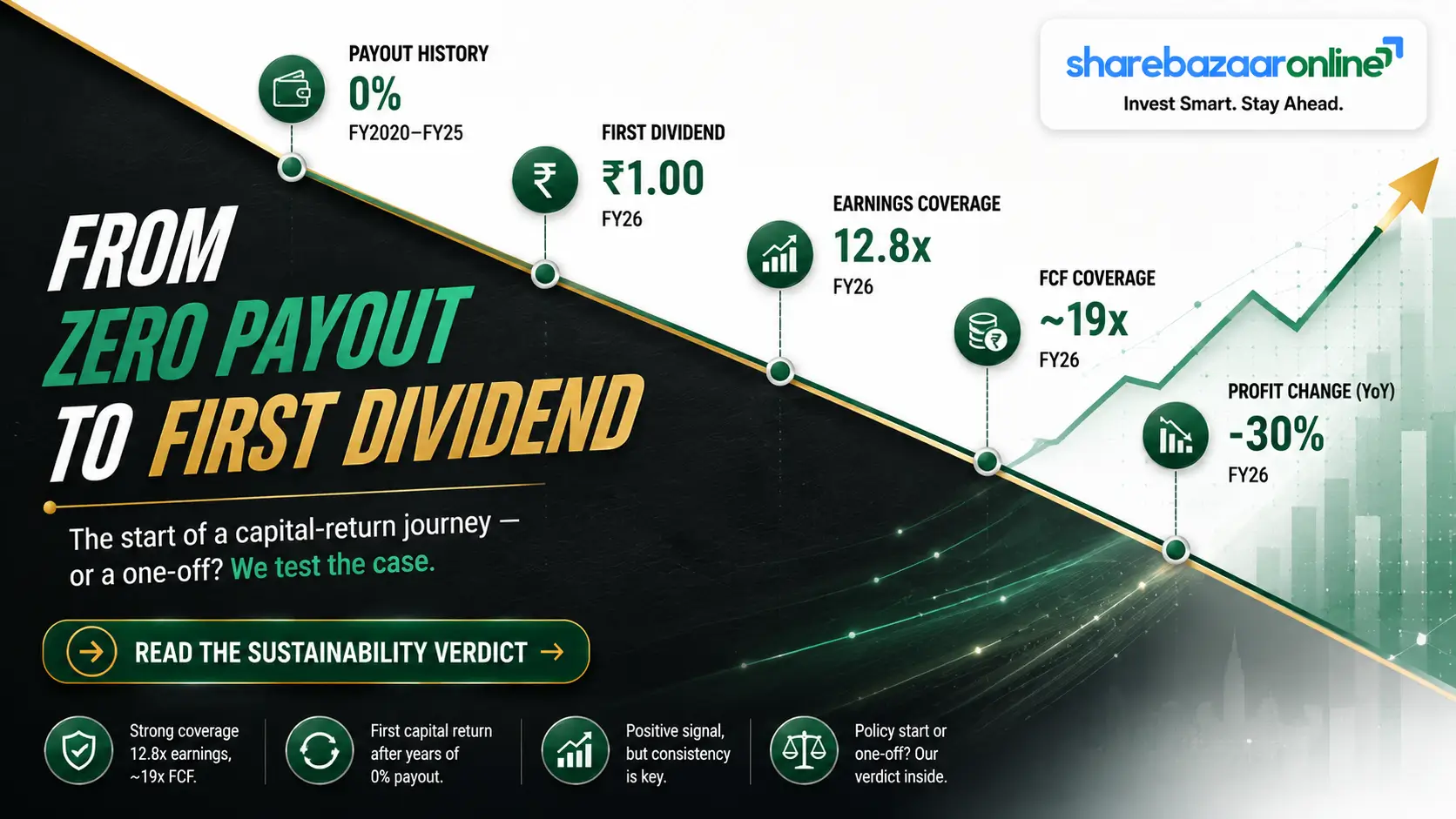
Updater Services Limited (NSE: UDS | BSE: 543996) has declared its first-ever dividend since listing on the exchanges in October 2023. The Board, at its meeting on 30 July 2026, approved an Interim Dividend of ₹1 per equity share (10% of the ₹10 face value) for the financial year 2026-27. For a company that has recorded a 0% dividend payout in every reported year since FY2020 (Source: Screener.in), this is a milestone maiden distribution rather than the continuation of any track record.
Key Numbers
- Dividend per share: ₹1.00
- Dividend rate: 10% on ₹10 face value
- Dividend type: Interim (FY2026-27)
- Dividend yield (at CMP ₹204): 0.49%
- Total outflow: ₹6.70 crore (approx.)
Company At A Glance
- Business: India's 2nd-largest outsourced IFM player
- Market cap: ₹1,364 crore (4 Aug 2026)
- Stock P/E: ~15.0 | Book value: ₹157
- Consolidated FY26 revenue: ₹2,940 crore
- Promoter holding: 59.09% (Jun 2026)
Note: Being an interim dividend declared by the Board, this payout does not require shareholder approval at the AGM. Live CMP and yield should be re-verified at publish time as prices move daily. Figures in crore are converted from the company's filing (reported in ₹ million; 1 crore = 10 million).
Dividend Announcement Summary
In its intimation to BSE and NSE under Regulation 30 and Regulation 42 of the SEBI (LODR) Regulations, 2015, Updater Services confirmed that the Board considered and approved the interim dividend alongside the unaudited standalone and consolidated financial results for the quarter ended 30 June 2026. The board meeting commenced at 3:00 P.M. and concluded at 6:55 P.M. on 30 July 2026.
What Was Declared
An interim dividend of ₹1 per equity share of face value ₹10 each, for FY2026-27. The company fixed Wednesday, 5 August 2026 as the record date, and stated the dividend will be paid on or before Friday, 28 August 2026.
Why It Stands Out
The distribution is modest in absolute terms (₹6.70 crore) but symbolically important: it is the company's first cash return to shareholders and a signal that management now views the balance sheet as comfortable enough to begin distributing surplus.
Key Dates Timeline
Announcement Date
30 July 2026 (board meeting outcome)
Record Date
5 August 2026 (Wednesday) — as fixed by the company
Ex-Date
5 August 2026 — Inferred under T+1 settlement convention, under which the ex-date and record date fall on the same trading day. Not separately disclosed by the company; confirm against the exchange corporate-action circular.
Payment Date
On or before 28 August 2026 (Friday) — the outer limit stated by the company. A specific payment date was not disclosed.
To be eligible, an investor must hold shares by the last cum-dividend trading day (one trading day before the ex/record date). Buying on or after the ex-date does not carry entitlement to this dividend.
Dividend Yield Analysis
Yield At Current Price
At the CMP of ₹204 (Screener.in, 4 Aug 2026), the ₹1 dividend translates to a yield of 0.49%. At the price around the announcement (₹203.28 on 31 Jul 2026), the yield was effectively the same at ~0.49%.
Yield Reality Check
This is a low headline yield, driven purely by the small size of the maiden dividend — not by a falling share price or a one-time special payout. The distribution equals just ~8% of trailing FY26 earnings, so there is no "high yield illusion" here to unpack.
Context: the stock is down roughly 28-30% over the past year (52-week range approx. ₹125 to ₹281–356 across data sources). Even after this derating, the yield stays sub-1% because the payout itself is token-sized. Yield figures become stale quickly — re-verify CMP at publish time.
Dividend History Analysis
There is effectively no dividend history to review. According to Screener.in, the dividend payout ratio has been 0% in every year from FY2020 through FY2026. The company listed in October 2023 and retained all earnings through its post-IPO period.
| Financial Year | Dividend / Share | Payout Ratio | Remark |
|---|---|---|---|
| FY2022 | ₹0 | 0% | Pre-IPO |
| FY2023 | ₹0 | 0% | Pre-IPO |
| FY2024 | ₹0 | 0% | First year as listed co. |
| FY2025 | ₹0 | 0% | No distribution |
| FY2026 | ₹0 | 0% | No distribution |
| FY2027 (Interim) | ₹1 | ~8%* | Maiden dividend |
*Interim payout measured against trailing FY26 PAT; full-year FY27 payout not yet determinable. Source: Screener.in, company filing.
Classification
On the available record, UDS is best classified as an Early-Stage / New Payer. It cannot yet be called a Consistent, Cyclical, or Irregular payer — there is only a single data point. Whether this becomes a recurring policy or a one-off gesture is the central open question.
Financial Performance Analysis
The Non-Obvious Finding: Revenue Up, Profit Sharply Down
The headline that aggregators miss is that FY26 was a year of margin compression. On a consolidated basis, revenue rose +7.5% (₹2,736 cr → ₹2,940 cr), yet operating profit fell -19.8% (₹167 cr → ₹134 cr) and net profit fell -30.3% (₹119 cr → ₹83 cr). EPS dropped -27.8% from ₹17.74 to ₹12.80. Operating margin thinned from 6.10% to 4.56%.
Q1 FY27 (Jun 2026, Consolidated)
- Revenue: ₹764 cr (+9.15% YoY)
- PBT: ₹33.15 cr (+6.76% YoY)
- PAT: ₹30.28 cr (+4.47% YoY)
- PAT (parent): ₹29.72 cr (+3.97% YoY)
- EPS: ₹4.44 (vs ₹4.33)
Operating Deleverage Persists
Even in Q1 FY27, the pattern continues: revenue grew +9.2% but PAT grew only +4.5%. Profit is not keeping pace with the top line — a defining characteristic of the low-margin facility management business, where wage inflation and people-heavy cost structures cap operating leverage.
Watch The Tax Line
Reported profit is being flattered by a persistently low tax rate. The consolidated Q1 FY27 effective tax rate was just 8.65%, and FY26 full-year tax was ~14% — well below the standard corporate rate. Screener explicitly flags "Tax rate seems low." A normalisation of the tax rate toward statutory levels would compress reported PAT further. (Source: company filing, Screener.in)
Cash Flow Analysis
Here is the reassuring part of the story. Despite the profit decline, cash generation was strong in FY26. Operating cash flow was ₹144 crore against operating profit of ₹134 crore — a CFO/Operating-Profit conversion of ~121%, meaning reported profit was fully backed by cash. Free cash flow was ₹125 crore. (Source: Screener.in, consolidated)
How The Dividend Is Funded
The ₹6.70 crore outflow is funded comfortably from current-year cash generation, not from borrowings or asset sales. FCF of ₹125 cr covers the dividend ~18.7 times over; CFO covers it ~21.5 times.
Working Capital Note
Debtor days sit around 75 days and working-capital days near 43 (FY26) — typical for a receivables-heavy services model. This is a recurring pressure point: strong headline CFO can swing year-to-year with collection timing, so cash quality should be tracked each quarter.
Balance Sheet Strength
Near Debt-Free
- Borrowings (FY26): ₹45 cr (down from ₹220 cr in FY23)
- Reserves: ₹985 cr
- Investments: ₹78 cr
- Book value: ₹157/share
What This Means For The Dividend
The company is described as "almost debt free" (Screener.in) and has been actively deleveraging. Against ₹985 cr of reserves and a ₹6.70 cr outflow, the balance sheet can absorb this dividend and much larger ones without strain. Debt is not rising to fund the payout.
Not Independently Verified: a standalone cash-and-bank balance line is not separately broken out in the summary financials used here; coverage above is therefore anchored on FCF and CFO rather than a discrete cash figure.
Dividend Sustainability Analysis
| Test | Metric | Verdict |
|---|---|---|
| Earnings coverage | EPS ₹12.80 vs DPS ₹1 = 12.8x | Very strong |
| OCF coverage | ₹144 cr CFO vs ₹6.70 cr = 21.5x | Very strong |
| FCF coverage | ₹125 cr FCF vs ₹6.70 cr = 18.7x | Very strong |
| Balance-sheet coverage | ₹985 cr reserves, near debt-free | Very strong |
Overall Verdict: Sustainable
On every quantitative test, the ₹1 dividend is comfortably sustainable — it is a fraction of both earnings and cash flow. The genuine question is not affordability but consistency: with a declining profit trend (FY26 PAT -30%) and thin margins, the size of future dividends will depend on whether operating profitability stabilises. Watch flag: margin compression and the low effective tax rate are the two variables that could constrain how much the payout can grow from here.
Peer Comparison
| Company | Div. Yield | ROE | Dividend Record | Balance Sheet |
|---|---|---|---|---|
| Updater Services (UDS) | ~0.49% | ~8.9% | Maiden (FY27) | Near debt-free |
| Quess Corp | ~4.5–5.5% | ~15–20% | Regular payer (₹11–14/yr) | Net cash ~₹271 cr |
| SIS Limited | ~1.6% | Not Independently Verified | Regular; div + buyback ~₹250 cr FY26 | Net Debt/EBITDA ~0.99x |
Sources: Screener.in, INDmoney, 5paisa (Jun–Jul 2026). Peer ROE and yield figures move with price and are approximate; Quess Corp underwent a 2025 demerger, so its metrics are not strictly like-for-like. Cells marked "Not Independently Verified" could not be confirmed from a primary source.
Read-through: UDS is the lowest yielder of the group precisely because it is a first-time payer. Established peers Quess and SIS already run mature dividend (and buyback) policies with higher yields and higher ROEs. Notably, SIS Limited has been accumulating UDS shares for treasury management, raising its UDS stake to ~6.65% by mid-July 2026 (Source: exchange disclosures via Screener.in).
Promoter Impact Analysis
Who Gets What
- Promoter holding: 59.09% (Jun 2026)
- Promoter share of dividend: ~₹3.96 crore
- Non-promoter (public + institutions): ~₹2.74 crore
Shareholding Shifts
- FII holding: 3.50% (Jun 2026)
- DII holding: 9.41% — down from 12.96% in Mar 2026
- Public: 27.99% (rising)
Because the promoter owns a majority stake, roughly 59 paise of every dividend rupee flows to the promoter group. That is normal for a promoter-heavy company, but worth flagging: a notable 3.5-percentage-point drop in DII holding in a single quarter (Mar→Jun 2026) sits alongside this maiden payout. Minority shareholders benefit proportionally, but the amounts are small at this dividend size.
Taxation Analysis
Since the abolition of the Dividend Distribution Tax (FY2020-21), dividends are taxed in the hands of the investor at their applicable income-tax slab rate. Under Section 194, the company deducts TDS at 10% only if total dividend from that company exceeds ₹5,000 in a financial year (10% for PAN holders; 20% without PAN). Investors below the taxable threshold can submit Form 15G/15H to avoid TDS.
Worked Example — Retail Investor (1,000 shares, 30% slab)
- Gross dividend: 1,000 × ₹1 = ₹1,000
- TDS u/s 194: ₹0 (below the ₹5,000 threshold, so no TDS)
- Tax at 30% slab (+ applicable cess): ₹300
- Net dividend after tax: ₹700
- Effective post-tax yield (at ₹204): ~0.34%
Illustrative; excludes cess/surcharge nuances. Consult a tax adviser for your specific situation.
Key Risks
1. Margin Compression
Operating margin fell from 6.10% to 4.56% in FY26; a people-heavy, low-margin model with limited pricing power leaves little cushion.
2. Declining Profit Trend
Net profit dropped ~30% in FY26 (₹119 cr → ₹83 cr) even as revenue grew — the top line is not translating into bottom-line growth.
3. Low Tax Rate Normalisation
Reported PAT benefits from a sub-15% effective tax rate. Any move toward statutory rates would further dent reported earnings.
4. Labour Cost / Regulatory Risk
The new four Labour Codes (notified Nov 2025) added ~₹5.4 cr provision in FY26; wage-definition changes could keep pressuring employee costs, the single largest expense line.
5. Institutional Selling
DII holding fell 3.5pp in one quarter (Mar→Jun 2026); combined with a ~30% one-year price decline, sentiment has been weak.
6. Receivables / Working Capital
Debtor days ~75 and rising working-capital days can pressure cash conversion in weaker collection quarters.
What To Monitor
- Operating margin trajectory — whether OPM stabilises above ~5% or keeps sliding.
- Effective tax rate — a jump toward 25% would meaningfully cut reported PAT.
- Dividend policy signal — whether management follows this maiden payout with a formal, recurring policy or a final dividend for FY27.
- Segment mix (IFM vs BSS) — margin and growth differ across the two segments; watch which is driving results.
- Employee cost as % of revenue — the key swing factor under the new Labour Codes.
- Institutional flows — whether DIIs continue exiting and whether SIS keeps raising its UDS stake.
Conclusion
Updater Services' ₹1 interim dividend is a symbolic first — a maiden cash return that signals management confidence in the balance sheet, backed by a near-debt-free position, ₹985 cr of reserves and ₹125 cr of free cash flow. On pure affordability, it is overwhelmingly covered (18–21x on cash metrics).
Positives
First-ever dividend; near debt-free; strong cash conversion (CFO/OP ~121%); dividend funded from current cash, not debt.
Negatives / Watch-outs
FY26 profit -30%; margins compressing; tax-flattered earnings; low yield (0.49%); DII selling; no prior dividend track record to judge consistency.
We present the facts, positives, risks and monitoring points — the decision is yours. This is research and information, not a buy/sell/hold recommendation.
Frequently Asked Questions
What dividend has Updater Services announced?
What is the dividend yield?
What is the record date?
What is the ex-date?
When will the dividend be paid?
Who is eligible for the dividend?
Does this interim dividend need AGM approval?
How is the dividend taxed?
Is the dividend sustainable?
What is the dividend history of Updater Services?
Why did profit fall in FY26 if revenue rose?
How much of the dividend goes to promoters?
What should investors monitor going forward?
Disclaimer
This article is for informational and educational purposes only and does not constitute investment, financial, or tax advice, nor a recommendation to buy, sell, or hold any security. ShareBazaar Online is not a SEBI-registered investment adviser. Figures are drawn from the company's exchange filing dated 30 July 2026 and third-party sources (Screener.in, INDmoney, 5paisa, exchange disclosures) and may contain errors or become outdated; live market price and corporate-action dates must be independently re-verified before acting. Dividend amounts, record/ex-dates and payment timelines are subject to change by the company and the exchanges. Investments in securities are subject to market risks. Please consult a SEBI-registered adviser and a qualified tax professional before making any decision.