
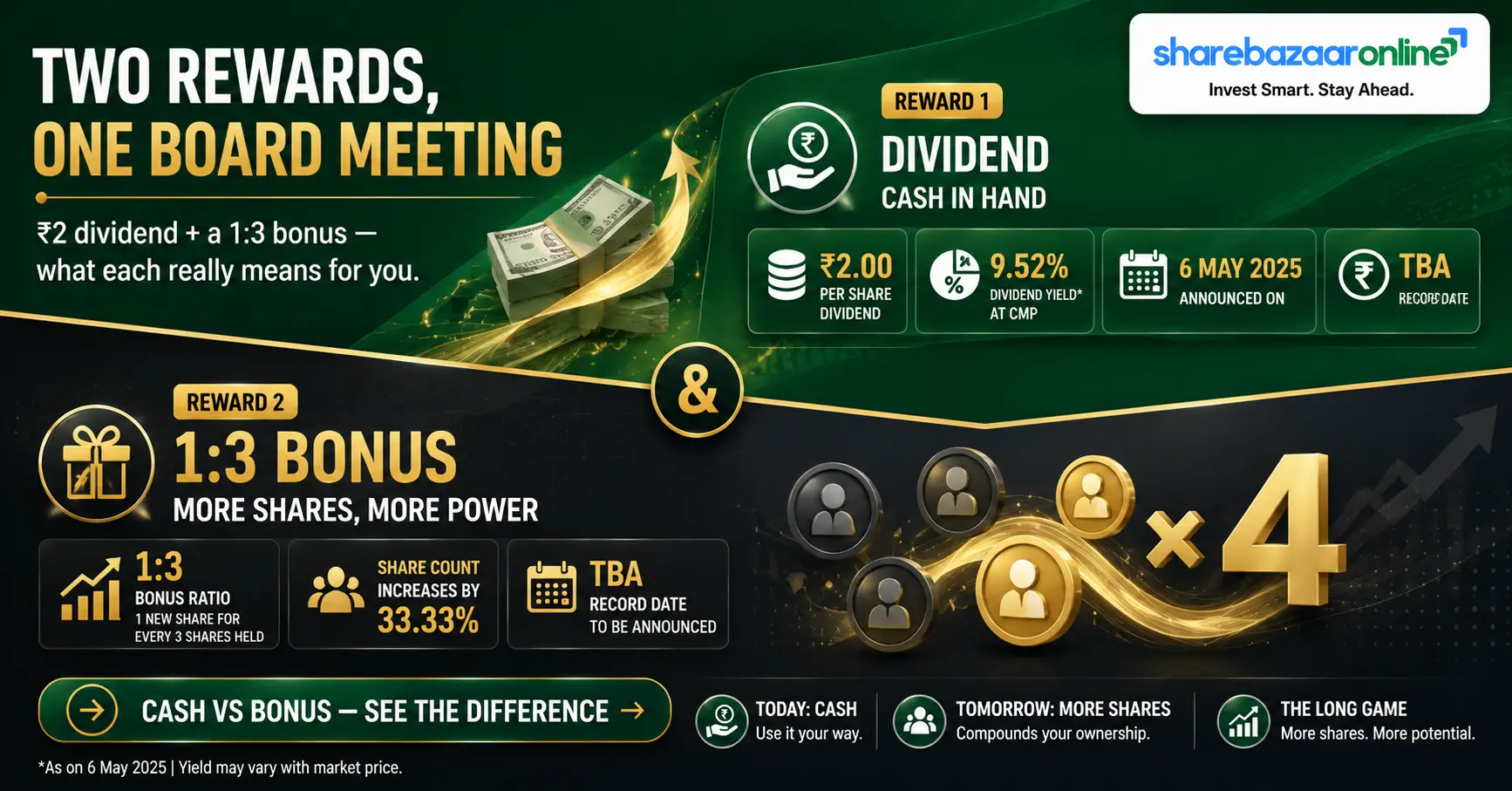
Dividend Snapshot
Company
Brigade Enterprises Limited
NSE: BRIGADE | BSE: 532929 | ISIN: INE791I01019
Sector: Real Estate (Residential, Leasing & Hospitality)
Dividend Declared (FY2025-26)
₹2.00 / share
Type: Final Dividend | 20% of ₹10 face value
Yield at CMP ₹560.20: 0.36%
Key numbers at a glance
- Consolidated PAT (owners): ₹644.39 cr (-6.0% YoY)
- Basic EPS: ₹26.36 (-8.3% YoY)
- Dividend payout: ~7.6% of owners' profit
- Estimated dividend outflow: ₹48.92 cr
Three things the wires missed
- This is a dividend cut — down from ₹2.50 (FY25) to ₹2.00 (-20%).
- FY26 operating cash flow turned negative (-₹137 cr); the payout is not funded by current operating cash.
- A separate 1:3 bonus issue was announced the same day — arguably the bigger event for shareholders.
Dividend Announcement Summary
At its board meeting on 6 May 2026, Brigade Enterprises recommended a final dividend of ₹2 per equity share (20% on ₹10 face value) for the year ended 31 March 2026. The dividend is not yet approved — it is subject to shareholder approval at the 31st Annual General Meeting on 13 August 2026, and will be paid within 30 days of that approval.
The board did much more than declare a dividend
The same meeting cleared a 1:3 bonus issue (one new share for every three held), an increase in authorised capital from ₹250 cr to ₹400 cr, and confirmed unmodified (clean) audit opinions from Walker Chandiok & Co LLP on both standalone and consolidated results. For a long-term holder, the bonus — expanding the share count by roughly a third — is a far more material capital-structure event than a ₹2 cash payout. The dividend is best read as a routine, token distribution alongside a growth-and-reward package.
Key Dates Timeline
Announcement (Board Meeting)
06 May 2026
Record Date
05 August 2026
Ex-Date
05 August 2026
Under T+1 settlement, ex-date and record date fall on the same day.
AGM (Approval)
13 August 2026
Payment Date
On/before 31 August 2026
Within 30 days of AGM approval (statutory outer limit).
Bonus Issue Record Date
To be communicated separately
Bonus (1:3) is a distinct corporate action via postal ballot.
Dividend Yield Analysis
Yield at current price
0.36%
₹2.00 ÷ ₹560.20 (NSE, ~05 Aug 2026)
Yield near announcement
~0.31%
₹2.00 ÷ ~₹650 (Not Independently Verified — exact 06-May-2026 close not confirmed)
A 0.36% yield is not an income story. Even though the share price has fallen sharply — the stock is down roughly a third over the past year and trades well below its 52-week high — the yield stays microscopic because Brigade pays out only a token slice of profit. A falling price would normally lift yield; here it barely moves the needle because the numerator (₹2) is so small. Anyone buying Brigade for dividends is looking at the wrong metric. This is a capital-appreciation and growth-reinvestment stock, not a yield instrument.
Dividend History Analysis
| Financial Year | Dividend / Share (₹) | Type | Ex / Record Date |
|---|---|---|---|
| FY2025-26 | 2.00 ▼ | Final | 05 Aug 2026 |
| FY2024-25 | 2.50 | Final | 13 Aug 2025 |
| FY2023-24 | 2.00 | Final | 30 Jul 2024 |
| FY2022-23 | 2.00 | Final | 31 Jul 2023 |
| FY2021-22 | 1.50 | Final | 26 Jul 2022 |
| FY2020-21 | 1.20 | Final | 03 Aug 2021 |
| FY2019-20 | 1.00 | Interim | 24 Mar 2020 |
| FY2018-19 | 1.33 | Final | 29 Jul 2019 |
| FY2017-18 | 1.33 | Final | 03 Aug 2018 |
| FY2016-17 | 1.33 | Final | 14 Sep 2017 |
Source: exchange corporate-action records / TipRanks & Trendlyne. FY19-onwards restated only where re-disclosed; no stock split has altered the ₹10 face value.
Classification
Consistent Payer — but Low & Lumpy
Uninterrupted dividends every year since at least FY17, with no suspensions even through COVID (FY20).
The non-obvious catch
The trend is not a clean staircase up. After rising to ₹2.50 in FY25, the board reduced the dividend to ₹2.00 in FY26. Wire coverage that simply says "Brigade declares ₹2 dividend" hides that this is a 20% year-on-year cut.
Financial Performance Analysis
Consolidated, FY26 vs FY25 (₹ crore)
| Metric | FY26 | FY25 | Change |
|---|---|---|---|
| Revenue from operations | 5,697.22 | 5,074.21 | +12.3% |
| EBITDA (approx.) | 1,730.68 | 1,646.37 | +5.1% |
| Profit before tax | 903.88 | 869.27 | +4.0% |
| PAT (total group) | 724.76 | 680.47 | +6.5% |
| PAT (owners of Brigade) | 644.39 | 685.76 | -6.0% |
| Minority (NCI) share of profit | 80.37 | -5.29 | swing |
| Basic EPS (₹) | 26.36 | 28.74 | -8.3% |
The finding aggregators miss: profit "grew" but shareholders got less
The headline "profit up 6.5%" is technically true for the whole group — but the profit that belongs to Brigade's own shareholders actually fell 6.0%, from ₹685.76 cr to ₹644.39 cr, and EPS dropped 8.3%. The gap is the minority interest line, which swung from -₹5.29 cr to +₹80.37 cr. Brigade sold sizeable stakes in its subsidiaries during the year (including raising roughly ₹840 cr from outside investors in group companies and, post year-end, diluting Vibrancy Real Estates to 50%). Those outside investors now claim a growing slice of group profit — which is precisely why the reported total rose while the per-share number for existing holders declined. A ₹2 dividend on a shrinking EPS base is the quiet subtext here.
Standalone tells a harsher story
On a standalone (parent-only) basis, revenue jumped +24.0% to ₹2,624.18 cr, yet standalone PAT collapsed 39.1% to ₹277.47 cr (from ₹455.30 cr). Rising land-purchase costs (₹1,962.91 cr vs ₹900.75 cr) compressed real-estate segment margins, and a labour-code provision hit as an exceptional item. Revenue growth is real; profit conversion at the parent level went backwards.
Cash Flow Analysis
Operating cash flow (FY26)
-₹137.06 cr
Down from a healthy +₹995.31 cr in FY25.
Free cash flow (FY26)
-₹1,875.66 cr
OCF (-137) minus capex/land & property investment (₹1,738.60 cr).
Reported profits are an opinion; cash is a fact
Brigade booked ₹724.76 cr of accounting profit yet generated negative operating cash. The reason is not distress — it is a deliberate land-buying binge. Inventories (land banks and work-in-progress) rose by roughly ₹2,545 cr during the year to ₹11,401 cr, absorbing all operating cash and more. That is normal for a developer in expansion mode, but it has a blunt implication for this payout: the FY26 dividend is not being paid out of FY26 operating cash flow.
So where does the dividend money come from?
With operating and free cash flow both negative, the ₹48.9 cr payout is effectively funded from the financing side of the balance sheet — the ₹1,202 cr of net financing inflow during FY26 (fresh borrowings of ₹2,087 cr + ₹840 cr raised from minority investors in subsidiaries) and the company's ₹2,735 cr liquidity cushion. In plain terms: the dividend leans on balance-sheet strength and new capital, not on cash earned this year. The amount is trivial relative to the balance sheet, so this is affordable — but it is not "self-funded" from operations, which is the distinction most coverage skips.
Balance Sheet Strength
Liquidity & leverage (Consolidated, 31 Mar 2026)
- Cash + bank + current investments: ₹2,735.40 cr
- Total borrowings: ₹6,109.63 cr
- Net debt: ₹3,374.23 cr
- Net debt / equity: 0.45x
Book value & inventory
- Owners' equity: ₹6,820.22 cr
- Book value / share: ~₹278.8
- Price / book at CMP: ~2.0x
- Inventory (land + WIP): ₹11,400.89 cr
Leverage is moderate for a developer — net debt of ₹3,374 cr against ₹7,524 cr of equity (0.45x), with a AA/positive-rated credit profile. But the direction matters: borrowings rose during FY26 (net financing inflow ₹1,202 cr) even as the company paid a dividend and prepared a bonus. The dividend itself is a rounding error against the balance sheet, so solvency is not the concern; the point is that Brigade is simultaneously adding debt, buying land, and distributing cash — a growth posture, not a return-of-capital one.
Dividend Sustainability Analysis
Four-test sustainability scorecard
1. Earnings coverage (EPS vs DPS)
PASS — 13.2x
EPS ₹26.36 vs DPS ₹2.00. Only ~8% of profit paid out.
2. Operating cash coverage
FAIL (this year) — OCF negative
FY26 OCF -₹137 cr. Not covered by current operating cash (FY25 OCF was +₹995 cr).
3. Free cash flow coverage
FAIL — FCF deeply negative
FCF -₹1,876 cr on ₹1,739 cr of land/property capex.
4. Cash / balance-sheet coverage
PASS — 55.9x
₹2,735 cr liquidity vs ₹48.9 cr outflow. Trivially affordable.
Verdict
Sustainable — but affordable ≠ earned
The dividend is easily affordable (huge earnings and cash cover) and will almost certainly continue. The nuance ShareBazaar flags: it is affordable because it is tiny and balance-sheet-backed, not because the business threw off free cash this year — it didn't. Watch flags: the 20% cut versus FY25, negative FY26 operating and free cash flow, and rising debt. None threaten the payout; all argue against treating Brigade as an income stock.
Peer Comparison
Listed real-estate developers (blank cells = not verifiable from primary sources)
| Company | Latest Dividend / Share | Div. Yield | Payout | ROE | Promoter % |
|---|---|---|---|---|---|
| Brigade Enterprises | ₹2.00 | ~0.36% | ~7.6% | ~10.3% | ~41.1% |
| Oberoi Realty | ~13.3% | ~15% | ~67.7% | ||
| DLF | ~74% | ||||
| Godrej Properties | ₹10.00 | ||||
| Prestige Estates | |||||
| Sobha |
Peer figures from public market data (Screener/Yahoo), rounded and indicative; blank cells intentionally left where a primary-source value could not be confirmed at publish time. Verify before print.
The read-across is that the entire listed-developer sector is a low-yield group — most pay out a small fraction of profit and reinvest the rest into land and projects. Brigade's ~7.6% payout is on the leaner end even by that standard. Investors comparing "dividend yield" across realty names are largely comparing noise; pre-sales growth, net debt, and return on capital are the metrics that actually separate these companies.
Promoter Impact Analysis
Shareholding (latest, ~Jun 2026)
- Promoter & group: ~41.1%
- FIIs: ~15.6%–16.7%
- DIIs: ~24.7%–25.5%
- Public / retail: ~17.4%–17.8%
Promoter dividend income (gross)
~₹20.1 cr
≈ 41.1% × ₹48.9 cr total outflow (pre-tax).
Because the promoter family holds ~41%, they receive roughly ₹20 cr of the ₹49 cr distributed, taxed at their slab. But the dividend is a minor line for them. The more telling promoter signal came weeks later: in July 2026 the board approved ₹180 cr of convertible warrants to promoter entity Mysore Holdings at ₹526 — i.e. the promoters are putting capital in, not primarily pulling it out. Combined with the 1:3 bonus (which is share-count neutral to ownership %), the promoter's economics are being driven by re-investment and stake maintenance, not by the token cash dividend.
Taxation Analysis
Since April 2020, dividends in India are taxed in the hands of the investor at their applicable income-tax slab rate (there is no separate Dividend Distribution Tax). The company must deduct TDS under Section 194 at 10% if total dividend paid to a resident shareholder exceeds ₹5,000 in the financial year (₹10,000 threshold applies for some cases; investors can file Form 15G/15H to avoid TDS if their income is below the taxable limit). For non-residents, TDS is generally 20% (plus surcharge/cess), subject to DTAA relief.
Worked example — retail investor holding 1,000 shares
| Shares held | 1,000 |
| Dividend per share | ₹2.00 |
| Gross dividend | ₹2,000 |
| TDS u/s 194 (10% only if > ₹5,000/yr) | ₹0 (not triggered — below threshold) |
| Tax at 30% slab + 4% cess | ₹624 |
| Net dividend after tax | ₹1,376 |
| Effective post-tax yield (at CMP ₹560.20) | ~0.25% |
Illustrative for a 30%-slab resident investor. Actual tax depends on your total income and slab. Not tax advice.
Key Risks
1. Income-tax survey overhang
A Section 133A survey was conducted at group premises in December 2025. The auditors flag it as an Emphasis of Matter; management believes provisions are adequate, but the final liability is unresolved.
2. Negative operating & free cash flow
FY26 OCF was -₹137 cr and FCF -₹1,876 cr. Heavy land buying is strategic, but sustained negative cash conversion raises reliance on debt and equity issuance.
3. Rising leverage & funding cost
Net debt is ₹3,374 cr and the board has approved up to ₹1,500 cr of fresh NCDs. Interest-rate moves and refinancing risk directly affect a capital-intensive developer.
4. EPS dilution from minorities & bonus
Selling stakes in subsidiaries has already cut owners' EPS; the 1:3 bonus and promoter warrants further reshape per-share economics.
5. Regulatory / approval & litigation risk
Real estate is exposed to project approvals and environmental clearances (e.g., reported EC disputes) plus ongoing litigation over refundable deposits and property-tax demands at a hotel subsidiary.
6. Cyclicality & concentration
Earnings depend on the residential upcycle and are concentrated in South India (Bengaluru-heavy). A demand slowdown or rate shock would hit pre-sales and margins.
What To Monitor
- Pre-sales & collections trajectory — the real leading indicator of future cash; watch whether the ₹2,545 cr inventory build converts into bookings.
- Return to positive operating cash flow — a swing back to positive OCF (as in FY25) would confirm the land binge is monetising.
- Net debt and NCD drawdown — track how much of the approved ₹1,500 cr NCD is used and where net debt/equity heads.
- Owners' EPS vs group PAT gap — further stake sales in subsidiaries could keep diluting per-share earnings even as group profit grows.
- Bonus record date & AGM outcome — confirm the 1:3 bonus and dividend are approved (13 Aug 2026 AGM) before treating either as final.
- Tax-survey resolution — any crystallised liability from the December 2025 Section 133A survey.
Conclusion
Positives
- Uninterrupted dividend record; clean (unmodified) audit.
- Revenue +12% consolidated; strong ₹2,735 cr liquidity.
- Dividend trivially affordable (56x cash cover, 13x earnings cover).
- Bonus 1:3 + promoter warrant infusion signal growth intent.
Negatives & watch-outs
- Dividend cut 20% (₹2.50 → ₹2.00); yield a token 0.36%.
- Owners' EPS -8.3%; standalone PAT -39%.
- FY26 operating & free cash flow both negative.
- Rising debt; unresolved tax-survey overhang.
Brigade's ₹2 dividend is a footnote, not a headline. The stock is a growth-and-reinvestment story — land banks, bonus shares and promoter capital infusion — where the cash payout is symbolic and, this year, was actually reduced. It is comfortably affordable but not earned from current cash. Read Brigade for its pre-sales momentum, cash conversion and balance sheet — not its yield. This is analysis, not advice; the decision is yours.
Frequently Asked Questions
What dividend has Brigade Enterprises announced for FY2025-26?
What is the dividend yield on Brigade shares?
What is the record date for the dividend?
What is the ex-date?
When will the dividend be paid?
Who is eligible to receive the dividend?
How is this dividend taxed?
Is the Brigade dividend sustainable?
Is this a dividend increase or a cut?
What is Brigade's dividend history?
What is the 1:3 bonus issue and how does it differ from the dividend?
Why did Brigade's earnings per share fall if group profit rose?
What should investors monitor going forward?
Disclaimer
This article is published by ShareBazaar Online for informational and educational purposes only and is not investment advice. It contains no buy, sell or hold recommendation. ShareBazaar Online is not a SEBI-registered investment adviser or research analyst. Figures are drawn from Brigade Enterprises' audited FY2026 filings and publicly available market data; some data points (e.g. the announcement-date price and certain peer figures) are labelled as not independently verified and should be confirmed against primary sources before relying on them. Market prices, yields and dates change; the live price and final ex/record/payment dates must be re-verified at the time of reading. Dividend and bonus are subject to shareholder approval at the AGM/postal ballot. Investing in equities involves risk, including loss of capital. Please consult a qualified, SEBI-registered financial adviser and read all official disclosures before making any decision.