
Dividend Snapshot
Bosch Limited (NSE: BOSCHLTD | BSE: 500530) has recommended a final dividend of ₹270 per equity share of face value ₹10 for the financial year 2025–26, a payout equal to 2,700% of face value. The recommendation was made at the board meeting held on 20 May 2026 and is subject to shareholder approval at the 74th Annual General Meeting.
Dividend Per Share
₹270
Final dividend, FY2025–26
Dividend Yield
~0.65%
On CMP ~₹41,755 (24 Jul 2026)
Record Date
04 Aug 2026
Exchange-fixed (Ex-date same day)
Dividend Payout Ratio
~28.7%
Of consolidated PAT (down from ~75%)
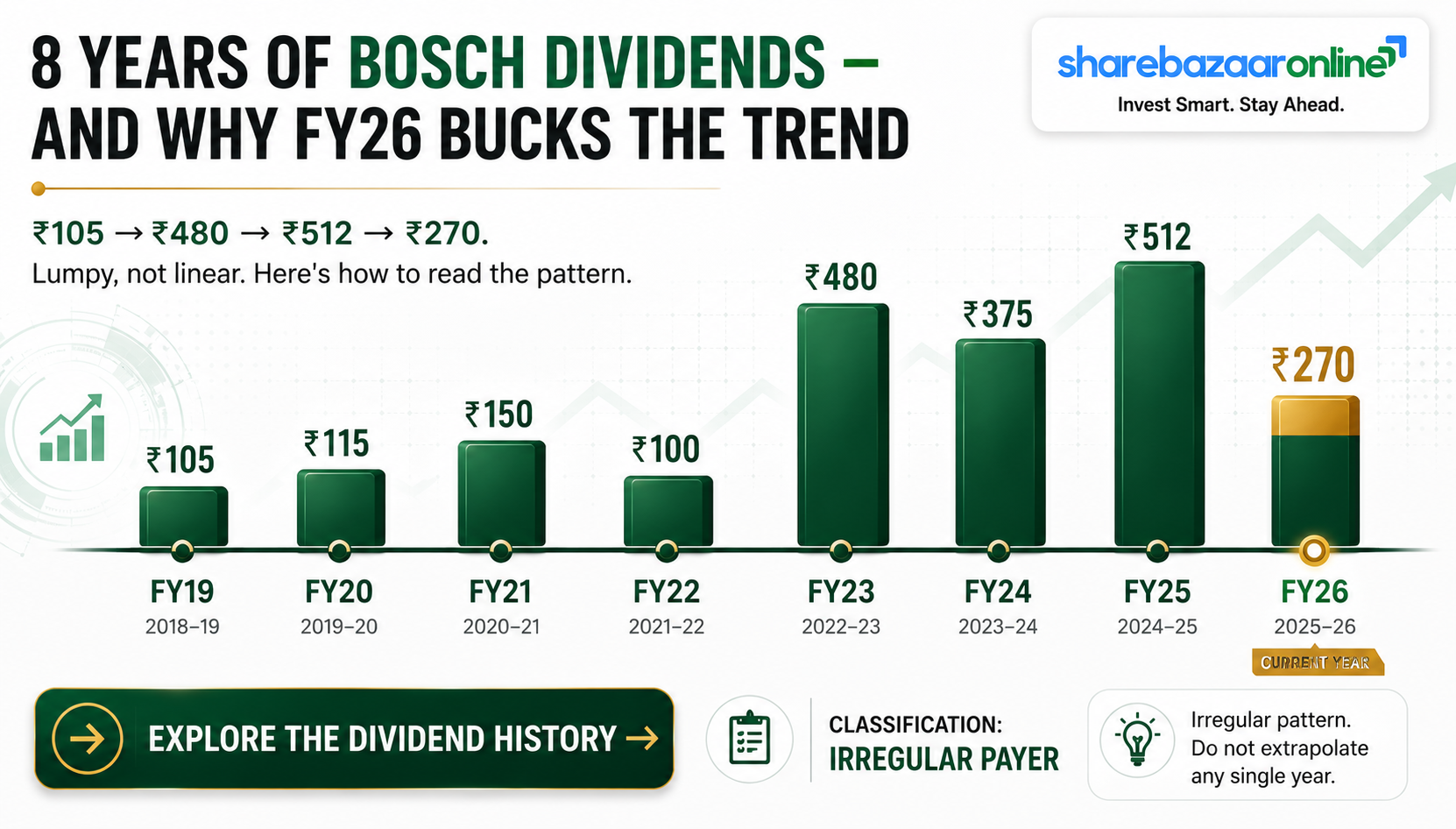
The headline the wire services missed: despite record profit, Bosch has cut its dividend by 47% — from ₹512 (FY24–25) to ₹270 (FY25–26). The cut coincides with the company’s ₹9,069 crore acquisition of Bosch Chassis Systems India, which closed on 1 July 2026. This report explains what the cut signals, and whether ₹270 is comfortably affordable.
Dividend Announcement Summary
At its meeting on 20 May 2026, the Board of Directors of Bosch Limited approved the audited standalone and consolidated results for the year ended 31 March 2026 and recommended a final dividend of ₹270 per share, subject to approval by shareholders at the ensuing AGM. Per the company’s filing (SEBI LODR Regulation 30 & 33 intimation), if declared, the dividend will be paid/dispatched on or after 14 August 2026. Market corporate-action data indicates an actual payment date of on/around 10 September 2026 — this should be re-verified against the final exchange circular at publish time.
What was declared
- Type: Final Dividend (no interim was paid for FY26)
- Amount: ₹270 per share (2,700% of ₹10 face value)
- Prior year: ₹512 (final) for FY2024–25
- Estimated total outflow: ~₹796.5 crore
Conditions attached
- Subject to shareholder approval at the 74th AGM on 11 August 2026
- Until AGM approval, the dividend is a recommendation, not a declared entitlement
- Auditors (S.R. Batliboi & Associates LLP) issued an unmodified (clean) opinion on the results
Context worth noting: the same board meeting also approved (a) a 50:50 joint venture with Wheels India and Brakes India for commercial-vehicle air systems, and (b) confirmed the ₹9,069 crore acquisition of fellow subsidiary Bosch Chassis Systems India. The dividend decision cannot be read in isolation from this capital-deployment agenda.
Key Dates Timeline
| Event | Date | Source / Status |
|---|---|---|
| Announcement Date | 20 May 2026 | Company filing (confirmed) |
| Ex-Dividend Date | 04 Aug 2026 | Exchange corporate-action (confirmed) |
| Record Date | 04 Aug 2026 | Company fixed 04 Aug 2026 (confirmed) |
| 74th AGM | 11 Aug 2026 | Company filing (confirmed) |
| Payment Date | On/after 14 Aug 2026 · market data ~10 Sep 2026 | Filing states outer date; payment date to be re-verified |
Eligibility rule: under India’s T+1 settlement, the ex-date and record date now fall on the same day (04 Aug 2026). To be eligible, you must hold the shares at the end of the record date, which means buying before the ex-date of 04 Aug 2026. Anyone buying on or after 04 Aug will not receive this dividend.
Dividend Yield Analysis
Yield on announcement
0.73%
₹270 ÷ ₹36,865 (NSE close, 20 May 2026)
Yield at current price
~0.65%
₹270 ÷ ~₹41,755 (NSE, 24 Jul 2026)
Yield reality check — why the yield is so low
A ~0.65% yield looks thin, but the reason is not a weak dividend — it is a very high share price. Bosch trades near ₹41,000–42,000, close to its 52-week high (₹42,985), on a P/E of ~44x. At this valuation, even a large absolute dividend of ₹270 produces a small percentage yield. The yield fell further versus the announcement (0.73% → 0.65%) purely because the stock rallied ~13% between 20 May and late July 2026. Bosch is a capital-appreciation and quality stock, not an income stock — investors buying it for yield are looking in the wrong place.
Do not be misled by "1.3–1.4%" yield figures shown on some aggregator pages — those are trailing-twelve-month figures that still include last year’s larger ₹512 dividend. The forward yield on the newly recommended ₹270 dividend is ~0.65% at the current price.
Dividend History Analysis
| Financial Year | Total Dividend/Share | Composition |
|---|---|---|
| FY2025–26 | ₹270 | Final ₹270 |
| FY2024–25 | ₹512 | Final ₹512 |
| FY2023–24 | ₹375 | Interim ₹205 + Final ₹170 |
| FY2022–23 | ₹480 | Interim ₹200 + Final ₹280 |
| FY2021–22 | ₹100 | Final ₹100 |
| FY2020–21 | ₹115 | Final ₹115 |
| FY2019–20 | ₹105 | Final ₹105 |
| FY2018–19 | ₹105 | Final ₹105 |
History compiled from exchange corporate-action records (TipRanks/market data). Amounts mapped to the financial year to which each dividend relates. Face value has been ₹10 throughout (no stock split in this window), so figures are directly comparable.
Classification: Irregular / Lumpy Payer
Bosch is not a smooth dividend grower. The per-share dividend has swung widely: ₹100 → ₹480 → ₹375 → ₹512 → ₹270 over the last four years. The step-up to ₹480–512 in FY23 to FY25 partly reflected special/elevated payouts and a high-payout policy; the FY26 drop to ₹270 is a deliberate reset tied to a large acquisition (detailed later). Investors should treat any single year’s dividend as a poor guide to the next. Independent analysts have flagged this volatility, noting the dividend has been cut at least once in the past decade.
Financial Performance Analysis
| Metric (Consolidated) | FY2025–26 | FY2024–25 | Change |
|---|---|---|---|
| Revenue from operations | ₹20,034.7 cr | ₹18,087.4 cr | +10.8% |
| Profit before tax (reported) | ₹3,641.7 cr | ₹2,732.3 cr | +33.3% |
| PBT before exceptional item | ₹3,085.7 cr | ₹2,730.9 cr | +13.0% |
| Net profit (PAT) | ₹2,773.2 cr | ₹2,015.2 cr | +37.6% |
| EPS (basic/diluted) | ₹940.27 | ₹683.25 | +37.6% |
| Net profit margin | 13.8% | 11.1% | +270 bps |
The 37.6% profit jump is flattering — here is the reality
Reported PAT grew a spectacular-looking 37.6%, but a large part is a one-time gain. FY26 profit includes an exceptional gain of ~₹556 crore from the sale of Bosch’s "Video solutions, Access and Intrusions and Communication systems" business (completed May 2025). This single item is 15.3% of reported PBT. Strip it out, and operating PBT grew a far more modest ~13.0% — solid, but not extraordinary. The company’s own press release confirms this: "PBT before exceptional items grew by 13.0%."
Operating leverage: where growth came from
The Mobility (automotive) segment drove the year, with product sales up ~16.9%. The Power Solutions division grew ~17.6% and the two-wheeler business surged ~69% on higher exhaust-gas-sensor sales following On-Board Diagnostics-II (OBD-II) norms. The "Beyond Mobility" segment shrank ~13.6% — but only because the security-systems business was sold, not due to demand weakness.
Treasury income is a big profit contributor
Bosch earned ~₹854 crore of "other income" (largely interest and investment gains on its huge cash pile) in FY26 — equal to ~27.7% of operating PBT. A meaningful slice of Bosch’s profit is therefore non-operating treasury income, not core auto-component earnings. This is a structural feature of Bosch’s cash-rich balance sheet, not a one-off.
Cash Flow Analysis
Reported profits are an accounting opinion; cash is a fact. Here Bosch holds up well, though with one nuance worth flagging.
Operating Cash Flow (FY26)
₹2,175.3 cr
Down from ₹2,373.4 cr in FY25
Free Cash Flow (OCF − capex)
₹1,858.8 cr
Capex was light at ~₹316.5 cr
OCF vs PAT: a quality flag to watch
Operating cash flow of ₹2,175 crore was lower than reported PAT of ₹2,773 crore (an OCF/PAT ratio of ~0.78). Part of the gap is simply the ~₹556 crore non-cash exceptional gain sitting in profit but not in operating cash. But OCF also fell ~8% year-on-year even as profit rose, driven by working-capital absorption — inventories rose ~₹120 cr and trade receivables rose ~₹314 cr during the year. This is not alarming for a growing business, but it means the profit growth was not fully converted into cash. Worth monitoring if receivables keep outpacing revenue.
How is the dividend funded?
The ₹270 dividend (~₹796.5 cr outflow) is comfortably funded by current earnings and free cash flow — FCF of ₹1,858.8 cr covers the outflow 2.33 times over, with no need to dip into reserves, sell assets, or borrow. The dividend is being paid out of genuinely generated cash, not financial engineering.
Balance Sheet Strength
Cash + Investments
~₹8,378 cr
Cash ₹396 cr + current inv ₹2,181 cr + non-current inv ₹5,801 cr
Total Borrowings
~₹119 cr
Lease liabilities only — effectively debt-free
Total Equity
₹14,845 cr
Book value ~₹5,032 per share
Return on Equity
~19.4%
On average equity (FY26)
A fortress balance sheet — with a hidden nuance
Bosch is essentially debt-free and sits on ~₹8,378 crore of cash and investments — among the strongest balance sheets in Indian auto ancillaries. But this cash pile drags down headline ROE: with over half of net worth parked in idle investments earning treasury income, reported ROE of ~19% understates the return on the core operating business, which is far higher. The flip side, now playing out, is that this war-chest is being deployed into the ₹9,069 crore Bosch Chassis acquisition — which is precisely why the dividend was cut.
Dividend Sustainability Analysis
Four-test sustainability scorecard (for the ₹270 dividend)
| Test | Coverage | Verdict |
|---|---|---|
| Earnings coverage (EPS ₹940 vs DPS ₹270) | 3.48x | Strong |
| OCF coverage (₹2,175 cr vs ₹796.5 cr) | 2.73x | Strong |
| FCF coverage (₹1,859 cr vs ₹796.5 cr) | 2.33x | Strong |
| Cash/balance-sheet coverage (cash+cur inv) | 3.24x | Strong |
Verdict: Highly Sustainable (at the reduced ₹270 level)
On every test, the ₹270 dividend is comfortably covered — by earnings (3.5x), operating cash (2.7x), free cash (2.3x) and the balance sheet (3.2x). There is no affordability concern at this level. The important insight is the opposite of a distress signal: the dividend was cut not because Bosch could not pay, but because management chose to conserve capital for the ₹9,069 crore acquisition. The old ₹512 payout (a ~75% payout ratio) was itself high; ₹270 (a ~29% payout) is arguably a more sustainable, repeatable base from which the dividend could grow again once the acquisition is digested.
Watch flag: sustainability of the ₹270 level is not in doubt; sustainability of future growth in the dividend is the real question. With ~₹9,069 crore now deployed into the Chassis acquisition and further JV funding commitments, near-term dividend increases may be capped as the balance sheet is rebuilt.
Peer Comparison
| Company (MNC auto-ancillary peers) | Div Yield | Payout Ratio | ROE (approx) | Promoter Holding |
|---|---|---|---|---|
| Bosch Ltd | ~0.65% | ~28.7% | ~19% | 70.54% |
| Schaeffler India | ~0.7% | ~47% | ~19% | 74.1% |
| SKF India | ~2.8% | ~116% | NV | NV |
| Sundram Fasteners | ~0.75% | ~30% | ~18% | NV |
Peer figures sourced from secondary market data (as of mid-to-late 2026) and are approximate; cells marked "NV" are not independently verified from primary filings and are intentionally left unstated. Auto-component industry average dividend yield is ~0.6%.
What the table shows: Bosch’s ~0.65% yield is in line with quality MNC peers like Schaeffler and Sundram Fasteners (~0.7–0.75%), all of which are low-yield/high-valuation names bought for growth, not income. SKF India stands out with a ~2.8% yield — but its payout ratio of ~116% means it is paying out more than it earns, likely including a special component, which is a different (and less repeatable) proposition. Bosch’s newly-reduced ~29% payout is the most conservative and reinvestment-friendly of the group, consistent with a company funding a major acquisition.
Promoter Impact Analysis
Promoter Holding (Robert Bosch group)
70.54%
As per Jun 2026 shareholding pattern
Estimated Promoter Dividend Income
~₹561.9 cr
70.54% of ~₹796.5 cr total outflow
Who benefits from the ₹796.5 crore?
Of the total dividend outflow, an estimated ₹561.9 crore (70.54%) flows to the Robert Bosch parent group, and the remaining ~₹234.6 crore to public shareholders (mutual funds ~7.0%, other domestic institutions ~9.0%, foreign institutions ~6.2%, and retail ~7.3%). Because the German parent is the majority owner, the dividend is a primary channel for repatriating India profits — which makes the willingness to cut the dividend by 47% especially notable: the promoter voluntarily forwent a larger repatriation to fund the domestic Chassis acquisition, a signal of reinvestment intent in India rather than cash extraction.
Alignment note: because dividends are paid pro-rata, minority shareholders receive the same ₹270 per share as the promoter. There is no structural disadvantage to minorities in the dividend itself; the key related-party item to watch is the arm’s-length pricing of the ₹9,069 crore acquisition from the parent group (shareholders approved it on 8 May 2026).
Taxation Analysis
How dividends are taxed in India (post-2020 regime)
Since April 2020, dividends are taxable in the hands of the shareholder at their applicable income-tax slab rate (there is no longer a Dividend Distribution Tax paid by the company). Additionally, under Section 194, the company must deduct TDS at 10% if a resident shareholder’s total dividend from the company in a financial year exceeds ₹5,000. TDS is 20% if PAN is not furnished. Investors whose income is below the taxable limit can submit Form 15G/15H to avoid TDS. Non-residents are taxed under Section 195 (typically 20% plus surcharge/cess, subject to DTAA relief).
Worked example — retail investor holding 1,000 shares (30% slab)
| Gross dividend (1,000 × ₹270) | ₹2,70,000 |
| Less: TDS @ 10% (Sec 194, > ₹5,000) | ₹27,000 |
| Amount credited to bank account | ₹2,43,000 |
| Final tax liability @ 30% + 4% cess (TDS is adjusted against this) | ₹84,240 |
| Net dividend in hand after full tax | ₹1,85,760 |
| Effective post-tax yield (at CMP ~₹41,755) | ~0.44% |
Illustrative; excludes surcharge that may apply at higher income levels. Not tax advice — consult a qualified tax professional for your situation.
Key Risks
1. Acquisition-driven capital drawdown. The ₹9,069 crore Bosch Chassis Systems India acquisition (closed 1 July 2026) consumes a large share of Bosch’s cash pile and is the direct cause of the dividend cut. Integration risk, and the risk that further funding needs constrain future dividends, is the single biggest dividend-relevant factor.
2. Dividend volatility / no fixed policy. Bosch’s dividend has swung from ₹100 to ₹512 to ₹270 in recent years. There is no committed payout policy, so future dividends are hard to forecast and can be cut again for strategic reasons.
3. Earnings quality — one-time and treasury income. ~15% of FY26 PBT was a one-off business-sale gain, and ~28% of operating PBT is non-operating treasury income. Core operating profit is growing more slowly (~13%) than the headline 38% PAT jump suggests.
4. Rich valuation. At a P/E of ~44x and near its all-time high, the stock offers a ~0.65% yield that provides little downside cushion. Any earnings disappointment could hit the price hard, and the low yield offers minimal income support.
5. Cyclicality and technology transition. Bosch’s core is internal-combustion-engine components. The auto sector is cyclical, and the long-term shift to EVs (which need fewer of Bosch’s legacy powertrain parts) is a structural risk to the earnings that fund the dividend, even as Bosch pivots to e-mobility and hydrogen.
6. Working-capital creep. Operating cash flow fell ~8% in FY26 as receivables and inventory rose. If cash conversion continues to lag profit, the buffer over the dividend narrows.
What To Monitor
1. Post-acquisition cash rebuild. Track how quickly Bosch rebuilds cash and investments after the ₹9,069 crore Chassis outflow — this determines when (and whether) the dividend can return toward earlier levels.
2. Chassis Systems contribution. Watch the revenue, margin and cash contribution of the newly-consolidated Bosch Chassis Systems India from Q2 FY27 onward — it materially changes the earnings base.
3. Operating (ex-exceptional) PBT growth. Ignore headline PAT; monitor PBT before exceptional items to see whether the core ~13% growth rate holds, accelerates, or fades.
4. Cash conversion (OCF/PAT and receivable days). Watch whether operating cash flow re-couples with profit and whether receivables stop outpacing revenue.
5. Two-wheeler / OBD-II tailwind durability. The ~69% two-wheeler surge was OBD-II-norm-driven; monitor whether this normalizes as the one-time regulatory ramp-up laps.
6. Payout-policy signals. Watch AGM commentary and future results for any move toward a formal, predictable dividend policy — and whether an interim dividend reappears in FY27.
Conclusion
Bosch Limited’s FY2025–26 final dividend of ₹270 per share tells a more interesting story than the number alone. On the positive side: the dividend is highly affordable (covered 3.5x by earnings, 2.3x by free cash flow), the balance sheet is debt-free with ~₹8,378 crore of cash and investments, revenue grew a healthy 10.8%, and ROE is a robust ~19%. On the cautionary side: the dividend was cut 47%, the headline 38% profit jump is inflated by a one-time ~₹556 crore gain (underlying operating growth was ~13%), a meaningful chunk of profit is treasury income, and the yield of ~0.65% is very low at a rich ~44x P/E.
The bottom line: the dividend cut is a capital-allocation choice, not a distress signal. Management chose to conserve ~₹714 crore of cash to help fund the ₹9,069 crore Bosch Chassis Systems acquisition rather than maintain a stretched ~75% payout. For income-seekers, Bosch offers little — the yield is minimal. For those focused on a cash-rich, high-quality franchise reinvesting in India’s auto value chain, the reduced-but-well-covered dividend is a rational feature of that strategy. Readers should weigh the positives, negatives, risks and monitoring factors above and reach their own conclusions.
Frequently Asked Questions
What dividend has Bosch Limited announced for FY2025–26?
What is the dividend yield on Bosch shares?
What is the record date for the Bosch dividend?
What is the ex-dividend date?
When will the Bosch dividend be paid?
Who is eligible to receive this dividend?
Why did Bosch cut its dividend from ₹512 to ₹270?
How is the Bosch dividend taxed?
Is the Bosch dividend sustainable?
What is Bosch’s dividend history?
Is the 38% profit growth real?
How much does the total dividend cost Bosch, and how much goes to the promoter?
What should investors monitor going forward?
Disclaimer
This article is published by ShareBazaar Online for informational and educational purposes only and does not constitute investment, financial, legal or tax advice, nor a recommendation to buy, sell or hold any security. ShareBazaar Online is not a SEBI-registered investment adviser or research analyst. Figures sourced from the company’s exchange filings dated 20 May 2026 are believed accurate; market data (current price, dividend history, ex/record/payment dates, shareholding and peer metrics) is drawn from third-party sources, may change, and should be independently verified before acting. Dividend amounts, dates and eligibility remain subject to shareholder approval at the AGM and to the final exchange corporate-action circular. Securities markets are subject to risks; past dividends and performance do not guarantee future outcomes. Readers must conduct their own due diligence and consult a SEBI-registered adviser and a qualified tax professional before making any investment decision. ShareBazaar Online and its authors accept no liability for any loss arising from the use of this content.