
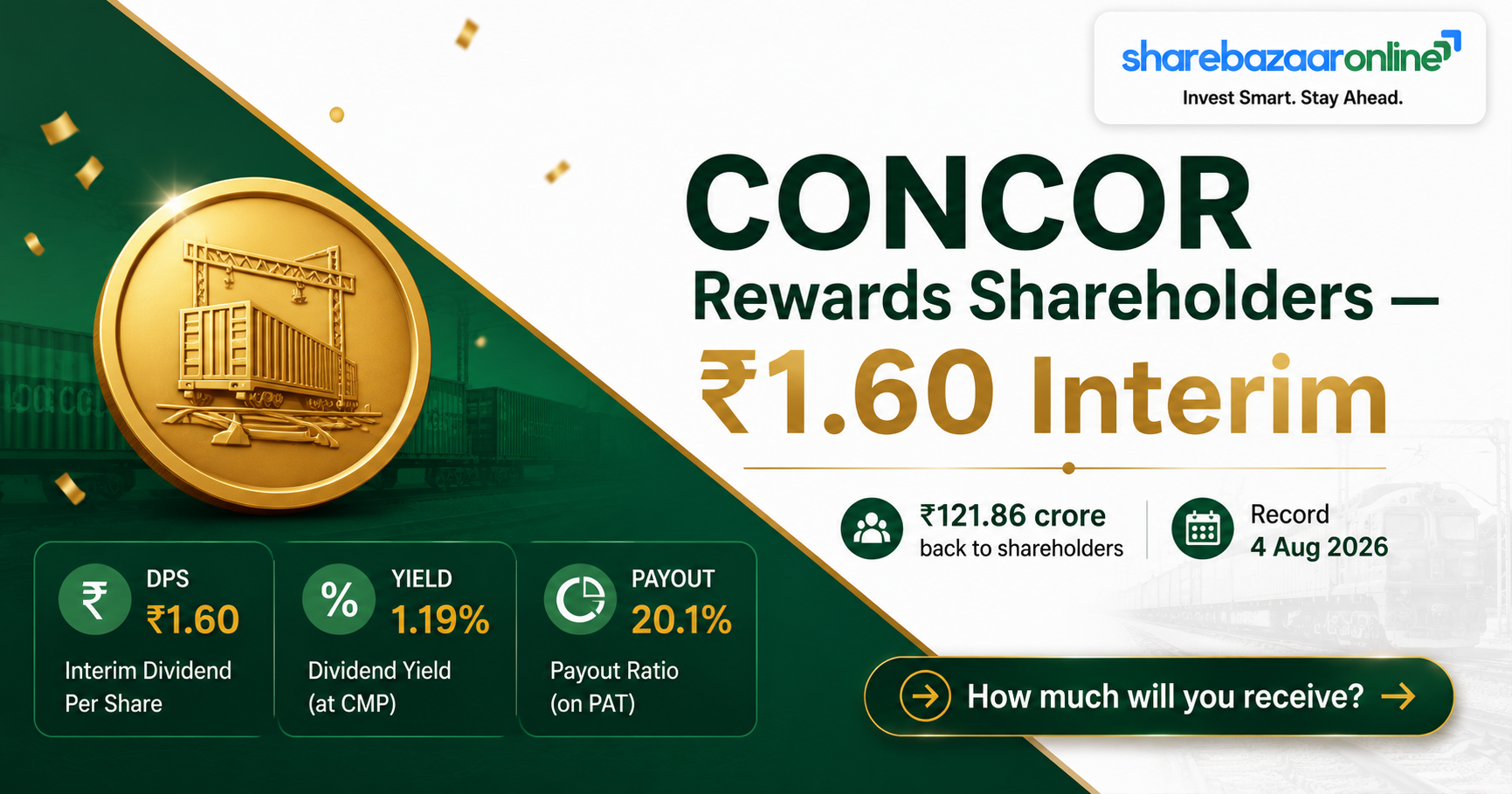
Dividend Snapshot
Container Corporation of India Limited (CONCOR), a Navratna PSU under the Ministry of Railways, has declared its first interim dividend for FY2026-27 of ₹1.60 per equity share (a 32% payout on the ₹5 face value). The total cash going out is ₹121.86 crore across 76,16,17,935 shares. At the announcement-day closing price of ₹477.55, this single payout works out to a yield of just 0.33%; on a trailing 12-month basis the stock yields roughly 1.44%–1.59%.
Dividend Per Share
₹1.60
32% of ₹5 face value · Interim
Total Outflow
₹121.86 Cr
Verified: ₹1.60 × 76.16 cr shares
Record Date
04 Aug 2026
Eligibility cut-off
This-Payout Yield
0.33%
TTM yield ~1.44–1.59%
Why this matters beyond the headline: The dividend itself is small and comfortably covered. The more important story sits underneath — CONCOR’s rail market share has slipped from 74% (FY20) to about 54.35% (9M FY26), full-year FY26 profit actually declined 3.6%, and free cash flow fell 60% as capex rose. This report unpacks all of it.
Dividend Announcement Summary
At its board meeting held on 24 July 2026 (14:30–17:05 hrs), CONCOR’s Board of Directors approved the un-audited Q1 FY2026-27 results and declared an interim dividend of ₹1.60 per equity share of ₹5 face value, amounting to ₹121.86 crore. Because this is an interim dividend, it does not require a separate shareholder vote at the AGM — it is payable directly on the board’s authority, unlike a final dividend.
Instrument details
NSE: CONCOR · BSE: 531344
ISIN: INE111A01025
Face value: ₹5 · Dividend type: Interim (FY27)
Payment mechanics
Payment on or after 12 Aug 2026
To be paid within 30 days of declaration (statutory outer limit ~23 Aug 2026)
Board authority — no AGM approval needed
Context note: The declaration coincided with a leadership transition — Ajit Kumar Panda took over as Chairman & Managing Director from 01 August 2026, following the superannuation of the previous CMD on 31 July 2026. The dividend was declared under the outgoing board.
Key Dates Timeline
Announcement Date
24 July 2026
Board meeting outcome filed with NSE/BSE
Record Date
04 August 2026
Shareholders on register are eligible
Ex-Dividend Date
04 August 2026*
*Inferred: under T+1 settlement the ex-date and record date typically coincide. Not separately disclosed by the company — confirm against the exchange corporate-action circular.
Payment Date
On/after 12 August 2026
Within 30 days of declaration
To receive this dividend you must hold CONCOR shares in your demat account as of the 04 August 2026 record date. Because of T+1 settlement, a purchase must generally be made on or before the ex-date for the trade to settle in time. Shares bought on the ex-date itself do not carry dividend entitlement.
Dividend Yield Analysis
A single interim dividend is not the same as an annual yield. On the ₹1.60 payout alone, the yield is only 0.33% (₹1.60 ÷ ₹477.55 announcement price). CONCOR, however, typically pays multiple interims plus a final dividend each year, so the meaningful figure is the trailing-twelve-month yield of roughly 1.44%–1.59% (Screener reports 1.59%).
Yield on Announcement Price
0.33%
₹1.60 ÷ ₹477.55 (24 Jul close)
Trailing-12M Yield
~1.44–1.59%
All interims + final combined
Yield reality check — is the yield “high” for a good or bad reason?
CONCOR’s yield has crept up mainly because the share price has fallen roughly 20% over the past year (52-week range ₹421–₹617), not because the rupee dividend has surged. A yield that rises on a falling price is a defensive signal, not a reward signal. The stock still trades at a rich 29x earnings and 2.8x book value, so this is not a classic deep-value high-yielder — the yield remains modest despite the de-rating.
Dividend History Analysis
CONCOR is a Consistent Payer with an uninterrupted multi-decade record and no dividend suspensions. One caveat: the company issued a 1:4 bonus in July 2025, so per-share dividends before and after that date are not directly comparable. Under Ind AS 33, older per-share figures must be divided by 1.25 to compare on today’s enlarged share base.
| Event (recent) | Reported DPS | Bonus-Adjusted DPS |
|---|---|---|
| FY27 — 1st interim (this event) | ₹1.60 | ₹1.60 (already post-bonus) |
| FY26 — interim (Sep 2025) | ₹2.00 | ₹2.00 (post-bonus) |
| FY25 — interim (Feb 2025) | ₹4.25 | ₹3.40 |
| FY25 — 2nd interim (Nov 2024) | ₹3.25 | ₹2.60 |
| FY25 — 1st interim (Sep 2024) | ₹2.50 | ₹2.00 |
| FY24 — final (Aug 2024) | ₹2.00 | ₹1.60 |
Dividend history sourced from exchange filings / TipRanks. Bonus-adjusted column applies the 1:4 factor (÷1.25).
Payer Classification
Consistent Payer
No cuts, no suspensions; multiple payouts per year
Long-run Payout Ratio
~45–56%
Screener 10-yr average payout 45.6%
Non-obvious flag: Screener records the FY26 payout ratio at just 27% versus 54% in FY25. This partly reflects dividend timing around the July 2025 bonus (which enlarged the share count mid-year) rather than a deliberate policy cut. The multi-year norm of ~45–55% is the more reliable anchor — but the drop is worth confirming from the FY26 annual report.
Financial Performance Analysis
The Q1 FY27 headline — standalone net profit up 7.7% to ₹277.65 crore — looks healthy, but the quality is thinner than it appears. Revenue barely moved (+0.21% YoY) to ₹2,154.04 crore. Profit before tax grew a modest 5.2%, and the gap between PBT growth (5.2%) and PAT growth (7.7%) is explained almost entirely by a lower effective tax rate of 23.85% (versus 25.63% a year earlier), not by operational strength.
Revenue Q1 FY27 (Standalone)
₹2,154.04 Cr
+0.21% YoY — essentially flat
Net Profit Q1 FY27
₹277.65 Cr
+7.7% YoY · EPS ₹3.65
Effective Tax Rate
23.85%
Down from 25.63% — boosted PAT
Other (Treasury) Income
₹93.87 Cr
A large 25.7% of PBT comes from non-operating income
Segment drivers — where the profit really came from
The EXIM (import-export rail) segment did the heavy lifting: segment PBIT rose 7.7% to ₹312.28 crore. The Domestic segment, however, saw PBIT collapse 32.4% to just ₹25.36 crore (from ₹37.51 crore), a weakness completely hidden by the consolidated headline. On volumes, management noted EXIM throughput rose 9.8% YoY to 10.7 lakh TEUs in Q1 — strong volume growth that did not translate into revenue growth, pointing to realisation/pricing pressure per container.
Full-year context: On a consolidated basis, FY26 revenue rose only 2.2% to ₹9,079 crore while net profit actually fell 3.6% to ₹1,246 crore. Five-year sales growth of just 7.15% and a three-year profit CAGR near 2% confirm this is a slow-growth, cash-generative franchise rather than a compounder.
Cash Flow Analysis
Reported profit is an opinion; cash is a fact. On this test CONCOR passes on operating cash but shows real strain on free cash flow. In FY26, operating cash flow was ₹1,482 crore against net profit of ~₹1,246 crore — a healthy cash-conversion of 95%. But free cash flow crashed 60% to just ₹344 crore (from ₹868 crore in FY25) as the company ramped up capital expenditure on terminals, rakes and land.
Operating Cash Flow FY26
₹1,482 Cr
CFO/Operating Profit = 95%
Free Cash Flow FY26
₹344 Cr
Down 60% YoY on heavy capex
How is this dividend funded?
This specific ₹121.86 crore payout is comfortably covered — FY26 operating cash flow covers it 12.2x and even the shrunken FY26 free cash flow covers it 2.8x. So this interim is funded out of current cash generation, not borrowings or asset sales. The nuance for full-year investors: CONCOR’s total annual dividend bill (multiple interims + final, historically several hundred crore) is now approaching the size of its shrunken free cash flow. If capex stays elevated, future full-year payouts may increasingly lean on the large cash pile rather than fresh free cash flow.
Receivables watch: Debtor days have quietly risen from just 4 days (FY15) to 20 days (FY26), and the working-capital cycle has swung from negative to slightly positive. This is a modest but persistent deterioration in cash conversion worth monitoring — revenue is increasingly being booked before cash is collected.
Balance Sheet Strength
CONCOR’s balance sheet is its single biggest strength and the real reason the dividend is safe. The company is almost debt-free — the ₹965 crore of “borrowings” on the books are largely lease liabilities, not financial debt, and the filing confirms “No Loans.” Reserves stand at roughly ₹12,562 crore and book value is about ₹170 per share.
Reserves (FY26)
₹12,562 Cr
Book value ~₹170/share
Net Debt
Effectively Nil
“No Loans” per filing; ₹965 Cr is lease liability
Investments
₹1,069 Cr
Plus a large unallocable treasury pool
Unallocable Corporate Assets
~₹4,863 Cr
Q1 FY27 treasury/surplus pool (consolidated)
That ~₹4,863 crore pool of unallocable corporate assets is what generates the ₹90-odd crore of quarterly “other income.” It also means the company could fund roughly 40 years of a dividend this size from surplus assets alone — affordability is not in question. The debate is about whether that cash should instead go toward defending market share.
Dividend Sustainability Analysis
We score sustainability on four independent tests. This interim passes all four comfortably, though the free-cash-flow test carries a watch flag at the full-year level.
1. Earnings Coverage
2.28x ✓
Q1 EPS ₹3.65 vs DPS ₹1.60 (interim = 43.8% of Q1 EPS)
2. Operating Cash Coverage
12.2x ✓
FY26 CFO ₹1,482 Cr vs outflow ₹121.86 Cr
3. Free Cash Flow Coverage
2.8x ⚠
FY26 FCF ₹344 Cr — adequate for this payout, but FCF fell 60%
4. Balance-Sheet Coverage
~40x ✓
Treasury pool ~₹4,863 Cr vs outflow
Verdict: Sustainable (this payout)
For the ₹1.60 interim in isolation, sustainability is not in doubt — earnings, cash flow and reserves all cover it several times over. The single watch flag is at the annual level: with free cash flow down to ₹344 crore and the total yearly dividend bill historically much larger, sustaining the full-year payout at past levels may increasingly depend on drawing down cash reserves if capex stays high and profit growth stays flat.
Peer Comparison
| Metric | CONCOR | Gateway Distriparks | Allcargo Logistics |
|---|---|---|---|
| Dividend Yield | ~1.59% | ~2.9% | Not Independently Verified |
| Dividend Payout | ~45.6% (10-yr avg) | ~26.7% | >100% (loss-distorted) |
| ROE | 9.81% | ~10.8% | Not Independently Verified |
| ROCE | 12.4% | Not Independently Verified | Not Independently Verified |
| P/E | ~29.3x | ~11–14x | Not Independently Verified |
| Balance sheet | Debt-free, cash-rich | D/E ~0.28 | Leveraged |
Peer figures are indicative, drawn from public aggregators and not re-verified from each company’s primary filings; cells that could not be confirmed are marked accordingly.
The read-across: CONCOR offers a lower yield but far higher quality than its listed peers — it is debt-free, government-backed and pays consistently, whereas smaller peers like Gateway Distriparks carry higher yields but also cyclicality and leverage. CONCOR’s premium 29x P/E versus peers at 11–14x is the market paying up for that safety and its 54% rail market share — a premium that looks stretched given flat profits and eroding share.
Promoter Impact Analysis
CONCOR’s promoter is the President of India (Government of India), holding 54.80%. Of the ₹121.86 crore total payout, the government receives an estimated ₹66.78 crore — a direct transfer to the Union exchequer. This is a structural feature of PSU dividends: they double as a fiscal tool for the government owner.
Promoter (GoI) — 54.80%
~₹66.78 Cr
DIIs — 29.85%
~₹36.38 Cr
FIIs — 7.85%
~₹9.57 Cr
Public — 7.49%
~₹9.13 Cr
The real ownership story: a dramatic FII exit
Foreign institutional holding has collapsed from 28.5% (FY19) and 22.24% (FY23) to just 7.85% (Jun 2026). Domestic institutions (LIC, mutual funds) have absorbed almost all of that selling, rising to 29.85%. This multi-year foreign exodus — alongside the ~20% one-year price fall — signals that global investors have grown wary of CONCOR’s market-share erosion, even as domestic institutions treat it as a defensive dividend holding. Minority shareholders are receiving the same ₹1.60 per share as the government, so the distribution itself is equitable.
Taxation Analysis
Since April 2020, dividends are taxed in the hands of the shareholder at their applicable income-tax slab rate — there is no separate Dividend Distribution Tax. Under Section 194, the company deducts 10% TDS if your total dividend from that company in a financial year exceeds ₹5,000 (₹10,000 from FY26 onwards under recent amendments — confirm the applicable threshold). Investors with income below the taxable limit can submit Form 15G/15H to avoid TDS.
Worked example — retail investor holding 1,000 shares
| Shares held | 1,000 |
| Dividend per share | ₹1.60 |
| Gross dividend | ₹1,600 |
| TDS u/s 194 | ₹0 (below the ₹5,000 threshold) |
| Tax at 30% slab (excl. cess) | ₹480 |
| Net dividend in hand | ₹1,120 |
| Post-tax yield (30% slab, on ~₹478) | ~0.23% |
Illustrative only; excludes surcharge and 4% health & education cess. Your actual tax depends on your total income and slab.
Key Risks
1. Structural market-share erosion
Rail market share has fallen from 74% (FY20) to ~54.35% (9M FY26) as private container-train operators and road freight take share. This is the single biggest long-term threat to earnings and, ultimately, dividends.
2. Land License Fee (LLF) overhang
CONCOR booked ₹112.87 crore of LLF for the quarter on its own assessment, which is “not final,” and has not recognised the Right-of-Use asset/lease liability for Railway land. The auditors flagged this as an Emphasis of Matter — a genuine, uncertain future liability.
3. Flat revenue despite volume growth
EXIM volumes grew ~9.8% but revenue was flat — evidence of pricing/realisation pressure. If volume gains keep failing to convert to revenue, margins stay squeezed.
4. Free-cash-flow compression
FCF fell 60% to ₹344 crore in FY26 on rising capex. A sustained squeeze could force future full-year dividends to draw down reserves.
5. Governance non-compliance
As of 30 June 2026 the company had only one independent director, breaching Section 149(4) and SEBI LODR — a board-composition and oversight risk typical of under-staffed PSU boards.
6. PSU / policy dependence
As a government-controlled entity dependent on Indian Railways for haulage rates and land, CONCOR’s economics can shift with policy decisions outside its control (e.g., haulage charge revisions, LLF policy).
What To Monitor
1. Quarterly market share & TEU volumes
Whether the 74%→54% slide stabilises. Watch EXIM/domestic TEU throughput and the market-share figure in each concall.
2. Realisation per container
Track whether revenue starts growing in line with volumes — the key sign that pricing pressure is easing.
3. Free cash flow recovery & capex plan
Watch whether FCF rebuilds from ₹344 crore as the capex cycle matures, and management’s capex guidance.
4. LLF resolution
Final crystallisation of the Land License Fee liability and any ROU recognition — this could materially change reported costs.
5. Dedicated Freight Corridor (DFC) ramp-up
DFC utilisation is the main structural tailwind that could reverse the volume/margin trend if it plays to CONCOR’s strengths.
6. New CMD’s capital-allocation stance
Whether new CMD Ajit Kumar Panda (from Aug 2026) shifts the balance between dividends, buybacks and reinvestment to defend share.
Conclusion
CONCOR’s ₹1.60 interim dividend is a safe, well-covered but small payout from a fortress balance sheet — earnings cover it 2.3x, operating cash flow 12x, and the cash pile roughly 40x. For income-focused holders, the reassurance is real: this is a debt-free, government-backed, consistent payer.
Positives
Debt-free, cash-rich; consistent multi-decade payer; EXIM PBIT up 7.7%; strong 9.8% EXIM volume growth; ~₹4,863 Cr treasury cushion.
Negatives / Watch-outs
Market share down 74%→54%; FY26 profit fell 3.6%; FCF down 60%; domestic PBIT down 32%; FII holding collapsed to 7.85%; LLF and governance overhangs; rich 29x valuation.
The honest framing: the dividend is not the risk — the business trajectory is. Investors are being paid a modest ~1.5% trailing yield to hold a slow-growth franchise that is defending a shrinking moat. Whether that’s attractive depends on your view of the Dedicated Freight Corridor and management’s ability to stabilise market share. We present the evidence; the decision is yours.
Frequently Asked Questions
What dividend has CONCOR announced?
What is the dividend yield on this payout?
What is the record date?
What is the ex-dividend date?
When will the dividend be paid?
Who is eligible for the dividend?
How is this dividend taxed?
Is CONCOR’s dividend sustainable?
What is CONCOR’s dividend history?
Does this interim dividend need AGM approval?
How much does the government earn from this dividend?
What should investors monitor going forward?
Why has CONCOR’s share price fallen?
Disclaimer
This article is published by ShareBazaar Online for informational and educational purposes only. It is not investment advice and contains no buy, sell or hold recommendation. ShareBazaar Online is not a SEBI-registered investment adviser or research analyst. All figures are compiled from the company’s exchange filings dated 24 July 2026 and publicly available sources; market prices, yields and dividend dates are time-sensitive and must be re-verified before acting. Dividend eligibility depends on the exchange-confirmed record and ex-dates. Investments in securities are subject to market risks; please read all related documents carefully and consult a SEBI-registered financial adviser before making any investment decision. ShareBazaar Online accepts no liability for any loss arising from the use of this information.