
Dividend Snapshot
The Board of The Grob Tea Company Limited (NSE: GROBTEA) recommended a Final Dividend of ₹2 per equity share (20% on face value of ₹10) for the financial year ended 31 March 2026. The payout is subject to shareholder approval at the AGM on 11 August 2026.
Dividend Type: Final Dividend
Dividend Per Share: ₹2.00
Face Value: ₹10
Dividend %: 20%
Financial Year: FY 2025-26
Payer Classification: Consistent Payer (10+ years)
Announcement Date: 13 May 2026
Record Date: 4 August 2026
Ex-Date: 4 August 2026 (T+1 convention)
Payment Date: On/around 10 Sep 2026 (within 30 days of AGM approval)
Dividend Yield: ~0.22% (at CMP ~₹900; re-verify)
Dividend Payout: ~4% of PAT
The one number that matters: the ₹2 dividend is tiny and safe — it is covered 24.7× by earnings. The real story sits around the dividend: operating cash flow fell ~80%, free cash flow turned deeply negative, and total debt nearly tripled to fund an acquisition. Details in the sections below.
Dividend Announcement Summary
At its meeting on 13 May 2026, the Board of Directors recommended a final dividend of ₹2 per share for FY2025-26, alongside audited standalone results. In the prior year (FY2024-25) the company had paid ₹3 per share, so the headline reads like a one-third cut.
Context aggregators miss: ₹2 is not a distress cut — it is Grob Tea’s long-run baseline. The company has paid ₹2 in most of the last ten years and only stepped up to ₹3 twice (FY2020-21 and FY2024-25). FY2025-26 is therefore best read as a reversion to its normal ₹2 after a one-off ₹3 bump, not the beginning of a downtrend. The distinction changes the interpretation entirely.
The same board meeting also noted the resignation of the statutory auditor (GARV & Associates), the appointment of a new auditor (B Nath & Company), several board changes, and approval of the company’s ongoing acquisition of The Bazaloni Group. These are discussed under Risks and Balance Sheet Strength.
Key Dates Timeline
Board / Announcement: 13 May 2026
Ex-Date: 4 August 2026
Record Date: 4 August 2026
Book Closure: 5 – 11 August 2026
AGM (approval): 11 August 2026
Expected Payment: On/around 10 Sep 2026
Notes on dates: The record date of 4 August 2026 is company-confirmed via the exchange corporate-action intimation. Under the T+1 settlement convention the ex-date coincides with the record date (4 Aug 2026) — buyers on or after this date do not receive the dividend. The payment date is not stated as a fixed calendar date in the board resolution; the company has committed to pay within 30 days of AGM approval (statutory outer limit), which points to ~10 September 2026. Confirm against the final exchange circular before publishing.
Dividend Yield Analysis
Dividend Per Share: ₹2.00
Reference CMP: ~₹900 (mid-2026; re-verify)
Current Yield: ~0.22%
FY25 (₹3) yield ref: ~0.33%
Yield reality check: A ~0.22% yield is very low, but not because the business is weak or the price has spiked. It simply reflects a token dividend against a high absolute share price (₹10 face value trading near ₹900). Grob Tea is a low-payout, capital-retention stock — it is not an income/yield play.
Important caveat — illiquidity: GROBTEA trades extremely thinly (average daily volume in the low hundreds of shares). Any quoted “live price” can be stale or driven by a handful of trades, so the yield figure should be recomputed against a verified closing price at publish time.
Dividend History Analysis
| Financial Year | Dividend / Share | Ex-Date | Type |
|---|---|---|---|
| FY2025-26 | ₹2.00 | 4 Aug 2026 | Final |
| FY2024-25 | ₹3.00 | 5 Aug 2025 | Final |
| FY2023-24 | ₹2.00 | 12 Aug 2024 | Final |
| FY2022-23 | ₹2.00 | 2 Aug 2023 | Final |
| FY2021-22 | ₹2.00 | 25 Jul 2022 | Final |
| FY2020-21 | ₹3.00 | 20 Aug 2021 | Final |
| FY2019-20 | ₹2.00 | 21 Sep 2020 | Final |
| FY2018-19 | ₹2.00 | 29 Aug 2019 | Final |
| FY2016-18 | ₹2.00 | 2016–2018 | Final |
History compiled from public dividend records (TipRanks / exchange filings); not company-tabulated. Verify each ex-date against exchange circulars.
Classification: Consistent Payer. Grob Tea has paid a dividend every year for over a decade with no suspensions and no misses — notable for a small, cyclical tea company. The payout has oscillated in a tight ₹2–₹3 band, anchored at ₹2. There is no evidence of a structural dividend cut; rather, a stable token payout that occasionally rises to ₹3 in stronger years.
Financial Performance Analysis
| Metric (Standalone, ₹ Cr) | FY2025-26 | FY2024-25 | Change |
|---|---|---|---|
| Revenue from Operations | 114.38 | 118.51 | −3.5% |
| Profit Before Tax | 7.09 | 12.14 | −41.6% |
| Net Profit (PAT) | 5.75 | 10.06 | −42.8% |
| Basic EPS (₹) | 49.49 | 86.52 | −42.8% |
Profit fell far faster than revenue. Sales dipped only ~3.5%, but PAT dropped ~43%. This is operating deleverage — a small revenue slip on a high fixed-cost tea estate (wages, stores, depreciation) compresses the bottom line sharply. Employee cost alone (₹66.4 cr) exceeds half of revenue.
The year was back-loaded. The full-year profit masks a heavy Q4 net loss of ~₹19 crore (quarterly EPS −163.59). Tea is seasonal — the crop and margins are earned in the first half. Judging Grob on a single quarter is misleading in both directions.
One-off in the numbers: FY26 PAT is stated after an exceptional charge of ₹0.50 crore — a provision against a single doubtful loan (out of a ₹43.95 crore opening loan-receivable book). It is small, but it flags that a chunk of the balance sheet sits in inter-corporate lending rather than the tea business (see Balance Sheet Strength).
Cash Flow Analysis
| Cash Flow (Standalone, ₹ Cr) | FY2025-26 | FY2024-25 |
|---|---|---|
| Operating Cash Flow (OCF) | 3.26 | 16.00 |
| Capital Expenditure | (14.88) | (6.97) |
| Free Cash Flow (OCF − Capex) | (11.62) | 9.03 |
| Net Investing Cash Flow | (35.91) | (23.53) |
| Dividend actually paid in year | (0.35) | (0.23) |
Reported profit is an opinion — cash is a fact. Operating cash flow collapsed ~80%, from ₹16.0 crore to just ₹3.3 crore, a far steeper fall than the 43% drop in reported profit. The gap was driven mainly by cash being tied up in other assets (a ~₹8.3 crore outflow into “other assets”) even as inventory released cash.
Free cash flow turned deeply negative. After ₹14.9 crore of capex, FCF was −₹11.6 crore (versus +₹9.0 crore the year before). So how is the dividend paid? Not out of FY26 free cash. The ₹2 payout (₹0.23 crore total) is affordable only because it is trivially small relative to the balance sheet — it is being funded from reserves and borrowings in aggregate, not from cash the business generated this year after investment.
Balance Sheet Strength
Total Equity: ₹92.81 cr
Total Borrowings FY26: ₹52.90 cr
Total Borrowings FY25: ₹18.34 cr
Debt Change: +188%
Debt-to-Equity: ~0.57×
Cash & Bank: ₹3.23 cr (thin)
Net Debt: ~₹49.67 cr
Loans Receivable (current): ₹48.82 cr
Non-current Investments: ₹2.24 cr
Dividend Outflow: ₹0.23 cr
The balance sheet was re-geared this year. Long-term borrowings jumped from ₹1.03 crore to ₹32.37 crore, taking total debt up ~188%. The reason is disclosed in the notes: the company is acquiring 100% of The Bazaloni Group Limited for ₹71.80 crore, of which ₹21.02 crore has been paid and ₹50.78 crore remains outstanding. Grob is levering up to become a bigger, multi-estate tea group.
A structural quirk: nearly ₹49 crore of the balance sheet is loans receivable (inter-corporate lending), and a separate ₹1.20 crore is stuck in a dormant LED-lighting venture that has had no sales for five years. For a ₹114-crore tea company, a meaningful slice of capital sits outside the core operating business — worth watching as the acquisition is funded.
Dividend Sustainability Analysis
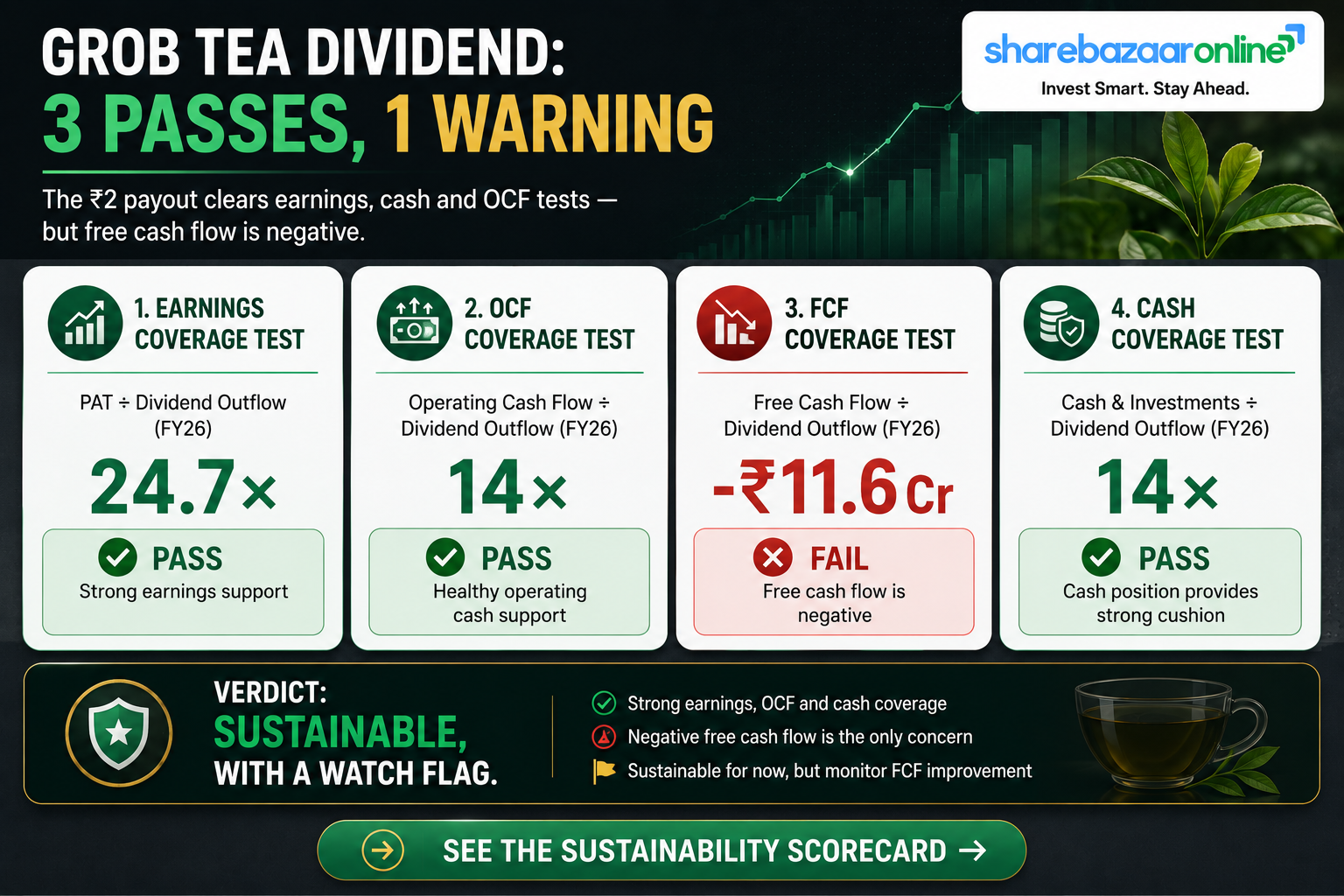
| Coverage Test | Result | Verdict |
|---|---|---|
| Earnings coverage (EPS vs DPS) | ₹49.49 vs ₹2 = 24.7× | PASS |
| OCF coverage (OCF vs outflow) | ₹3.26 cr vs ₹0.23 cr = 14× | PASS |
| FCF coverage (FCF vs outflow) | FCF = −₹11.62 cr | FAIL |
| Cash coverage (cash vs outflow) | ₹3.23 cr vs ₹0.23 cr = 14× | PASS |
Verdict: Sustainable (low-payout) — with a capital-allocation watch flag. On three of four tests the ₹2 dividend passes comfortably; it is so small (₹0.23 crore) that earnings and cash cover it many times over. The single failed test — negative free cash flow — does not threaten the payout itself, but it tells the real story: the company is not generating surplus cash after investment this year. The dividend is safe; the surrounding cash generation and leverage are the things to monitor, not the ₹2 cheque.
Peer Comparison
| Company | Latest DPS | Div. Yield | Payout | Notes |
|---|---|---|---|---|
| Grob Tea | ₹2.00 | ~0.22% | ~4% | Micro-cap, illiquid |
| Jay Shree Tea | ₹0.50 | ~0.5% | ~2% | Mid/small-cap Assam |
| Rossell India | ₹0.40 | — | — | Tea + aerospace |
| Goodricke Group | — | — | — | Largest CTC producer |
| Dhunseri Tea | — | — | — | Consistent payer |
Blank cells indicate data not independently verified from primary sources at time of writing. Peer figures sourced from public market data and should be refreshed before publishing.
Sector read-through: Listed tea is a structurally low-yield sector (typical yields 0.2%–0.7%), well below the broader consumer-staples average. Grob’s ~0.22% yield sits at the bottom of an already-low range, consistent with its low-payout, capital-retention posture. Investors seeking yield will not find it here; the tea plays are cyclical, crop- and auction-price-driven businesses.
Promoter Impact Analysis
Promoter Holding: ~75.00%
Public Holding: ~25.00%
FII / DII: ~0.00% / ~0.10%
Total Dividend Outflow: ₹0.23 cr
To Promoters (75%): ~₹17.4 lakh
To Public (25%): ~₹5.8 lakh
Dividend is not the main promoter channel here. With a ~4% payout, the dividend returns only ~₹17 lakh to the 75% promoter block — immaterial. The more relevant related-party angle is elsewhere: the board approved fresh unsecured loans of up to ₹5 crore each to two promoter-group entities (Banka Enterprises and K L Support), and the balance sheet already carries ~₹49 crore of loans receivable. For minority shareholders, the flow of capital through inter-corporate loans is a more material governance item than the token dividend.
Taxation Analysis
Since April 2020, dividends are taxable in the hands of the shareholder at their applicable income-tax slab rate (the company no longer pays Dividend Distribution Tax). The company must deduct TDS under Section 194 at 10% if total dividend paid to a resident shareholder in a financial year exceeds ₹5,000 (20% if PAN is not furnished). Small shareholders below the taxable limit can file Form 15G/15H to avoid TDS.
Worked Example A — 1,000 shares
- Gross dividend: 1,000 × ₹2 = ₹2,000
- TDS: Nil (below ₹5,000 threshold)
- Tax at 30% slab: ₹600 + 4% cess = ₹624
- Net in hand: ₹1,376
- Effective post-tax yield (on ~₹900): ~0.15%
Worked Example B — 3,000 shares (TDS triggers)
- Gross dividend: 3,000 × ₹2 = ₹6,000
- TDS @10% (> ₹5,000): ₹600 withheld
- Credited to bank: ₹5,400
- Final tax at 30% slab: ₹1,800 + cess = ₹1,872
- TDS of ₹600 is adjusted against this at filing.
Illustrative only; assumes a resident individual with PAN. NRIs face different rates (typically 20% plus surcharge/cess, subject to DTAA relief). Consult a tax adviser for your situation.
Key Risks
1. Leveraged acquisition overhang. ₹50.78 crore of the ₹71.80 crore Bazaloni purchase is still unpaid; total debt has already tripled to ₹52.9 crore. Funding and integration risk is now the dominant story.
2. Earnings & cash-flow volatility. PAT fell 43% and OCF ~80% in one year; Q4 alone was a ~₹19 crore loss. Tea is crop-, weather- and auction-price-driven, so results swing hard.
3. Statutory auditor resignation. The auditor resigned citing fees not commensurate with the workload arising from the acquisitions. A mid-transaction auditor change is a governance/continuity item to watch neutrally, not a conclusion of wrongdoing.
4. Capital outside the core. ~₹49 crore in inter-corporate loans (with fresh promoter-group loans approved) plus ₹1.20 crore stuck in a dormant LED business. A single ₹0.50 crore loan already turned doubtful this year.
5. Extreme illiquidity. Average daily volume is in the low hundreds of shares. Quoted prices are easily distorted, and exiting a position at a fair price can be difficult.
6. AGM approval pending. The final dividend is a recommendation only until shareholders approve it at the 11 August 2026 AGM.
What To Monitor
1. Bazaloni completion & funding. Watch how the remaining ₹50.78 crore is paid (fresh debt vs internal funds) and when Bazaloni becomes a subsidiary requiring consolidated accounts.
2. Operating cash flow recovery. Does FY27 OCF rebound toward the ₹16 crore seen in FY25, or does the ~₹3 crore level persist? This determines whether dividends can eventually be funded from operations.
3. First opinion from the new auditor. B Nath & Company’s first audit report — any qualifications, emphases of matter or changes in accounting treatment.
4. Debt & interest cost trajectory. Finance costs and the debt-to-equity ratio as the acquisition is funded; whether borrowings keep climbing beyond ₹53 crore.
5. Recovery of loans receivable. Whether the ~₹49 crore loan book is recovered on schedule or attracts further provisioning.
6. Next year’s dividend signal. Whether FY27 holds at the ₹2 baseline, which would confirm the “stable token payout” read rather than a downtrend.
Conclusion
Positives
- Dividend covered 24.7× by earnings — extremely safe in isolation.
- 10+ years of unbroken payouts; no suspensions.
- Low ~4% payout leaves a large retention cushion.
- Promoters hold 75% — aligned skin in the game.
- ₹2 is the historic norm, not a distress cut.
Negatives / Watch-outs
- PAT down 43%, OCF down ~80%.
- Free cash flow deeply negative (−₹11.6 cr).
- Total debt tripled (+188%) for the acquisition.
- Statutory auditor resigned mid-transaction.
- Large capital tied in loans & a dormant LED unit; extreme illiquidity.
The ₹2 dividend is the least interesting fact in Grob Tea’s FY26 result. It is small, safe and consistent with a decade of behaviour. The genuinely important development is that a sleepy, cash-generative tea company has levered up materially to fund a ₹71.8 crore acquisition, seen its operating cash generation shrink sharply in the same year, and changed auditors along the way. The dividend cheque tells you almost nothing; the balance sheet and cash-flow statement tell you everything. We present the evidence and leave the decision to you.
Frequently Asked Questions
What dividend has Grob Tea announced for FY2025-26?
What is the dividend yield?
What is the record date?
What is the ex-date?
When will the dividend be paid?
Who is eligible to receive the dividend?
How is the dividend taxed?
Is the dividend sustainable?
Did Grob Tea cut its dividend?
What is Grob Tea’s dividend history?
Why did profit fall so sharply in FY2026?
Why did the company’s debt increase so much?
What should investors monitor going forward?
Disclaimer
This article is for informational and educational purposes only and does not constitute investment, tax or legal advice, nor a recommendation to buy, sell or hold any security. ShareBazaar Online is not a SEBI-registered investment adviser. All financial figures are drawn from the company’s standalone results and exchange filings; market prices, yields, peer data and dates are sourced from public providers, may be delayed or stale (the stock is thinly traded), and must be independently re-verified before any decision. Grob Tea does not currently publish consolidated financials. Figures marked as inferred, not disclosed, or not independently verified should be treated accordingly. Dividends are subject to shareholder approval at the AGM. Investing in equities carries risk of capital loss. Please consult a qualified financial adviser and read all offer/statutory documents before investing.