
Dividend Snapshot
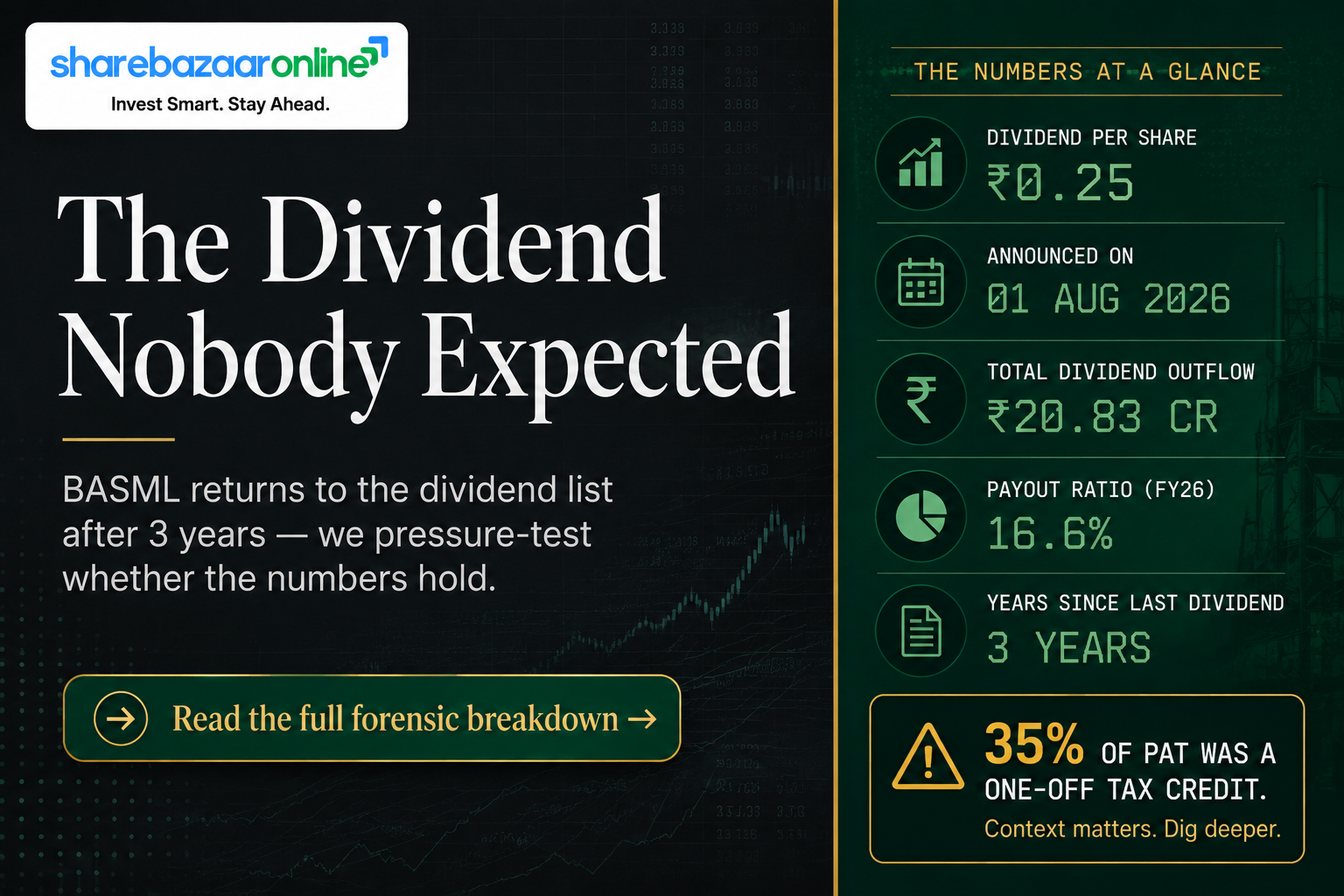
Bannari Amman Spinning Mills Limited, a Coimbatore-based vertically integrated cotton-yarn and textile manufacturer, has recommended a final dividend of ₹0.25 per equity share (5% of the ₹5 face value) for the financial year ended 31 March 2026. The most notable feature is not the size of the payout but its timing: this is the company’s first dividend in roughly three years, reinstated after it turned its continuing operations back to profit — but reinstated at a level well below the ₹0.60 it last paid for FY2021-22.
Dividend Per Share
₹0.25 (5%)
Dividend Yield (approx.)
~0.93% @ ₹27 CMP
Dividend Type
Final Dividend
Subject to AGM approval (10 Aug 2026)
Record Date
03 Aug 2026
Payment on or before 08 Sep 2026
Classification: Irregular / Cyclical payer. The dividend was suspended for FY2022-23, FY2023-24 and FY2024-25 and has now resumed at a reduced rate. Total cash outflow is a token ~₹2.00 crore — comfortably affordable, but modest relative to the company’s ~₹396 crore gross debt.
Dividend Announcement Summary
At its board meeting on 29 May 2026 (held 3:00–5:25 PM), the Board of Directors approved the audited standalone and consolidated results for the quarter and year ended 31 March 2026 — on which the statutory auditors, P.N. Raghavendra Rao & Co, issued an unmodified opinion — and recommended the ₹0.25 final dividend. The same board meeting also re-appointed Sri S V Arumugam as Managing Director for a further three years (27 Jun 2026 to 26 Jun 2029) and approved the forfeiture of 42,25,806 share warrants.
Explicit affordability caveat: The dividend is a recommendation, not yet a paid distribution. Under the Companies Act, a final dividend must be approved by shareholders at the AGM before it becomes payable. The 36th AGM is scheduled for 10 August 2026 via video conferencing.
Scale check: At ₹0.25 on ~7.99 crore shares, the outflow is ~₹2.00 crore — roughly 0.9% of the consolidated net worth of ~₹473 crore, and about 14.5% of consolidated FY26 net profit. This is a conservative, capital-preserving payout.
Key Dates Timeline
| Event | Date | Note |
|---|---|---|
| Announcement (Board Meeting) | 29 May 2026 | Company disclosed |
| Ex-Date | 03 Aug 2026 | Inferred = record date under T+1 (confirm against exchange circular) |
| Record Date | 03 Aug 2026 | Company disclosed |
| Book Closure | 04–10 Aug 2026 | Company disclosed |
| AGM (approval) | 10 Aug 2026 | 36th AGM, via video conferencing |
| Payment Date | On or before 08 Sep 2026 | Statutory outer limit (within 30 days of AGM) |
Sourcing note: The ex-date is almost never separately disclosed by Indian companies. Under the current T+1 settlement cycle, the ex-date and record date typically fall on the same trading day. Readers should verify the ex-date against the NSE/BSE corporate-action circular before trading on it.
Dividend Yield Analysis
At an approximate market price of ₹27, the ₹0.25 dividend works out to a yield of roughly 0.93%. This is a low, almost symbolic yield — the payout is a signal of restored confidence rather than an income proposition. Live CMP must be re-verified at publish time; the yield figure is stale within days.
Yield Reality Check — why the yield is low
The low yield is driven by the small absolute dividend, not by a high share price. In fact the stock has de-rated sharply — down roughly 40%–50% over the past year and trading at about 0.46x book value (book value ~₹59/share). A falling price would normally inflate a yield; here the dividend is simply too small to produce a meaningful figure even at a depressed price. This is a rebuilding-balance-sheet dividend, not a high-yield dividend.
Dividend History Analysis
| Financial Year | Dividend / Share | Remark |
|---|---|---|
| FY2025-26 | ₹0.25 | Resumption after gap (this event) |
| FY2024-25 | Nil | No dividend |
| FY2023-24 | Nil | No dividend |
| FY2022-23 | Nil | No dividend |
| FY2021-22 | ~₹0.60 (12%) | Last dividend before the gap (paid 2022) |
| Earlier years | ₹0.48–0.64 band | Broadly annual through the 2010s (Not Independently Verified for all years) |
Consistency verdict
Irregular / Cyclical payer. The company historically paid a modest annual dividend through the 2010s, then suspended distributions for three straight years as earnings and cash flow came under pressure. FY26 marks a deliberate resumption.
Growth trend
The resumed dividend is lower than the pre-gap level (₹0.25 vs ~₹0.60). Management is re-establishing the habit of paying cautiously rather than restoring the prior rate — consistent with a company still carrying heavy debt.
Dividend-history dates and amounts sourced from third-party corporate-action records (TipRanks, exchange filings). Amounts for years before FY22 are indicative and labelled Not Independently Verified.
Financial Performance Analysis
| Consolidated (₹ Cr) | FY2024-25 | FY2025-26 | Change |
|---|---|---|---|
| Revenue from operations | 887.36 | 870.32 | -1.9% |
| Cost of materials consumed | 654.58 | 568.87 | -13.1% |
| EBITDA (ex-other income) | ~64.6 | ~85.9 | +33.1% |
| Profit before tax | (3.90) | 21.76 | Loss → Profit |
| Net profit (owners) | 7.19 | 13.75 | +91.2% |
| EPS (₹, total) | 1.14 | 1.76 | +54% |
Operating leverage — the real driver
Revenue actually fell 1.9%, yet profit swung from a pre-tax loss to a ₹21.76 crore pre-tax profit. The engine was input-cost deflation: cost of materials consumed dropped 13.1% (falling cotton/yarn input prices), lifting EBITDA margin from ~7.3% to ~9.9%. This is a cyclical margin recovery, not volume-led growth — a distinction that matters because it can reverse if cotton prices climb.
⚠ Quality-of-earnings flag: one-off tax reversal
Reported profit is flattered by a ₹483.66 lakh (~₹4.84 crore) “earlier years” tax credit. Stripping out this one-time reversal, the effective tax charge would have been ~₹11.6 crore instead of ~₹6.77 crore, and net profit would have been roughly 35% lower. The underlying operational recovery is genuine, but the headline PAT growth of +91% overstates the run-rate improvement.
Cash Flow Analysis
Reported profit is an opinion; cash is a fact — and on the cash test, BASML looks far stronger than its thin reported profit suggests. Consolidated operating cash flow (OCF) was a robust ₹116.83 crore, versus net profit of just ₹13.75 crore — an OCF-to-PAT ratio of about 8.5x. The gap is explained by heavy non-cash depreciation (~₹27.7 cr), large finance costs added back (~₹44.7 cr), and a favourable working-capital release (inventory drawdown of ~₹22.5 cr).
Operating Cash Flow
₹116.83 cr
Covers the dividend ~58x
Free Cash Flow (OCF − Capex)
~₹45.67 cr
Capex ₹71.16 cr; covers dividend ~23x
How is the dividend funded?
The ₹2.00 crore dividend is funded from current-year free cash flow, not from reserves, asset sales, or fresh borrowing. Even after a heavy ₹71.16 crore capex year, positive FCF of ~₹45.67 crore leaves the dividend covered ~23 times. Note, however, that most of the year’s cash was deliberately routed into capex and debt repayment (financing outflow of ~₹72.6 crore), which is why the closing cash balance is deliberately thin.
Receivables vs revenue: Trade receivables rose ~₹9.8 crore even as revenue dipped — a mild negative signal on collection quality worth monitoring, though offset by the large inventory drawdown that powered the cash generation.
Balance Sheet Strength
Total Borrowings
~₹395.9 cr
78% is short-term working-capital debt (₹309.4 cr)
Cash + Bank Balances
~₹5.71 cr
Net debt ~₹390 cr
Net Worth (owners)
~₹473.6 cr
Book value ~₹59/share
Net Debt / Equity
~0.82x
Moderate leverage; interest coverage remains low
The debt load is large but improving. Non-current borrowings fell from ~₹143 crore to ~₹86 crore year-on-year, and a June 2026 credit-rating action by CARE revised the outlook to Stable from Negative (long-term BBB-, short-term A3) on ~₹612.7 crore of bank facilities — a supportive development for the dividend resumption. That said, the mostly short-term nature of the debt and a low interest-coverage ratio mean the balance sheet still needs careful watching.
Deep-value optics: The stock trades at roughly 0.46x book value. That partly reflects genuine concerns (cyclicality, debt, weak ROE), but also means the dividend resumption is happening while the market prices the equity at less than half its accounting net worth.
Dividend Sustainability Analysis
| Sustainability Test | Metric | Verdict |
|---|---|---|
| Earnings coverage | EPS ₹1.76 vs DPS ₹0.25 = 7.0x | Comfortable |
| OCF coverage | ₹116.83 cr / ₹2.00 cr = 58.5x | Very strong |
| FCF coverage | ₹45.67 cr / ₹2.00 cr = 22.9x | Strong |
| Cash / balance-sheet coverage | Cash & investments ~₹12.2 cr = 6.1x | Adequate but thin cash |
Verdict: Sustainable (at the current token level)
On every cash-based test the ₹0.25 dividend is trivially affordable. The genuine caveats are watch flags rather than red flags: (1) profit is partly propped up by a one-off tax credit; (2) the business is cotton-cycle sensitive, so earnings coverage could compress if input costs rise; and (3) the company’s priority is clearly debt reduction and capex, so investors should not extrapolate this token payout into a rising dividend trajectory.
Peer Comparison
| Company | Div/Share | Div Yield | ROE (3-yr) | P/B | Mkt Cap |
|---|---|---|---|---|---|
| BASML | ₹0.25 | ~0.93% | ~ -0.5% | 0.46x | ~₹215 cr |
| Nitin Spinners | ₹3.00 | ~0.56% | ~13.1% | — | ~₹3,035 cr |
| Ambika Cotton | ₹37.0 | ~3.05% | — | 0.73x | ~₹681 cr |
Blank cells are intentionally left where the figure could not be verified from a primary source. Peer figures sourced from public aggregators and are indicative only; different face values and year-ends limit strict comparability.
BASML is the smallest and lowest-quality dividend payer in this peer set. Ambika Cotton is a genuine high-yield, cash-rich cotton-yarn name; Nitin Spinners is a scaled, profitable grower recently upgraded to CARE A+. BASML, by contrast, offers the deepest discount to book but the weakest profitability (negative three-year ROE) — the classic profile of a cyclical turnaround rather than a dividend compounder.
Promoter Impact Analysis
Promoter Holding
~49.55%
FII ~0.13% · DII ~0% · Public ~50.3%
Promoter Dividend Income
~₹0.99 cr
Public shareholders receive ~₹1.01 cr
A subtle governance point: following the FY26 rights issue, the ultimate holding company Murugan Enterprises Private Limited saw its stake fall from 54.29% to 48.49%, and BASML technically ceased to be its subsidiary and became an associate. Promoters now hold slightly under half the company, so the dividend is split almost evenly between promoter (~₹0.99 cr) and public (~₹1.01 cr) shareholders — there is no disproportionate promoter benefit here. The payout is small enough that it functions as a confidence signal to minority holders rather than a cash-extraction mechanism.
Potential dilution flag: One warrant tranche (42,25,806 warrants) was forfeited in May 2026, but a second tranche of 41,66,660 convertible warrants (allotted Aug 2025 to the promoter group) remains outstanding and convertible within 18 months — a future source of promoter-favourable equity issuance to monitor.
Taxation Analysis
Since the abolition of the Dividend Distribution Tax (April 2020), dividends in India are taxable in the hands of the shareholder at their applicable income-tax slab rate. The company deducts TDS at 10% under Section 194 only if the total dividend paid to a resident individual in a financial year exceeds ₹5,000 (10% if PAN is available; 20% if not; NRIs face different rates under Section 195, subject to DTAA relief). Investors below the threshold can file Form 15G/15H to avoid TDS where eligible.
Worked example — retail investor holding 1,000 shares
| Gross dividend (1,000 × ₹0.25) | ₹250.00 |
| TDS u/s 194 (payout below ₹5,000 threshold) | Nil |
| Tax at 30% slab (payable at filing) | ₹75.00 |
| Net dividend in hand (post-tax) | ₹175.00 |
| Effective post-tax yield @ ₹27 CMP | ~0.65% |
The gross dividend on 1,000 shares is far below the ₹5,000 TDS threshold, so no tax is withheld at source — but the ₹250 is still added to the investor’s income and taxed at their slab. Figures are illustrative; consult a tax adviser for your situation.
Key Risks
1. Cotton-cycle sensitivity
FY26 profit came from a 13% fall in raw-material cost, not volume growth. A rebound in cotton/yarn input prices could compress margins back toward loss-making levels.
2. High, short-tenor debt
~₹396 crore gross borrowings, 78% of it short-term working-capital debt, against a sub-investment-grade BBB- rating and a low interest-coverage ratio.
3. Low-quality earnings base
A one-off ₹4.84 crore tax reversal inflated FY26 PAT by ~35%; three-year ROE is negative. Underlying profitability remains fragile.
4. Equity dilution overhang
41,66,660 promoter warrants remain convertible; a FY26 rights issue already expanded the share count, spreading future dividends over a larger base.
5. Thin liquidity & small-cap risk
Low trading volumes, a ~₹215 crore market cap and a stock down ~40% in a year make the price vulnerable to sharp swings on limited news flow.
6. Approval & execution risk
The dividend is not final until approved at the 10 Aug 2026 AGM. Heavy capex (₹71 cr in FY26) also carries execution and return-on-investment risk.
What To Monitor
- Cotton & yarn spreads: quarter-on-quarter movement in raw-material cost as a share of revenue — the single biggest swing factor for margins.
- Gross-debt trajectory: whether working-capital borrowings and total debt keep falling, and any further CARE rating actions after the June 2026 outlook upgrade.
- Underlying tax rate: the FY27 effective tax rate, to see the true post-normalisation profit once the one-off earlier-year credit drops out.
- Warrant conversion: whether the outstanding 41.67 lakh promoter warrants convert (dilution) or lapse.
- Capex payback: capacity utilisation and incremental revenue/EBITDA from the ₹71 crore FY26 capex and new polyester-cotton blended yarn line.
- Dividend continuity: whether FY27 sustains or raises the payout — the real test of whether this is a durable resumption or a one-off gesture.
Conclusion
Bannari Amman Spinning Mills’ ₹0.25 final dividend is best read as a signal, not a payout. After three dry years, the company is using a small, easily affordable distribution (covered ~58x by operating cash flow and ~23x by free cash flow) to mark its return to profitability. The positives are real: a genuine operating turnaround driven by lower input costs, falling long-term debt, and a credit-rating outlook upgrade to Stable.
The offsetting negatives are equally real: the reported profit is flattered by a one-off tax credit worth ~35% of PAT, three-year ROE is negative, the balance sheet still carries ~₹396 crore of mostly short-term debt, and the resumed dividend is lower than the pre-gap level. This is a cyclical, deep-discount-to-book turnaround that has begun rewarding shareholders cautiously — not an income stock. The positives, negatives, risks and monitoring factors are laid out above so readers can weigh them for themselves.
Frequently Asked Questions
What dividend has Bannari Amman Spinning Mills announced for FY2025-26?
What is the dividend yield?
What is the record date for the dividend?
What is the ex-date?
When will the dividend be paid?
Who is eligible to receive the dividend?
How is this dividend taxed?
Is the dividend sustainable?
What is the company’s dividend history?
Why did profit jump if revenue fell?
How does BASML compare with peers like Nitin Spinners and Ambika Cotton?
How much of the dividend goes to promoters?
What should investors monitor going forward?
Disclaimer
This article is for informational and educational purposes only and does not constitute investment, financial, legal or tax advice, nor a recommendation to buy, sell or hold any security. ShareBazaar Online is not a SEBI-registered investment adviser or research analyst. Figures are drawn from the company’s audited FY2025-26 filings and publicly available third-party sources; market prices, yields and shareholding data change continuously and must be independently re-verified before any decision. Certain items (ex-date, peer metrics, some historical dividends) are inferred or unverified and are flagged as such. Dividends are subject to shareholder approval at the AGM. Readers should consult a qualified financial and tax adviser before acting. ShareBazaar Online accepts no liability for losses arising from reliance on this content.