
Dividend Snapshot
Dividend Declared
₹3.00 per share
Interim Dividend for FY2026-27 · 150% of ₹2 face value
Record Date
Mon, 3 Aug 2026
Payment on or before 26 Aug 2026 (statutory outer limit)
What the wires missed: This ₹3 interim dividend was declared in the same board meeting that approved a ₹600 crore QIP equity raise. The company is returning ~₹40 crore of cash while preparing to raise 15x that amount — making the dividend a signalling gesture, not a capital-return strategy.
Dividend Announcement Summary
At its board meeting held on Tuesday, 28 July 2026, the Board of Directors of Transrail Lighting Limited declared an interim dividend of ₹3 per equity share of face value ₹2 each — equal to 150% of face value — for the financial year 2026-27. The record date to determine eligible shareholders was fixed as Monday, 3 August 2026, with payment/dispatch to follow within the timelines prescribed under the Companies Act, 2013.
The dividend was one of five board decisions the same day:
- Interim dividend of ₹3/share (this event).
- ₹600 crore QIP approved — fundraise via equity/eligible securities, subject to shareholder approval by postal ballot.
- MOA amendment to enter drones/UAVs/defence and solar-BESS, EV-charging & data-centre verticals (new sub-clauses III(A)(7) and III(A)(8)).
- AED 15.3 million (~₹40.09 crore) further investment into wholly-owned UAE subsidiary Transrail Trading LLC.
- Approval of a Postal Ballot Notice for the QIP and MOA resolutions.
Read alongside: The company had separately recommended a final dividend of ₹2/share for FY26 on 26 May 2026 (still pending AGM approval). If both land in the same window, an eligible holder could receive ₹5/share in aggregate over a short period — a fact most single-event trackers report in isolation.
Key Dates Timeline
Announcement Date
Tuesday, 28 July 2026
Board meeting outcome filed with NSE & BSE.
Ex-Date
Monday, 3 August 2026
Inferred to coincide with the record date under India's T+1 settlement; not separately disclosed by the company — verify against the NSE/BSE corporate-action circular.
Record Date
Monday, 3 August 2026
Only shareholders on the register on this date are entitled.
Payment Date
By 26 August 2026
Statutory outer limit (within 30 days of declaration). Exact credit date not disclosed by the company.
Dividend Yield Analysis
Yield on Latest Price
~0.61%
₹3 ÷ ~₹489 CMP (latest available; re-verify at publish)
Yield on Announcement-Day Price
~0.62%
₹3 ÷ ₹481.95 (NSE close, 28 Jul 2026)
Yield Reality Check
The ~0.61% yield is low, and it is low for the right reason — not because the price collapsed, but because the payout ratio itself is small. Transrail retains almost all of its earnings to fund a fast-growing order book (~₹16,000+ crore). The stock is down sharply from its 52-week high of ₹855.80 to the ₹450–490 band, but the yield remains thin because the dividend has grown only from ₹0.80 to ₹3.00 — not because a large dividend is being spread over a falling price. If the FY26 final ₹2 is added, the combined trailing payout lifts the effective yield to roughly 1.0%, still modest.
Dividend History Analysis
| Financial Year | Type | DPS (₹) | Record / Ex-Date | Payout % |
|---|---|---|---|---|
| FY2024-25 | Final | 0.80 | Ex 04-Sep-25 / Paid 23-Oct-25 | ~3.3% |
| FY2025-26 | Final (pending AGM) | 2.00 | Recommended 26-May-26 | ~7% |
| FY2026-27 | Interim (this event) | 3.00 | Record 03-Aug-26 | ~10% of FY26 EPS |
The Trajectory Looks Strong…
Dividends have risen sharply: ₹0.80 → ₹2.00 (+150%) → ₹3.00 (+50%). This is also the company's first interim dividend since listing, signalling growing board confidence in cash generation.
…But the Track Record Is Short
Transrail listed only in December 2024. With under two years of public dividend history, calling it a "consistent dividend payer" is premature. The correct classification today is Early-Stage / Rising Payer — the growth is real, but the durability is unproven across a full capex-and-cycle test.
Financial Performance Analysis
Consolidated, ₹ Crore (Source: Screener.in)
| Metric | FY24 | FY25 | FY26 | FY26 Growth |
|---|---|---|---|---|
| Revenue | 4,077 | 5,308 | 6,880 | +29.6% |
| EBITDA (Op. Profit) | 559 | 776 | 820 | +5.7% |
| OPM % | 14% | 14.6% | 11.9% | −270 bps |
| Interest | 246 | 300 | 219 | −27% |
| Net Profit (PAT) | 233 | 327 | 404 | +23.5% |
| EPS (₹) | 18.81 | 24.33 | 30.06 | +23.5% |
Non-Obvious Finding: The Profit Growth Is Not an Operating Story
Revenue grew +29.6% in FY26, but EBITDA rose only +5.7% — operating margin compressed by ~270 basis points to 11.9%. So how did PAT still grow +23.5%? The answer sits below the operating line: interest cost fell 27% (₹300 Cr → ₹219 Cr) as December-2024 IPO proceeds deleveraged working-capital borrowing. In other words, a meaningful slice of FY26 profit growth came from financial deleveraging, not operational improvement. Investors should watch whether margins re-expand once the one-time interest benefit is fully lapped.
Longer term, the record is genuinely strong: revenue has compounded ~26% and profit ~33% over five years, with an order book of ~₹16,000+ crore providing roughly two years of revenue visibility. The FY26 margin dip is the point to interrogate, not the growth.
Cash Flow Analysis
Operating Cash Flow FY26
₹643 Cr
vs PAT of ₹404 Cr → CFO/PAT = 159%
Free Cash Flow FY26
₹532 Cr
Covers the ₹40.3 Cr interim payout ~13x over
Reported profits are opinions; cash is fact — and here the cash confirms the profit.
FY26 is a genuine cash-quality turnaround. Operating cash flow of ₹643 crore exceeds net profit by ~59%, and free cash flow reached ₹532 crore — a dramatic improvement from the cash-starved FY24 (operating cash flow of just ₹35 crore). The dividend is being funded from current cash generation, not reserves or borrowings. This is the strongest single pillar under the payout.
Working-Capital Engine: A Structural Positive
Transrail runs a negative cash conversion cycle of ~−147 days — supplier payment terms (~330 days) exceed the combined receivable (~92 days) and inventory (~91 days) cycle. In plain terms, suppliers finance a large part of the working capital, which is a real advantage for an EPC contractor and helps explain the FY26 cash surge. The watch-item is receivable days (92), which must not creep up as revenue scales.
Balance Sheet Strength
The balance sheet is lightly geared for an EPC company — net debt of ~₹274 crore against a net worth of ~₹2,281 crore (net gearing ~0.12x). One flagged caution from Screener is a relatively high cost of borrowing. The proposed ₹600 crore QIP, if executed, would further strengthen equity and cut leverage — but would also dilute existing shareholders and spread future dividends over a larger share base. Cash & investments figure is inferred as gross borrowings minus reported net debt and is Not Independently Verified against the audited balance sheet.
Dividend Sustainability Analysis
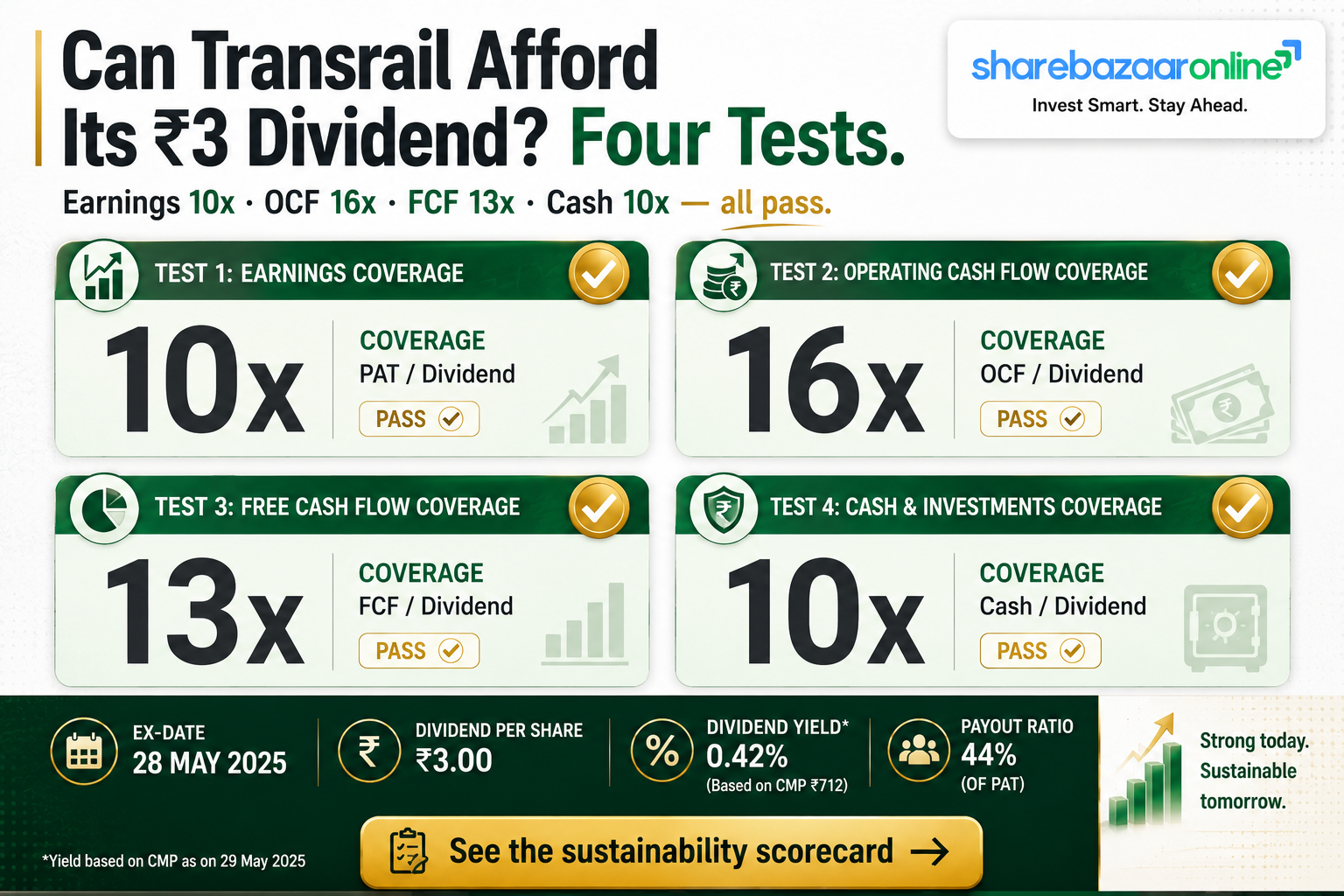
Test 1 — Earnings Coverage
10.0x (EPS ₹30.06 / DPS ₹3)
Only ~10% of earnings paid out. Very comfortable.
Test 2 — Operating Cash Coverage
15.9x (CFO ₹643 Cr / ₹40.3 Cr)
Cash generation dwarfs the payout.
Test 3 — Free Cash Flow Coverage
13.2x (FCF ₹532 Cr / ₹40.3 Cr)
Funded from surplus cash, not debt.
Test 4 — Cash / Balance-Sheet Coverage
~10x (Cash ~₹404 Cr / ₹40.3 Cr)
Inferred cash; balance-sheet cushion ample.
Verdict: Sustainable (on current cash) — with one watch flag
All four coverage tests pass with large margins, so the current ₹3 payout is comfortably affordable. The watch flag is not affordability but policy durability: a <2-year track record, a heavy growth/capex agenda, and a pending ₹600 crore equity raise mean the dividend's future direction is less certain than its present coverage. Affordable today does not guarantee escalating tomorrow.
Peer Comparison
Power T&D EPC peers (latest available; some cells left blank where not verifiable from primary sources)
| Company | Div. Yield | Payout | ROE | ROCE |
|---|---|---|---|---|
| Transrail Lighting | ~0.6% | ~7% | 20.0% | 29.2% |
| KEC International | ~1.0% | — | 12.1% | 14.3% |
| Kalpataru Projects | 0.73% | ~25.5% | 12.9% | 18.3% |
| Skipper | ~0.1% | — | — | ~20% |
The Standout: Best Returns, Smallest Payout
Transrail posts the highest ROE (20.0%) and ROCE (29.2%) in this peer set — comfortably ahead of larger rivals KEC and Kalpataru — yet pays out the least (~7% payout vs Kalpataru's ~25.5%). The read-through: Transrail is prioritising reinvestment at high returns over cash distribution, which is arguably the right call at 29% ROCE, but it means income-focused investors get a smaller cheque than peers.
Promoter Impact Analysis
Promoter Dividend Income
~₹28.7 Cr
71.12% (Ajanma Holdings) × ₹40.3 Cr outflow
Public / Minority Share
~₹11.6 Cr
Remaining 28.88% of the interim outflow
With promoters holding 71.12%, roughly ₹7 of every ₹10 paid flows to the promoter group. Two nuances worth stating plainly: (1) the payout is small in absolute terms (~₹40 crore), so this is not a case of cash being aggressively extracted; and (2) shareholders should read the dividend against the ₹600 crore QIP — the company is set to take in far more equity than it is paying out, and the QIP would modestly reduce the promoter percentage over time. FII holding rose to 2.17% and DII eased to 8.14% as of March 2026.
Taxation Analysis
How Dividends Are Taxed in India (post-2020)
Since the abolition of Dividend Distribution Tax, dividends are taxable in the hands of the investor at their income-tax slab rate. The company deducts TDS at 10% under Section 194 only if a resident shareholder's total dividend from the company in the year exceeds ₹10,000 (threshold raised from ₹5,000 with effect from FY2025-26). Form 15G/15H can be filed to avoid TDS where income is below the taxable limit.
Worked Example — Retail investor holding 1,000 shares
| Gross dividend (1,000 × ₹3) | ₹3,000 |
| TDS under Sec 194 | ₹0 (below ₹10,000 threshold) |
| Tax @ 30% slab + 4% cess (31.2%) | ₹936 |
| Net dividend after tax | ₹2,064 |
| Post-tax yield on cost (~₹489) | ~0.42% |
Even with no TDS withheld, the full ₹3,000 must be added to income and tax paid via the investor's return. A 30%-slab investor keeps ~₹2,064. Lower slabs keep more. Illustrative only; not tax advice — consult a professional.
Key Risks
1. Margin Compression
FY26 OPM fell ~270 bps to 11.9%. If input costs or competitive bidding keep pressuring margins, EBITDA growth could keep lagging revenue growth.
2. Equity Dilution (QIP)
The ₹600 crore QIP will expand the share count, diluting EPS and spreading future dividends over more shares.
3. New-Vertical Execution
The MOA now permits drones/defence and solar-BESS/data-centre businesses — capital-heavy, unproven areas for Transrail that could absorb cash otherwise available for dividends.
4. EPC Working-Capital / Receivables
Debtor days of ~92 and heavy reliance on supplier credit (~330 payable days) make cash flow sensitive to client payment delays, common in government/PSU T&D contracts.
5. High Cost of Borrowing
Screener flags an elevated borrowing cost; if the FY26 interest-saving tailwind reverses, reported profit growth could decelerate sharply.
6. Short Dividend Track Record
Listed only Dec 2024. There is no multi-cycle history to confirm the dividend will be maintained through a downturn or a heavy capex year.
What To Monitor
- Operating margin trajectory — does OPM recover toward the 14–15% seen in FY24–FY25, or stay compressed near 12%?
- QIP execution & pricing — timing, issue price, dilution quantum, and the intended use of the ₹600 crore.
- Order inflow & book-to-bill — sustaining the ~₹16,000+ crore order book and international wins (recent ₹459 crore T&D order).
- Receivable / working-capital days — any deterioration would directly threaten the cash that funds dividends.
- Interest cost normalisation — whether the FY26 interest drop holds once IPO-deleveraging benefits are lapped.
- Dividend policy signals — whether the board pairs the FY26 final (₹2) with this interim and formalises a payout policy.
Conclusion
Positives
- Payout covered ~13x by free cash flow and ~10x by earnings.
- Best-in-peer-set ROE 20% / ROCE 29%.
- FY26 cash-quality turnaround (CFO/PAT 159%).
- Dividend rising: ₹0.80 → ₹2.00 → ₹3.00; first-ever interim.
- Light net gearing (~0.12x); strong order book.
Negatives / Cautions
- FY26 PAT growth aided by a 27% interest drop, not operations.
- Operating margin compressed ~270 bps.
- Yield thin (~0.6%); small payout ratio.
- ₹600 crore QIP dilution ahead.
- Under-2-year dividend history; capital-heavy new verticals.
Transrail's ₹3 interim dividend is easily affordable and well-covered by cash — the near-term sustainability question is settled. The open questions are strategic, not financial: whether margins re-expand, how much the QIP dilutes, and whether the new drone/defence and energy-storage ambitions consume the very cash that makes today's dividend look so safe. We present the evidence; the decision is yours.
Frequently Asked Questions
What dividend has Transrail Lighting announced?
What is the dividend yield?
What is the record date?
What is the ex-date?
When will the dividend be paid?
Who is eligible to receive the dividend?
How is this dividend taxed?
Is the dividend sustainable?
What is Transrail's dividend history?
Why is the dividend yield so low despite strong profits?
Did FY26 profit growth come from operations?
How does the ₹600 crore QIP affect shareholders?
What should investors monitor from here?
How much of the dividend goes to promoters?
Disclaimer
This article is published by ShareBazaar Online for informational and educational purposes only and does not constitute investment, financial, legal or tax advice, nor any buy/sell/hold recommendation. ShareBazaar Online is not a SEBI-registered investment adviser. Financial figures are drawn from the company's exchange filing dated 28 July 2026 and third-party sources including Screener.in, exchange data and dividend-history aggregators; some figures (e.g. current market price, cash & investments, ex-date) are inferred or Not Independently Verified and must be re-confirmed against primary sources before acting. The FY26 final dividend of ₹2/share remains subject to AGM approval, and the QIP and MOA changes remain subject to shareholder approval. Market prices and yields change continuously. Investments in securities are subject to market risks; please read all related documents carefully and consult a qualified professional before making any decision.