
Dividend Snapshot
Dividend Declared
₹12.00 per share
Final dividend, FY2026 (600% on face value of ₹2)
Dividend Yield
0.83%
On CMP of ₹1,439.50 (NSE, 31-Jul-2026) — re-verify at publish
Record / Ex-Date: 3 August 2026
Announcement: 18 April 2026 (with Q4/FY26 results)
AGM: 21 August 2026 | Payment: ~25 August 2026 (Inferred)
Total outflow: ~₹8,593 crore
Payout ratio: ~17% standalone / ~16% consolidated
Classification: Consistent / Progressive Payer
The one-line takeaway: This is ICICI Bank's largest-ever rupee dividend, yet it consumes only about one-sixth of profit. The story here is retained-earnings-funded growth, not high yield — and with zero promoter holding, every rupee flows to public shareholders.
Dividend Announcement Summary
On 18 April 2026, the Board of Directors of ICICI Bank Limited (NSE: ICICIBANK, BSE: 532174, NYSE: IBN) recommended a final dividend of ₹12 per equity share of face value ₹2 each for the financial year ended 31 March 2026. The recommendation was made alongside the bank's audited Q4-FY2026 and full-year results, on which the joint statutory auditors — B S R & Co. LLP and C N K & Associates LLP — issued an unmodified (clean) opinion.
The dividend is subject to shareholder approval at the bank's 32nd Annual General Meeting and will be paid only after that approval. In a separate board action on 29 June 2026, the bank fixed the record date and scheduled the AGM.
What the wire feeds miss: Headlines called this the "highest dividend in 12 years." That is true in absolute rupees, but it is a low-payout decision. At roughly 16–17% of profit, ICICI is choosing to retain about ₹5 of every ₹6 earned to fund 15.8% loan growth and thicken its capital buffer — the opposite of a company distributing surplus it cannot deploy.
Key Dates Timeline
Board Recommendation
18 April 2026
Record Date Fixed (Board)
29 June 2026
Ex-Date & Record Date
3 August 2026
Ex-date = record date under T+1 (confirmed by exchange schedule)
Last Cum-Dividend Day
1 August 2026
Inferred as record date minus one trading day (T+1)
Annual General Meeting (32nd)
21 August 2026, 11:00 AM (VC/OAVM)
Expected Payment / Credit
~25 August 2026 (Inferred)
Statutory outer limit: within 30 days of AGM approval
Dividend Yield Analysis
Current yield: ₹12 ÷ ₹1,439.50 = 0.83%
Announcement-window yield: ~0.85% (on an approximate April-2026 price of ~₹1,410 — Not Independently Verified)
Post-tax yield (30% slab): ~0.57%
A yield below 1% is low in absolute terms but normal for a high-return private bank that reinvests most of its profit. ICICI's yield is thinner than State Bank of India's (~1.7%) precisely because the market values ICICI's growth and pays a premium price for it — a low yield here is a sign of strength, not weakness.
Yield reality check: The yield is low because of a high share price, not a weak dividend. The dividend itself rose 9.1% year-on-year (₹11 → ₹12). There is no special/one-off component and no yield inflated by a falling price — over the past year the stock is roughly flat to modestly lower.
Dividend History Analysis
| Financial Year | Dividend / Share (₹) | Ex-Date | Comment |
|---|---|---|---|
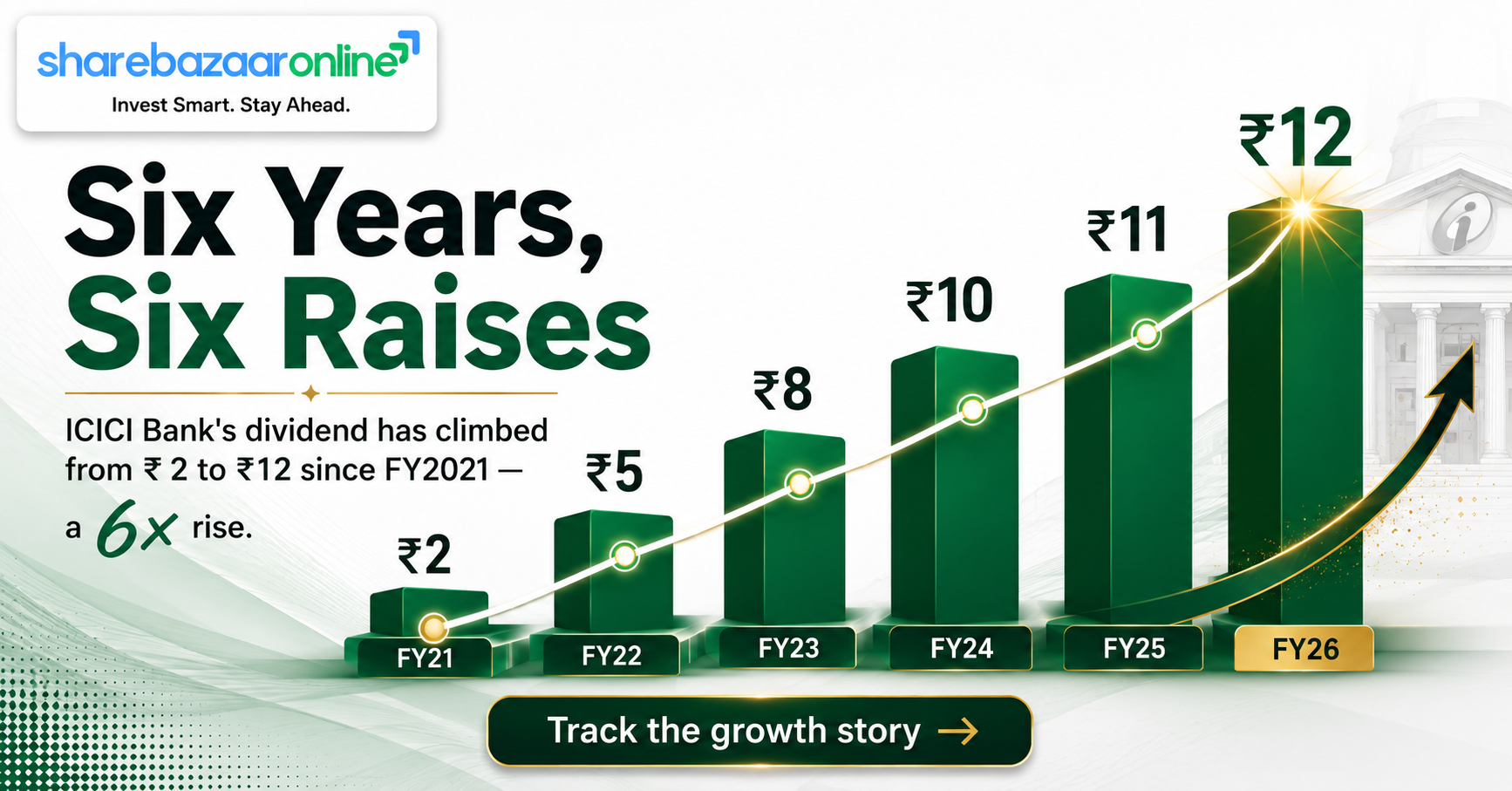
| FY2026 | 12.00 | 03 Aug 2026 | Highest-ever rupee payout |
| FY2025 | 11.00 | 12 Aug 2025 | — |
| FY2024 | 10.00 | 12 Aug 2024 | — |
| FY2023 | 8.00 | 09 Aug 2023 | — |
| FY2022 | 5.00 | 08 Aug 2022 | Post-COVID normalisation |
| FY2021 | 2.00 | 29 Jul 2021 | First dividend after the pause |
| FY2020 | NIL | — | RBI barred bank dividends (COVID) |
| FY2019 | 1.00 | 22 Jul 2019 | — |
All figures on the current ₹2 face value. Pre-2017 per-share figures are not directly comparable due to the 2014 stock split (1:5) and 2017 bonus (1:10); restatement per Ind AS 33 would be required for a like-for-like long-run series.
Trend: An unbroken rising ladder from ₹2 (FY2021) to ₹12 (FY2026) — six consecutive increases. On this window the payout has 6×'d in five years.
Classification: Consistent / Progressive Payer — with one honest caveat: the FY2020 skip was a regulator-imposed COVID restriction on all banks, not a sign of ICICI's own stress. Every year the bank was permitted to pay, it has paid — and raised.
Financial Performance Analysis
Standalone PAT (FY2026)
₹50,147 crore
+6.2% YoY | Basic EPS ₹70.21
Consolidated PAT (FY2026)
₹54,208 crore
+6.2% YoY | Basic EPS ₹75.89
Net Interest Margin
4.32%
Steady vs FY2025 despite rate cuts
Return on Assets / Equity
2.33% / ~16.4%
Best-in-class among large Indian banks
Non-obvious finding — the core was stronger than the headline: Reported Q4 profit-before-tax grew 7.9%, but PBT excluding treasury grew 10.1%. The gap is a treasury loss of ₹106 crore in Q4 that dragged the reported number. Meanwhile, Q4 provisions collapsed to just ₹96 crore (from ₹891 crore a year earlier), which flattered profit growth — though for the full year provisions actually rose to ₹5,380 crore, partly on a one-time ₹1,283 crore RBI-directed agricultural priority-sector provision. In short: the operating engine is healthier than the flat-looking 6% PAT growth suggests, but the year carried a genuine regulatory provisioning hit worth flagging.
Cash Flow Analysis
Operating cash flow (standalone): ₹64,726 crore
Consolidated OCF: ₹67,325 crore
Year-end cash & equivalents: ₹2,30,335 crore (standalone)
Dividend actually paid in FY2026: ₹7,853 crore (the FY2025 ₹11 dividend)
The proposed ₹8,593 crore outflow is covered ~7.5× by operating cash flow and ~27× by year-end cash balances on a simple arithmetic basis.
Read this carefully — why "Free Cash Flow" is the wrong lens for a bank: A bank's cash-flow statement is dominated by swings in deposits and advances. In FY2026, ICICI's advances grew a huge ₹2,18,335 crore (a cash "outflow" in the statement) while deposits grew ₹1,84,274 crore (an "inflow"). These are the mechanics of lending, not surplus available for dividends. So the "FCF coverage" numbers that aggregator sites sometimes quote for banks are economically meaningless. The correct affordability test for a bank is regulatory capital — covered in the next two sections.
Balance Sheet Strength
Total Capital Adequacy (CAR)
17.18%
vs 11.70% minimum requirement
CET-1 Ratio (post-dividend)
16.35%
vs 8.20% minimum — already reckons this dividend
Gross / Net NPA
1.40% / 0.33%
Provisioning coverage 75.8%
Standalone Net Worth
₹3,26,795 crore
Dividend = just 2.6% of net worth
The number that actually matters: ICICI's CET-1 of 16.35% is reported after subtracting the impact of this proposed dividend, and still sits nearly double the 8.20% regulatory floor. On top of that, the bank holds a ₹13,100 crore contingency buffer and total non-specific provisions of ~₹22,710 crore (1.5% of loans). Affordability is simply not in question.
Dividend Sustainability Analysis
| Test | Metric | Verdict |
|---|---|---|
| Earnings coverage | EPS ₹70.21 vs DPS ₹12 = 5.85× (consol 6.32×) | Very strong |
| Payout discipline | ~17% standalone / ~16% consolidated | Conservative |
| Capital coverage (bank test) | CET-1 16.35% vs 8.20% min | Ample buffer |
| Balance-sheet coverage | Outflow 2.6% of net worth | Comfortable |
Overall verdict: Sustainable
Every affordability test clears with a wide margin. The forward-looking constraint is not cash — it is management policy: ICICI deliberately keeps its payout low to fund growth. A watch-flag rather than a risk: dividend growth will track earnings growth, so if loan growth or NIM slows, the rate of increase in the dividend (not the dividend itself) would moderate.
Peer Comparison
| Bank (FY2026) | DPS (₹) | Approx Yield | ROE | ROA |
|---|---|---|---|---|
| ICICI Bank | 12.00 | ~0.83% | ~16.4% | 2.33% |
| HDFC Bank | 15.50* | ~1.5% | ~14.9% | — |
| State Bank of India | 17.35 | ~1.7% | — | — |
| Axis Bank | 1.00 | ~0.1% | — | — |
| Kotak Mahindra Bank | 0.65 | ~0.03% | — | — |
*HDFC Bank: ₹13 final + ₹2.50 special (face value ₹1); yield approximate. Blank cells left intentionally where a figure could not be verified from primary sources. Peer face values differ (ICICI/Axis ₹2, HDFC/SBI ₹1, Kotak ₹5), so per-share amounts are not directly comparable — yield and payout are the fair basis.
Where ICICI sits: Its yield is lower than SBI's and HDFC Bank's, but its ROA of 2.33% is the strongest in the peer set. The pattern is consistent across the private lenders: Axis and Kotak pay almost nothing (they retain aggressively for growth), while SBI, as a PSU, distributes more. ICICI occupies the sweet spot — a rising, well-covered dividend backed by the best profitability of the group.
Promoter & Distribution Impact
The stand-out fact: ICICI Bank has zero promoter holding — it is a professionally managed, widely-held institution with no controlling family or group. That means not a single rupee of the ₹8,593 crore payout goes to a promoter. This is rare among India's large-caps and is a genuine governance positive: the dividend decision cannot be a channel for controlling-shareholder cash extraction.
| Shareholder Category (Jun-2026) | Holding | Share of Dividend (₹ cr) |
|---|---|---|
| Promoter | 0.00% | ₹0 |
| Foreign Institutions (FII/FPI) | 43.87% | ~3,770 |
| Domestic Institutions (MFs, LIC, others) | ~47.00% | ~4,039 |
| Retail & Others | ~9.13% | ~785 |
Minority-shareholder view: Because there is no promoter, the entire payout is a straight pro-rata return to public owners. Domestic institutions — which include the mutual funds and LIC that back millions of retail SIPs — collect the largest slice (~₹4,039 crore), so the benefit ultimately loops back to ordinary Indian savers.
Taxation Analysis
Since April 2020, dividends are taxed in the hands of the shareholder at their applicable income-tax slab rate — there is no separate Dividend Distribution Tax. The company deducts TDS under Section 194 before paying: 10% for resident shareholders (with PAN) once total dividends from the company in the year exceed ₹10,000, or 20% without PAN. Residents can file Form 15G/15H to avoid TDS if their income is below the taxable limit.
Worked example — investor holding 1,000 ICICI Bank shares
- Gross dividend: 1,000 × ₹12 = ₹12,000
- TDS @ 10% (exceeds ₹10,000 threshold): ₹1,200 → net credited ₹10,800
- If in the 30% slab: total tax incl. 4% cess = ₹3,744
- Additional tax payable at filing (after TDS credit): ₹2,544
- Net dividend in hand after full tax: ₹8,256 (effective tax ~31.2%)
- Post-tax yield at CMP ₹1,439.50: ~0.57%
Illustration only; slab rates, surcharge for high incomes, and the latest thresholds vary by investor. This is not tax advice — consult a qualified professional.
Key Risks
1. Margin compression. NIM held at 4.32%, but a falling interest-rate cycle re-prices loans faster than deposits. Peers are already guiding to margin pressure.
2. Regulatory provisioning. The FY2026 ₹1,283 crore RBI-directed agri priority-sector provision shows how quickly a regulator can impose costs; further directions can dent profit.
3. Retail-led credit risk. Advances grew 15.8% with retail at ~50% of the book. Any turn in the unsecured/retail credit cycle would raise slippages from today's low 1.40% gross NPA.
4. Approval & timing risk. The dividend is not final until the AGM on 21 August 2026 approves it; the record date (3 Aug) precedes approval.
5. Low absolute yield. At ~0.83%, the stock is unsuitable for income-focused investors; total return depends on price appreciation, which is not guaranteed.
6. Subsidiary / insurance drag. Consolidated profit leans on life and general insurance arms, where combined ratios (103.4% at ICICI Lombard) and market swings add volatility.
What To Monitor
1. NIM trajectory through the rate-cut cycle — the single biggest swing factor for earnings and, by extension, future dividend growth.
2. Slippage & credit cost trends in retail and rural, where growth has been fastest (rural +25.6%, business banking +24.4%).
3. CET-1 buffer — as long as it stays well above ~14–15%, the bank has room to keep raising the dividend while funding growth.
4. Deposit growth & CASA ratio (38.6% average in Q4) — the cheap-funding engine that protects margins.
5. Payout-ratio policy — watch whether management lifts the ~16–17% payout over time; a structural increase would re-rate the stock's income appeal.
6. AGM outcome (21 Aug) and the formal payment-date confirmation from the registrar.
Conclusion
ICICI Bank's ₹12 FY2026 dividend is comfortably its largest ever, extends a six-year rising streak, and is backed by record profit, best-in-peer-group profitability (ROA 2.33%), and a CET-1 buffer of 16.35% that already absorbs the payout. On every affordability test, the dividend is clearly sustainable.
Two things keep it honest. First, this is a low-yield, low-payout stock — around 0.83% — so it rewards owners through growth and share-price appreciation, not income. Second, the flat-looking 6% profit growth masks a stronger operating core (PBT-ex-treasury up 10.1%) but also a genuine one-time regulatory provisioning hit. And uniquely for a large-cap, with no promoter, the entire payout is a clean pro-rata return to public shareholders.
Positives: record, well-covered, rising dividend; fortress capital; zero promoter. Negatives: sub-1% yield; margin & regulatory headwinds; approval still pending. We present the evidence; the decision is yours.
Frequently Asked Questions
What dividend has ICICI Bank announced for FY2026?
What is the dividend yield?
What is the record date?
What is the ex-date?
When will the dividend be paid?
Who is eligible to receive it?
How is the dividend taxed?
Is the dividend sustainable?
What is ICICI Bank's dividend history?
Does a promoter receive any of this dividend?
How does ICICI's dividend compare with peers?
What should investors monitor going forward?
Is this a good stock for income investors?
Disclaimer
This article is published by ShareBazaar Online for informational and educational purposes only and does not constitute investment, financial, legal or tax advice, nor a recommendation to buy, sell or hold any security. ShareBazaar Online is not a SEBI-registered investment adviser or research analyst. Figures are drawn from ICICI Bank's audited FY2026 results and board filings dated 18 April 2026, and from publicly available market data; items that could not be independently verified are labelled as such. The live market price (₹1,439.50, NSE, 31 July 2026) and yield (~0.83%) change continuously and must be re-verified before any action. Dividends, record dates and payment schedules are subject to shareholder approval and regulatory change. Investments in securities are subject to market risks; please read all related documents carefully and consult a qualified, registered financial adviser before investing. ShareBazaar Online and its authors accept no liability for any loss arising from the use of this information.