
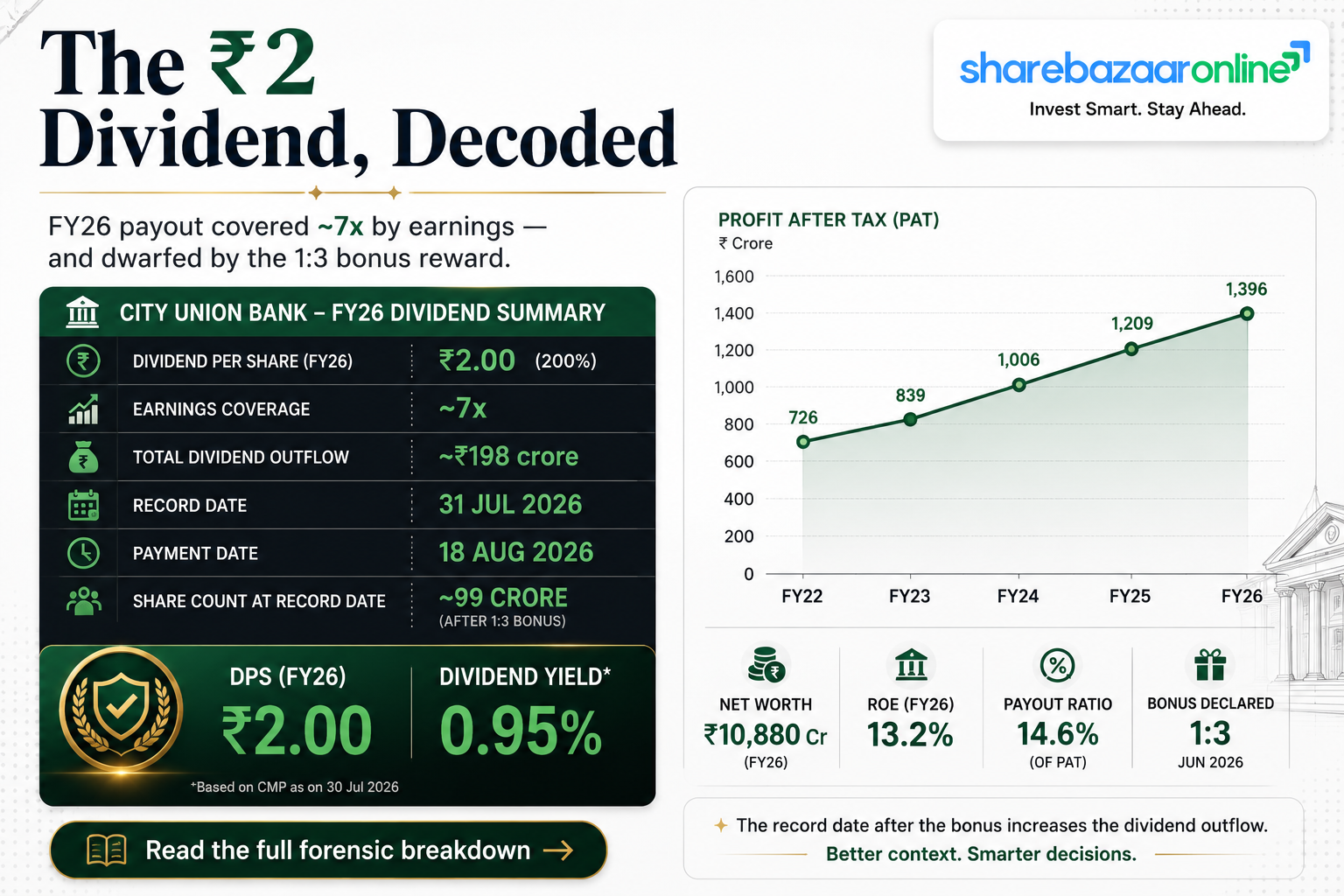
Dividend Snapshot
*Ex-date inferred as record date under the T+1 settlement convention; last cum-dividend trading day ≈ 30 Jul 2026. CMP and yield to be re-verified at publish time.
Dividend Announcement Summary
At its board meeting on 27 April 2026, City Union Bank recommended a final dividend of ₹2 per equity share (200%) for the financial year ended 31 March 2026, alongside its audited results. The same meeting also recommended a 1:3 bonus issue (one new share for every three held). A subsequent board meeting on 23 June 2026 fixed the dividend record date at 31 July 2026 and confirmed payment on or after 14 August 2026, the date of the Annual General Meeting. The dividend remains subject to shareholder approval at that AGM.
The non-obvious detail most wire reports miss: the bonus shares were already allotted (≈24.77 crore shares, credited around 15 June 2026), lifting the share count from 74.31 crore to 99.08 crore. Because the dividend record date (31 July) falls after the bonus record date (12 June), the ₹2 rate is applied to the enlarged post-bonus base. That raises the likely cash outflow from the ~₹148.6 crore contemplated when the board proposed it, to roughly ₹198 crore — a point examined in the Promoter Impact and Sustainability sections below. The bank has also flagged an enabling resolution for a ₹500 crore QIP at the same AGM.
Key Dates Timeline
27 Apr 2026 — Board Recommendation
₹2 dividend + 1:3 bonus recommended with FY26 audited results.
12 Jun 2026 — Bonus Record Date
Eligibility fixed for the 1:3 bonus (last cum-bonus day 11 Jun).
15–16 Jun 2026 — Bonus Allotment / Trading
≈24.77 cr bonus shares allotted; post-bonus trading begins.
31 Jul 2026 — Dividend Record Date
Shareholders on record entitled to the ₹2 dividend (ex-date ≈ same day, T+1).
14 Aug 2026 — AGM
Shareholders vote on the dividend, bonus and QIP enabling resolution.
On/after 14 Aug 2026 — Payment
Dividend credited within the statutory window after AGM approval.
Dividend Yield Analysis
At roughly 0.95%, CUB is a low-yield, capital-appreciation stock rather than an income play — the payout is small relative to a share that has re-rated sharply (up ~37% over the trailing year). The yield here reflects a deliberately modest, growth-retentive dividend policy, not a distressed or falling price. Note the two figures differ because the ₹2 rate is a forward, post-bonus number while aggregator "trailing" yields still blend bonus-adjusted historical dividends of ~₹1.50.
*CMP is a live input and must be re-verified at publish time; yield moves inversely with price.
Dividend History Analysis
| Financial Year | Dividend/Share (as declared, ₹) | Type | Payout %* |
|---|---|---|---|
| FY26 | 2.00 | Final | ~11% |
| FY25 | 2.00 | Final | ~13% |
| FY24 | 1.50 | Final | ~11% |
| FY23 | 1.00 | Final | ~8% |
| FY22 | 1.00 | Final | ~10% |
| FY21 | 0.50 | Final | ~6% |
Per-share figures shown "as declared" (face value ₹1). Compiled from secondary sources — Not Independently Verified against each year's annual report. *Payout % per Screener. A 1:10 bonus (2018) and the current 1:3 bonus (2026) affect strict per-share comparability under Ind AS 33.
Classification: Consistent Payer. CUB has distributed a dividend every year for well over a decade, with the per-share amount rising steadily from ₹0.50 to ₹2.00. What stands out is that FY26's dividend is flat versus FY25 (₹2 both years) even though net profit grew ~18% — so the payout ratio actually eased. The bank chose to reward shareholders through the 1:3 bonus (capital reward) rather than a higher cash dividend, retaining earnings to fund ~26% loan growth. This is a growth-retentive, not income-maximising, distribution philosophy.
Financial Performance Analysis
| Metric (₹ Cr, standalone) | FY25 | FY26 | Growth |
|---|---|---|---|
| Net Interest Income | 2,315.7 | 2,829.8 | +22.2% |
| Total Income | 6,732.1 | 7,908.6 | +17.5% |
| Operating Profit | 1,678.6 | 2,014.2 | +20.0% |
| Profit Before Tax | 1,416.6 | 1,671.2 | +18.0% |
| Net Profit (PAT) | 1,123.6 | 1,326.2 | +18.0% |
| EPS (₹, reported) | 15.17 | 17.88 | +17.9% |
Positive operating leverage — but watch the cost line. Net interest income (+22.2%) and operating profit (+20.0%) both grew faster than PAT (+18.0%). The gap is explained by two below-the-line items: operating expenses rose 20.8% (employee cost +21.4%, partly a ₹5 crore new labour-code provision) and non-tax provisions jumped 30.9% to ₹343 crore. Profit growth is operationally driven — not a tax-rate collapse — with the effective tax rate steady near 21%.
The Ind AS 33 restatement. Reported EPS is ₹17.88, but on the enlarged post-bonus share count the comparable figure is ₹13.39 (per Screener). Investors reading naive year-on-year EPS across the bonus date will overstate growth. All per-share valuation and coverage metrics in this report use the appropriate basis and flag which one applies.
Cash Flow Analysis
Read bank cash flows with care. For a lender, operating cash flow is dominated by loan and deposit movements, so the industrial notion of "free cash flow" does not apply cleanly. CUB's net OCF fell from ₹1,128 Cr to ₹802 Cr — not a red flag, but a direct result of deploying heavy deposit inflows (+₹14,782 Cr) into even faster advances growth (funds advanced to customers absorbed ₹14,048 Cr). The dividend is funded out of current earnings and retained profits, not asset sales or borrowings.
Financing-flow swing worth flagging: financing cash flow flipped from −₹2,662 Cr in FY25 to +₹3,042 Cr in FY26, driven almost entirely by borrowings rising ~145% (₹2,169 Cr → ₹5,327 Cr). CUB is increasingly using wholesale borrowings to bridge the gap between rapid loan growth and deposit accretion — a structural point to monitor even though the ₹198 Cr dividend is trivially small against a ₹8,927 Cr cash pile.
Balance Sheet Strength
The balance sheet is the bank's strongest card. Asset quality improved materially — gross NPA fell to 1.91% from 3.09% and net NPA to a near-clean 0.68%. A 21.92% capital adequacy ratio sits far above the regulatory minimum, comfortably funding both the cash dividend and the bonus capitalisation (drawn from a ₹940 crore securities premium). The one caveat is the sharp rise in borrowings, which nudges the funding mix toward costlier wholesale money.
Dividend Sustainability Analysis
| Sustainability Test | Reading | Verdict |
|---|---|---|
| Earnings coverage (EPS vs DPS) | ~6.7x (post-bonus) / 8.9x (reported) | Strong |
| Payout ratio | ~15% (post-bonus outflow) / ~11% (as proposed) | Very Low |
| Cash / balance-sheet coverage | Cash equiv ₹8,927 Cr vs ~₹198 Cr outflow (~45x) | Strong |
| Capital adequacy headroom | CRAR 21.92% vs regulatory floor | Strong |
Overall verdict: Sustainable. On every test the dividend is comfortably covered — earnings cover it ~7x, it consumes only ~11–15% of profit, and cash reserves dwarf it. The only "watch flag" is not sustainability but generosity: with a ~15% payout and a 21.9% capital ratio, CUB has ample room to pay far more, and is deliberately choosing not to — retaining earnings to fund loan growth and future capital needs (including the proposed QIP).
Peer Comparison
| Bank | Div. Yield | Payout % | ROE | Gross NPA | Promoter |
|---|---|---|---|---|---|
| City Union Bank | ~0.95% | ~11–15% | 13.2% | 1.91% | Nil |
| Karur Vysya Bank | ~0.85% | ~10% | — | — | 2.07% |
| Tamilnad Mercantile Bank | ~2.45% | ~15% | — | — | Nil |
| Federal Bank | — | — | — | — | — |
| DCB Bank | — | — | — | — | — |
Peer figures are approximate and drawn from secondary aggregators; cells left blank where data could not be verified from primary sources ("—"). To be re-checked before publishing.
Among South-India-focused private banks, CUB's yield is middle-of-the-pack and low in absolute terms. Tamilnad Mercantile Bank offers a much richer ~2.45% yield; Karur Vysya is comparable to CUB. CUB's differentiators are its cleanest-in-class asset quality (1.91% GNPA) and its unusual ownership — a professionally managed bank with no promoter at all, examined next.
Promoter Impact Analysis
A dividend with no promoter beneficiary. Unlike most Indian companies, City Union Bank has zero promoter holding — it is a widely held, professionally managed bank. Every rupee of the ~₹198 crore dividend flows to institutions (FIIs + DIIs ≈ 64%) and 2.07 lakh public shareholders, not to a controlling family. There is no promoter-versus-minority distribution skew here; the payout is neutral across the register. Domestic institutions have steadily raised their stake (DII up to 40.7%), a vote of confidence in the earnings trajectory.
Shareholding as per the latest disclosed pattern (Mar 2026). Promoter classification: none reported.
Taxation Analysis
Since April 2020, dividends are taxable in the hands of the shareholder at their applicable income-tax slab rate (the company no longer pays Dividend Distribution Tax). The bank deducts TDS under Section 194 at 10% only if total dividend paid to a resident shareholder in the financial year exceeds ₹5,000. Investors with income below the taxable limit can submit Form 15G / 15H to avoid TDS; non-residents are taxed under Section 195 subject to DTAA relief.
Worked example — retail investor holding 1,000 shares (30% slab)
Effective post-tax yield for a 30%-slab investor is roughly 0.65% at current prices. A shareholder in the 30% bracket keeps about ₹1.38 of every ₹2 declared.
Illustrative only — not tax advice. Actual liability depends on the investor's total income, residency and any DTAA benefit.
Key Risks
1. Funding-mix shift. Borrowings surged ~145% to ₹5,327 Cr as loan growth (+26.5%) outpaced deposit growth (+23.3%), pushing the CD ratio to ~84% — a potential margin and liquidity pressure point.
2. Approval & timing risk. The dividend is not final until approved at the 14 Aug 2026 AGM; the record date sits before the AGM, so payment hinges on that vote.
3. Post-bonus outflow drift. The ₹2 rate on the enlarged 99.08 cr share base costs ~₹198 Cr versus the ~₹149 Cr provided for at the balance-sheet date, a modest but real capital drawdown.
4. Equity dilution ahead. The proposed ₹500 crore QIP will add shares and could dilute per-share metrics if deployed slowly.
5. Leadership transition. A long-serving MD & CEO handed over to a new MD & CEO effective 1 May 2026; execution continuity through the transition is a watch item.
6. Concentration & cyclicality. A largely South-India, MSME-heavy book leaves the bank exposed to regional and small-business credit cycles.
What To Monitor
1. Deposit vs credit growth gap — whether deposit accretion catches up so reliance on borrowings eases.
2. Net interest margin trend (~3.7%) as the funding mix and rate cycle evolve.
3. Asset-quality durability — can GNPA hold near/below 1.9% and slippages stay contained?
4. QIP execution — timing, pricing and how the ₹500 Cr is deployed into earning assets.
5. Payout policy signal — whether management lifts the payout ratio above ~15% once the growth runway matures.
6. AGM outcome (14 Aug) — confirmation of the dividend, bonus ratification and QIP enabling resolution.
Conclusion
City Union Bank's ₹2 (200%) FY26 final dividend is safe, small and secondary to the story. It is covered roughly seven times by earnings, consumes only ~11–15% of profit and is dwarfed by an ₹8,927 crore cash pile and a 21.9% capital ratio. But the real reward this cycle is the 1:3 bonus, which increased shareholders' unit count by a third — CUB is choosing capital-based rewards and earnings retention over a fat cash yield.
Positives: 18% profit growth, sharply improved asset quality (GNPA 3.09% → 1.91%), a fortress capital ratio, and a promoter-free, institution-backed register. Negatives / watch-items: a low ~0.95% yield, a 145% jump in borrowings, upcoming QIP dilution and a fresh leadership transition. The single most important nuance — and the thing most reports overlook — is that the ₹2 rate lands on the post-bonus 99.08 crore share base, lifting the actual outflow to ~₹198 crore.
Frequently Asked Questions
What dividend has City Union Bank announced for FY26?
What is the dividend yield?
What is the record date for the CUB dividend?
What is the ex-date?
When will the dividend be paid?
Who is eligible to receive it?
How does the 1:3 bonus affect this dividend?
How is the dividend taxed?
Is the dividend sustainable?
Does City Union Bank have a promoter?
What is CUB's dividend history?
How did CUB perform financially in FY26?
What should investors monitor going forward?
Disclaimer
This article is published by ShareBazaar Online for informational and educational purposes only and does not constitute investment advice or any buy, sell or hold recommendation. ShareBazaar Online is not a SEBI-registered investment adviser. Figures are compiled from the company's exchange filings and publicly available secondary sources; items marked "Not Independently Verified", inferred, or "to be re-verified" should be independently confirmed. The dividend, bonus and QIP are subject to shareholder approval; the live market price, record date, ex-date and payment date must be re-verified against official exchange corporate-action circulars before acting. Markets carry risk; readers should conduct their own research or consult a registered adviser before making any decision.