
Dividend Snapshot
Company
JK Tyre & Industries Ltd
NSE / BSE
JKTYRE / 530007
ISIN
INE573A01042
Sector
Auto Tyres & Rubber
Dividend Type
Final Dividend
Financial Year
FY2025-26
Dividend / Share
₹4.00
Dividend %
200%
Face Value
₹2
Yield (at CMP ₹401)
~1.00%
Dividend Outflow
~₹115.32 Cr
Payout Ratio
~14.9%
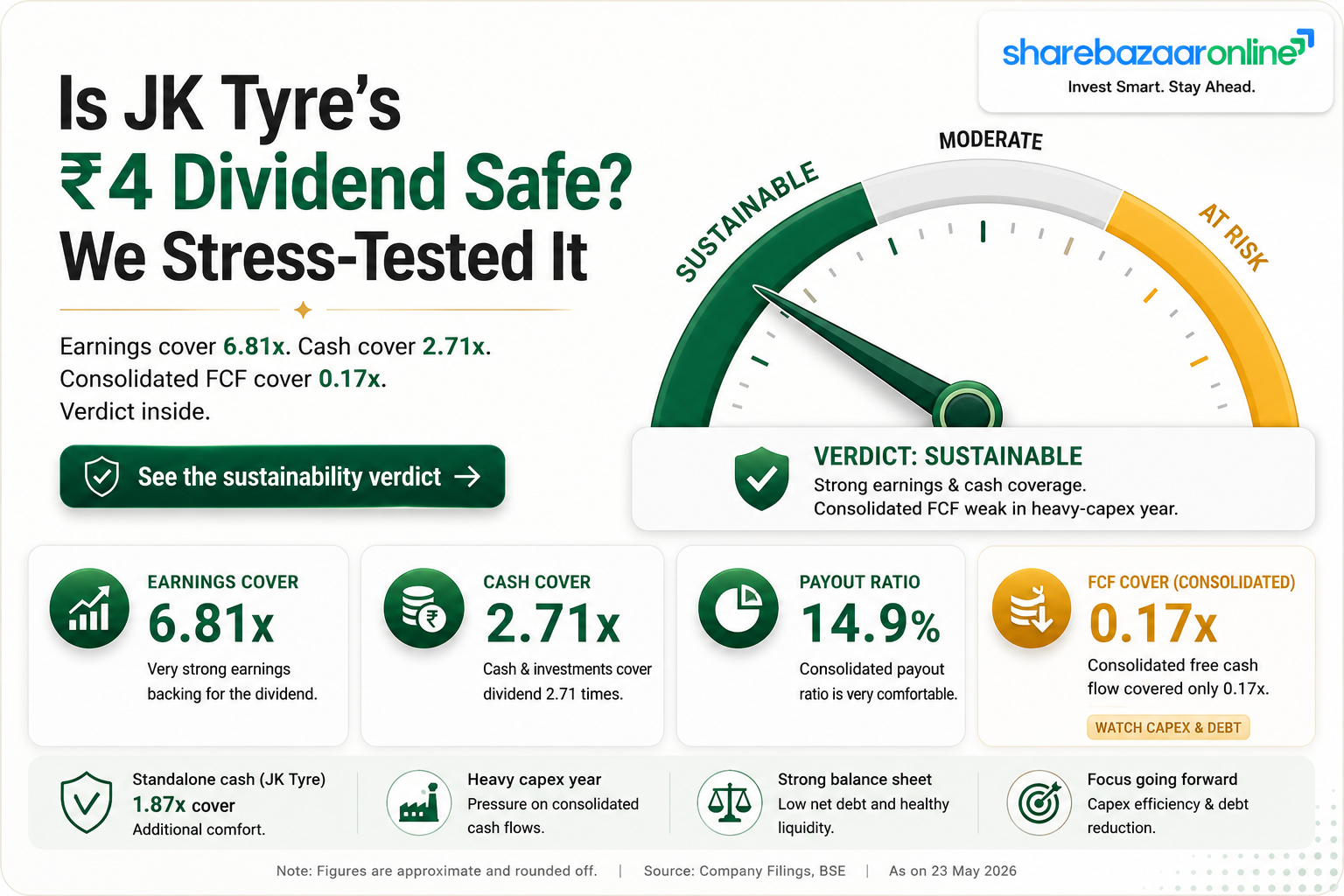
The one-line takeaway: At ₹4/share, this is JK Tyre's largest single final dividend since its 2016 stock split, and it is comfortably covered by earnings (6.81x) and cash reserves (2.71x). The subtlety wire reports miss: on a consolidated basis the payout is not funded by free cash flow — heavy expansion capex left only ~₹19.87 Cr of FCF for the year. More on this below.
Dividend Announcement Summary
At its board meeting held on 26 May 2026, the Board of Directors of JK Tyre & Industries approved the audited standalone and consolidated results for the year ended 31 March 2026 and recommended a final dividend of ₹4.00 per equity share of ₹2 each (200%).
Because this is a final dividend, it must be declared by members at the ensuing AGM (6 August 2026). The company has stated the dividend, once approved, is planned to be credited/dispatched within two weeks of the AGM. The auditors (Lodha & Co LLP) issued an unmodified opinion on both the standalone and consolidated results.
Source: Company outcome letter to BSE/NSE dated 26 May 2026 and press release. AGM date corroborated by exchange-feed aggregators.
Key Dates Timeline
| Event | Date | Basis |
|---|---|---|
| Board Meeting / Announcement | 26 May 2026 | Company disclosed |
| Record Date | ~30 Jul 2026 | To be verified vs Reg 42 intimation |
| Ex-Date | ~30 Jul 2026 | Inferred (T+1); not company-disclosed |
| AGM (declaration) | 6 Aug 2026 | Per exchange feed — verify |
| Payment / Credit | Within ~2 weeks of AGM (by ~20 Aug 2026) | Company plan / statutory outer limit |
To be eligible you must hold shares before the ex-date. For a final dividend, actual payout follows AGM approval.
Dividend Yield Analysis
Yield is dividend divided by share price. At the current market price of about ₹401, the ₹4 dividend gives a yield of roughly 1.00%.
| At CMP ₹401 | 1.00% |
| At ₹450 | 0.89% |
| At 52-wk high ₹611.90 | 0.65% |
| At 52-wk low ₹311 | 1.29% |
Yield reality check
JK Tyre is a low-yield, capital-appreciation stock, not an income play. A ~1% yield is typical for the tyre sector (Apollo ~1.3-1.6%, MRF ~0.2%, CEAT ~0.9%). The dividend has risen in absolute terms — from ₹3 (FY25) to ₹4 (FY26) — so the modest yield reflects a higher share price, not a weak dividend. This is a "strong dividend" reason for the yield level, not a "falling price" one.
CMP must be verified against live NSE/BSE bhavcopy before publication. Announcement-date (26 May 2026) closing price was Not Independently Verified at research time; the yield on the announcement date should be recomputed once that close is confirmed.
Dividend History Analysis
| Financial Year | Dividend/Share (₹) | Type |
|---|---|---|
| FY26 | 4.00 | Final |
| FY25 | 3.00 | Final |
| FY24 | 4.50 | 3.50 Final + 1.00 Interim |
| FY23 | 2.00 | Final |
| FY22 | 1.50 | Final |
| FY21 | 2.00 | Final |
| FY20 | 0.70 | Final (cut year) |
| FY19 | 1.50 | Final |
| FY18 | 1.50 | Final |
| FY17 | 2.50 | Final |
Pattern
JK Tyre is best classified as a Cyclical Payer. Payouts move with the tyre profit cycle — note the drop to ₹0.70 in the COVID-hit FY20. Since then the trend has been broadly upward, and FY26's ₹4.00 is the highest single-year final dividend in the post-split era.
Important caveat
Dividends before FY2016-17 were on a ₹10 face value (the stock later split to ₹2). Older amounts are not directly comparable per-share and would need restating before any long-run comparison.
Dividend history compiled from Trendlyne / exchange corporate-action records; per-share figures for FY26 are company-disclosed.
Financial Performance Analysis (Consolidated)
| Metric (₹ Cr) | FY26 | FY25* | Growth |
|---|---|---|---|
| Revenue from Operations | 16,326.65 | 14,692.92 | +11.1% |
| Operating Profit (PBIDT) | 2,089.00 | 1,677.83 | +24.5% |
| Profit Before Tax | 1,042.74 | 713.43 | +46.2% |
| Profit After Tax (owners) | 776.09 | 509.43 | +52.3% |
| EPS Basic (₹) | 27.24 | 17.88 | +52.3% |
| EBITDA Margin | 12.8% | 11.4% | +1.4pp |
*FY25 figures are restated for the amalgamation of Cavendish Industries Ltd (pooling-of-interest, applied retrospectively).
Operating leverage worked hard
Revenue grew 11.1% but PAT jumped 52.3%. That gap is operating leverage: EBITDA margin expanded ~1.4pp to 12.8% on better product mix, volume growth (India volumes +21%) and cost control, so more of each extra rupee of sales fell through to profit.
Read the headline with care
Part of the optically large jump is a restatement effect. The FY25 base was restated upward for the Cavendish merger, and FY26 also carries exceptional items (forex loss, VRS, stamp duty, labour-code provisioning) totalling ~₹145.59 Cr. Underlying operating momentum is real, but the "83% Q4 jump" headline flatters the trend.
Cash Flow Analysis — The Real Story
Reported profit is an opinion; cash is a fact. Here is where JK Tyre's dividend gets interesting.
Consolidated (FY26)
| Operating Cash Flow | ₹1,443.84 Cr |
| Less: Capex (PPE) | ₹1,423.97 Cr |
| Free Cash Flow | ₹19.87 Cr |
| Dividend outflow | ₹115.32 Cr |
| FCF coverage | 0.17x |
Standalone (FY26)
| Operating Cash Flow | ₹1,498.12 Cr |
| Less: Capex (PPE) | ₹1,282.80 Cr |
| Free Cash Flow | ₹215.32 Cr |
| Dividend outflow | ₹115.32 Cr |
| FCF coverage | 1.87x |
What this means: Cash quality is good — OCF is 1.86x of PAT, so profits are converting into real cash. But on a consolidated basis, a heavy capex year (₹1,423.97 Cr, largely the Mexico/JK Tornel operations plus the Laksar expansion) left only ₹19.87 Cr of free cash — roughly one-sixth of the dividend. The dividend is therefore funded from a mix of current earnings and cash reserves, not from consolidated free cash flow. On the standalone India entity, where capex is lower, FCF covers the dividend 1.87x — a much more comfortable picture, and the more relevant one since the dividend is paid by the parent.
Receivables rose (₹257.63 Cr working-capital outflow on trade & other receivables) roughly in line with the sales increase — worth monitoring but not alarming for FY26.
Balance Sheet Strength
| Liquid (cash + bank + current inv) | ₹312.56 Cr |
| Total Borrowings | ₹4,746.00 Cr |
| Net Debt (approx) | ₹4,394.42 Cr |
| Equity (owners) | ₹6,060.82 Cr |
| Net Debt / Equity | ~0.73x |
JK Tyre carries a meaningful debt load — roughly ₹4,394 Cr of net debt against ₹6,061 Cr of equity (~0.73x). That is not alarming for a capital-intensive tyre maker, and finance costs (₹428.47 Cr) are well covered by operating profit (₹2,089 Cr, ~4.9x). But it does mean the ₹115 Cr dividend is being paid while the company still carries net debt — a legitimate capital-allocation debate (see below).
The dividend itself is tiny relative to the balance sheet (₹115 Cr vs ₹6,061 Cr equity), so it poses no threat to solvency. Cash coverage of the dividend is 2.71x.
Dividend Sustainability Analysis
✓ Earnings cover: EPS ₹27.24 vs DPS ₹4.00 = 6.81x. Payout is only ~14.9% — very conservative.
✓ Cash reserves: Liquid assets cover the dividend 2.71x.
✓ Cash quality: OCF is 1.86x PAT — profits convert to cash.
⚠ Consolidated FCF cover: only 0.17x in a heavy-capex year; standalone is a healthier 1.87x.
⚠ Net debt present: ~₹4,394 Cr; dividends paid alongside borrowings.
⚠ Cyclical earnings: tyre profits swing with rubber/crude prices and demand.
The dividend is very safe on an earnings and cash-reserve basis because the payout ratio is low. The one caution is that in expansion-heavy years the group generates little surplus free cash after capex, so the buffer sits in reserves and the parent's standalone cash generation rather than in group-level FCF. As long as JK Tyre keeps the payout ratio conservative, the dividend looks comfortably maintainable.
Peer Comparison (Indian Tyre Majors, FY26)
| Company | FY26 Div/Share | Face Value | Approx Yield | Notes |
|---|---|---|---|---|
| JK Tyre | ₹4.00 (final) | ₹2 | ~1.00% | Payout ~15%; net debt present |
| Apollo Tyres | ₹6.00 (3.50 int + 2.50 fin) | ₹1 | ~1.3-1.6% | FY26 PAT ~₹1,372 Cr |
| MRF | ₹235 (incl 2x₹3 int) | ₹10 | ~0.18% | Huge absolute, tiny yield (high price) |
| CEAT | Verify | ₹10 | ~0.9% | FY26 revenue ~₹15,678 Cr |
| Balkrishna Inds | Verify | ₹2 | ~1% | Off-highway; near-zero long-term debt |
JK Tyre sits mid-pack on yield and has the most conservative payout ratio of the group. The key structural difference: peers like Balkrishna run near-debt-free balance sheets, whereas JK Tyre funds a bigger debt book — so JK Tyre's dividend, while safe, is being paid by a more leveraged business.
Cells marked "Verify" left blank/flagged rather than filled with unverified figures. Peer yields fluctuate with live prices — confirm before publication.
Promoter Impact Analysis
| Holder | Stake | Dividend Share |
|---|---|---|
| Promoters | 51.72% | ~₹59.64 Cr |
| FIIs | 18.59% | ~₹21.44 Cr |
| DIIs | 7.44% | ~₹8.58 Cr |
| Public / others | ~22.25% | ~₹25.66 Cr |
With a 51.72% promoter stake (Singhania family / Bengal & Assam group), roughly ₹59.64 Cr of the ₹115.32 Cr outflow flows to the promoter group. That is normal for a majority-held company and is a legitimate reward for the controlling shareholder.
For minority shareholders, the flip side of a low payout is positive: ~85% of profit is retained and reinvested in capacity and debt reduction rather than distributed, which favours long-term value creation over near-term income.
Shareholding as of Mar 2026 (aggregator data). Verify against the latest BSE/NSE shareholding pattern before publication.
Dividend Taxation Analysis
Since FY2020-21, dividends are taxed in the hands of the investor at their applicable income-tax slab rate (classical system). The company deducts TDS at 10% under Section 194 if a resident shareholder's total dividend from that company exceeds ₹5,000 in a financial year (10% is the rate under current provisions; verify the threshold applicable for FY2026-27 in your final copy). TDS is adjustable against final tax liability.
Worked example — investor holding 1,000 shares, 30% slab
| Gross dividend (1,000 × ₹4) | ₹4,000 |
| TDS @10% u/s 194 (adjustable) | ₹400 |
| Tax @30% + 4% cess | ₹1,248 |
| Net dividend in hand | ₹2,752 |
| Post-tax yield (on CMP ₹401) | ~0.69% |
Illustrative only, ignores surcharge for high incomes. Not tax advice — consult a qualified professional.
Key Risks
1. Raw material volatility. Natural rubber, crude-linked synthetic rubber, carbon black and steel can compress margins quickly; management itself flags "near-term input cost challenges."
2. High debt / interest sensitivity. ~₹4,394 Cr net debt means margins and cash are exposed to interest-rate moves and refinancing.
3. Cyclical demand. Auto OE and replacement demand is tied to the economic cycle; a slowdown hits volumes and margins together.
4. Mexico / forex exposure. The JK Tornel operations add scale but also currency translation risk and capex intensity (FY26 exceptional items included forex losses).
5. Capex crowding out free cash. Heavy expansion left consolidated FCF at just ₹19.87 Cr in FY26; sustained high capex could keep group-level free cash thin.
6. Regulatory / labour codes. New Labour Codes drove exceptional provisioning; further compliance cost is possible.
What To Monitor
1. Capex vs FCF trajectory. Watch whether capex normalises so consolidated free cash flow recovers above the dividend.
2. Net debt reduction. Track quarterly borrowings — falling net debt would strengthen the dividend case.
3. EBITDA margin. Sustaining the ~12.8% margin (or better) against input-cost pressure.
4. Working capital. Whether receivables growth stays in line with sales rather than outrunning it.
5. Payout policy. Whether the payout ratio stays conservative (~15%) or rises materially.
6. Mexico contribution. Profitability and cash generation of JK Tornel relative to its capex draw.
Conclusion
JK Tyre's FY26 final dividend of ₹4.00 per share (200%) is its largest post-split final payout and lands on the back of a genuinely strong operating year — revenue up 11.1%, EBITDA margin up to 12.8%, and owners' PAT up 52.3% to ₹776 Cr, helped by operating leverage.
Positives: conservative ~15% payout, 6.81x earnings cover, 2.71x cash cover, and good cash conversion (OCF 1.86x PAT). Negatives / cautions: the group carries ~₹4,394 Cr net debt, and a heavy capex year left consolidated free cash flow at just ₹19.87 Cr — so the dividend leans on reserves and the parent's standalone cash rather than group FCF. The reported profit jump is also partly a restatement/exceptional-items effect.
Net-net, this is a Sustainable but low-yield (~1%) dividend from a cyclical, capital-intensive business. It is best read as a shareholder-reward signal from a growth-and-capex story, not as an income stock. Investors should weigh the positives and cautions above and decide for themselves.
Frequently Asked Questions
What dividend has JK Tyre announced for FY26?
What is the dividend yield?
What is the record date?
What is the ex-date?
When will the dividend be paid?
Who is eligible for the dividend?
How is the dividend taxed?
Is the dividend sustainable?
Is ₹4 the highest dividend JK Tyre has paid?
What is the dividend history and payer type?
How much of the dividend goes to promoters?
Why did profit jump so much in FY26?
How does JK Tyre's dividend compare with peers?
What should investors monitor going forward?
Does this article recommend buying JK Tyre for the dividend?
Disclaimer
This article is for informational and educational purposes only and does not constitute investment, financial, legal or tax advice or any buy/sell/hold recommendation. Figures are drawn from JK Tyre & Industries' audited FY26 results and publicly available sources; some data points (current market price, record/ex-dates, peer figures, shareholding) require independent verification against live exchange data before any decision. Dividends are subject to shareholder approval and applicable taxes. Securities markets carry risk; past dividends do not guarantee future payouts. Consult a SEBI-registered investment adviser before investing. ShareBazaar Online accepts no liability for actions taken based on this content.