
Dividend Snapshot
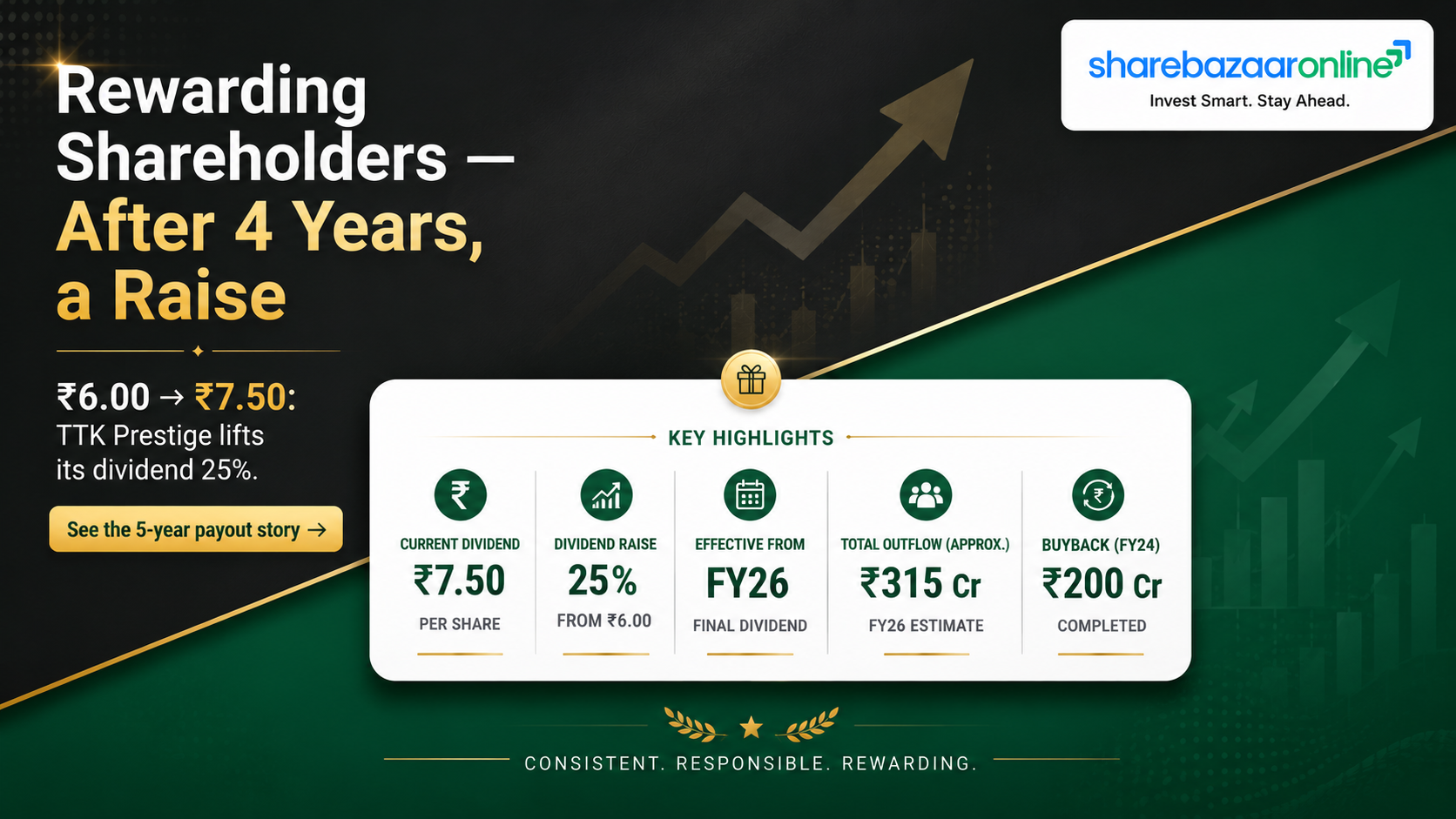
The one-line story: TTK Prestige has raised its dividend for the first time in five years — from a flat ₹6.00 held through FY22–FY25 to ₹7.50, a 25% increase. On the surface this looks like a straightforward hike. Underneath, the picture is more nuanced: consolidated revenue grew ~9.5% but operating profit before exceptional items was virtually flat, and the eye-catching 43% jump in reported net profit is mostly a base effect from a large one-time impairment that dented FY25.
Dividend Announcement Summary
At its board meeting on Friday, 22 May 2026, the Board of TTK Prestige recommended a final dividend of ₹7.50 per equity share (face value ₹1), equivalent to 750%, for the financial year 2025–26. Per the exchange filing, the dividend "shall be paid within 30 days from the date of AGM, subject to the approval of the shareholders at the ensuing 70th Annual General Meeting."
What was confirmed
- Dividend of ₹7.50/share recommended (not interim — it is a final dividend requiring AGM approval).
- Audited standalone & consolidated FY26 results approved, with an unmodified (clean) auditor's opinion from PKF Sridhar & Santhanam LLP.
- 70th AGM scheduled for 04 August 2026 via video conferencing.
What the board did not disclose
- Record date — Not disclosed in the board outcome (to be intimated separately under Regulation 42).
- Ex-date — Not disclosed by company. Third-party data indicates ~29 July 2026, unverified.
- Exact payment date — only an outer limit of "within 30 days of AGM" is stated.
Key Dates Timeline
| Event | Date | Source / Status |
|---|---|---|
| Board Meeting / Announcement | 22 May 2026 | Confirmed (exchange filing) |
| Record Date | To be announced | Not disclosed by company — verify Reg 42 filing |
| Ex-Date | ~29 July 2026? | Indicated by third-party data, not verified |
| 70th AGM (approval) | 04 August 2026 | Confirmed (exchange filing) |
| Payment Date | By ~03 Sep 2026 | Derived from "within 30 days of AGM" (statutory outer limit) |
Important: The ex-date and record date above are inferred / third-party figures, not company disclosures. Because the dividend requires AGM approval on 04 Aug 2026, the record date for eligibility is typically set shortly before the AGM. Investors should confirm the exact record date from the company's Regulation 42 intimation on NSE/BSE before acting.
Dividend Yield Analysis
Yield reality check
TTK Prestige is not a high-yield stock. A ~1.2–1.4% yield is modest and typical for a premium, brand-heavy consumer-durables compounder that reinvests and trades at a rich multiple (roughly 40–56x earnings). The yield is driven by a genuine dividend increase, not by a collapsing share price or a one-off special payout — a healthier reason for a higher yield.
Context: The stock has de-rated over the past year (down roughly 14–24% depending on the window), which mechanically lifts the yield somewhat. Even so, at these levels TTK Prestige is a growth-and-quality holding first and a dividend name second. Live market price must be verified against the NSE/BSE bhavcopy before publication.
Dividend History Analysis
All figures below are split-adjusted to face value ₹1. TTK Prestige executed a 10:1 stock split (from ₹10 to ₹1 face value) effective December 2021, so older per-share dividends have been restated for a like-for-like comparison.
| Financial Year | Dividend / Share (₹) | Consol EPS (₹) | Payout (Consol) |
|---|---|---|---|
| FY22 | 6.00 | 21.99 | 27% |
| FY23 | 6.00 | 18.34 | 33% |
| FY24 | 6.00 | 16.48 | 36% |
| FY25 | 6.00 | 8.21 | 73% |
| FY26 | 7.50 | 11.73 | 64% |
Per-share dividends cross-checked against Screener.in consolidated payout ratios. Pre-FY26 amounts should be verified against the respective annual reports before publication.
Two non-obvious findings
- The dividend was frozen at ₹6.00 for four straight years (FY22–FY25). FY26's ₹7.50 is the first hike in five years.
- The FY25 payout spiked to 73% not because of a dividend rise but because earnings fell (a large impairment cut consolidated EPS to ₹8.21). Payout optics can mislead when the denominator drops.
Don't forget the buyback
Dividends understate total shareholder returns. In FY25 the company also completed a ~₹200 Crore share buyback at ₹1,200/share (record date 14 Aug 2024). So the flat dividend in FY25 was accompanied by a large capital return through the buyback route.
Classification: Consistent Payer. TTK Prestige has paid a dividend in 9 of the last 10 years with no cuts or suspensions — a steady, reliable payer, now returning to dividend growth.
Financial Performance Analysis
FY26 results at a glance (₹ Crore)
| Metric | Standalone FY26 | Standalone FY25 | Consol FY26 | Consol FY25 |
|---|---|---|---|---|
| Revenue from operations | 2,772.69 | 2,530.32 | 2,973.57 | 2,714.78 |
| PBT before exceptional items | 277.64 | 264.37 | 247.13 | 246.00 |
| Profit before tax | 250.72 | 232.11 | 219.78 | 174.58 |
| Net profit (owners) | 185.47 | 162.68 | 160.59 | 112.44 |
| EPS (₹) | 13.54 | 11.81 | 11.73 | 8.17 |
The revenue-vs-profit gap
Consolidated revenue rose 9.5%, but PBT before exceptional items was essentially flat (+0.5%) and operating profit grew only ~6.6%. Revenue is growing faster than operating profit — the classic signature of margin compression. Consolidated operating margin slipped to roughly 9% from ~10%.
Where the margin went
- Other expenses +17.2% vs revenue +9.5% — the biggest drag.
- Purchase of traded goods +14.6% vs in-house materials −2% — a mix shift toward lower-margin bought-out products.
- Employee cost +9.3%, broadly in line with sales.
Read the headline carefully. Consolidated net profit "jumped 43%" — but that is largely a base effect. FY25 was hit by a ~₹71 Crore goodwill/investment impairment that crushed the comparison base. FY26 also carries one-time hits (a ₹9.98 Cr VRS at Hosur and a ~₹17 Cr Labour-Codes provision). Stripping out exceptionals, underlying operating profit growth is in single digits, not 43%.
Cash Flow Analysis
Reported profit is an opinion; cash is a fact. Here TTK Prestige passes the cash test.
Cash quality is genuinely good
Operating cash flow (₹209.73 Cr) exceeds reported net profit (₹156.67 Cr) by ~1.34x. Profits are converting into real cash, and cash conversion (CFO/operating profit) is close to 97%. The dividend is therefore backed by cash the business actually collected, not accounting profit alone.
The working-capital watch-out
Cash generation would have been higher but for an inventory build (working-capital days rose to ~97 from ~69). Receivable discipline is actually improving (debtor days down to 35), so the drag is inventory-led, not collection-led — something to monitor rather than alarm over.
How the dividend is funded: The ~₹102.75 Cr FY26 dividend is comfortably covered by current-year free cash flow (₹121.70 Cr consolidated). It does not require dipping into cash reserves, asset sales, or borrowings.
Balance Sheet Strength
The balance sheet is a fortress for dividend purposes: almost no debt, nearly ₹2,000 Crore of reserves, and a sizeable treasury (evidenced by ~₹55 Cr of interest income). The ₹102.75 Cr dividend is just ~5% of reserves. The honest caveat: returns are only moderate — ROE has drifted to ~9% (from mid-teens historically) and ROCE to ~12.5%, reflecting a large low-yielding cash pile and softer margins. Strong safety, average efficiency.
Dividend Sustainability Analysis
| Sustainability Test | Result | Verdict |
|---|---|---|
| Earnings coverage (Standalone EPS ÷ DPS) | 1.81x | Comfortable |
| Earnings coverage (Consol EPS ÷ DPS) | 1.56x | Adequate |
| FCF coverage (Consol) | 1.18x | Adequate but not thick |
| Cash coverage (cash + BS investments) | >2.8x | Strong (understated) |
| Payout ratio (Consol) | 64% | Elevated vs history (~27–36%) |
| Balance-sheet strength | Debt-free | Very strong |
Verdict: Sustainable
On earnings, cash and balance-sheet tests the ₹7.50 dividend is Sustainable. It is covered ~1.8x by standalone earnings, funded by current-year free cash flow, and trivial against reserves. The one yellow flag: the consolidated payout has risen to ~64% (well above the 27–36% of FY22–FY24). That is not dangerous, but it means future dividend growth now depends more on earnings recovery than on simply expanding the payout ratio. If margins stay soft, dividend growth could plateau.
Peer Comparison
| Company | Latest Dividend | Div Yield | Payout | ROE | Debt |
|---|---|---|---|---|---|
| TTK Prestige | ₹7.50 (FV ₹1) | ~1.2–1.4% | 64% | ~9.3% | Almost debt-free |
| Hawkins Cookers | ₹140 (FV ₹10) | ~1.7–1.8% | ~58% | ~33% | Debt-free |
| Stove Kraft | — | ~0.5% | ~26% | — | Some debt |
| Butterfly Gandhimathi | — | — | — | — | Crompton group |
Face values differ (TTK ₹1, Hawkins ₹10), so absolute per-share and "%" dividends are not directly comparable — use yield and payout instead. Blank cells are left empty where a verified figure was unavailable at research time rather than estimated.
The sharpest contrast is with Hawkins Cookers. Both are debt-free, brand-led kitchenware players, but Hawkins earns a ~33% ROE versus TTK Prestige's ~9% — because Hawkins runs an asset-light, high-return, low-cash-hoard model, while TTK carries a large low-yielding treasury and a broader (thinner-margin) appliances portfolio. TTK Prestige is bigger and more diversified; Hawkins is smaller but far more capital-efficient. For a pure dividend/quality lens, Hawkins screens better on returns; TTK offers scale, diversification and a fortress balance sheet.
Promoter Impact Analysis
With a 70.52% promoter stake, roughly ₹72 Crore of the ₹102.75 Crore payout flows to the TTK promoter group. This is normal for a tightly held promoter company and is not a red flag by itself — promoters receive dividends on the same per-share basis as every other holder. Promoter holding has been rock-steady at ~70.4–70.5% for years, with no pledging or selling pressure signalled. It's simply worth knowing that dividend policy and buyback decisions here are heavily aligned with a controlling family's cash-flow preferences.
Dividend Taxation Analysis
How dividends are taxed in India (post-2020 rules)
- Dividends are fully taxable in the hands of the shareholder at their applicable income-tax slab rate. There is no separate Dividend Distribution Tax (DDT) since FY21.
- TDS at 10% is deducted by the company if total dividend paid to a resident shareholder in a financial year exceeds ₹5,000 (20% if PAN is not furnished).
- The dividend adds to "Income from Other Sources"; the net after-tax amount depends on the investor's total income and slab.
Worked example — 1,000 shares, 30% slab investor
| Gross dividend (1,000 × ₹7.50) | ₹7,500 |
| TDS @10% (deducted, as > ₹5,000) | ₹750 |
| Total tax @30% slab | ₹2,250 |
| Net dividend in hand (after full tax) | ₹5,250 |
| Effective post-tax yield (@ ₹640) | ~0.82% |
TDS of ₹750 is an advance; the investor's final liability at 30% is ₹2,250, so a further ₹1,500 is payable at filing (plus applicable cess/surcharge). Investors in lower slabs pay less; those who submit Form 15G/15H (if eligible) may avoid TDS. This is general information, not tax advice — consult a qualified tax professional.
Key Risks
- Margin compression: Other expenses (+17%) and a shift toward lower-margin traded goods pulled operating margin to ~9%. If this persists, earnings — and dividend growth — stay capped.
- Elevated payout, soft returns: Consolidated payout has climbed to ~64% while ROE has slipped to ~9%. Rewarding shareholders more from a lower-return base leaves less room for error.
- Raw-material / aluminium inflation: As a cookware and appliances maker, input-cost spikes squeeze margins unless passed on through price hikes.
- Overseas subsidiary drag: The UK subsidiaries (TTK British Holdings, Horwood Homewares) reported a net loss and needed impairments in the prior year — a continued source of consolidated volatility and FX risk.
- Demand cyclicality & competition: Kitchen/home appliances are discretionary and highly competitive (Hawkins, Bajaj, Stove Kraft, Crompton/Butterfly, plus unorganised players), exposing volumes to consumption slowdowns.
- Working-capital creep: Working-capital days rose to ~97 (from ~69) on inventory build; if it continues it will keep eating into free cash flow that funds the dividend.
What To Monitor
- Operating margin trajectory: Watch whether OPM recovers back toward 11–12% or stays stuck near 9%.
- Traded-goods vs in-house mix: A rising share of bought-out products dilutes gross margin — track this in segmental/concall commentary.
- Working-capital & inventory days: Confirm the FY26 inventory build unwinds; a sustained rise would pressure free cash flow.
- ROE / ROCE recovery: Look for returns climbing back toward the mid-teens as the treasury is deployed or returned.
- UK subsidiary performance: Track whether the overseas business turns profitable or requires further impairments.
- Capital-return policy: After the FY25 buyback and FY26 dividend hike, watch whether management signals a formal dividend/payout policy or another buyback.
Conclusion
TTK Prestige's ₹7.50 final dividend marks its first dividend increase in five years — a genuine, cash-backed hike after four years frozen at ₹6.00. The payout is Sustainable: covered ~1.8x by standalone earnings, funded by free cash flow, and negligible against a debt-free, ₹1,964 Crore reserve base.
Positives
- First dividend hike in 5 years (+25%).
- Strong cash conversion (OCF 1.34x profit).
- Almost debt-free, large treasury.
- Consistent payer — 9 of last 10 years.
Watch-outs
- Margin compression; OPM down to ~9%.
- Payout up to ~64%; ROE down to ~9%.
- 43% profit "jump" is mostly a base effect.
- Modest ~1.2–1.4% yield — not an income stock.
In short: a safe, growing dividend from a high-quality but currently lower-return business. The dividend is secure; the open question is whether margins and returns recover enough to keep the dividend growing. We present the facts and let you decide.
Frequently Asked Questions
What dividend has TTK Prestige announced for FY 2025-26?
What is the dividend yield?
What is the record date for the TTK Prestige dividend?
What is the ex-date?
When will the dividend be paid?
Who is eligible to receive the dividend?
How is the TTK Prestige dividend taxed?
Is the dividend sustainable?
Why did net profit jump 43% — is the business really booming?
What is TTK Prestige's dividend history?
How does the dividend compare with Hawkins Cookers?
What should investors monitor going forward?
Disclaimer
This article is for informational and educational purposes only and does not constitute investment, financial, legal or tax advice, nor a recommendation to buy, sell or hold any security. Figures are drawn from TTK Prestige's audited FY26 results and exchange filings, with market and third-party data sourced from public providers; some figures (current market price, record/ex-date) require independent verification against live NSE/BSE data before any action. Dividends are subject to shareholder approval and statutory processes and may change. Securities investments are subject to market risks; past performance is not indicative of future results. Please consult a SEBI-registered investment adviser and a qualified tax professional before investing. ShareBazaar Online and its authors accept no liability for any loss arising from the use of this information.