
1. Right Issue Highlights
| Particulars | Details |
|---|---|
| Company Name | EFC (I) Limited |
| CIN | L74110PN1984PLC216407 |
| Registered Office | 6th Floor, VB Capitol Building, Range Hill Road, Shivajinagar, Pune 411007 |
| Exchange / Symbol | BSE 512008 | NSE EFCIL |
| Designated Stock Exchange | BSE Limited |
| Industry | Real Estate as a Service — managed offices, design & build, furniture |
| Corporate Action Type | Rights Issue of fully paid-up equity shares |
| Board Meeting Dates | Apr 3, 2026 (approval); May 1, 2026 (terms & Letter of Offer); May 25, 2026 (allotment) |
| Record Date | Thursday, May 7, 2026 |
| Ex-Date | Wednesday, May 6, 2026 (last cum-rights trading day) |
| Issue Opening Date | Wednesday, May 13, 2026 |
| Issue Closing Date | Friday, May 22, 2026 |
| Last Date for On-Market Renunciation | Monday, May 18, 2026 |
| Last Date for Off-Market Renunciation | Not Disclosed by the Company in the filings reviewed |
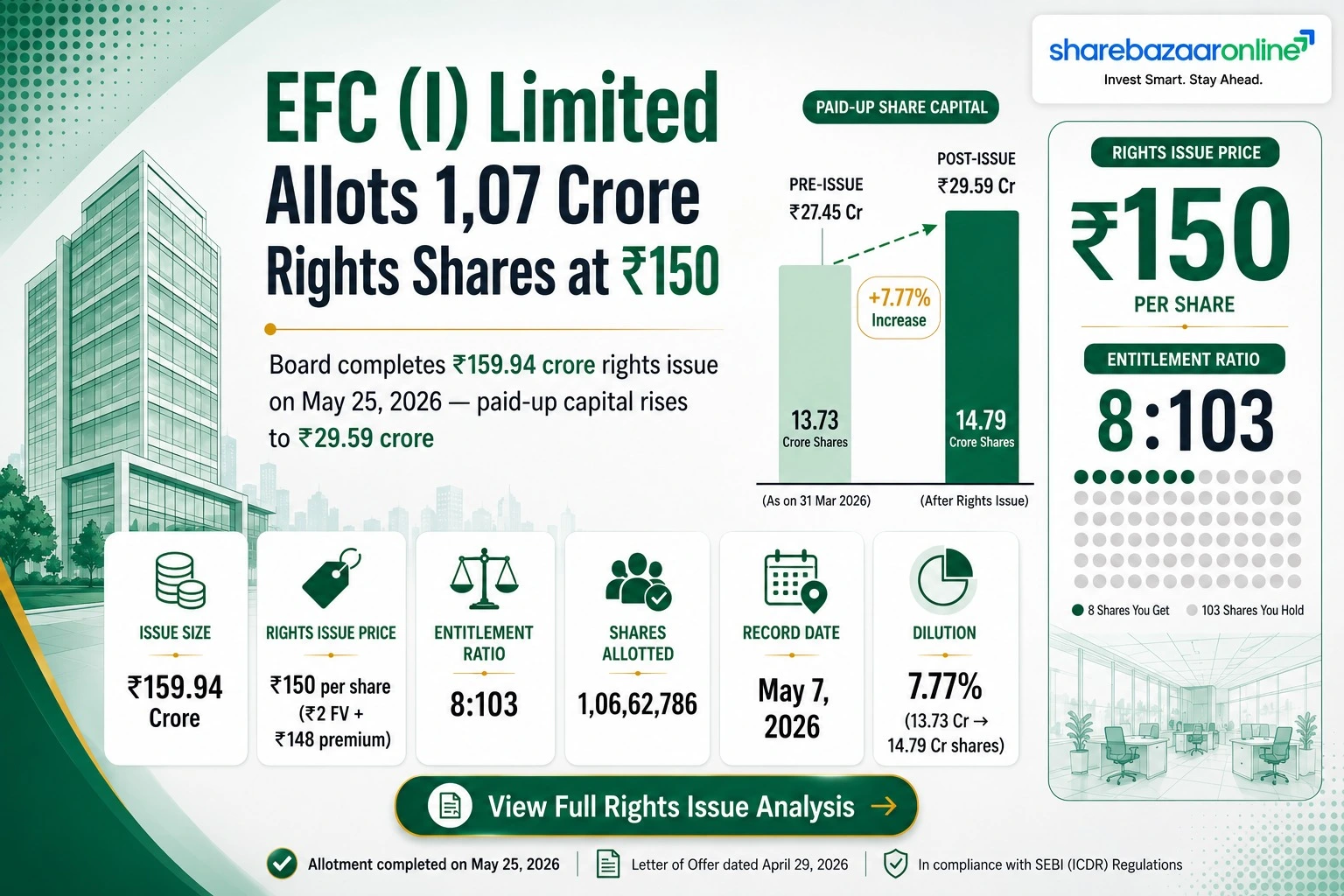
| Rights Entitlement Ratio | 8:103 — 8 rights shares for every 103 shares held |
| Issue Price | ₹150 per rights equity share |
| Face Value | ₹2 per share |
| Premium | ₹148 per share |
| Number of Shares Offered / Allotted | 1,06,62,786 equity shares |
| Total Issue Size | ₹159,94,17,900 (₹159.94 crore / ₹15,994.18 lakh) |
| Existing Paid-up Capital | 13,72,83,376 shares — ₹27,45,66,752 |
| Post Issue Capital | 14,79,46,162 shares — ₹29,58,92,324 |
| Object of the Issue | Working capital requirements and general corporate purposes |
| Net Proceeds | ₹15,912.08 lakh after issue expenses of ₹82.10 lakh |
| Lead Manager | Not Disclosed by the Company (self-managed issue in filings reviewed) |
| Registrar | MUFG Intime India Private Limited (formerly Link Intime) |
| Monitoring Agency | CARE Ratings Limited |
| Banker to the Issue | HDFC Bank Limited |
| Rights Entitlement ISIN | INE886D20018 |
| Subscription | Approx. 1.98x as tracked on May 21, 2026 (2,11,64,862 shares bid) |
| Allotment Date | Monday, May 25, 2026 |
| Credit of Shares | On or about Tuesday, May 26, 2026 |
| Listing Date | On or about Wednesday, May 27, 2026 — BSE and NSE |
| Listing Status | Fully paid-up, dematerialised, ranking pari passu with existing shares |
| Lock-in | Not Disclosed by the Company |
| Category Wise Allocation | Not Disclosed by the Company — entitlement-based, no reserved categories |
Note on the source document: the board outcome letter dated May 25, 2026 carries a typographical reference to "May 25, 2025" in the allotment paragraph. The surrounding disclosure, the letterhead date and the exchange filing timeline all confirm the correct allotment date as May 25, 2026.
2. About the Company
Business and history
EFC (I) Limited is a Pune-headquartered real estate-as-a-service company. The listed entity was renamed and repositioned after a change in promoters and management around FY23, and now runs three linked verticals: managed office and coworking solutions, design & build turnkey interiors, and furniture manufacturing. Founders Umesh Sahay and Abhishek Narbaria built the platform around recurring rental income supported by project-based fit-out and product revenue.
Position and outlook
Scale has expanded quickly, with billed seats reported at roughly 73,932 in Q3 FY26 and managed area above three million sq ft. Technology and software clients form about half the tenant base, while the West region contributes the bulk of capacity. Growth strategy centres on adding managed centres, cross-selling interiors to leasing clients, and building owned assets. The company also moved to an NSE listing during 2025.
3. What is this Right Issue?
A rights issue lets a listed company raise fresh equity from people who already own its shares, instead of approaching the wider market. EFC (I) Limited offered 1,06,62,786 new shares at ₹150 each to shareholders on the register as on May 7, 2026, in a ratio of 8 rights shares for every 103 held. Applications were accepted only through ASBA, and the board completed the allotment on May 25, 2026, taking paid-up capital from 13,72,83,376 shares to 14,79,46,162 shares.
4. Important Dates
| Event | Date |
|---|---|
| Board approval of the issue | April 3, 2026 |
| Exchange in-principle approvals | April 27, 2026 |
| Terms and Letter of Offer approved | May 1, 2026 |
| Last cum-rights trading day | May 6, 2026 |
| Record Date | May 7, 2026 |
| Credit of Rights Entitlements | May 8, 2026 |
| Dispatch of issue material completed | May 9, 2026 |
| Issue opens | May 13, 2026 |
| Last date for on-market renunciation | May 18, 2026 |
| Issue closes | May 22, 2026 |
| Basis of allotment and allotment | May 25, 2026 |
| Credit of rights equity shares | On or about May 26, 2026 |
| Listing and trading | On or about May 27, 2026 |
5. Right Issue Timeline
Approval to entitlement
The board cleared the fund-raise on April 3, then waited for BSE and NSE in-principle letters dated April 27 before fixing terms on May 1. The record date of May 7 froze the eligible shareholder list. Rights entitlements were credited on May 8 under a separate ISIN, and physical and electronic dispatch of the Letter of Offer finished by May 9.
Subscription to listing
The subscription window ran from May 13 to May 22, with on-market renunciation ending May 18. Basis of allotment was finalised with BSE as designated exchange and the board approved allotment of 1,06,62,786 shares on May 25 in a meeting that ran from 6:15 pm to 6:30 pm. Credit followed on May 26 and listing on or about May 27.
6. Issue Structure
Price, face value and premium
Each rights share carries a face value of ₹2 and was priced at ₹150, so ₹148 of every rupee subscribed above par flows to the securities premium account. Reported filings indicate the premium reserve rises from about ₹34,664.93 lakh to roughly ₹50,445.85 lakh on full subscription.
Ratio, size and capital change
The 8:103 ratio translates to roughly 7.8 new shares for every 100 held. The issue raised ₹159.94 crore. Share count rises 7.77% from 13,72,83,376 to 14,79,46,162, and paid-up capital moves from ₹27.46 crore to ₹29.59 crore.
7. Objects of the Issue
Working capital
The dominant use is working capital across the group. A managed-office operator funds security deposits, fit-out spend and rent before a centre reaches occupancy, so cash is consumed ahead of revenue. Equity funding reduces reliance on short-term borrowing for that cycle.
General corporate purposes
The balance is earmarked for general corporate purposes, a permitted residual head under SEBI ICDR rules. Net proceeds are stated at ₹15,912.08 lakh after ₹82.10 lakh of issue expenses. CARE Ratings acts as monitoring agency, so deployment must be reported periodically.
8. Promoter Participation
Promoter and promoter group holding was reported near 60% ahead of the issue, with no pledged shares. The post-allotment promoter percentage has not been separately disclosed in the board outcome letter and should be read from the updated shareholding pattern filed with the exchanges. Where promoters subscribe to their full entitlement, their percentage stays broadly stable and signals alignment; where they do not, their stake dilutes modestly. Investors should treat promoter subscription as one input, not a verdict.
9. Financial Performance
| Metric (consolidated) | Q3 FY26 | Q4 FY26 |
|---|---|---|
| Net sales | ₹269.59 crore | ₹292.88 crore |
| Net profit | ₹63.24 crore | ₹69.40 crore |
| Year-on-year profit growth | 43.2% | 58.2% |
| Operating margin ex-other income | Not separately disclosed | 49.02% vs 51.80% a year earlier |
Revenue and profit have compounded sharply over recent years as seat count scaled. Margins remain high but have narrowed year on year, and reported commentary points to rising debt levels. Five-year series for EPS, book value, ROE, ROCE, debt-equity, interest coverage, working capital and cash flow are not restated in the rights issue filings; readers should take them from the audited annual report. Detailed ratios are Not Disclosed by the Company in the corporate action documents.
10. Financial Analysis
Quality of growth
Topline momentum is real and broad-based: rental revenue, design & build and furniture all contributed. The concern is composition. Operating margin slipped roughly 280 basis points year on year in the March quarter, which suggests the faster-growing project verticals carry lower structural margins than pure rental. For a capital-intensive operator, growth that dilutes margin needs a longer runway before it improves returns on capital.
Why equity rather than debt
Raising ₹159.94 crore of permanent capital at a 7.77% dilution is a comparatively cheap way to fund a working capital gap that would otherwise sit on short-term credit lines. It supports the balance sheet without fixed repayment obligations. The trade-off is that equity has no tax shield and the return bar is higher: the funds must earn more than the company's cost of equity to be accretive.
11. Balance Sheet Analysis
Equity capital rises by ₹2.13 crore and securities premium by about ₹157.81 crore, lifting net worth by roughly ₹159.94 crore before expenses. That mechanically lowers the debt-to-equity ratio and widens headroom for lease liabilities and future borrowing. Line-item balance sheet detail as on the allotment date is Not Disclosed by the Company.
12. Cash Flow Analysis
The proceeds appear as a financing inflow and then move into operating working capital as centres are fitted out and deposits placed. Managed-office models typically show operating cash lagging reported profit because of upfront deposits and capitalised fit-outs. Quarterly cash flow statements are not disclosed in the rights issue documents; the audited annual cash flow statement remains the reference point.
13. Shareholding Pattern
Before the issue
Reported figures around December 2025 placed promoters near 60%, foreign institutional investors close to 2.4%, domestic institutions around 5.8% and public shareholders about 31.4%. No promoter shares were pledged. Total shares outstanding stood at 13,72,83,376.
After the issue and impact
Outstanding shares rise to 14,79,46,162. Category-wise post-issue percentages are Not Disclosed by the Company in the allotment letter. Shareholders who applied in full keep roughly their prior percentage; those who did not apply see their stake fall by about 7.2% in relative terms.
14. Industry Analysis
Size and growth
India's flexible workspace market has expanded rapidly as global capability centres and technology firms favour managed seats over long leases. Demand is concentrated in Bengaluru, Pune, Mumbai, Hyderabad, Delhi NCR and Chennai. Operators monetise the spread between long landlord leases and shorter client contracts.
Competition, opportunity, threat
Competition includes listed and private flex operators, traditional developers launching managed products, and landlords going direct. Opportunity lies in enterprise-scale deals and integrated fit-out services. The structural threat is duration mismatch: lease obligations are long and fixed while client contracts are short and cancellable.
15. Competitive Position
EFC's differentiator is vertical integration. Owning the interiors and furniture capability lets it fit out its own centres at lower cost and sell the same service to third parties, converting an internal cost centre into external revenue. Owned assets such as Sprint Wakadewadi, Marisoft IT Park, Sprint Towers and Konark Alpha reduce dependence on landlords. Weaknesses are geographic concentration in the West at roughly 70% of capacity and low institutional ownership relative to market capitalisation.
16. Growth Drivers
Seat additions remain the primary driver, with billed seats up about 26% year on year to 73,932 in Q3 FY26. Enterprise clients taking large managed floors lengthen contract tenure and improve revenue visibility.
Secondary drivers include the design & build vertical growing roughly 76% year on year, furniture manufacturing scaling with corporate vendor registrations, geographic expansion beyond the West, and new formats such as retail spaces.
17. Risk Factors
Lease duration mismatch
Long fixed landlord commitments funded by short client contracts. If occupancy falls, rent obligations continue while revenue does not.
Margin compression
Operating margin fell to 49.02% from 51.80% year on year in Q4 FY26. A revenue mix shifting toward lower-margin verticals can keep pressure on profitability.
Leverage and working capital
Reported commentary flags rising debt. Rapid centre additions consume cash upfront, so funding needs may recur beyond this issue.
Concentration risk
Technology clients account for roughly half the portfolio and the West region for about 70% of capacity. A downturn in either would hit occupancy disproportionately.
Execution risk
Proceeds must convert into occupied, revenue-generating seats. Delays in fit-out or slow ramp-up leave capital idle and returns diluted.
Market and liquidity risk
The stock has traded in a wide 52-week band and institutional ownership is low, which can amplify price swings around corporate actions.
18. Opportunities
Fresh equity lets the company sign new centres without stretching credit lines. Global capability centre demand continues to favour managed space. Cross-selling interiors and furniture to leasing clients raises revenue per relationship. Expanding into the South and North reduces regional concentration. A stronger net worth also improves negotiating position with landlords and lenders, and the NSE listing widens the potential investor base over time.
19. Advantages (Pros)
Pricing relative to market
What it means: rights shares were offered at ₹150 while the stock traded materially higher for much of early 2026. Why it matters: subscribing shareholders acquire stock below prevailing market levels. Who benefits: shareholders on the register as on May 7. When it may not apply: if the market price falls below ₹150, the discount disappears and applying becomes value-destructive.
Protection of ownership
What it means: applying in full keeps your percentage stake intact. Why it matters: pre-emption is the core shareholder right a rights issue preserves. Who benefits: long-term holders. When it may not apply: shareholders with odd lots may not receive whole entitlement shares and can still be marginally diluted.
Capital for expansion
What it means: ₹159.94 crore funds working capital for new centres. Why it matters: growth in this model is cash-hungry before it is cash-generative. Who benefits: all shareholders if seats fill. When it may not apply: if leasing demand softens, the capital sits underused.
Balance sheet strength and flexibility
What it means: net worth rises with no repayment obligation, lowering gearing. Why it matters: a lower debt-equity ratio reduces interest burden and refinancing risk. Who benefits: shareholders and lenders. When it may not apply: if the company simply re-levers afterwards, the improvement is temporary.
Monitored deployment
What it means: CARE Ratings has been appointed monitoring agency. Why it matters: use of proceeds is reported to the exchanges, improving accountability. Who benefits: minority shareholders. When it may not apply: monitoring confirms where money went, not whether it earned a return.
Tradeable entitlement
What it means: rights entitlements were credited under ISIN INE886D20018 and could be sold on-market until May 18. Why it matters: shareholders unwilling to invest more could still realise value. Who benefits: cash-constrained holders. When it may not apply: entitlements not sold or applied for lapsed worthless after the closing date.
20. Disadvantages (Cons)
Equity dilution
The risk: share count rises 7.77%. Effect on shareholders: non-participants own a smaller slice of the same company and their claim on future dividends shrinks. How to evaluate: compare your entitlement value against the cash outlay required, and check whether earnings can grow faster than the share count.
Possible EPS decline
The risk: profit is divided across more shares before the new capital produces earnings. Effect: reported EPS can fall in the interim even if absolute profit grows. How to evaluate: track quarterly EPS against the enlarged share base for at least three to four quarters.
Execution and deployment risk
The risk: working capital does not convert into occupied seats on schedule. Effect: return on the new equity lags the cost of equity. How to evaluate: read the monitoring agency reports and watch occupancy and billed-seat disclosures each quarter.
Increased share supply and price pressure
The risk: 1.07 crore new shares list around May 27. Effect: renouncees and short-term applicants may sell on listing, weighing on the price. How to evaluate: consider your holding period; supply effects are usually transient, fundamentals are not.
Sector and regulatory risk
The risk: commercial real estate is cyclical and interest-rate sensitive, and corporate actions are subject to SEBI ICDR and LODR compliance. Effect: occupancy, rentals and timelines can move outside management control. How to evaluate: stress-test occupancy assumptions rather than extrapolating recent growth.
Opportunity cost and capital loss
The risk: money committed here is unavailable elsewhere, and equity carries no capital protection. Effect: concentration in a single small-cap position increases portfolio risk. How to evaluate: size the application against your total portfolio and your own risk tolerance, not against the discount alone.
21. Should Existing Shareholders Apply?
This issue has already closed and been allotted, so the question is now retrospective for EFC and forward-looking for similar corporate actions. The framework that applied here applies generally.
Valuation comes first. A rights price only represents value if it sits meaningfully below what the business is worth, not merely below the last traded price. Second, the stated use of funds matters: working capital for a growing operator is defensible, but it is less transformative than debt repayment or a defined capacity project, and it can recur. Third, financial position: rising leverage and narrowing margins alongside strong revenue growth is a mixed signal that deserves attention rather than dismissal.
Fourth, promoter behaviour and monitoring arrangements give some read on alignment and discipline. Fifth, industry outlook: flexible workspace demand has been strong, but it is cyclical and sensitive to technology sector hiring. Finally, personal objectives, holding period and position sizing usually matter more than any single issue metric. This article is educational and does not recommend buying, selling or applying.
22. Investor Insights
Subscription tracked at roughly 1.98 times before the close, indicating shareholders and renouncees applied for close to double the shares on offer. For a rights issue, oversubscription mainly signals that the price was seen as attractive relative to the market, and it means additional applications beyond entitlement were scaled down.
Dilution of 7.77% is modest by rights issue standards. The metric to watch from here is whether ₹159.94 crore of working capital translates into billed seats and revenue within two to three quarters, and whether operating margin stabilises. Monitoring agency disclosures and quarterly occupancy data are the practical checkpoints.
23. Analyst Perspective
Neutral read: the raise is small relative to market capitalisation, priced at a discount to recent trading levels, oversubscribed, and directed at the part of the business that consumes cash first. That is internally consistent. The open questions are margin trajectory and leverage, both of which have moved the wrong way while revenue accelerated. Whether the equity proves accretive depends on deployment speed, not on the terms of the issue itself. No view on the share price is expressed here.
24. Conclusion
EFC (I) Limited has completed one of the cleaner mid-cap rights issues of the 2026 calendar so far. The board approved the fund-raise on April 3, secured exchange in-principle approvals on April 27, fixed terms on May 1, and set May 7 as the record date. Eligible shareholders received 8 rights shares for every 103 held, priced at ₹150 with a face value of ₹2 and a premium of ₹148. The subscription window ran from May 13 to May 22, and on May 25 the board allotted 1,06,62,786 fully paid-up equity shares aggregating ₹159.94 crore, lifting paid-up capital from ₹27.46 crore to ₹29.59 crore.
The economics are straightforward. Dilution is 7.77%, the issue was oversubscribed at close to twice the offer, and the proceeds are directed at working capital and general corporate purposes with CARE Ratings monitoring deployment. Against that, the company enters this phase with margins narrower than a year ago, leverage that has been rising, and revenue concentrated in technology tenants and western India.
For existing shareholders, the practical work now shifts from the corporate action to the follow-through: tracking whether the new capital converts into occupied seats, whether operating margin steadies, and whether the enlarged share base is matched by proportionate earnings growth. Rights issues are neutral events on the day of allotment; they become good or bad only through what the capital subsequently earns. Investors should read the Letter of Offer and the audited financial statements before drawing conclusions, and consult a SEBI-registered adviser for decisions specific to their circumstances.