
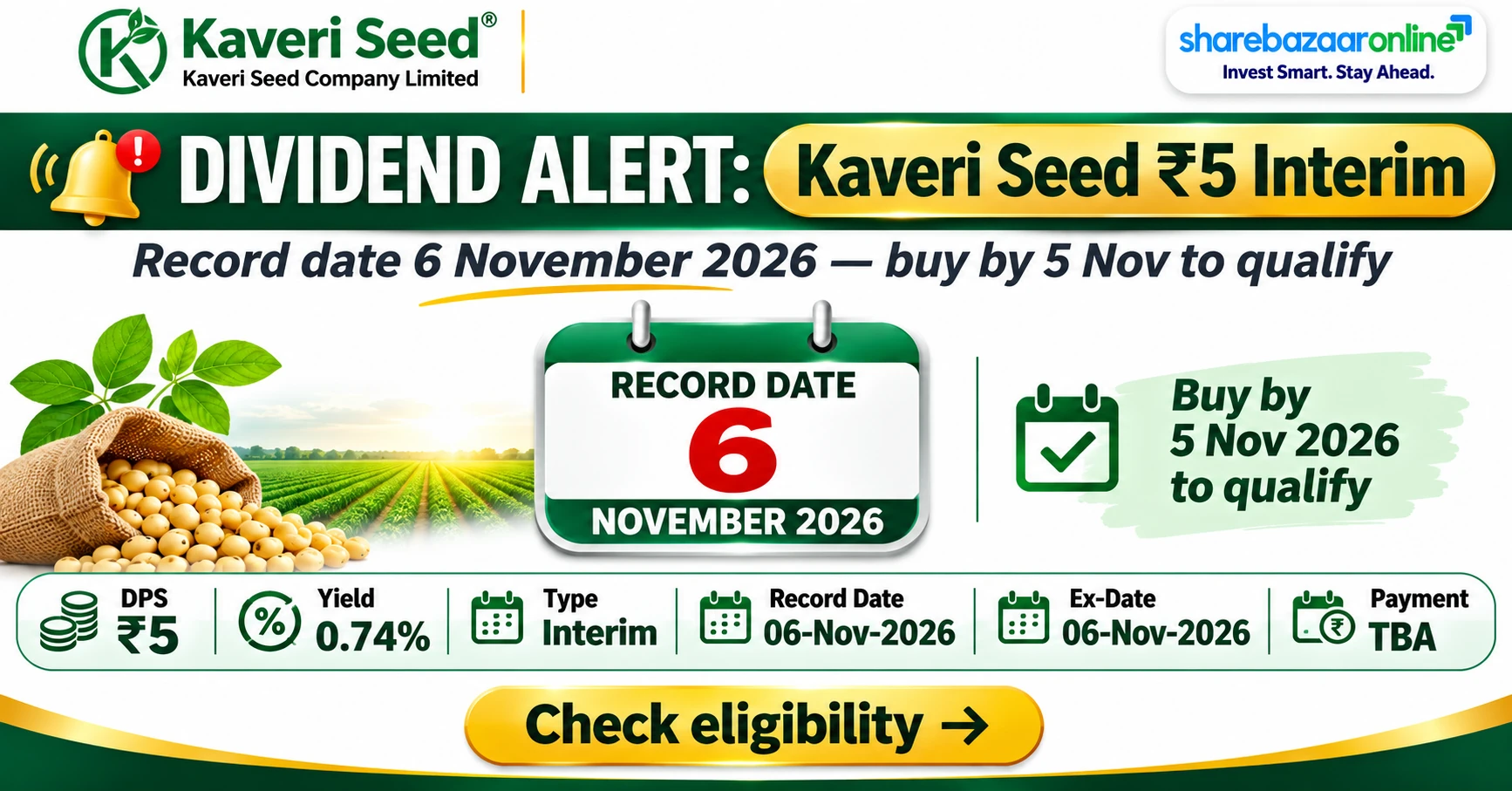
Dividend Snapshot – Kaveri Seed Company Limited
Dividend / Share
₹5.00
250% on FV ₹2
Dividend Type
Interim
FY2026-27
Market Yield
0.74%
on CMP ₹680
Record Date
06 Nov
2026 (Friday)
The Board of Kaveri Seed Company Limited approved a ₹5 per share interim dividend on 28 October 2026, continuing a four-year run at this level. Total payout works out to roughly ₹25.7 crore on about 5.14 crore shares. Earnings cover the dividend ~11.5 times, and the company is almost debt-free — but FY26 operating cash flow turned mildly negative, a nuance explored below. The 250% headline reflects the face value, not what a buyer at today’s price actually earns.
Company Overview – Kaveri Seed Company Limited
Kaveri Seed Company Limited is one of India’s largest home-grown hybrid-seed companies, engaged in research, production, processing and marketing of seeds for cotton, maize, rice, bajra, sunflower and vegetable crops. It operates across 12 agro-climatic zones spanning 18 states, with 125-plus hybrids and varieties. The business is highly seasonal: the June (Kharif) quarter drives the bulk of annual profit, while other quarters are typically weak or loss-making. For FY2026-27, Kaveri Seed Company Limited reported consolidated FY26 revenue of about ₹1,392 crore and net profit near ₹296 crore. It is classified as a small-cap in the agricultural products / FMCG space and carries negligible debt.
Dividend Announcement Summary – Kaveri Seed Company Limited
| Company | Kaveri Seed Company Ltd |
| NSE Symbol | KSCL |
| BSE Code | 532899 |
| ISIN | INE455I01029 |
| Face Value | ₹2 |
| Dividend Type | Interim (FY2026-27) |
| Dividend / Share | ₹5.00 |
| Dividend % | 250% |
| Announcement | 28-10-2026 |
| AGM Approval | Not required (interim) |
Per the company’s Regulation 42 intimation, the Kaveri Seed Company Limited Board declared the interim dividend at its meeting on 28 October 2026 and fixed 6 November 2026 as the record date. As an interim dividend, it is paid on the Board’s authority and does not need separate AGM approval. Eligibility is based on shares held in the register of members / depository records on the record date.
Key Dates Timeline – Kaveri Seed Company Limited Dividend
Announcement
28-10-2026
Ex-Date
06-11-2026
Record Date
06-11-2026
Payment Date
Not Disclosed
Under India’s T+1 settlement, the ex-date equals the record date, so both fall on 6 November 2026 — consistent with Kaveri Seed Company Limited’s own pattern in 2023, 2024 and 2025. To be eligible, shares should be bought on or before 5 November 2026 (the last cum-dividend session). The company did not state a payment date in its filing; it is marked “Not Disclosed by Company”. Under the Companies Act, an interim dividend must reach shareholders within 30 days of declaration. Investors should treat the ex-date as inferred until the official NSE/BSE circular confirms it.
Kaveri Seed Company Limited Dividend Yield Analysis
The 250% headline explained
The “250%” is calculated on the ₹2 face value (₹5 ÷ ₹2), not on the market price. On the current market price of about ₹680, the real dividend yield is just 0.74% (₹5 ÷ ₹680). On the announcement-date close of ₹700.35, it was 0.71%. This face-value illusion is why a “250% dividend” headline can mislead first-time investors.
Yield reality check
Kaveri Seed Company Limited’s yield has crept up mainly because the share price fell about 36% over the past year — a higher yield here signals a weaker price, not a bigger payout. The dividend itself (₹5) is unchanged for a fourth year. At ~0.74%, the stock is a capital-appreciation / growth name, not a dividend-income stock; the yield sits well below the broader market average of roughly 2.5%.
Kaveri Seed Company Limited Dividend History
| Financial Year | Type | DPS (₹) | % on FV ₹2 |
|---|---|---|---|
| FY2026-27 (current) | Interim | 5.00 | 250% |
| FY2025-26 | Interim | 5.00 | 250% |
| FY2024-25 | Interim | 5.00 | 250% |
| FY2023-24 | Interim | 5.00 | 250% |
| FY2022-23 | Interim | 4.00 | 200% |
| FY2021-22 | Interim | 4.00 | 200% |
| FY2020-21 | Interim | 4.00 | 200% |
| FY2019-20 | Interim | 3.00 | 150% |
| FY2018-19 | Interim | 3.00 | 150% |
| FY2017-18 | Interim | 3.00 | 150% |
Source: BSE/NSE corporate-action records, Trendlyne, 5paisa. Pre-2014 payouts were on a ₹10 face value (10:2 split, Jan 2014) and must be divided by 5 to compare on today’s ₹2 face value.
Kaveri Seed Company Limited Dividend History Analysis
Kaveri Seed Company Limited is a Consistent Payer. Over the last decade it has paid an interim dividend every single year, with a clear step-up: ₹3 → ₹4 → ₹5. The payout has now held at ₹5 for a fourth consecutive year (FY24–FY27). There have been no dividend cuts, no suspensions and no special dividends in recent years. One caveat for history-watchers: a 10:2 stock split in January 2014 changed the face value from ₹10 to ₹2, so older per-share figures look larger than they really are unless restated. On a like-for-like basis, the trend is steady and gently rising.
Kaveri Seed Company Limited Financial Performance Analysis
| Metric (Consolidated) | FY25 | FY26 | Change |
|---|---|---|---|
| Revenue (₹ cr) | 1,202 | 1,392 | +15.8% |
| Operating Profit (₹ cr) | 291 | 337 | +15.8% |
| Net Profit (₹ cr) | 282 | 296 | +5.0% |
| EPS (₹) | 54.69 | 57.51 | +5.2% |
Revenue and EBITDA both grew 15.8% in FY26, but PAT rose only 5.0%. The leakage came from a sharp rise in depreciation (₹40 cr → ₹60 cr) and lower other income (₹46 cr → ₹29 cr), not from margin loss — operating margin held near 24%. Longer term, growth is modest: 5-year revenue CAGR is about 6% and 5-year profit CAGR is roughly flat. Q2 FY27 (Sep-26) posted a small seasonal loss of ₹8.8 crore, normal for this business.
Kaveri Seed Company Limited Cash Flow Analysis
The finding most trackers miss
Reported profit is an opinion; cash is a fact. In FY26, Kaveri Seed Company Limited reported PAT of ₹296 crore, yet operating cash flow was negative at about –₹6 crore and free cash flow was –₹155 crore. Only 7% of operating profit converted to cash (versus 76% in FY25 and 142% in FY24). The cause is a working-capital build-up — inventory days ballooned to ~608 and working-capital days jumped from 99 to 171 as the company stocked seeds ahead of the season.
Importantly, this is a timing and seasonality effect, not a loss. That inventory converted to sales in Q1 FY27 (Jun-26), which generated PAT of ₹280 crore. So the ₹25.7 crore dividend is funded from accumulated reserves and normalised cash generation (₹200–390 crore in typical years), not from borrowings. Investors should still watch whether cash conversion normalises in FY27.
Kaveri Seed Company Limited Balance Sheet Strength
Borrowings
₹4 cr
Near debt-free
Reserves
₹2,016 cr
Sep-2026
Investments
₹206 cr
Sep-2026
Book Value
₹394
per share
Kaveri Seed Company Limited runs a fortress balance sheet: borrowings of just ₹4 crore against reserves of ₹2,016 crore, making it effectively debt-free. Liquid investments of ₹206 crore alone cover the ₹25.7 crore dividend outflow about 8 times. There is no question of debt being raised to pay this dividend. The only balance-sheet watch-item is the elevated inventory, which inflates working-capital needs and is the direct cause of FY26’s weak cash conversion.
Kaveri Seed Company Limited Dividend Sustainability Analysis
- Earnings coverage (EPS/DPS)11.5x ✓
- Dividend payout ratio~9% ✓
- Liquidity coverage (investments)8.0x ✓
- FY26 FCF coverage–6.0x ×
- Normalised FCF coverage~7.7x ✓
Verdict
Sustainable
Three of the four tests pass comfortably. The dividend consumes under 10% of profit, is covered 11.5x by earnings and 8x by liquid investments. The single red flag — negative FY26 free cash flow — is a seasonal working-capital distortion that reverses in Q1, so it does not threaten a payout this small.
Kaveri Seed Company Limited Peer Comparison
| Company | Dividend Yield | ROE |
|---|---|---|
| Kaveri Seed Company Ltd | ~0.74% | 15.0% |
| Bayer CropScience | ~3.7–4.3% | ~23% |
| Rallis India | ~2.5% | ~9% |
| PI Industries | ~0.5–0.6% | ~18% |
| Dhanuka Agritech | ~0.2% | ~17% |
| Sumitomo Chemical India | ~0.24% | ~17% |
Peers are agri-input companies (closest listed comparison; Kaveri is a pure-play seed company). Yields are indicative, Aug–Oct 2026.
Among agri-input peers, Kaveri Seed Company Limited sits in the low-yield, growth-oriented camp — well below income-style payers such as Bayer CropScience (~4%) and Rallis (~2.5%), but ahead of low-payout names like Dhanuka. Its 15% ROE is mid-pack and has drifted down from the 18–27% range it enjoyed earlier in the decade.
Kaveri Seed Company Limited Promoter Impact Analysis
- Promoter holding60.50%
- FII holding17.56%
- DII holding3.48%
- Public / others18.46%
- Promoter pledgeNil
With 60.50% ownership, the promoter group receives about ₹15.6 crore of the ₹25.7 crore payout; public and institutional shareholders share the remaining ~₹10.2 crore. Because the dividend is small, this is a modest cash transfer. More telling is capital-allocation history: Kaveri Seed Company Limited has returned far more cash through buybacks — share count has fallen roughly 26% (about 7 crore to 5.14 crore) over a decade — so buybacks, not dividends, are its primary return tool.
Kaveri Seed Company Limited Dividend Taxation Analysis
Since the Dividend Distribution Tax was abolished (FY2020-21), dividends are taxable in the shareholder’s hands at their income-tax slab rate as “income from other sources”. For the Kaveri Seed Company Limited dividend, TDS under Section 194 applies at 10% only if total dividend from the company exceeds ₹10,000 in the financial year (threshold raised from ₹5,000 w.e.f. 1 April 2025); 20% if PAN is not provided. Non-residents are taxed under Section 195.
Worked example — ₹5 per share, 30% slab
| Holding | Gross | TDS | Tax @30% | Net in hand |
|---|---|---|---|---|
| 1,000 shares | ₹5,000 | ₹0 (below limit) | ₹1,500 | ₹3,500 |
| 3,000 shares | ₹15,000 | ₹1,500 | ₹4,500 | ₹10,500 |
The full dividend is taxable even if TDS is not deducted; TDS is adjusted against final liability. Post-tax effective yield at a 30% slab on CMP ₹680 is about 0.52%. This is general information, not tax advice.
Expert Commentary on the Kaveri Seed Company Limited Dividend
The ₹5 interim dividend from Kaveri Seed Company Limited is best read as a signal of stability, not income. At ~0.74% yield it adds little to total return; the real decision for shareholders is the business, not the payout. Two things stand out this cycle: the dividend is unchanged for a fourth year even as the stock halved from its highs, and FY26 saw a rare negative free cash flow driven by inventory. Neither threatens the dividend — coverage is 11.5x on earnings — but both point to a company prioritising reinvestment and buybacks over rising dividends. The yield looks higher simply because the price is lower.
Kaveri Seed Company Limited Key Risks
- Monsoon / weather dependence: Seed demand hinges on rainfall and sowing patterns; a poor Kharif season directly hits cotton and maize volumes.
- Cash-conversion weakness: FY26 operating cash flow was negative and inventory days hit ~608; if this persists, reported profit will keep diverging from cash.
- Declining returns & flat growth: ROCE has fallen from ~27% to ~16%, and 5-year profit growth is roughly flat — the business is maturing.
- Regulatory / pricing risk: Cotton (Bt) seed prices are government-regulated, capping pricing power in the largest segment.
- Low-yield profile: At ~0.74%, the stock offers little downside cushion from dividends during price declines.
- Seasonality & lumpy earnings: Profit is concentrated in the June quarter, so interim quarters can show losses and volatility.
What To Monitor – Kaveri Seed Company Limited
- Cash conversion in FY27: Does operating cash flow return to positive as inventory unwinds through the selling season?
- Inventory & working-capital days: A pullback from ~608 inventory days toward historical norms would confirm the FY26 build-up was seasonal.
- Buyback announcements: Given its history, the next capital-return move may again be a buyback rather than a higher dividend.
- Non-cotton growth: Progress in maize, rice and vegetable seeds, which carry better economics than regulated cotton.
- ROCE / ROE trajectory: Whether returns stabilise or keep sliding from current mid-teens levels.
- Official ex-date / payment-date circular: Confirm the NSE/BSE corporate-action notice and the credit date.
Kaveri Seed Company Limited Dividend Outlook
On disclosed facts, the Kaveri Seed Company Limited dividend looks steady but static. The company has held ₹5 for four years and shows no stated intention to raise it; with earnings cover above 11x and a near debt-free balance sheet, the payout has ample room but little momentum. The forward question is business-driven: whether cash conversion normalises in FY27 and whether non-cotton segments can revive growth. The company has not disclosed any future dividend guidance, so investors should treat the payout as a continuation of policy rather than a trend of increases. Buybacks remain the more likely lever for larger cash returns.
Conclusion – Should You Consider Kaveri Seed Company Limited for Dividend Income?
The Kaveri Seed Company Limited interim dividend of ₹5 per share (250% on FV ₹2) is well-covered, consistent and comfortably affordable — but at a real yield of about 0.74% it is not an income play. Positives: near debt-free, 11.5x earnings cover, a decade of uninterrupted payouts and heavy buyback-led capital return. Negatives: negative FY26 free cash flow, slowing growth, falling ROCE and a yield far below broader-market levels. This is a growth-and-buyback business that pays a token dividend, not a dividend stock. Weigh the positives, the risks and the monitoring points, and decide based on your own objectives.
Frequently Asked Questions About Kaveri Seed Company Limited Dividend
What dividend has Kaveri Seed Company Limited announced?
What is the Kaveri Seed dividend yield?
What is the record date for the Kaveri Seed dividend?
What is the ex-dividend date for Kaveri Seed Company Limited?
When will the Kaveri Seed dividend be paid?
Who is eligible for the Kaveri Seed Company Limited dividend?
How is the Kaveri Seed dividend taxed?
Is the Kaveri Seed Company Limited dividend sustainable?
What is the dividend history of Kaveri Seed Company Limited?
What should investors monitor after this dividend?
Why is Kaveri Seed’s dividend yield higher than before?
Does Kaveri Seed Company Limited prefer dividends or buybacks?
What is the dividend outflow and promoter share?
Disclaimer – Kaveri Seed Company Limited Dividend
This article is for informational and educational purposes only and does not constitute investment, tax or legal advice, or any buy/sell/hold recommendation. ShareBazaar Online is not a SEBI-registered investment adviser. Figures are drawn from the company’s exchange filings and publicly available sources (BSE/NSE, Screener.in, Trendlyne, 5paisa) and may contain errors or become outdated; the market price, record date and ex-date should be independently verified against official NSE/BSE corporate-action circulars before acting. Dividend taxation depends on individual circumstances — consult a qualified professional. Investments in securities are subject to market risks. Readers should do their own research and make their own decisions.