
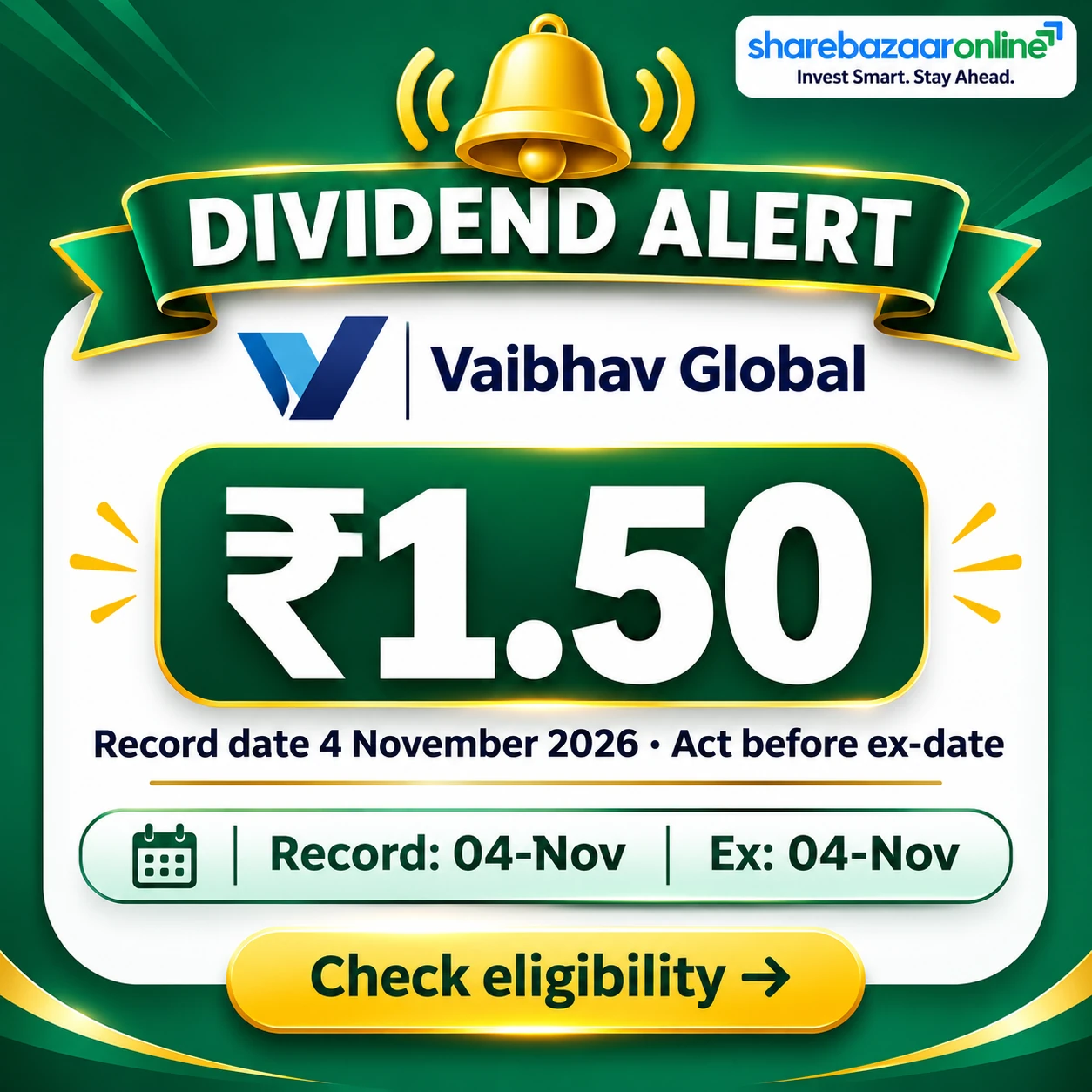
Dividend Snapshot – Vaibhav Global Limited
Vaibhav Global Limited (NSE: VAIBHAVGBL, BSE: 532156) has declared a 2nd Interim Dividend of ₹1.50 per equity share for FY2026-27, on a face value of ₹2. The headline reads as a 75% dividend, but on the market price that single payout works out to under 1%. The real story for income seekers is the annual run-rate: VGL pays ₹1.50 every quarter, so the trailing 12-month payout is ₹6.00 per share, a dividend yield of roughly 3.9% at the current price of about ₹155. The record date is 4 November 2026.
Key Figures
- Dividend per share: ₹1.50 (2nd interim)
- Dividend rate on face value: 75%
- Annual run-rate: ₹6.00 per share
- Annualised dividend yield: ~3.9%
- Face value: ₹2
At a Glance
- Record date: 4 November 2026
- Payment: within 30 days of declaration
- Estimated outflow (tranche): ~₹25 crore
- Promoter holding: 57.19%
- FY27 dividends so far: ₹3.00 per share
Vaibhav Global Limited – Company Overview
Vaibhav Global Limited is a Jaipur-headquartered, vertically integrated electronic retailer of fashion jewellery and lifestyle products. Unlike domestic jewellers, VGL sells chiefly through its own TV home-shopping and digital platforms — Shop LC in the United States and Shop TJC in the United Kingdom — so the bulk of revenue is earned in dollars and pounds. In H1 FY27, the USA contributed about 62% and the UK about 27% of consolidated revenue. The group runs in-house manufacturing with 14,000–15,000 new jewellery designs launched annually. Consolidated FY26 revenue was ₹3,692 crore with net profit of ₹266 crore. Promoters hold 57.19%, with FIIs at 16.26% and public at 24.21% (September 2026).
Vaibhav Global Limited – Financial Analysis
Vaibhav Global’s Q2 FY27 numbers carry a warning for dividend watchers. Consolidated revenue rose about 7% year-on-year to ₹938 crore, but net profit fell 12% to ₹41.7 crore and operating profit slipped from ₹78 crore to ₹68 crore. Revenue up while profit falls is classic margin compression — cost of materials and content/broadcasting expenses grew faster than sales. The H1 FY27 picture is steadier: revenue of ₹1,855 crore and PAT of ₹98 crore. Reported return ratios remain healthy (ROE ~17.9%, ROCE ~16.4%), and the standalone parent carries large cash and investments that back the dividend. But the quarterly deceleration in margins is the metric to watch going forward.
Vaibhav Global Limited Dividend History Table
Vaibhav Global — Dividend Payout History (Consolidated)
| Financial Year | Dividend / Share | EPS (₹) | Payout Ratio |
|---|---|---|---|
| FY2026-27 (so far) | ₹3.00 | 5.87 (H1) | ~51% (H1) |
| FY2025-26 | ₹6.00 | 15.93 | 38% |
| FY2024-25 | ₹6.00 | 9.22 | 65% |
| FY2023-24 | ₹6.00 | 7.72 | 78% |
| FY2022-23 | ₹6.00 | 6.36 | 94% |
| FY2021-22 | ~₹6.00 | 14.50 | 41% |
| FY2020-21 | ~₹5.00 | 16.70 | 30% |
Per-share figures rounded; VGL pays ₹1.50 per quarter. The ₹10→₹2 stock split (ex-date 7 May 2021) means pre-FY22 per-share data is shown on the current ₹2 face value. Source: company filings, Screener.in.
Expert Commentary on Vaibhav Global Limited Dividend
The most important fact investors miss about Vaibhav Global is the gap between the 75% headline rate and the money that actually reaches a shareholder. On the ₹2 face value the percentage looks dramatic; on the market price of about ₹155, each ₹1.50 tranche yields under 1%, and the full year adds up to roughly 3.9%. A second nuance: part of that “high” yield exists because the share price has fallen about 42% over the past year, mechanically lifting the yield. The dividend itself has been remarkably stable at ₹6 annually, so VGL reads as a consistent payer whose yield has been flattered by a weak stock, not by rising distributions. Both halves of that picture matter.
Vaibhav Global Limited – Future Outlook
Looking ahead, Vaibhav Global’s dividend capacity rests on two levers it has disclosed: a strong consolidated cash and investment pile (around ₹300 crore) and its history of generating healthy annual free cash flow (₹290 crore in FY26). Those cushions comfortably cover the roughly ₹100 crore annual dividend. The forward concern is operating momentum: margins compressed in Q2 FY27 and currency moves on US/UK sales can swing reported earnings. Management has not guided any change to the quarterly ₹1.50 cadence, and no special dividend has been disclosed. Investors should treat the ₹6 annual run-rate as the realistic base case while tracking whether margin pressure and working-capital build continue into the second half. This is analysis, not a forecast of company action.
Vaibhav Global Limited Dividend Announcement Summary
At its board meeting on 28 October 2026, Vaibhav Global Limited approved its unaudited Q2 and H1 FY27 results and declared a 2nd Interim Dividend of ₹1.50 per equity share (face value ₹2) for the financial year 2026-27. As an interim dividend, it is declared by the board under the Companies Act, 2013 and does not require separate AGM approval. The company fixed Wednesday, 4 November 2026 as the record date and will pay the dividend within 30 days of declaration. The board also granted 8,018 Restricted Stock Units under the VGL RSU Plan 2019. Combined with the 1st interim dividend of ₹1.50 paid earlier in the year, VGL has declared ₹3.00 per share in FY27 to date.
Vaibhav Global Limited Dividend Key Dates Timeline
Important Dates
- Announcement (board meeting): 28 October 2026
- Record date: 4 November 2026
- Ex-dividend date: 4 November 2026
- Payment: on or before 27 November 2026 (within 30 days)
What the Dates Mean
Under India’s T+1 settlement, the ex-dividend date and record date fall on the same day — 4 November 2026 — which VGL’s recent dividend history confirms. To be eligible, shares must be held in the demat account as of the record date, which generally means buying at least one trading day before the ex-date.
Vaibhav Global Limited Dividend Yield Analysis
This is where the headline misleads. The “75% dividend” is simply ₹1.50 expressed on the ₹2 face value — it is not a yield. The real dividend yield divides the cash by the market price:
- This ₹1.50 tranche at ₹155: 0.97%
- This tranche at announcement price (₹187.83): 0.80%
- Annual ₹6.00 at ₹155: ~3.9%
- Annual ₹6.00 at announcement price: ~3.2%
The annualised yield of roughly 3.9% (Screener.in reports 3.86%) is genuinely attractive for a consumer-discretionary stock — but note it is high partly because the price has dropped sharply over the past year, not only because the dividend is generous.
Vaibhav Global Limited Dividend History Analysis
Vaibhav Global qualifies as a consistent dividend payer. It has paid a steady ₹6.00 per share annually for several years, delivered as four quarterly tranches of ₹1.50 each, with no cuts or suspensions in recent memory. What has moved is the payout ratio, because earnings have swung: payout touched 94% in FY23 and 78% in FY24 when profits were depressed, then normalised to a comfortable 38% in FY26 as earnings recovered to ₹266 crore. A high past payout funded by a weak-profit year is a yellow flag; the recent drop back toward 35–40% is a healthy sign. The company has not paid special dividends recently, so the stream is predictable rather than lumpy.
Vaibhav Global Limited Financial Performance Analysis
Over five years, Vaibhav Global grew consolidated revenue from ₹1,986 crore (FY20) to ₹3,692 crore (FY26), a compound rate of about 8–11%. Profit has been far bumpier: PAT peaked at ₹272 crore in FY21, dipped to ₹105 crore in FY23 as margins and currency weighed, and recovered to ₹266 crore in FY26. The trailing-twelve-month figure is about ₹279 crore. The single most important recent signal is in Q2 FY27: revenue +7% but PAT −12%, driven by higher material and content/broadcasting costs. Operating margin for the quarter was roughly 7%, below the double-digit levels seen in strong quarters. Earnings quality, not top-line growth, is the swing factor for VGL’s dividend-paying ability.
Vaibhav Global Limited Cash Flow Analysis
Reported profit is an opinion; cash is a fact — and here the two diverged sharply in H1 FY27. Vaibhav Global posted PAT of ₹98 crore but generated only ₹24 crore of operating cash flow, an OCF-to-PAT of just 0.24x. The main drag was a large inventory build of about ₹114 crore ahead of the seasonally strong festive/holiday quarters. After capex of ₹63 crore, half-year free cash flow was negative ₹40 crore. In other words, this half’s dividends were funded from reserves, not current free cash flow. The reassurance is the full-year track record: FY26 operating cash flow was ₹310 crore and free cash flow ₹290 crore. The weak H1 cash conversion looks seasonal, but it is the number to re-check at the full-year mark.
Vaibhav Global Limited Balance Sheet Strength
Vaibhav Global’s balance sheet is the dividend’s best friend. As of 30 September 2026, the consolidated entity held cash, bank balances and investments of about ₹300 crore against current borrowings of roughly ₹130 crore — a comfortable net-cash position of around ₹170 crore. Total equity stands near ₹1,713 crore with a book value of about ₹102 per share. Leverage is modest: reported borrowings have crept up (from about ₹416 crore to ₹426 crore including leases over the past half), so the trend of rising debt alongside steady dividends is worth monitoring, but absolute debt remains small relative to equity and cash. The company carries meaningful lease liabilities (about ₹296 crore) tied to its retail operations.
Vaibhav Global Limited Dividend Sustainability Analysis
Four-Test Scorecard
- Earnings coverage: Pass — TTM EPS ₹16.70 covers ₹6 dividend 2.78x
- Annual FCF coverage: Pass — FY26 FCF ₹290 cr vs ~₹100 cr outflow (2.9x)
- Liquidity/cash coverage: Pass — ~₹300 cr liquid vs ~₹100 cr (3.0x)
- H1 operating cash flow: Watch — OCF/PAT only 0.24x, FCF negative this half
Verdict: Moderately Sustainable. On a full-year basis the ₹6 dividend is well covered by earnings, free cash flow and a net-cash balance sheet. The caution flag is the half-year collapse in cash conversion and the Q2 profit decline — if margin pressure persists and working capital does not unwind, the comfortable multi-year cover could narrow.
Vaibhav Global Limited Dividend Peer Comparison
Vaibhav Global vs Listed Jewellery Retail Peers
| Metric | Vaibhav Global | Jewellery-retail peers* |
|---|---|---|
| Dividend yield | ~3.9% | typically <1% |
| Dividend payout (FY26) | ~38% | low (growth-focused) |
| ROE | ~17.9% | varies widely |
| ROCE | ~16.4% | varies widely |
| Balance sheet | net cash | often gold-loan funded |
Vaibhav Global stands out among listed jewellery and lifestyle names for its unusually high yield and net-cash balance sheet. Growth-oriented domestic jewellers such as Titan, Kalyan Jewellers and Senco Gold reinvest aggressively and generally yield well under 1%. VGL’s higher yield reflects both its mature payout policy and a depressed share price.
*Directional, based on publicly reported figures; peer precise yields not disclosed here. Source: Screener.in, public filings.
Vaibhav Global Limited Promoter Impact Analysis
With promoters holding 57.19% of Vaibhav Global, a majority of every rupee distributed flows to the promoter group. On the estimated ₹25 crore outflow for this 2nd interim tranche, roughly ₹14 crore accrues to promoters; across the full ₹6 annual dividend, promoter dividend income is around ₹58 crore. Public shareholders (24.21%) collectively receive about ₹24 crore a year, and FIIs (16.26%) about ₹16 crore. This concentration is neutral in itself — promoters and minority investors are paid the same ₹1.50 per share — but it does mean dividends are a meaningful, tax-efficient channel of cash to the founding family, which can influence how generously the board sets payout policy over time.
Vaibhav Global Limited Dividend Taxation Analysis
Since FY2020-21, dividends in India are taxed in the hands of the shareholder at their applicable income-tax slab rate; the company no longer pays Dividend Distribution Tax. If total dividend from a company exceeds ₹10,000 in a financial year, the company deducts TDS at 10% (20% without a valid PAN) before payment.
Worked Example — 1,000 shares
- Gross annual dividend (1,000 × ₹6): ₹6,000
- TDS: ₹0 (below the ₹10,000 threshold)
- Tax at 30% slab (+4% cess = 34.32%): ₹2,059
- Net in hand: ₹3,941
- Post-tax yield at ₹155: ~2.5%
Illustrative only; actual tax depends on your total income and slab. This is not tax advice.
Vaibhav Global Limited – Key Risks
- Margin compression: Q2 FY27 showed revenue up 7% but PAT down 12%; sustained cost pressure directly threatens dividend-paying earnings.
- Currency exposure: ~89% of revenue comes from the US and UK, so a weaker dollar/pound or adverse hedging can dent reported profit and cash.
- Weak H1 cash conversion: operating cash flow was only 0.24x of profit and half-year free cash flow was negative, leaving dividends funded by reserves.
- Rising debt: consolidated borrowings have edged up while dividends continue, modestly reducing financial headroom.
- Price-driven yield: the ~42% one-year share-price fall is a large part of why the yield looks high — a value trap risk if earnings do not stabilise.
Vaibhav Global Limited Dividend – What To Monitor
- Operating margin trend: whether Q3/Q4 FY27 recovers the double-digit OPM seen in strong quarters.
- Cash conversion: does the ₹114 crore inventory build unwind and full-year OCF/PAT return toward 1x.
- Full-year free cash flow: confirmation that FY27 FCF again exceeds the ~₹100 crore dividend outflow.
- Payout ratio: whether it stays in the healthy 35–40% band rather than spiking on weak earnings.
- US/UK demand and currency: volume growth at Shop LC and Shop TJC and the dollar/pound trend.
Conclusion – Vaibhav Global Limited Dividend
Vaibhav Global’s 2nd interim dividend of ₹1.50 adds to a dependable ₹6 annual stream that, at today’s price, yields a notable ~3.9% — far above most jewellery-retail peers. The payout is backed by a net-cash balance sheet, strong full-year free cash flow and a moderate 38% payout ratio, which together support a Moderately Sustainable verdict. The counterweights are real: Q2 profit fell even as revenue grew, half-year cash conversion was weak, and much of the high yield reflects a 42% share-price decline. For income-focused readers, VGL offers one of the better yields in its space; the trade-off is a business whose margins and cash flow need to re-stabilise. Weigh the positives, negatives, risks and monitoring points, and decide based on your own objectives.
Frequently Asked Questions About Vaibhav Global Dividend
What dividend has Vaibhav Global announced?
What is the Vaibhav Global dividend yield?
What is the record date for the Vaibhav Global dividend?
What is the ex-dividend date for Vaibhav Global?
When will the Vaibhav Global dividend be paid?
Who is eligible for the Vaibhav Global dividend?
How is the Vaibhav Global dividend taxed?
Is the Vaibhav Global dividend sustainable?
What is Vaibhav Global’s dividend history?
What should investors monitor in Vaibhav Global?
Why does Vaibhav Global’s 75% dividend look so small as a yield?
Does Vaibhav Global’s promoter benefit most from the dividend?
Disclaimer – Vaibhav Global Limited Dividend
This article is for informational and educational purposes only and does not constitute investment, legal or tax advice, or any recommendation to buy, sell or hold securities. ShareBazaar Online is not a SEBI-registered investment adviser. Dividend details are based on company filings with NSE and BSE; market data (price, yield, shareholding, historical financials) is sourced from Screener.in and public exchange disclosures and may change. Figures marked as estimates or computed are derived from disclosed data. Taxation examples are illustrative and depend on your individual circumstances. Please verify all details with official sources and consult a qualified financial or tax professional before making any investment decision. Investments in securities are subject to market risks.