
Dividend

Asian Paints Interim Dividend ₹5.75 (FY27) – Yield, Record Date & Analysis

Asian Paints Interim Dividend ₹5.75 (FY27) – Yield, Record Date & Analysis

Dividend Snapshot – Asian Paints Limited

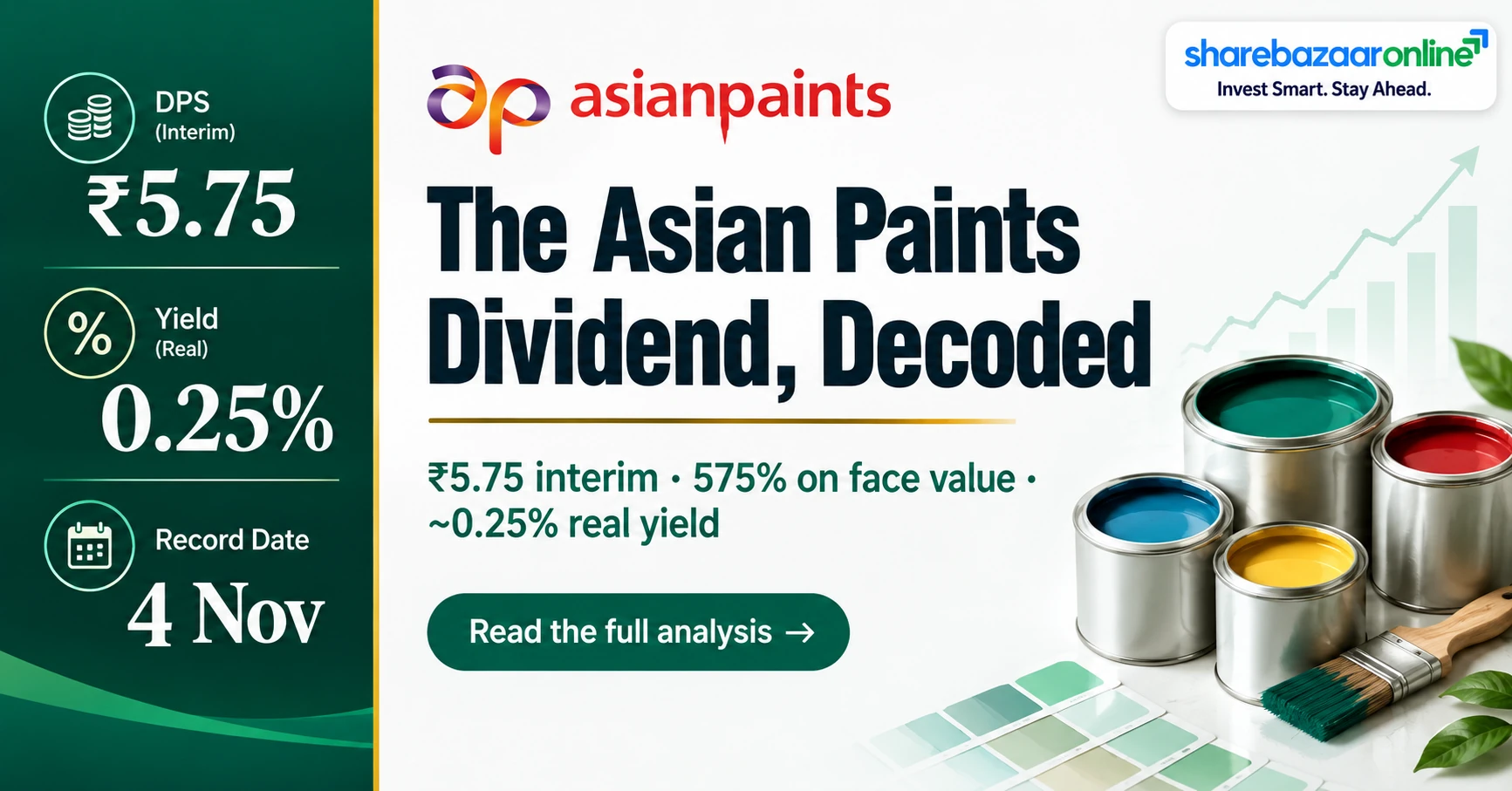
Asian Paints Limited has declared an interim dividend of ₹5.75 per share for the financial year 2026–27, alongside its Q2 FY27 results announced on 29 October 2026. On a face value of ₹1, that works out to a headline 575% dividend — a figure that looks dramatic but, on the market price, translates into a real yield of only about 0.25% for this single payout. The Asian Paints dividend carries a record date of 4 November 2026, with payment on or after 13 November 2026.

CompanyAsian Paints Limited
NSE SymbolASIANPAINT
BSE Code500820
ISININE021A01026
Face Value₹1
Dividend TypeInterim Dividend
Dividend Per Share₹5.75
Dividend %575%
Record Date4 November 2026
Payment DateOn/after 13 November 2026

Company Overview – Asian Paints Limited

Asian Paints Limited is India’s largest paint and décor company and ranks among the world’s top eight coatings makers. In FY26 it reported a consolidated turnover of about ₹35,516 crore, with a market capitalisation of roughly ₹2.3 lakh crore. The group operates in 14 countries with 25 manufacturing facilities and serves customers in over 60 markets through brands such as Asian Paints, Apco, Berger (international), SCIB and Kadisco.

Beyond decorative paints, the company is building an industrial coatings portfolio (its APPPG and PPGAP joint ventures) and a Home Décor business spanning bath fittings, kitchens, and furnishings. During Q2 FY27 it commissioned Phase 1 of a Vinyl Acetate Ethylene (VAE) plant at Dahej, a backward-integration step aimed at cost and raw-material security. Its business is cyclical with demand, but underpinned by a dominant decorative-paints franchise.

Asian Paints Financial Analysis at a Glance

Q2 FY27 (Consolidated)

Revenue from operations₹9,976.5 cr
PBDIT (operating)₹1,557.1 cr
Profit before tax₹1,477.8 cr
Net profit (owners)₹1,067.6 cr

Key Ratios

ROCE26.3%
ROE21.8%
Stock P/E~45×
FY26 Dividend Payout61%

Financials from the company’s Q2 FY27 board filing and press release; ratios from Screener.in.

Asian Paints Dividend History Table

Financial YearInterim (₹)Final (₹)Total DPS (₹)Dividend %
FY2016-172.655.65 + 2.00 special10.301030%
FY2017-182.656.058.70870%
FY2018-192.857.6510.501050%
FY2019-2010.50*1.5012.001200%
FY2020-213.3514.5017.851785%
FY2021-223.6515.5019.151915%
FY2022-234.4021.2525.652565%
FY2023-245.1528.1533.303330%
FY2024-254.2520.5524.802480%
FY2025-264.5023.0027.502750%
FY2026-275.75 (first interim)—5.75 so far575% so far

*FY2019-20 interim includes a first and second interim dividend. Source: Asian Paints official Dividend Payout History.

Expert Commentary on the Asian Paints Dividend

The ₹5.75 interim is the richest first-interim Asian Paints has paid, up 28% from the ₹4.50 first interim of FY26. Yet the more revealing number sits in the profit-and-loss statement: Q2 FY27 revenue rose 16.9% while operating PBDIT grew only 3.6%, pushing the consolidated margin down to 15.6% from 17.7% a year earlier.

In plain terms, Asian Paints is selling far more paint but keeping less of each rupee, as raw-material inflation and a softer product mix squeeze margins. Management has flagged a further round of staggered price hikes. The dividend is comfortable today, but the quality-of-earnings signal — volume without matching profit — is the figure long-term holders should watch, not the 575% headline.

Asian Paints Dividend Outlook & Future View

Asian Paints has not disclosed a fixed dividend-per-share target. Based on disclosed trends, a second interim and a final dividend typically follow in the second half of the financial year, as in prior years. The company has lifted total annual payout from ₹17.85 in FY21 to ₹27.50 in FY26, and its stated payout policy has kept the ratio in a 55–65% band.

What happens next depends on two things: whether price hikes restore margins, and how much cash the Dahej VAE plant and Home Décor investments absorb. With roughly ₹5,956 crore in liquid resources and modest net cash, the company has ample room to maintain its payout, but the pace of dividend growth will likely track earnings recovery rather than outrun it. Future corporate actions are at the board’s discretion and are not disclosed in advance.

Asian Paints Dividend Announcement Summary

At its board meeting on 29 October 2026, Asian Paints approved its audited standalone and unaudited consolidated results for the quarter and half-year ended 30 September 2026 and declared a first interim dividend of ₹5.75 per equity share (face value ₹1) for FY2026-27. The board fixed the record date as 4 November 2026, with payment to shareholders on or after 13 November 2026.

  • Interim dividend: ₹5.75 per share (575% of face value)
  • Total estimated outflow: approximately ₹551.5 crore
  • Approving authority: Board of Directors (interim dividends do not require AGM approval)
  • Also approved: Q2 and H1 FY27 financial results

Asian Paints Dividend Key Dates Timeline

Announcement Date29 October 2026
Record Date4 November 2026
Ex-Dividend Date4 November 2026
Payment DateOn/after 13 November 2026

Under India’s T+1 settlement cycle, the ex-date and record date fall on the same trading day. To be eligible, shares must be held before the ex-date of 4 November 2026.

Asian Paints Dividend Yield Analysis

This is where the face-value illusion matters most. The 575% headline is calculated on the ₹1 face value, not on the price you pay. On the latest market price of about ₹2,320, the ₹5.75 interim dividend is a yield of just 0.25%. Even on the announcement-day price near ₹2,270, the single-payout yield is only about 0.25%.

A fairer measure is the trailing dividend yield: Asian Paints paid ₹27.50 across FY26 (₹4.50 interim + ₹23.00 final), which is about a 1.19% yield on today’s price — and that matches the yield Screener reports. Asian Paints is a growth compounder, not a high-yield stock; investors have historically been rewarded by share-price appreciation, not dividend income.

Asian Paints Dividend History Analysis

Asian Paints qualifies as a consistent and growing dividend payer. Total annual dividend has risen from ₹10.30 in FY17 to ₹27.50 in FY26 — with no cuts, no suspensions, and a steady habit of paying one interim plus one final each year. The only interruption to the straight-line growth was FY25, when the total dipped to ₹24.80 from FY24’s ₹33.30, tracking that year’s weaker profit.

The current ₹5.75 first interim is the largest opening payout in the company’s history, signalling board confidence despite margin pressure. One special dividend appears in the record — ₹2.00 in FY17 to mark the company’s 75th year — but routine payouts have otherwise been predictable, which is the pattern income-oriented investors value.

Asian Paints Financial Performance Analysis

The forensic story of Q2 FY27 is operating de-leverage. Consolidated revenue grew 16.9% to ₹9,976.5 crore, but operating PBDIT rose only 3.6% and net profit to owners 7.5%. The gap is margin: PBDIT margin fell to 15.6% from 17.7%, as material costs climbed to about 60% of revenue from roughly 57% a year earlier.

Over five years, consolidated revenue has compounded at about 10.4% but PAT at only 6.5% (FY21–FY26) — confirming that profit growth has lagged sales. The H1 picture is better (PBT +23.2%), helped by a stronger Q1, but the Q2 trend shows raw-material inflation and a softer, lower-margin mix biting. Revenue is healthy; the question is whether margins recover.

Asian Paints Cash Flow Analysis

Cash is fact, and here it tells a cautionary tale. H1 FY27 operating cash flow was ₹1,899.8 crore — down a sharp 45% from ₹3,482.3 crore a year earlier — even though pre-tax profit rose. The culprit is a large working-capital swing: inventories rose by ₹1,519 crore in H1, versus a ₹708 crore release in the prior year.

After capex of ₹604.8 crore, free cash flow for H1 was about ₹1,295 crore — still comfortably more than twice the ₹551.5 crore interim-dividend outflow (2.35× FCF coverage). So the dividend is funded from current operations, not borrowings or asset sales. But the inventory build deserves monitoring: if it reflects stockpiling ahead of the festive season it may reverse; if it reflects slowing sell-through it is a warning.

Asian Paints Balance Sheet Strength

The balance sheet comfortably supports the dividend. As at 30 September 2026, Asian Paints held about ₹5,956 crore in cash and investments against total borrowings of roughly ₹2,900 crore — a net cash position of about ₹3,056 crore. The ₹551.5 crore interim outflow is covered nearly 11 times over by liquid resources alone.

Equity attributable to owners stands at about ₹21,735 crore (book value near ₹227 per share), and the company earns a strong 26.3% ROCE and 21.8% ROE on that base. There is no solvency concern around this payout; the balance-sheet question is simply how much cash future capex and Home Décor scale-up will consume.

Asian Paints Dividend Sustainability Analysis

Earnings coverage (H1 EPS ₹27.2 / DPS ₹5.75)4.7× ✓
FCF coverage (H1)2.35× ✓
Cash coverage (liquid resources)10.8× ✓
Debt positionNet cash ✓

On all four tests — earnings, free cash flow, liquidity and debt — the Asian Paints interim dividend clears comfortably. Verdict: Sustainable. The only caveat is directional, not immediate: the sharp fall in operating cash flow and the margin squeeze mean dividend growth could slow if margins do not recover, even though the current payout is secure.

Asian Paints Peer Comparison – Paint Sector Dividends

CompanyDiv YieldROEROCEP/E
Asian Paints~1.1%21.8%26.3%~45×
Berger Paints0.80%18.7%23.1%~47×
Kansai Nerolac1.30%9.8%12.4%~24×
Akzo Nobel India*6.55%16.3%——
Indigo Paints0.43%14.9%—~34×

Asian Paints offers a middling yield but the strongest return ratios in the pack — its 26.3% ROCE leads the listed decorative peers. *Akzo Nobel India’s elevated 6.55% yield reflects large special/one-off distributions tied to corporate restructuring and is not a like-for-like regular yield. Among paint majors, the sector is uniformly low-yield; investors buy these names for compounding quality, not income.

Peer metrics sourced from Value Research and Screener.in; figures approximate and subject to daily price movement.

Asian Paints Promoter Impact Analysis

Asian Paints is a promoter-led company: the promoter group holds 52.65%, with FIIs at 13.76%, DIIs at 20.50% and public shareholders at 13.03% (September 2026). Of the roughly ₹551.5 crore interim dividend, the promoter group is entitled to about ₹290 crore, institutions to roughly ₹189 crore, and public shareholders to about ₹72 crore.

A majority of the cash therefore flows to the promoter family, which is normal for a founder-controlled business. Importantly, the dividend is equal per share — every shareholder receives ₹5.75 regardless of size — so minority holders are treated on identical terms. Because the company is debt-light and cash-rich, this distribution does not come at the expense of growth funding.

Asian Paints Dividend Taxation Analysis

Since FY21, dividends are taxed in the hands of the shareholder at their applicable income-tax slab rate; there is no separate Dividend Distribution Tax. The company deducts TDS at 10% under Section 194 if a resident shareholder’s total dividend from the company in a financial year exceeds ₹5,000 (PAN furnished; otherwise 20%).

Worked Example (1,000 shares, 30% slab)

Gross dividend (1,000 × ₹5.75)₹5,750
TDS @10% (u/s 194, as > ₹5,000)₹575
Tax @30% slab + 4% cess₹1,794
Net dividend in hand₹3,956
Effective post-tax yield on CMP~0.17%

TDS is adjustable against final tax liability. Taxation is general in nature and not personal tax advice.

Asian Paints Dividend – Key Risks for Investors

  • Raw-material inflation: Material costs rose to about 60% of revenue in Q2 FY27, compressing PBDIT margin to 15.6% from 17.7% — the single biggest pressure on profits.
  • Margin-led profit lag: Revenue grew 16.9% but profit only 7.5% in Q2; five-year PAT CAGR (6.5%) trails revenue CAGR (10.4%).
  • Operating cash-flow decline: H1 FY27 OCF fell 45% on a ₹1,519 crore inventory build — a working-capital swing worth watching.
  • Competitive intensity: New entrants (including a large conglomerate) and aggressive peers are pressuring decorative-paint pricing and market share.
  • High valuation: At a P/E near 45×, the stock prices in strong growth; any sustained earnings miss can hurt total returns far more than the modest dividend adds.
  • Home Décor losses: Parts of the Home Décor segment (kitchens, bath) remain loss-making and absorb cash during scale-up.

Asian Paints Dividend – What To Monitor

  • Margin recovery: Whether the announced staggered price hikes restore PBDIT margin toward the historical 18–20% band in H2 FY27.
  • Inventory normalisation: Whether the ₹1,519 crore inventory build reverses post-festive season, restoring operating cash flow.
  • Decorative volume growth: Sustained mid-to-high single-digit volume growth (6.4% in Q2) against rising competition.
  • VAE plant & backward integration: How quickly the Dahej VAE facility improves raw-material cost and gross margin.
  • Full-year payout trajectory: The size of the expected second interim and final dividend, and whether the 55–65% payout band holds.
  • Home Décor turnaround: Progress toward profitability in bath and kitchen businesses.

Should You Consider Asian Paints for Dividend Income? – Conclusion

The Asian Paints ₹5.75 interim dividend is a financially comfortable payout — covered 4.7× by earnings, 2.35× by free cash flow and almost 11× by liquid resources — from a debt-light, net-cash balance sheet. The 575% headline, however, is a face-value artifact: the real single-payout yield is about 0.25%, and the trailing yield about 1.19%. Asian Paints is a compounding story, not an income stock.

The more useful takeaway for shareholders is the quality-of-earnings signal: strong revenue growth met by margin compression and a 45% drop in operating cash flow. The dividend is safe; the watch-item is whether margins and cash generation recover. This article presents the positives, negatives, risks and monitoring factors so readers can form their own view — it does not offer any buy, sell or hold recommendation.

Frequently Asked Questions About Asian Paints Dividend

What dividend has Asian Paints announced?
Asian Paints has declared a first interim dividend of ₹5.75 per equity share for FY2026-27, equal to 575% of the ₹1 face value. It was announced on 29 October 2026 along with the company’s Q2 FY27 results.
What is the Asian Paints dividend yield?
On the latest price near ₹2,320, the ₹5.75 interim is a yield of about 0.25%. The trailing-12-month yield, counting FY26’s full ₹27.50 dividend, is about 1.19%. The 575% figure is on face value, not market price.
What is the record date for the Asian Paints dividend?
The record date is Wednesday, 4 November 2026. Shareholders on the company’s register as of that date are eligible to receive the ₹5.75 interim dividend.
What is the ex-dividend date for Asian Paints?
Under India’s T+1 settlement cycle, the ex-date and record date fall on the same day — 4 November 2026. To qualify, you must buy the shares before the ex-date so the trade settles in time.
When will the Asian Paints dividend be paid?
The company has stated the interim dividend will be paid to eligible shareholders on or after Friday, 13 November 2026, typically credited directly to registered bank accounts.
Who is eligible for the Asian Paints interim dividend?
Any shareholder holding Asian Paints shares in their demat account as of the record date, 4 November 2026, is eligible. You must purchase shares before the 4 November ex-date to be on the register in time.
How is the Asian Paints dividend taxed?
Dividends are taxed at your income-tax slab rate. Asian Paints deducts 10% TDS under Section 194 if your dividend from the company exceeds ₹5,000 in the year (20% without PAN). The TDS is adjustable against your final tax liability.
Is the Asian Paints dividend sustainable?
Yes, on current numbers. The ₹5.75 interim is covered 4.7× by H1 earnings, 2.35× by free cash flow and nearly 11× by liquid resources, from a net-cash balance sheet. Dividend growth, however, may slow if margins do not recover.
What is the Asian Paints dividend history?
Asian Paints is a consistent payer. Total annual dividend has grown from ₹10.30 in FY17 to ₹27.50 in FY26, with no cuts or suspensions and one special dividend (₹2.00 in FY17). It typically pays one interim and one final each year.
What should investors monitor after this dividend?
Watch margin recovery from announced price hikes, whether the ₹1,519 crore inventory build reverses and restores operating cash flow, decorative volume growth against new competition, and the size of the expected second interim and final dividend.
Why is the Asian Paints dividend yield so low despite a 575% figure?
The 575% is calculated on the ₹1 face value, not the ₹2,320 market price. Because the share trades far above face value, the real cash yield on a ₹5.75 payout is only about 0.25%. This is the common face-value illusion in Indian dividend headlines.
Does the Asian Paints interim dividend need AGM approval?
No. Interim dividends are declared and paid under the authority of the Board of Directors and do not require shareholder approval at an AGM. Only final dividends are subject to AGM approval under the Companies Act.

Disclaimer

This article is for informational and educational purposes only and does not constitute investment, legal or tax advice, nor any buy, sell or hold recommendation. ShareBazaar Online is not a SEBI-registered investment adviser. Dividend figures, dates and financial data are based on Asian Paints Limited’s official stock-exchange disclosures dated 29 October 2026 and publicly available sources including Screener.in and Value Research; market prices and ratios are indicative and change daily. Taxation is explained in general terms and may vary by individual circumstances — consult a qualified professional. Investments in securities are subject to market risks; please read all related documents carefully and verify details with official exchange filings before making any decision.

Share this update
Back to Corporate Actions

Explore More Investment Opportunities

Discover IPOs, unlisted shares, and broker comparison tools curated for smart investors.