
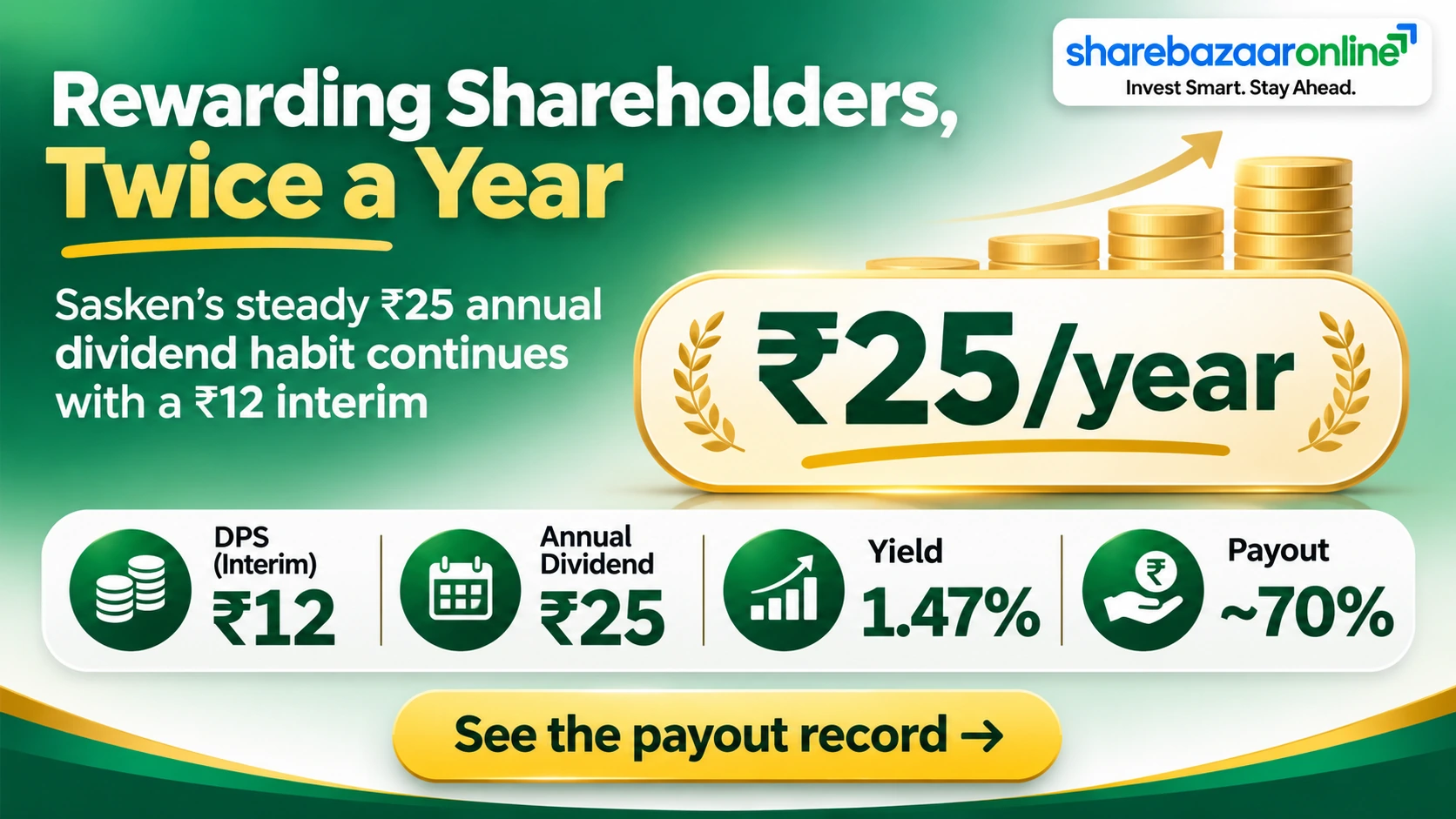
Dividend Snapshot – Sasken Technologies Limited
Sasken Technologies Limited has declared an interim dividend of ₹12 per equity share for the financial year 2026-27, a payout the board describes as 120% on the ₹10 face value. The 120% figure applies only to the face value — on the current market price of roughly ₹1,698, the real interim dividend yield works out to about 0.71%. The record date is 3 November 2026, and the dividend will be paid on or before 26 November 2026. This continues Sasken's long-running pattern of an interim dividend each November plus a final dividend each July.
Key Figures
- Dividend per share: ₹12
- Dividend type: Interim (FY 2026-27)
- Face value: ₹10
- Dividend on face value: 120%
- Real yield on CMP (₹1,698): ~0.71%
- Announcement date: 28 October 2026
Why This Matters
Sasken pairs a modest cash yield with a very strong balance sheet. The headline figure to watch is not the 120% label but the gap between Sasken's healthy standalone cash generation and its weak consolidated operating cash flow — a divergence driven by the Borqs product-solutions business and explained in the cash flow section below.
Company Overview – Sasken Technologies Limited
Established in 1989 and headquartered in Bengaluru, Sasken Technologies Limited (NSE: SASKEN, BSE: 532663, ISIN: INE231F01020) is a specialist in product engineering and digital transformation, delivering "chip-to-cognition" R&D services across semiconductors, automotive, industrials, consumer electronics, satellite communications and telecom. It is a small-cap IT-services company with around 2,844 employees and a market capitalisation of roughly ₹2,579 crore. Following the acquisition of Borqs Technologies, Sasken added original design manufacturing (ODM) and runs two reporting segments: Software Services and Product Solutions. Sasken Silicon adds ASIC and semiconductor engineering. The group is debt-light at the parent level, cash-rich, and a consistent dividend payer.
Sasken Technologies Financial Analysis at a Glance
Sasken's Q2 FY27 (quarter ended 30 September 2026) showed strong profit recovery on a consolidated basis, driven by Software Services and operating leverage.
| Metric (Consolidated) | Q2 FY27 | Q2 FY26 | YoY |
|---|---|---|---|
| Revenue | ₹320.95 Cr | ₹255.49 Cr | +25.6% |
| EBIT | ₹28.49 Cr | ₹5.76 Cr | +394.6% |
| PAT | ₹25.59 Cr | ₹10.50 Cr | +143.7% |
| EPS (Basic) | ₹16.14 | ₹6.44 | +150.6% |
Source: Company filing (28 October 2026), Screener.in consolidated data.
Sasken Technologies Dividend History Table
| Financial Year | Interim | Final | Total per Share |
|---|---|---|---|
| FY 2026-27 | ₹12 (current) | To be decided | ₹12 so far |
| FY 2025-26 | ₹12 | ₹13 | ₹25 |
| FY 2024-25 | ₹12 | ₹13 | ₹25 |
| FY 2023-24 | ₹12 | ₹13 | ₹25 |
| FY 2022-23 | ₹12 | ₹13 | ₹25 |
Sasken Technologies has paid a steady ₹25 per share annually (₹12 interim + ₹13 final) for several consecutive years, marking it a consistent dividend payer. Source: 5paisa / exchange disclosures.
Expert Commentary on the Sasken Technologies Dividend
The ₹12 interim dividend is well within Sasken's means, but the more interesting story sits in the cash flow statement. On a standalone basis — the parent entity that actually funds the dividend — Sasken generated healthy operating cash flow of ₹47.07 crore in H1 FY27. On a consolidated basis, operating cash flow was barely positive at ₹0.23 crore negative, held back by a large inventory build in the Borqs product-solutions business. Reported consolidated profit of ₹49 crore did not convert to cash during the half-year. For a dividend investor, the standalone cash engine is what matters most, and it remains strong.
Future Outlook for Sasken Technologies Shareholders
Management has disclosed a Q2 order book of $47.3 million, of which $24.8 million was new business, including four new logo wins across automotive telematics, Cockpit and ADAS programmes, electric mobility and semiconductor IP. Software Services grew 34% year-on-year, while Product Solutions moderated on global memory-supply tightness. The company has publicly stated its focus for H2 FY27 is to convert these bookings into revenue and manage the product-supply environment. Whether the consistent ₹25 annual dividend is maintained will depend on the final dividend decision in mid-2027 — a matter the company has not yet disclosed, and which this article does not predict.
Sasken Technologies Interim Dividend Announcement Summary
At its board meeting on 28 October 2026, the Board of Directors of Sasken Technologies Limited declared an interim dividend of ₹12 (120%) per equity share of ₹10 each for the financial year 2026-27. As disclosed, the board fixed Tuesday, 3 November 2026 as the record date to identify shareholders eligible for the dividend, which will be paid on or before Thursday, 26 November 2026. Because it is an interim dividend declared by the board, it does not require separate approval at an Annual General Meeting. The declaration accompanied Sasken's audited Q2 and H1 FY27 financial results, on which the statutory auditors expressed an unmodified opinion.
Sasken Technologies Dividend Key Dates Timeline
Announcement Date
28 October 2026
Record Date
3 November 2026
Ex-Dividend Date
3 November 2026
Payment Date
On or before 26 November 2026
Under India's T+1 settlement cycle, the ex-dividend date and record date fall on the same day, 3 November 2026. To be eligible for the Sasken Technologies interim dividend, investors needed to hold shares at the close of the trading day before the ex-date. Buying on or after the ex-date does not confer dividend eligibility.
Sasken Technologies Dividend Yield Analysis
The "120%" headline is calculated on the ₹10 face value, not the market price. This is the single most common misunderstanding in dividend announcements. The real dividend yield is what a buyer at today's price actually earns.
Headline (on ₹10 face value)
120%
Real interim yield (on CMP ₹1,698)
~0.71%
Adding the trailing full-year dividend of ₹25 per share (interim + final), the annualised dividend yield is roughly 1.47% at the current market price — consistent with the figure reported on Screener.in. So the 120% label translates, in real cash-return terms, to a yield comfortably under 1.5%.
Sasken Technologies Dividend History Analysis
Sasken Technologies has maintained a remarkably stable dividend pattern: ₹12 interim every November and ₹13 final every July, totalling ₹25 per share annually across FY2023 through FY2026. There have been no dividend cuts or suspensions in recent years. Sasken has periodically used larger special/buyback-style distributions in earlier years, but the recent cadence is predictable and twice-yearly. This consistency classifies Sasken as a Consistent Payer rather than a cyclical or irregular one. The dividend payout ratio has stayed high — around 70% of consolidated earnings in FY26 and 75% in FY25 — signalling that management prioritises returning surplus cash to shareholders over aggressive reinvestment.
Sasken Technologies Financial Performance Analysis
Q2 FY27 is a clear example of positive operating leverage. Consolidated revenue rose 25.6% YoY to ₹320.95 crore, but EBIT jumped 394.6% to ₹28.49 crore and PAT rose 143.7% to ₹25.59 crore — profits growing far faster than revenue as fixed costs were absorbed over a larger base. EBITDA margin expanded to 12.9% and EBIT margin to 8.9%. The growth engine was Software Services (+34% YoY), while Product Solutions moderated on component-supply constraints. On a longer view, however, consolidated profit growth has been uneven: Screener data shows a 3-year profit CAGR of negative 15%, reflecting the margin compression Sasken faced in FY24–FY25 before this recovery. Return ratios remain modest at ROCE 9.90% and ROE 7.00%.
Sasken Technologies Cash Flow Analysis
Reported profits are an accounting view; cash is the fact. Here Sasken shows a sharp standalone-versus-consolidated divergence that standard wire coverage misses:
Standalone OCF (H1 FY27)
+₹47.07 Cr
Strong — the parent that funds the dividend
Consolidated OCF (H1 FY27)
−₹0.23 Cr
Near-zero despite ₹49 Cr consolidated PAT
The gap is driven by a large inventory build of roughly ₹59 crore in the Borqs product-solutions business, which is working-capital heavy. The ₹12 interim dividend is funded from the parent's standalone cash generation and sizeable cash reserves, not from new borrowings or asset sales. Historically, consolidated free cash flow has been negative (−₹35 Cr in FY26, −₹67 Cr in FY25), so investors should track whether product-solutions working capital normalises.
Sasken Technologies Balance Sheet Strength
Sasken remains net-cash positive. Per the company's investor presentation, cash and cash equivalents stood at about ₹398.8 crore at quarter-end. One change worth flagging: consolidated borrowings rose from ₹28 crore at March 2026 to about ₹117 crore at September 2026, including roughly ₹80.76 crore of new current borrowings that were nil six months earlier. Even so, cash comfortably exceeds debt, leaving an estimated net cash position of about ₹282 crore. Book value per share is ₹581, and the stock trades at roughly 2.9 times book. The balance sheet gives the dividend a very wide margin of safety at current payout levels.
Sasken Technologies Dividend Sustainability Analysis
Interim dividend outflow
~₹18.23 Cr
Cash coverage of this outflow
~21.9x
Earnings coverage: H1 FY27 consolidated EPS of ₹32.51 covers the ₹12 interim 2.7 times (3.2x on standalone EPS). Cash coverage: reserves of ~₹398.8 crore cover the ~₹18.23 crore outflow nearly 22 times. Earnings trend: recovering strongly in FY27 after a weak FY25. The one caveat is consolidated free cash flow, which has been negative. On balance, with strong standalone cash generation and a large cash cushion, the dividend is assessed as Sustainable at current levels — though continued negative consolidated FCF would warrant watching over a multi-year horizon.
Sasken Technologies Peer Comparison
Within the Indian mid- and small-cap IT / engineering-services space, dividend yields are generally modest because these are growth-oriented businesses. Sasken's annualised yield of about 1.47% sits toward the higher end of that engineering-services band, reflecting its high payout ratio.
| Metric | Sasken Technologies | IT engineering-services peers (typical) |
|---|---|---|
| Dividend yield (annualised) | ~1.47% | ~0.5% – 2% |
| Dividend payout ratio | ~70% (FY26) | Varies widely |
| ROE | 7.0% | Generally higher for larger peers |
| ROCE | 9.9% | Generally higher for larger peers |
| Balance sheet | Net cash | Mostly net cash |
Peer bands are indicative sector ranges, not live per-company figures. Investors should verify current yields for named peers independently before comparing.
Sasken Technologies Promoter Impact Analysis
Promoters hold 42.93% of Sasken Technologies (as of September 2026). Of the total interim dividend outflow of about ₹18.23 crore, the split by shareholder category is:
To promoters (42.93%)
~₹7.83 Cr
To public shareholders (37.11%)
~₹6.76 Cr
FIIs hold 18.61% and receive about ₹3.39 crore. Because the dividend is paid uniformly per share, every shareholder benefits proportionally — there is no structural tilt favouring promoters beyond their ownership share. The high payout does, however, mean a meaningful recurring cash return to the promoter group, which can align their interests with minority shareholders who also value the income stream.
Sasken Technologies Dividend Taxation Analysis
In India, dividends are taxable in the hands of the shareholder at their applicable income-tax slab rate (there is no longer a Dividend Distribution Tax at the company level). For resident investors, the company deducts TDS at 10% under Section 194 when total dividend from that company in a financial year exceeds ₹10,000 (threshold raised from ₹5,000 in Budget 2025, effective FY2025-26). Without a PAN, TDS applies at 20%.
Worked Example (illustrative)
- Shares held: 1,000
- Dividend: ₹12 per share
- Gross dividend: ₹12,000
- TDS @10% (above ₹10,000): ₹1,200
- Investor at 30% slab — total tax: ₹3,600
- Net in hand after full tax: ₹8,400
- Effective post-tax yield on CMP (₹1,698): ~0.49%
This is a general illustration, not tax advice. Actual liability depends on your total income and slab; TDS is adjustable against final tax. Consult a qualified tax professional.
Key Risks for Sasken Technologies Dividend Investors
- 1. Low real cash yield: The eye-catching 120% figure is on face value; the real interim yield is about 0.71%, and annualised only ~1.47%. This is not a high-income stock in cash terms.
- 2. Weak consolidated cash conversion: Consolidated operating cash flow was near-zero in H1 FY27 and consolidated free cash flow has been negative for two years, largely due to the working-capital-heavy Product Solutions / Borqs business.
- 3. Component-supply dependence: Product Solutions revenue moderated on global memory-supply tightness, a factor outside the company's control that affects shipment volumes.
- 4. Rising borrowings: New current borrowings of ~₹80.76 crore appeared in H1 FY27, taking consolidated debt to ~₹117 crore (still below cash).
- 5. Modest return ratios & uneven profit history: ROE of 7% and a negative 3-year profit CAGR underline that earnings have been volatile, which can pressure future payout decisions.
What To Monitor in Sasken Technologies Going Forward
- 1. Consolidated operating cash flow: Watch whether product-solutions inventory normalises and consolidated OCF and free cash flow turn durably positive.
- 2. Order-book conversion: Track how the $47.3 million Q2 order book, including $24.8 million of new wins, converts into revenue over H2 FY27.
- 3. Software Services momentum: Software Services (+34% YoY) is the margin engine — its growth trajectory drives profitability and dividend capacity.
- 4. Borrowing trend: Monitor whether the newly drawn ~₹80.76 crore of current borrowings is repaid or grows further.
- 5. Final dividend decision (mid-2027): Whether the steady ₹25 annual total (interim + final) is maintained will confirm the dividend trajectory; the company has not yet disclosed this.
Conclusion: Assessing the Sasken Technologies Interim Dividend
Sasken Technologies' ₹12 interim dividend continues one of the more predictable payout records in small-cap IT. Positives: a consistent ₹25-per-share annual habit, a high ~70% payout, strong standalone cash generation, a net-cash balance sheet, and sharp Q2 profit recovery with 25.6% revenue and 143.7% PAT growth. Negatives: a real cash yield under 1.5%, weak consolidated cash conversion, negative consolidated free cash flow, newly drawn borrowings, and modest return ratios. The dividend itself is comfortably covered by earnings and cash. The deeper question for long-term holders is whether the Borqs-driven product-solutions business can convert its growing revenue into consolidated cash. We present the positives, negatives, risks and monitoring factors — the decision rests with each investor.
Frequently Asked Questions About the Sasken Technologies Dividend
What dividend has Sasken Technologies announced?
What is the Sasken Technologies dividend yield?
What is the record date for the Sasken Technologies dividend?
What is the ex-date for the Sasken Technologies dividend?
When will the Sasken Technologies dividend be paid?
Who is eligible for the Sasken Technologies interim dividend?
How is the Sasken Technologies dividend taxed?
Is the Sasken Technologies dividend sustainable?
What is the Sasken Technologies dividend history?
What should investors monitor in Sasken Technologies?
What is the difference between the 120% figure and the real yield?
Does the Sasken interim dividend need AGM approval?
Disclaimer
This article is for informational and educational purposes only and does not constitute investment, legal or tax advice. ShareBazaar Online is not a SEBI-registered investment adviser. The content is based on publicly disclosed company filings and third-party data sources (including the company's exchange filing dated 28 October 2026, Screener.in and 5paisa) believed to be reliable but not independently guaranteed. Market prices and yields are indicative and change continuously. Dividend decisions, record dates and payments are subject to the company's disclosures and applicable regulations. Nothing here is a recommendation to buy, sell or hold any security. Investors should conduct their own research and consult a qualified financial and tax adviser before making any investment decision. Investments in securities are subject to market risks.