
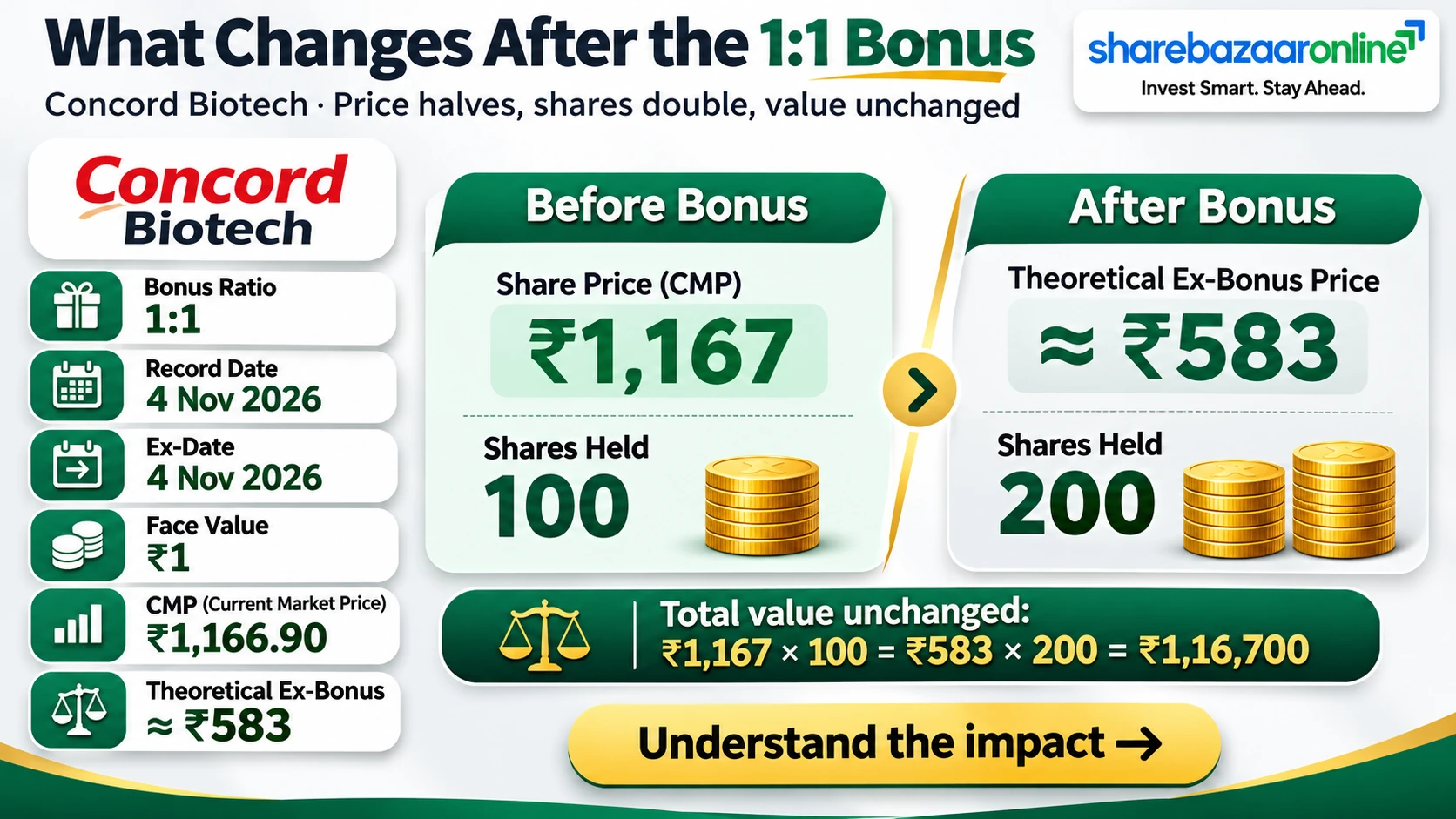
Bonus Issue Snapshot – Concord Biotech Limited
Concord Biotech Limited has announced its first-ever bonus issue in the ratio of 1:1 — one free equity share for every one share held. The board fixed 4 November 2026 as the record date, with 5 November 2026 as the deemed date of allotment. The move capitalises the company's share premium reserves into fresh paid-up equity. Below is a quick-reference snapshot of the key bonus details, prices and share-capital figures for investors tracking this corporate action.
| Particulars | Details |
|---|---|
| Company Name | Concord Biotech Limited |
| NSE Symbol | CONCORDBIO |
| BSE Code | 543960 |
| ISIN | INE338H01029 |
| Bonus Ratio | 1:1 |
| Announcement Date | 23 September 2026 |
| Record Date | 4 November 2026 |
| Ex-Bonus Date | 4 November 2026 |
| Deemed Date of Allotment | 5 November 2026 |
| Face Value | ₹1 |
| CMP (as of 2 Nov 2026, indicative) | ₹1,166.90 |
| Theoretical Ex-Bonus Price | ≈ ₹583 (indicative, not guaranteed) |
| Shares Before Bonus | 10,46,16,204 |
| Bonus Shares Issued | 10,46,16,204 |
| Shares After Bonus | 20,92,32,408 |
| Paid-up Capital Before | ₹10.46 crore |
| Paid-up Capital After | ₹20.92 crore |
| Source of Capitalisation | Securities / Share Premium Account |
| Bonus Share Credit / Trading Date | Not Disclosed by Company |
Concord Biotech Limited – Company Overview
Concord Biotech Limited is a Gujarat-based biopharmaceutical company and one of the leading global developers and manufacturers of select fermentation-based active pharmaceutical ingredients (APIs), spanning immunosuppressants, oncology, anti-infectives and anti-fungals, alongside a growing formulations business. It operates manufacturing facilities in Dholka and Limbasi, Gujarat, and serves customers across more than 70 countries. Listed on the NSE and BSE after its August 2023 IPO, the company is promoter-led and largely export-driven. Its fermentation platform and regulatory approvals across key markets give it a differentiated position within the Indian API and CDMO landscape.
Concord Biotech Limited Financial Analysis
Concord Biotech's consolidated financials show strong profitability but an uneven recent trajectory. After growing through FY2025, FY2026 was a decline year — revenue, operating profit and net profit all fell as margins compressed. Encouragingly, the first two quarters of FY2027 point to a recovery, led by API exports. The table below summarises three years of consolidated performance; figures are in ₹ crore unless stated otherwise.
| Metric (Consolidated) | FY2024 | FY2025 | FY2026 |
|---|---|---|---|
| Revenue | 1,017 | 1,200 | 1,055 |
| Operating Profit (EBITDA) | 432 | 506 | 368 |
| Operating Margin (OPM %) | 42% | 42% | 35% |
| Net Profit (PAT) | 308 | 372 | 259 |
| EPS (₹) | 29.45 | 35.52 | 24.94 |
| Operating Cash Flow | 265 | 245 | 267 |
| ROCE | 28% | 28% | 17% |
| Borrowings | 10 | 3 | 2 |
Source: Company disclosures and public consolidated financial databases. FY ends 31 March.
Concord Biotech Limited Bonus Issue History
This 1:1 bonus is Concord Biotech's first-ever bonus issue since its stock-market listing in August 2023. No previous bonus issue was identified from the verified sources reviewed, so there is no prior bonus track record to compare against for this company.
| Year | Bonus Ratio | Record Date | Remarks |
|---|---|---|---|
| 2026 | 1:1 | 4 November 2026 | First bonus issue since listing |
Concord Biotech Limited Bonus Issue Expert Commentary
A 1:1 bonus from a debt-free, cash-generating company is best read as a signal of confidence and a liquidity measure, not as value creation. By capitalising share premium, Concord Biotech converts reserves into permanent equity and lowers its per-share price, which can widen retail participation. The important caveat is that FY2026 earnings fell sharply, so the bonus arrives against a softer fundamental backdrop even as FY2027 quarters recover. Investors should weigh the improved affordability and optics against the need to see sustained revenue and margin recovery before drawing conclusions about underlying business momentum.
Concord Biotech Limited Bonus Issue Future Outlook
The near-term outlook hinges on whether the FY2027 recovery holds. Q1 FY27 revenue rose about 26% and Q2 FY27 revenue reached roughly ₹309 crore, suggesting demand for fermentation-based APIs and exports is firming after a weak FY2026. The bonus itself changes nothing operationally: enterprise value, order book and margins are unaffected. For the stock, the lower post-bonus price and larger float may aid liquidity. Sustained double-digit revenue growth, margin recovery toward historic 40%-plus levels and steady cash generation will matter far more to long-term value than the bonus adjustment.
Concord Biotech Limited Bonus Issue Announcement Summary
Concord Biotech's board first approved the 1:1 bonus issue at its meeting on 23 September 2026, subject to shareholder approval. At a subsequent board meeting on 27 October 2026, the company fixed 4 November 2026 as the record date for determining eligible shareholders, with 5 November 2026 as the deemed date of allotment. The issue involves 10,46,16,204 new equity shares of ₹1 face value, capitalised from the securities premium account. The disclosures were made to the NSE and BSE under SEBI's Listing Obligations and Disclosure Requirements framework and the Issue of Capital and Disclosure Requirements rules.
Concord Biotech Limited Bonus Issue Key Dates & Timeline
| Event | Date |
|---|---|
| Board Meeting (Bonus Approval) | 23 September 2026 |
| Board Meeting (Record Date Fixed) | 27 October 2026 |
| Shareholder Approval | As per company intimation |
| Record Date | 4 November 2026 |
| Ex-Bonus Date | 4 November 2026 |
| Deemed Date of Allotment | 5 November 2026 |
| Bonus Share Credit Date | Not Disclosed by Company |
| Listing / Trading Date | Not Disclosed by Company |
Concord Biotech Limited Bonus Issue Ratio & Entitlement Analysis
A 1:1 ratio means every eligible shareholder receives one additional share for each share held on the record date — doubling the number of shares held. Entitlement is calculated as Existing Shares × 1 ÷ 1. Because it is a whole-number ratio, fractional entitlements do not arise. The illustration below shows how a sample holding changes; it is based on the actual announced 1:1 ratio and does not account for market price movement.
| Illustration (1:1) | Shares |
|---|---|
| Shares held before bonus | 100 |
| Bonus shares received | 100 |
| Total shares after bonus | 200 |
Concord Biotech Limited Bonus Share Eligibility
To qualify for the bonus shares, an investor must hold Concord Biotech shares in their demat account as of the record date, 4 November 2026. Under the current T+1 settlement cycle, shares must be bought on or before the last cum-bonus trading session so they are settled by the record date; buying on the ex-bonus date (also 4 November 2026) does not confer eligibility. Existing shareholders need take no action — bonus shares are credited automatically to eligible demat accounts. Both promoter and public shareholders on the register as of the record date participate proportionately in the 1:1 issue.
Concord Biotech Limited Theoretical Ex-Bonus Price Analysis
After a 1:1 bonus, the share price is adjusted downward so total value stays broadly the same. The theoretical ex-bonus price is calculated as Pre-Bonus Price × Y ÷ (X + Y). Using an indicative pre-bonus price of around ₹1,167, the theoretical ex-bonus price works out to roughly ₹583. This is a purely mathematical adjustment, not a guaranteed market price — the actual opening price on the ex-date depends on live demand and supply.
| Calculation | Value |
|---|---|
| Pre-bonus price (indicative) | ₹1,166.90 |
| Formula (1:1) | Price × 1 ÷ 2 |
| Theoretical ex-bonus price | ≈ ₹583 |
Concord Biotech Limited Share Capital Impact After Bonus Issue
The bonus doubles Concord Biotech's issued and paid-up equity capital. Paid-up capital rises from ₹10.46 crore to ₹20.92 crore — a 100% increase — as 10,46,16,204 new ₹1 shares are created. To accommodate the enlarged capital base, the company increased its authorised share capital (reported at ₹22 crore). No cash leaves the business; reserves are simply reclassified into paid-up equity.
| Item | Before Bonus | After Bonus |
|---|---|---|
| Shares Outstanding | 10,46,16,204 | 20,92,32,408 |
| Paid-up Equity Capital | ₹10.46 crore | ₹20.92 crore |
| Increase | +100% | |
Concord Biotech Limited Reserves & Capitalization Analysis
Concord Biotech is funding the bonus from its securities (share) premium account, capitalising ₹10.46 crore against a reported premium balance of about ₹81.97 crore as of 31 March 2026. The company also carries large free reserves, with total consolidated reserves of roughly ₹2,007 crore. A bonus issue converts a portion of these eligible reserves into paid-up equity — an internal accounting reclassification. It is not a cash outflow like a dividend, so the company's liquidity and balance-sheet strength are preserved while the equity base expands.
Concord Biotech Limited Financial Performance Analysis
Performance has been uneven. FY2025 was strong, but FY2026 saw revenue fall about 12% to ₹1,055 crore, EBITDA drop to ₹368 crore with margins sliding from 42% to 35%, and net profit decline roughly 30% to ₹259 crore. ROCE halved to 17%. The decline reflects weaker operating leverage during the year. FY2027 is recovering: Q1 revenue rose about 26% and Q2 revenue reached around ₹309 crore. The bonus does not alter this picture — investors should track whether the recovery in revenue and margins sustains through the full year.
Concord Biotech Limited Cash Flow Analysis
Cash generation remains a relative strength. Even in a weak FY2026, operating cash flow was about ₹267 crore — broadly in line with net profit of ₹259 crore, indicating healthy conversion of earnings into cash. Operating cash flow held steady across FY2024–FY2026 (₹265, ₹245, ₹267 crore) despite swings in reported profit. A bonus issue involves no cash payment to shareholders, so it does not affect this cash position. The quality of cash conversion is reassuring, though it should be read alongside the FY2026 fall in headline profitability rather than in isolation.
Concord Biotech Limited Balance Sheet Strength
The balance sheet is a clear positive. Concord Biotech is effectively debt-free, with borrowings down to about ₹2 crore in FY2026 and a debt-to-equity ratio near zero. Reserves of roughly ₹2,007 crore underpin a book value of about ₹198 per share before the bonus. This financial cushion is what makes a reserve-capitalising bonus comfortable to execute. Post-bonus, total net worth is unchanged; only its distribution across a larger share count changes. A strong, low-leverage balance sheet also provides room for future capex and growth without stretching the company's finances.
Concord Biotech Limited EPS & Book Value Adjustment After Bonus Issue
Because the share count doubles, per-share metrics mechanically halve. This is an accounting adjustment, not a deterioration in the business — total profit and total net worth are unchanged. EPS and book value simply spread across twice as many shares. The table shows the approximate adjustment; actual reported figures will reflect the exact post-bonus share count and future earnings.
| Per-Share Metric | Before Bonus | After Bonus (approx.) |
|---|---|---|
| EPS (TTM) | ₹26.70 | ≈ ₹13.35 |
| Book Value per Share | ₹198.42 | ≈ ₹99.21 |
Concord Biotech Limited Bonus Issue Liquidity Impact
Doubling the share count and roughly halving the price can improve trading liquidity. A lower absolute price — from around ₹1,167 to a theoretical ₹583 — makes each share more affordable, which may widen retail participation and deepen the order book. More tradable shares can narrow bid-ask spreads over time. However, higher liquidity does not guarantee higher returns. The company's market capitalisation, enterprise value and fundamentals are unchanged by the bonus; liquidity is a mechanical and sentiment effect, not an improvement in the underlying business or its earnings power.
Concord Biotech Limited Historical Corporate Actions
As a company listed only since August 2023, Concord Biotech has a short corporate-action history. This 1:1 bonus is its first. It has not undertaken a stock split, rights issue or buyback to date, and it pays a modest dividend (indicative yield around 0.6%). Investors can review full details of Concord Biotech's dividend record and other corporate actions on the related ShareBazaar Online pages.
| Corporate Action | Status |
|---|---|
| Bonus Issue | First-ever, 1:1 (2026) |
| Stock Split | None identified |
| Rights Issue | None identified |
| Buyback | None identified |
| Dividend | Paid (modest yield) |
Concord Biotech Limited Promoter & Shareholding Impact
A bonus is distributed to all eligible shareholders proportionately, so ownership percentages do not change. Promoters, FIIs, DIIs and public investors each hold double the number of shares but the same percentage stake. Promoter holding has been steady near 44%. The table shows the latest reported pattern (September 2026); these percentages remain unchanged after the 1:1 bonus.
| Category | Holding (Sep 2026) |
|---|---|
| Promoters | 44.09% |
| Public | 37.68% |
| DII | 10.95% |
| FII / FPI | 7.28% |
Concord Biotech Limited Peer Comparison
Within the Indian API and CDMO space, Concord Biotech's closest listed reference points include Divi's Laboratories, Laurus Labs and Neuland Laboratories. Concord stands out for being debt-free with historically high margins, though FY2026 margins compressed. Divi's is larger and premium-valued; Laurus carries more leverage and a diversified mix; Neuland is smaller and more volatile. The table lists Concord's verified metrics; peer figures should be checked against each company's latest filings before comparison.
| Metric (Concord, Consolidated) | Value |
|---|---|
| FY2026 Revenue | ₹1,055 crore |
| FY2026 Operating Margin | 35% |
| ROCE (FY2026) | 17% |
| Debt-to-Equity | ~0 (debt-free) |
| Indicative P/E (TTM) | ~46.6x |
Concord Biotech Limited Bonus Issue Benefits
- Lower per-share price improves affordability and can broaden retail participation.
- Larger free float may enhance trading liquidity over time.
- Capitalises reserves into permanent equity without any cash outflow.
- Signals management and board confidence in the company's reserve position.
- Existing shareholders receive additional shares automatically, with no action required.
- Ownership percentages are preserved for all shareholder categories.
Concord Biotech Limited Bonus Issue Risks
- Earnings softness: FY2026 revenue fell ~12% and net profit ~30%, with margins compressing from 42% to 35%.
- No value creation: the bonus does not raise enterprise value; the price adjusts down proportionately.
- Margin and pricing risk: API pricing pressure and input costs can keep margins below historic highs.
- Customer / export concentration: reliance on key customers and export markets exposes the company to demand and regulatory shifts.
- Valuation risk: a P/E near 46x leaves limited room for disappointment if recovery stalls.
- Subsidiary drag: newer subsidiaries reduced consolidated profit versus standalone.
What Investors Should Monitor After Concord Biotech Limited Bonus Issue
- Whether the FY2027 revenue recovery (Q1 and Q2 growth) sustains for the full year.
- Operating margin trajectory and progress back toward historic 40%-plus levels.
- API export demand and new product / regulatory approvals.
- Operating cash flow conversion relative to reported profit.
- Performance of subsidiaries and their impact on consolidated earnings.
- Post-bonus trading liquidity, price behaviour and the credit of bonus shares.
- Any change in promoter or institutional holding at the next shareholding disclosure.
Taxation of Concord Biotech Limited Bonus Shares
Receiving bonus shares is not a taxable event in India — no tax arises at the time of credit. For capital-gains purposes, the cost of acquisition of bonus shares is treated as nil, and their holding period is counted from the date of allotment of the bonus shares (not the original purchase). Original shares retain their actual cost and purchase date. Tax applies only when shares are sold, as short-term or long-term capital gains depending on the holding period of each tranche.
| Worked Example (1:1) | Detail |
|---|---|
| Original shares | 100 @ ₹1,000 (cost ₹1,00,000) |
| Bonus shares (1:1) | 100 @ nil cost |
| Total holding | 200 shares |
| On sale of original 100 | Gain = Sale price − ₹1,000 cost |
| On sale of bonus 100 | Gain = Sale price − ₹0 cost |
Tax rules may change. Investors should verify the latest applicable provisions or consult a qualified tax professional.
Concord Biotech Limited Bonus Issue Conclusion
Concord Biotech's first-ever 1:1 bonus is a reserve-capitalising, liquidity-oriented action from a debt-free, cash-generative company. It doubles the share count and halves per-share metrics without changing total value, ownership percentages or the underlying business. The key context is that it follows a weak FY2026, even as FY2027 quarters show recovery. For investors, the bonus improves affordability and optics, but the real decision rests on sustained revenue growth, margin recovery and cash generation — not on the bonus adjustment itself. Track the fundamentals, verify the record-date eligibility, and treat the price change as mechanical.
Frequently Asked Questions About Concord Biotech Limited Bonus Issue
What bonus issue has Concord Biotech Limited announced?
What is the Concord Biotech Limited bonus ratio?
What is the Concord Biotech Limited bonus record date?
What is the Concord Biotech Limited ex-bonus date?
Who is eligible for Concord Biotech Limited bonus shares?
How many bonus shares will Concord Biotech Limited investors receive?
When will Concord Biotech Limited bonus shares be credited?
What happens to the Concord Biotech Limited share price after the bonus issue?
Does a Concord Biotech Limited bonus issue increase investor wealth?
How is EPS affected after the Concord Biotech Limited bonus issue?
How is book value affected after the Concord Biotech Limited bonus issue?
Are Concord Biotech Limited bonus shares taxable when received?
What is the cost of acquisition of Concord Biotech Limited bonus shares?
What should investors monitor after the Concord Biotech Limited bonus issue?
Has Concord Biotech Limited issued bonus shares previously?
Concord Biotech Limited Bonus Issue Disclaimer
This article is for informational and educational purposes only and does not constitute investment, tax, legal or financial advice, or any recommendation to buy, sell or hold any security. Market prices, financial data and corporate-action details may change. Figures marked indicative are approximate and the theoretical ex-bonus price is a mathematical adjustment, not a guaranteed price. Investors should independently verify current disclosures with the NSE, BSE and the company's official filings before making any decision. Tax treatment may vary by individual circumstances and tax rules may change; please consult a qualified professional.