
Rights Issue Snapshot — Indian Emulsifiers Limited
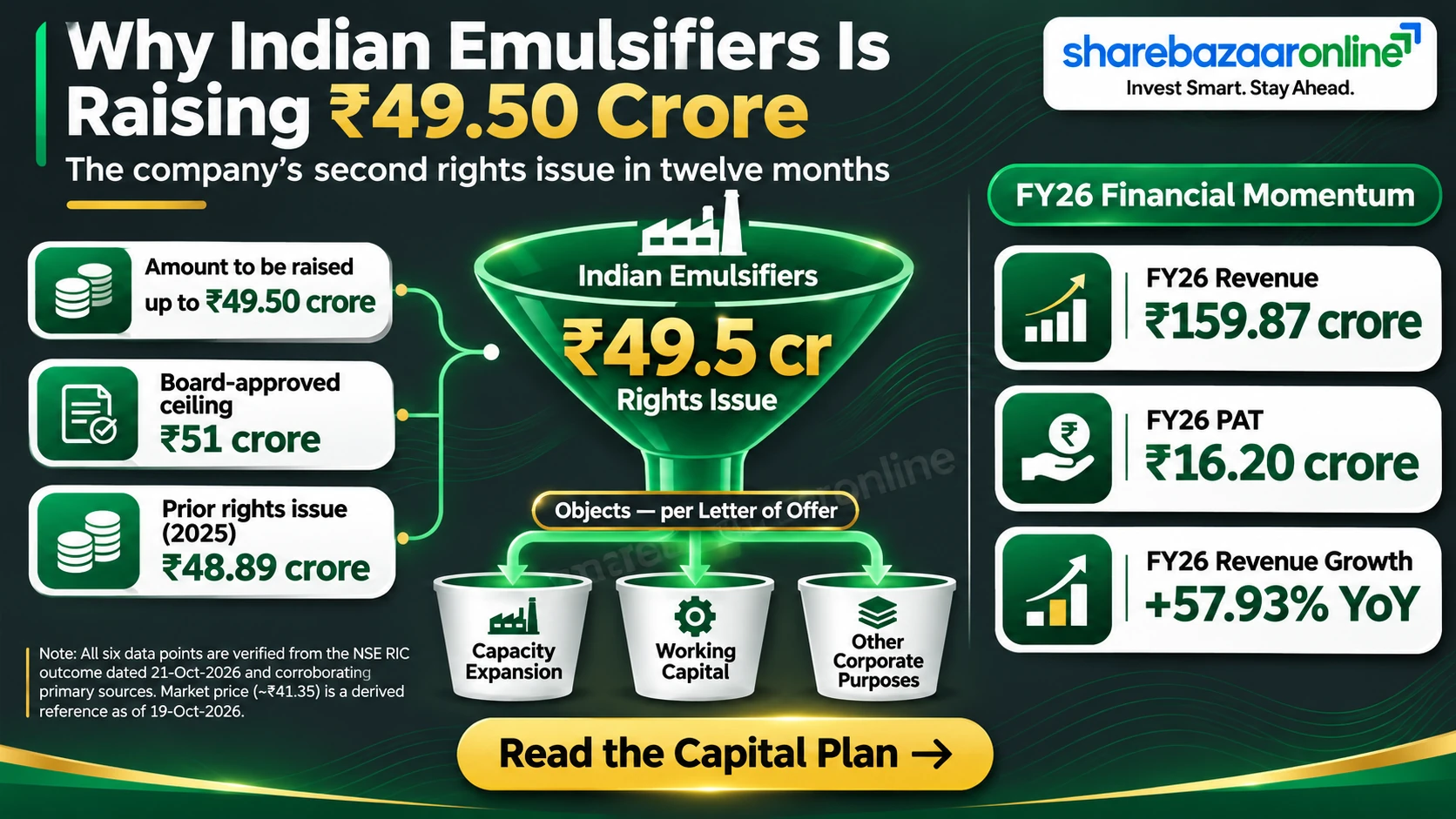
Indian Emulsifiers Limited (NSE: IEML) has announced a rights issue of equity shares, confirmed by the Rights Issue Committee on 21 October 2026. The table below summarises the material terms disclosed by the company. This is the company's second rights issue in roughly twelve months.
| Company Name | Indian Emulsifiers Limited |
| Exchange / Platform | NSE Emerge (SME) |
| NSE Symbol | IEML |
| ISIN | INE0RRU01016 |
| Rights Entitlement Ratio | 1:1 (one rights share for every one share held) |
| Issue Price | Rs 27 per share (incl. Rs 17 premium) |
| Face Value | Rs 10 per share |
| Premium | Rs 17 per share |
| Total Issue Size | Rs 49,49,96,994 (approx Rs 49.50 crore) |
| Shares Offered | 1,83,33,222 equity shares |
| Record Date | 27 October 2026 |
| Issue Opening Date | 16 November 2026 |
| Issue Closing Date | 1 December 2026 |
| RE Trading Period | 16–25 November 2026 (symbol IEML-RE) |
| Issue Purpose | To be detailed in the Letter of Offer |
| Registrar | To be confirmed from the Letter of Offer |
| Lead Manager | To be confirmed from the Letter of Offer |
| Promoter Participation | Not Disclosed by the Company (pending Letter of Offer) |
| Listing Status | Existing shares listed on NSE Emerge; rights shares to be listed post-allotment |
| Announcement Date | 21 October 2026 (board approval 16 May 2026) |
About Indian Emulsifiers Limited
Indian Emulsifiers Limited was incorporated on 5 December 2020 as a private company and converted to a public limited company on 5 January 2024. Its equity shares were listed on the NSE Emerge SME platform on 22 May 2024 following an initial public offer. The company is a manufacturer and supplier of specialty chemicals, working largely on an order-driven, customised-formulation basis.
Its product portfolio spans esters, esterquats, polyamides, polymerised surfactants, sulphates, amphoterics, phosphate esters, imidazolines, wax emulsions and formulated specialities — reported at more than 120 products across eight to nine end-use industries including personal care, cosmetics, cleaning, preservatives, metalworking, oil and gas, lubricants, mining and textiles. The registered office is in Worli, Mumbai, and the company has disclosed a manufacturing presence at MIDC Lote, Ratnagiri.
The promoter is Yash Tikekar, who serves as Managing Director. For FY26 the company reported revenue of about Rs 159.87 crore and profit after tax of about Rs 16.20 crore, with management describing capacity expansion as a key part of its growth plan.
Indian Emulsifiers Rights Issue Explained
A rights issue is a way for a listed company to raise fresh capital by offering new shares to its existing shareholders, usually at a price below the prevailing market price, in proportion to their current holding. It is a corporate action governed by SEBI's ICDR Regulations, 2018 and the Companies Act, 2013.
How the 1:1 ratio works
In the Indian Emulsifiers rights issue, the entitlement ratio is 1:1. This means an eligible shareholder receives the right to apply for one new share at Rs 27 for every one share held as on the record date of 27 October 2026. The full Rs 27 is payable on application.
Your three choices
Eligible shareholders can (1) apply for the rights shares by paying Rs 27 each, (2) renounce — sell — their Rights Entitlements on the market (symbol IEML-RE) or transfer them off-market, or (3) do nothing and let the entitlement lapse. Receiving a Rights Entitlement does not mean shares are automatically allotted; an application and payment are required.
Because this is a 1:1 issue, a shareholder who does not apply or renounce sees their proportional ownership reduced relative to those who do subscribe, since the total share count can double on full subscription.
Important Dates for Indian Emulsifiers Rights Issue
| Event | Date |
|---|---|
| Board Approval | 16 May 2026 |
| Rights Issue Committee / Announcement | 21 October 2026 |
| Record Date | 27 October 2026 |
| Ex-Date | 27 October 2026 (per exchange/aggregator sources) |
| Issue Opening Date | 16 November 2026 |
| Last Date for On-Market Renunciation | 25 November 2026 |
| Issue Closing Date | 1 December 2026 |
| Off-Market Renunciation | To be completed so REs reach the renouncee's demat on or before the closing date |
| Allotment Date | Not Disclosed by the Company (pending Letter of Offer) |
| Credit / Listing of Rights Shares | Not Disclosed by the Company (pending Letter of Offer) |
The company's board may extend the issue period, provided the issue does not remain open for more than 30 days from the opening date. No application may be withdrawn after the closing date.
Indian Emulsifiers Rights Issue Timeline
The sequence below explains the practical significance of each milestone in the Indian Emulsifiers rights issue.
Record Date — 27 October 2026
The cut-off for determining which shareholders are eligible. Only those on the register as on this date receive Rights Entitlements.
RE Credit — before 16 November 2026
Rights Entitlements are credited to eligible demat accounts in dematerialised form via NSDL and CDSL before the issue opens.
Subscription & RE Trading — 16 November 2026
The issue opens for application, and Rights Entitlements begin trading on the exchange under IEML-RE for those wishing to buy or sell them.
Last Renunciation Date — 25 November 2026
The final day to sell entitlements on the market. After this, unexercised entitlements cannot be traded.
Issue Closes — 1 December 2026
The last day to apply. Entitlements not applied for or renounced lapse and hold no value thereafter.
Rights Issue Structure of Indian Emulsifiers
Pricing
Issue price Rs 27 = face value Rs 10 + premium Rs 17. Premium per share = Rs 27 − Rs 10 = Rs 17 (disclosed by the company).
Discount to reference price (derived)
Against a reference market price of about Rs 41.35 (19 October 2026), the Rs 27 price reflects an indicative discount of about 34.7%: ((41.35 − 27) ÷ 41.35) × 100. This is a derived calculation using an aggregator-sourced price and should be re-checked against the live price.
Capital structure
Outstanding equity shares before the issue: 1,83,33,222. On full subscription, post-issue shares: 3,66,66,444 (both figures disclosed in the filing).
Gross proceeds
1,83,33,222 shares × Rs 27 = Rs 49,49,96,994 (approx Rs 49.50 crore) if fully subscribed. The company has not stated the issue is underwritten; full subscription is not assumed.
Why Is Indian Emulsifiers Raising Capital Through a Rights Issue?
The detailed objects of this 2026 rights issue will be set out in the Letter of Offer, which the company has stated it will file with NSE Emerge and SEBI. As on the date of this report, a specific, line-item use of proceeds for the 2026 issue has not been publicly disclosed, and is therefore marked as pending the Letter of Offer rather than estimated.
For context only, the board approval of 16 May 2026 linked the broader capital-raising plan (a rights issue not exceeding Rs 51 crore) to the company's growth agenda, and separately the board approved a Rs 600 lakh investment for a 10.99% stake in Chemical Brothers Enterprises Private Limited. This context is derived from announcements and should be confirmed against the Letter of Offer before being treated as the formal objects of the issue. In its most recent prior rights issue (2025), the company had stated incremental working capital and construction of new factory premises as objects.
Promoter Participation in Indian Emulsifiers Rights Issue
Promoter shareholding stood at about 32.64% as of September 2026, according to public shareholding data — down from about 48.11% a year earlier, a reduction associated with the earlier rights issue and subsequent changes in the capital base.
Whether the promoter intends to subscribe to the full entitlement in this 2026 issue has not been disclosed in the announcement reviewed, and is marked "Not Disclosed by the Company" pending the Letter of Offer. Readers should not assume full promoter subscription. The extent of promoter participation materially affects how ownership proportions shift after the issue, so it is an item to verify directly from the Letter of Offer when filed.
Indian Emulsifiers Financial Performance Overview
The table shows reported annual figures. Investors should note these are drawn from company results and public financial databases; where sources differ slightly on rounding, the company's own disclosures are preferred.
| Metric (Rs crore) | FY22 | FY23 | FY24 | FY25 | FY26 |
|---|---|---|---|---|---|
| Revenue | 17.68 | 41.18 | 66.72 | 102.66 | 159.87 |
| EBITDA | 0.80 | 7.87 | 14.84 | 21.05 | 26.15 |
| Net Profit (PAT) | 0.04 | 3.89 | 8.83 | 13.30 | 16.20 |
| ROCE (%) | 6 | 26 | 31 | 24 | 15 |
FY26 revenue grew about 57.93% year on year, with PAT up about 21.83%. Past performance does not guarantee future results. Figures appear to be reported on a standalone basis; consolidated statements should be used where available.
In-Depth Financial Analysis of Indian Emulsifiers
Observation (factual): Revenue has compounded rapidly, rising from about Rs 17.68 crore in FY22 to about Rs 159.87 crore in FY26, with profit after tax expanding alongside. However, ROCE has eased from a peak of about 31% in FY24 to about 15% in FY26, and working-capital intensity has increased — debtor days, inventory days and the cash conversion cycle have all lengthened over the period.
Interpretation (editorial): A fast-scaling specialty-chemicals manufacturer that is also building new capacity typically absorbs cash into working capital and capital expenditure. In that context, a rights issue can be read as a way to fund growth without adding materially to leverage. This is an analytical interpretation, not a company statement, and the actual objects remain to be confirmed from the Letter of Offer.
Balance Sheet Strength of Indian Emulsifiers
A full, line-item FY26 balance sheet was not uniformly available across the public sources reviewed, so specific asset, liability and net-worth figures for FY26 are marked as not fully verified here rather than estimated. What can be observed from available ratio data is a lengthening working-capital cycle (working-capital days rising toward the 200 mark by FY26) and a moderating return on capital.
If the rights issue is subscribed, the fresh equity would strengthen the net-worth base and could support working capital and capacity needs. The precise balance-sheet impact depends on the final subscription level and the confirmed use of proceeds, both of which should be read from the Letter of Offer and subsequent allotment disclosures.
Cash Flow Position of Indian Emulsifiers
Detailed operating, investing and financing cash-flow statements for FY26 were not consistently available in the public sources reviewed and are therefore not reproduced here, in line with a policy of not estimating undisclosed figures.
Conceptually, the rising working-capital intensity noted above suggests that a meaningful share of reported profit has been reinvested into receivables and inventory as the business scales. Accounting profit is not the same as cash generated, and a growing, order-driven manufacturer can be profitable while still needing external capital to fund the working-capital gap and capacity build — one reason capital-raising through a rights issue can arise even in a profitable year.
Shareholding Pattern of Indian Emulsifiers Before and After the Rights Issue
Promoter holding was about 32.64% as of September 2026 per public data. Because the issue is 1:1 and offered pro-rata to all eligible shareholders, if every shareholder subscribes in full, ownership proportions remain broadly unchanged even as the share count doubles.
Dilution illustration (hypothetical)
If a shareholder owning 1,000 shares does not subscribe while the issue is otherwise fully taken up, their stake weight would fall to roughly half of its prior proportion, because the total number of shares can rise from 1,83,33,222 to 3,66,66,444. This is an illustrative calculation to explain dilution mechanics, not a statement of any individual's actual post-issue holding, which depends on overall subscription.
Actual post-issue promoter, FII, DII and public shareholding splits will only be known from the post-allotment shareholding disclosure and are marked Not Disclosed until then.
Industry Analysis: Where Does Indian Emulsifiers Stand?
Indian Emulsifiers operates in India's specialty chemicals sector, supplying emulsifiers, surfactants and formulated specialities into diverse end markets such as personal care, home care, textiles, metalworking, oil and gas and mining. Specialty chemicals is generally characterised by customised, application-specific formulations, closer customer relationships and value-added pricing relative to commodity chemicals.
Specific market-size and growth-rate figures for the relevant sub-segments are not reproduced here, to avoid presenting unverified industry statistics. As a small-cap, SME-listed manufacturer, the company competes with larger, better-capitalised specialty-chemicals players, which is a relevant backdrop when assessing its need for growth capital.
Competitive Position of Indian Emulsifiers
The company's reported competitive characteristics include a broad product portfolio (120-plus specialty chemicals), an order-driven and customised-formulation model, and exposure across multiple end-use industries, which can reduce dependence on any single sector. It has also disclosed securing direct export orders from a U.S. customer during 2026, indicating some international reach.
As a relatively young and small company, it faces the usual challenges of scale, bargaining power with larger customers and suppliers, and the capital intensity of expanding manufacturing capacity. Claims of market leadership are avoided here in the absence of comparable peer data for the specific segments in which it operates.
Key Growth Drivers for Indian Emulsifiers
- Capacity expansion — management has described new capacity as a basis for targeted revenue growth (a forward-looking company expectation, not a guarantee).
- Revenue momentum — about 57.93% YoY revenue growth in FY26 extends a multi-year high-growth trajectory.
- Export orders — disclosed direct export orders from a leading U.S. customer point to a widening customer base.
- Broad product and end-market mix — diversification across eight-to-nine industries can cushion sector-specific demand swings.
- Fresh capital — rights-issue proceeds, subject to the confirmed objects, could fund working capital and capex to support the above.
Risk Factors Associated with Indian Emulsifiers Rights Issue
Dilution risk
Non-participating shareholders face reduced proportional ownership in a 1:1 issue.
Share-price volatility
The stock has shown a wide 52-week range (about Rs 37.80 to Rs 173.81) and a steep decline over the past year.
Second raise in 12 months
A second rights issue within a year warrants scrutiny of how the earlier proceeds were deployed and why further capital is needed.
Use-of-proceeds uncertainty
Formal objects for the 2026 issue are pending the Letter of Offer.
Subscription uncertainty
Full subscription is not assured; the earlier issue required an extension of its closing date.
Working-capital & execution risk
Lengthening working-capital cycle and capacity-build execution could pressure returns.
SME-segment liquidity
NSE Emerge securities can be less liquid and more volatile than main-board stocks.
Regulatory / terms change
Dates and terms may be revised by corrigendum or extension.
Additional risks disclosed in the Letter of Offer should be read in full once available.
Opportunities Emerging from Indian Emulsifiers Rights Issue
Subject to the confirmed objects, the capital raised could support opportunities such as funding incremental working capital for a rapidly scaling order book, financing capacity expansion, and strengthening the equity base to underpin future growth. The disclosed intent to acquire a stake in Chemical Brothers Enterprises (as part of the broader board-approved plan) could point to inorganic or supply-chain-related opportunities, though this should be confirmed against the Letter of Offer.
These are potential opportunities, not guaranteed outcomes, and they depend on effective deployment of proceeds and continued business execution.
Advantages of Indian Emulsifiers Rights Issue
| Advantage | What it means / when it may not apply |
|---|---|
| Discounted price | Rs 27 is below the recent reference price (~Rs 41.35, 19 Oct 2026). The benefit erodes if the market price falls to or below Rs 27. |
| Maintain ownership | Participating lets eligible holders avoid dilution. Does not apply to those who choose not to subscribe. |
| Tradable entitlement | Those who do not wish to subscribe may sell the RE (IEML-RE) rather than let it lapse, subject to market demand. |
| Growth capital for the company | Proceeds may fund working capital/capex. Benefit depends on effective deployment. |
| Balance-sheet support | Equity funding can strengthen net worth without adding debt. Depends on subscription level. |
Potential benefits are not guaranteed outcomes.
Disadvantages and Risks of Indian Emulsifiers Rights Issue
| Disadvantage | How it may affect shareholders |
|---|---|
| Additional capital outlay | Participating requires fresh money (Rs 27 per entitlement) on application. |
| Equity & EPS dilution | A near-doubling of share count can dilute EPS, especially if proceeds take time to generate returns. |
| Price risk | The market price could fall below Rs 27, removing the discount advantage. |
| Repeated fundraising | Two rights issues in a year may raise questions about cash needs and prior-proceed utilisation. |
| Opportunity cost | Capital committed here is unavailable for other uses. |
| Subscription / liquidity risk | Under-subscription or thin RE liquidity could affect outcomes. |
These describe possible outcomes, not certainties; confirmed facts are distinguished from risks throughout.
Should Existing Shareholders Participate in the Indian Emulsifiers Rights Issue?
This is an educational discussion, not a recommendation to apply or to refrain. Factors an eligible shareholder may wish to weigh include:
- The Rs 27 price versus the current market price on the day they decide (not a stale reference).
- The company's fundamentals — strong revenue growth against easing ROCE and rising working-capital intensity.
- The confirmed use of proceeds, once the Letter of Offer is available.
- The implications of a second raise within twelve months.
- Their own tolerance for SME-segment volatility and the additional capital outlay required.
- Whether, if they do not wish to subscribe, selling the RE is preferable to letting it lapse.
- Their personal financial circumstances and objectives, ideally with a SEBI-registered adviser.
Investor Insights on Indian Emulsifiers Rights Issue
Pulling the threads together: the terms are clearly disclosed and confirmed (1:1 at Rs 27, Rs 49.50 crore, record date 27 October 2026). The company is growing revenue quickly but is also absorbing cash into working capital and capacity, which is a plausible reason to raise equity. The price offers an indicative discount to recent levels, but the stock has been highly volatile and has fallen sharply over the past year.
What the available evidence does not yet establish is the formal use of proceeds for this specific issue, the registrar and lead manager, and the promoter's subscription intent — all pending the Letter of Offer. These gaps are material to a full assessment and should be filled from primary documents before any decision.
Analyst Perspective on Indian Emulsifiers
On a neutral, fact-based view: the strategic rationale for a specialty-chemicals company in a steep growth phase to raise equity is understandable, given working-capital and capex needs. The pricing and 1:1 structure are shareholder-friendly in form, offering a discount and the choice to participate, renounce or exit the entitlement. The principal unanswered questions are the confirmed objects, the deployment track record of the 2025 proceeds, and the promoter's commitment this time. ShareBazaar Online has not issued, and does not issue, a formal investment recommendation; no analyst rating, price target or consensus figure is attributed in this article.
Conclusion: Indian Emulsifiers Rights Issue Review
The Indian Emulsifiers rights issue is a 1:1 offer of 1,83,33,222 equity shares at Rs 27 each (Rs 10 face value plus Rs 17 premium), aggregating about Rs 49.50 crore. The record date was 27 October 2026, with subscription scheduled from 16 November to 1 December 2026 and Rights Entitlements trading as IEML-RE from 16 to 25 November. The price sits at an indicative discount to recent traded levels, and the company has delivered strong multi-year revenue growth, though ROCE has eased and working-capital intensity has risen. It is the company's second rights issue within roughly a year, and the formal use of proceeds, registrar, lead manager and promoter participation remain to be confirmed from the Letter of Offer. Eligible shareholders should read that document in full and consider their own circumstances before deciding. This review is educational and is not a recommendation to apply for, renounce, buy or sell any security.
Frequently Asked Questions — Indian Emulsifiers Rights Issue
What is the Indian Emulsifiers rights issue 2026?
What is the Indian Emulsifiers rights issue ratio?
What is the Indian Emulsifiers rights issue price?
What is the record date for the Indian Emulsifiers rights issue?
What is the ex-date for this rights issue?
Who is eligible for the Indian Emulsifiers rights issue?
What is a Rights Entitlement (RE)?
Can the Rights Entitlements be traded?
What is renunciation of a Rights Entitlement?
When does the Indian Emulsifiers rights issue open?
When does the rights issue close?
How can eligible shareholders apply?
What is the purpose of the Indian Emulsifiers rights issue?
How much can the issue raise?
Is this Indian Emulsifiers' first rights issue?
How could the issue affect ownership dilution?
Does a rights issue have a GMP like an IPO?
When are the rights shares expected to be credited or listed?
What happens if a shareholder does nothing?
What should shareholders understand before deciding?
Disclaimer: This article is for educational and informational purposes only and does not constitute investment, legal, tax or regulatory advice, nor a recommendation to apply for, renounce, buy or sell any security. Rights issue terms and dates are based on the company's exchange filing dated 21 October 2026 and may be revised. Market price references are indicative and dated. Investors should read the Letter of Offer and consult a SEBI-registered financial adviser before making any decision.