
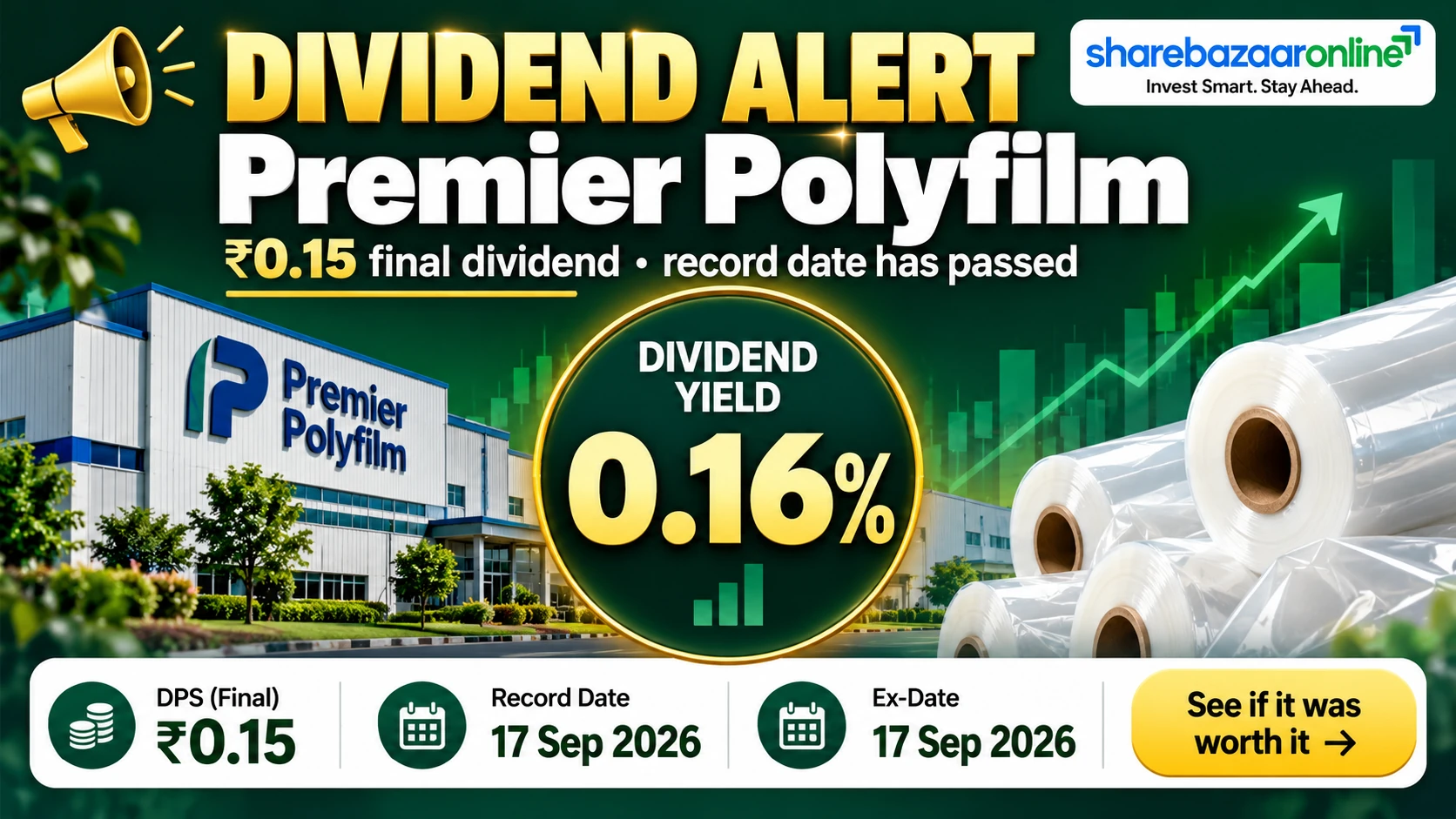
Dividend Snapshot – Premier Polyfilm Limited
Premier Polyfilm Limited (NSE: PREMIERPOL, BSE: 514354) declared a final dividend of ₹0.15 per equity share for FY2025–26, which the board recommended on 9 May 2026. The headline reads “15%”, but that figure is 15% of the ₹1 face value, not of the market price. Against the current price of about ₹93.49, the real Premier Polyfilm dividend yield works out to just 0.16%. This is a textbook face-value illusion: a large-sounding percentage that converts into a token cash payout. The eligibility record date of 17 September 2026 has already passed.
Dividend Per Share
₹0.15
15% of ₹1 face value (Final)
Real Dividend Yield
0.16%
at CMP ₹93.49 (26 Oct 2026)
Record Date / Ex-Date
17 Sep 2026
Already passed
Dividend Outflow
~₹1.57 Cr
Payout ratio ~4.9% of PAT
Company Overview – Premier Polyfilm Limited
Premier Polyfilm Limited is a New Delhi–headquartered PVC and vinyl products manufacturer, incorporated in 1992 (CIN: L52109DL1992PLC049590). Its product range covers vinyl flooring, PVC sheeting, PVC geomembranes and PVC artificial leather cloth, with its plant at Sahibabad, Ghaziabad (Uttar Pradesh). The company is a small-cap with a market capitalisation of roughly ₹980 crore and an equity base of about 10.47 crore shares of ₹1 face value. Over FY2026 it grew revenue to ₹341 crore while keeping debt low. Premier Polyfilm is a consistent, long-standing dividend payer, though the cash amounts are deliberately modest relative to earnings, pointing to a growth-retention capital policy rather than an income-distribution one.
Premier Polyfilm Limited Financial Analysis
Premier Polyfilm's FY2026 financials show a business compounding steadily. Revenue rose ~12% to ₹341.26 crore, EBITDA grew ~18% to ₹48.31 crore, and net profit climbed ~22.7% to ₹31.89 crore (EPS ₹3.04). Operating margin expanded to about 14.2% from 11.6% two years earlier — evidence of positive operating leverage as PVC input costs eased. Return on equity is strong at roughly 24% (average equity basis). The balance sheet is lightly geared (debt-to-equity 0.13) and effectively net-cash. On these numbers the ₹0.15 dividend is trivially affordable; the analytical question is not affordability but why the payout stays so low.
Premier Polyfilm Limited Dividend History Table
Premier Polyfilm Limited — final dividend history (per share adjusted for the Nov 2024 5:1 split, ₹1 face value basis).
| Financial Year | Type | As Declared | Split-Adjusted (₹1 FV) |
|---|---|---|---|
| FY2025–26 | Final | ₹0.15 | ₹0.15 |
| FY2024–25 | Final | ₹0.15 | ₹0.15 |
| FY2023–24 | Final | ₹0.75 | ₹0.15 |
| FY2022–23 | Final | ₹0.50 | ₹0.10 |
| FY2021–22 | Final | ₹0.50 | ₹0.10 |
| FY2020–21 | Final | ₹0.50 | ₹0.10 |
| FY2018–19 | Final | ₹0.50 | ₹0.10 |
| FY2017–18 | Final | ₹0.50 | ₹0.10 |
| FY2016–17 | Final | ₹0.50 | ₹0.10 |
| FY2015–16 | Final | ₹0.50 | ₹0.10 |
Source: company exchange filings and public dividend records. Pre-split amounts were declared on the earlier ₹5 face value.
Expert Commentary on Premier Polyfilm Limited Dividend
The most important fact about the Premier Polyfilm dividend is what it is not: it is not an income play. A payout ratio of under 5% means the company distributes barely one rupee of every twenty it earns. For a business compounding profit at 20%-plus with an ROE near 24%, retaining earnings is a defensible choice — reinvested capital at those returns usually beats cash in a shareholder's hand. The genuine shareholder reward here has come from price appreciation (the stock is up over 100% in a year), not from the cheque. Investors attracted by the “15%” label should recalibrate: the cash yield is a rounding error, and that is by design, not by weakness.
Premier Polyfilm Limited Dividend Outlook
On a split-adjusted basis, Premier Polyfilm's dividend has moved in one small step — from ₹0.10 (FY2016–FY2023) to ₹0.15 (FY2024 onward) — and has then stayed flat for three years despite profits rising sharply. That pattern suggests the absolute cash dividend is being held as a symbolic continuity signal rather than scaled with earnings. The company has not disclosed any formal dividend-distribution policy target, so future increases are not assured. Given the heavy reinvestment stance, strong balance sheet and expanding margins, the realistic base case is continuation of a small, stable final dividend. Any step-up would most likely track capacity additions slowing rather than a deliberate shift toward higher payouts. This outlook is editorial, not a forecast of company action.
Premier Polyfilm Limited Dividend Announcement Summary
The Premier Polyfilm dividend announcement relates to a final dividend of ₹0.15 per equity share (15% of the ₹1 face value) for the financial year 2025–26. The board recommended the dividend on 9 May 2026 alongside the audited FY2026 results, and on 18 July 2026 the company intimated the exchanges, under Regulation 42 of SEBI (LODR) Regulations, 2015, that the record date is 17 September 2026. Being a final dividend, it was subject to shareholder approval at the Annual General Meeting. The record date determined which shareholders were eligible for the payout.
Scrip: NSE PREMIERPOL • BSE 514354
ISIN: INE309M01020
Face Value: ₹1 per share
Dividend Type: Final
Financial Year: 2025–26
Regulation: SEBI LODR Reg. 42
Premier Polyfilm Limited Key Dates Timeline
Board Recommendation (Announcement)
9 May 2026
Record Date Intimation Filed
18 July 2026
Ex-Dividend Date
17 September 2026
Record Date
17 September 2026
Payment Date
Not Disclosed by Company
Final dividends are statutorily payable within 30 days of AGM declaration under the Companies Act, 2013.
Under India's T+1 settlement framework, the Premier Polyfilm ex-date and record date fall on the same day (17 September 2026). Shares had to be bought on or before 16 September 2026 to qualify.
Premier Polyfilm Limited Dividend Yield Analysis
The Premier Polyfilm dividend yield is where the face-value illusion becomes concrete. The company's “15%” is calculated on the ₹1 face value, giving ₹0.15 in cash. Divide that by the market price and the picture changes completely:
Yield at Current Price (₹93.49)
0.16%
Yield at Announcement (₹57.80)
0.26%
Even at the lower May 2026 price, the yield was only a quarter of one percent. As the share price nearly doubled through 2026, the effective yield compressed further to about 0.16%. A ₹1 lakh holding earns roughly ₹160 a year in dividends — before tax. For context, a standard savings account pays far more. The takeaway: the Premier Polyfilm dividend percentage is a face-value label, not a yield.
Premier Polyfilm Limited Dividend History Analysis
On the Premier Polyfilm dividend history, the headline story is consistency: the company has paid a final dividend every year for at least a decade, with no cuts and no suspensions, which marks it a consistent payer. The caveat is the November 2024 stock split, which reduced face value from ₹5 to ₹1. Un-adjusted, the ₹0.50 historical payouts and the recent ₹0.15 look like a fall; split-adjusted, the true path is ₹0.10 held for years, stepped up to ₹0.15 in FY2024, then flat. So the dividend grew once by 50% and has since plateaued even as earnings surged — a widening gap between profit growth and dividend growth that income-focused investors should note.
Premier Polyfilm Limited Financial Performance Analysis
| Metric (₹ Cr) | FY2024 | FY2025 | FY2026 |
|---|---|---|---|
| Revenue | 297.28 | 304.64 | 341.26 |
| EBITDA | 34.47 | 40.87 | 48.31 |
| Net Profit (PAT) | 20.60 | 26.00 | 31.89 |
| EPS (₹) | 1.97 | 2.48 | 3.04 |
| Operating Margin | 11.6% | 13.4% | 14.2% |
The three-year trend is healthy operating leverage: PAT rose faster than revenue because margins expanded from 11.6% to 14.2%. FY2026 revenue growth of ~12% converted into ~22.7% profit growth. Importantly, there is no sign of revenue rising while profit falls — the usual red flag — so the Premier Polyfilm earnings base underpinning the dividend is improving, not deteriorating.
Premier Polyfilm Limited Cash Flow Analysis
Reported profit is an opinion; cash is a fact — so the Premier Polyfilm cash flow deserves a close look. FY2026 operating cash flow was ₹26.70 crore against PAT of ₹31.89 crore, a cash conversion of about 84%. That is acceptable but below 100%, and the gap sits in working capital: short-term investments jumped from ₹3.94 crore to ₹22.49 crore, and total investing outflow was ₹27.58 crore. After capex of ₹8.95 crore, free cash flow was still a comfortable ₹17.75 crore. The dividend of ₹1.57 crore is funded many times over by current free cash flow — it is paid out of genuine surplus cash, not from reserves or borrowings.
Premier Polyfilm Limited Balance Sheet Strength
The Premier Polyfilm balance sheet is a key reason the dividend is never in doubt. As of March 2026, cash and short-term investments totalled about ₹27.53 crore against total debt of just ₹18.55 crore — a net-cash position of roughly ₹8.98 crore. Debt-to-equity is a low 0.13, and debt actually declined year-on-year. Net worth stands at ₹147.20 crore (book value ~₹14 per share). With a net-cash, low-leverage structure, the company can comfortably sustain or raise its dividend without any strain on solvency; the constraint on a bigger payout is strategic choice, not financial capacity.
Premier Polyfilm Limited Dividend Sustainability Analysis
Earnings Coverage (EPS ÷ DPS)
20.3x
Free Cash Flow Coverage
11.3x
Operating Cash Flow Coverage
17.0x
Cash & Investments Coverage
17.5x
On all four tests — earnings, free cash flow, operating cash flow and liquidity — the Premier Polyfilm dividend clears comfortably, with coverage in double digits. Verdict: Sustainable. The more accurate framing is that the dividend is so small it is effectively un-stressable; the risk to shareholders is not that it gets cut, but that it never grows meaningfully.
Premier Polyfilm Limited Peer Comparison
| Company | Dividend Yield | ROE | ROCE |
|---|---|---|---|
| Premier Polyfilm | ~0.16% | ~24% | Not Disclosed by Company |
| Finolex Industries | ~1.4% | ~9.6% | ~8.6% |
| Supreme Industries | ~1.04% | ~16.7% | ~19.5% |
Peer figures sourced externally (as of 26 Oct 2026) and shown for context only; companies differ in size and product mix.
Against larger plastics peers, Premier Polyfilm offers the lowest dividend yield but the highest return on equity. Finolex and Supreme pay roughly 1%–1.4%, several times Premier's 0.16%. The trade-off is clear: Premier retains almost everything it earns and converts it into ~24% ROE, which has rewarded holders through price rather than payout. Income seekers would find the peers more generous; growth-oriented holders may prefer Premier's reinvestment model.
Premier Polyfilm Limited Promoter Impact Analysis
Promoters hold 70.81% of Premier Polyfilm, so they also receive the lion's share of the dividend. Of the total ₹1.57 crore outflow, roughly ₹1.11 crore flows to the promoter group and only about ₹0.44 crore to public shareholders (FII 0.09%, DII 1.02%, retail/public ~28%). Because the payout is tiny, this skew has negligible cash impact in absolute terms. More relevant is the alignment it signals: with over 70% ownership, promoters benefit far more from reinvested growth and share-price appreciation than from a larger cash dividend — which helps explain the deliberately low payout policy.
Premier Polyfilm Limited Dividend Taxation Analysis
Since FY2020–21, dividends in India are taxed in the hands of the shareholder at their applicable income-tax slab rate; the dividend distribution tax regime is gone. The company deducts TDS at 10% only if an individual's total dividend from that company in a financial year exceeds ₹10,000 (threshold raised from ₹5,000 w.e.f. FY2025–26). For Premier Polyfilm's ₹0.15 per share, that threshold is effectively out of reach for ordinary retail holders.
Worked Example — 1,000 shares, ₹0.15/share, 30% slab
Gross dividend = 1,000 × ₹0.15 = ₹150
TDS (below ₹10,000 threshold) = ₹0
Tax at 30% slab = ₹45
Net in hand = ₹105
Effective post-tax yield on a ~₹93,490 holding = ~0.11%
This is general information, not tax advice. Consult a qualified professional for your specific situation.
Premier Polyfilm Limited Key Risks
- Negligible income return: at ~0.16% yield, the dividend offers virtually no income cushion; the investment case rests entirely on capital growth.
- Raw-material and margin volatility: as a PVC processor, profitability is exposed to crude-linked resin prices and currency moves, which can compress the ~14% operating margin.
- Dividend not scaling with profit: absolute dividend has been flat at ₹0.15 for three years despite rising earnings, so payout growth is not assured.
- Valuation re-rating risk: after a 100%-plus one-year run, the stock trades at a rich multiple (P/E ~26); any earnings disappointment could hit the price hard.
- Small-cap liquidity and concentration: high promoter holding (70.81%) leaves a limited free float, which can amplify price swings.
What To Monitor in Premier Polyfilm Limited
- Operating margin trajectory: whether the 14.2% margin holds or expands as volumes grow and input costs move.
- Cash conversion: whether operating cash flow catches up to PAT (it was ~84% in FY2026) or working-capital build continues.
- Payout policy: any move to raise the absolute dividend or adopt a formal distribution policy, signalling a shift from pure retention.
- Capex and capacity: how reinvested earnings translate into new capacity and future revenue growth.
- Promoter holding changes: any pledge, dilution or stake change that could affect float and governance.
Conclusion – Premier Polyfilm Limited Dividend
The Premier Polyfilm final dividend of ₹0.15 per share is best understood as a continuity gesture from a growth-focused company, not an income opportunity. The “15%” headline shrinks to a 0.16% real yield once measured against the market price. On the positive side, the dividend is backed by rising profits (₹31.89 crore), strong ROE (~24%), a net-cash balance sheet and coverage in double digits — so sustainability is not a concern. On the negative side, the payout is tiny, has not grown with earnings, and offers no meaningful income. Investors should weigh Premier Polyfilm as a reinvestment-driven compounder where returns come from price, with the dividend a minor extra. The decision rests with each reader.
Frequently Asked Questions About Premier Polyfilm Limited Dividend
What dividend has Premier Polyfilm announced for FY2026?
What is the Premier Polyfilm dividend yield?
What was the Premier Polyfilm dividend record date?
What is the Premier Polyfilm ex-dividend date?
When will the Premier Polyfilm dividend be paid?
Who was eligible for the Premier Polyfilm dividend?
How is the Premier Polyfilm dividend taxed?
Is the Premier Polyfilm dividend sustainable?
What is the Premier Polyfilm dividend history?
Why is the Premier Polyfilm dividend yield so low?
Did Premier Polyfilm split its shares?
What should investors monitor in Premier Polyfilm?
What is the dividend outflow and how much goes to promoters?
Disclaimer – Premier Polyfilm Limited Dividend Analysis
This article is for informational and educational purposes only and does not constitute investment, legal or tax advice, or any recommendation to buy, sell or hold securities. ShareBazaar Online is not a SEBI-registered investment adviser. Dividend figures and corporate-action dates are based on the company's exchange disclosures; financial and market data are drawn from publicly available third-party sources and may contain errors or be subject to revision. Market prices, yields and ratios change continuously. Investors should verify all figures with official company filings and consult a qualified financial adviser before making any investment decision. Past performance and past dividends are not indicative of future results.