
Star Paper Mills Dividend 2026: ₹2.50 Final Dividend Announced — Yield, Record Date & Sustainability Analysis
Star Paper Mills Limited has recommended a final dividend of ₹2.50 per equity share (25%) on a face value of ₹10 for FY2025-26. For investors tracking the Star Paper Mills dividend record date, dividend yield and payout quality, this analysis goes beyond the headline number — examining cash coverage, the two-year decline in the payout, the company's large investment pile, and what the dividend means for shareholders. All figures are drawn from the company's audited results dated 25 May 2026 and publicly disclosed market data.
Dividend Snapshot – Star Paper Mills Limited
Star Paper Mills has declared a ₹2.50 final dividend for FY2025-26, subject to shareholder approval at the AGM. The record date of 17 September 2026 has already passed. At the current price the yield is a modest 1.73%, and the ₹3.90 crore outflow is small relative to the company's resources.
Company Overview – Star Paper Mills Limited
Star Paper Mills Limited (NSE: STAR PAPER | BSE: 516022 | ISIN: INE733A01018) is one of India's oldest paper manufacturers, incorporated in 1936, with its registered office in Kolkata and its manufacturing unit at Saharanpur, Uttar Pradesh. The company operates in a single business segment — paper, paperboard and related products. It is an ISO 9001, ISO 14001 and ISO certified producer. For FY2025-26 the company reported revenue from operations of ₹409.94 crore and net profit of ₹32.75 crore. Star Paper Mills is effectively debt-free, carries a large investment and cash pile, and has a long record of paying annual dividends, making it a name frequently tracked by dividend-focused retail investors.
Financial Analysis – Star Paper Mills Limited
FY2025-26 was a weaker year: revenue fell 6.0% and net profit dropped 20.4%. Returns remain low — ROE of 4.62% and ROCE of 4.45% — partly because a large idle investment pile dilutes overall capital efficiency.
Star Paper Mills Limited Dividend History
| Financial Year | Dividend Type | DPS (₹) | Dividend % | Ex-Date |
|---|---|---|---|---|
| FY2025-26 | Final | 2.50 | 25% | 17-09-2026 |
| FY2024-25 | Final | 3.50 | 35% | 18-09-2025 |
| FY2023-24 | Final | 4.00 | 40% | 18-09-2024 |
| FY2022-23 | Final + Special | 5.00 | 50% | 15-09-2023 |
| FY2021-22 | Final | 3.50 | 35% | 13-09-2022 |
| FY2020-21 | Final | 2.50 | 25% | 16-09-2021 |
| FY2019-20 | Final | 2.50 | 25% | 17-09-2020 |
| FY2018-19 | Final | 2.50 | 25% | 09-09-2019 |
| FY2017-18 | Final | 2.50 | 25% | 02-08-2018 |
| FY2016-17 | Final | 2.00 | 20% | 05-09-2017 |
Source: NSE/BSE corporate action disclosures and public dividend records. FY mapping based on announcement year.
Expert Commentary – Star Paper Mills Limited
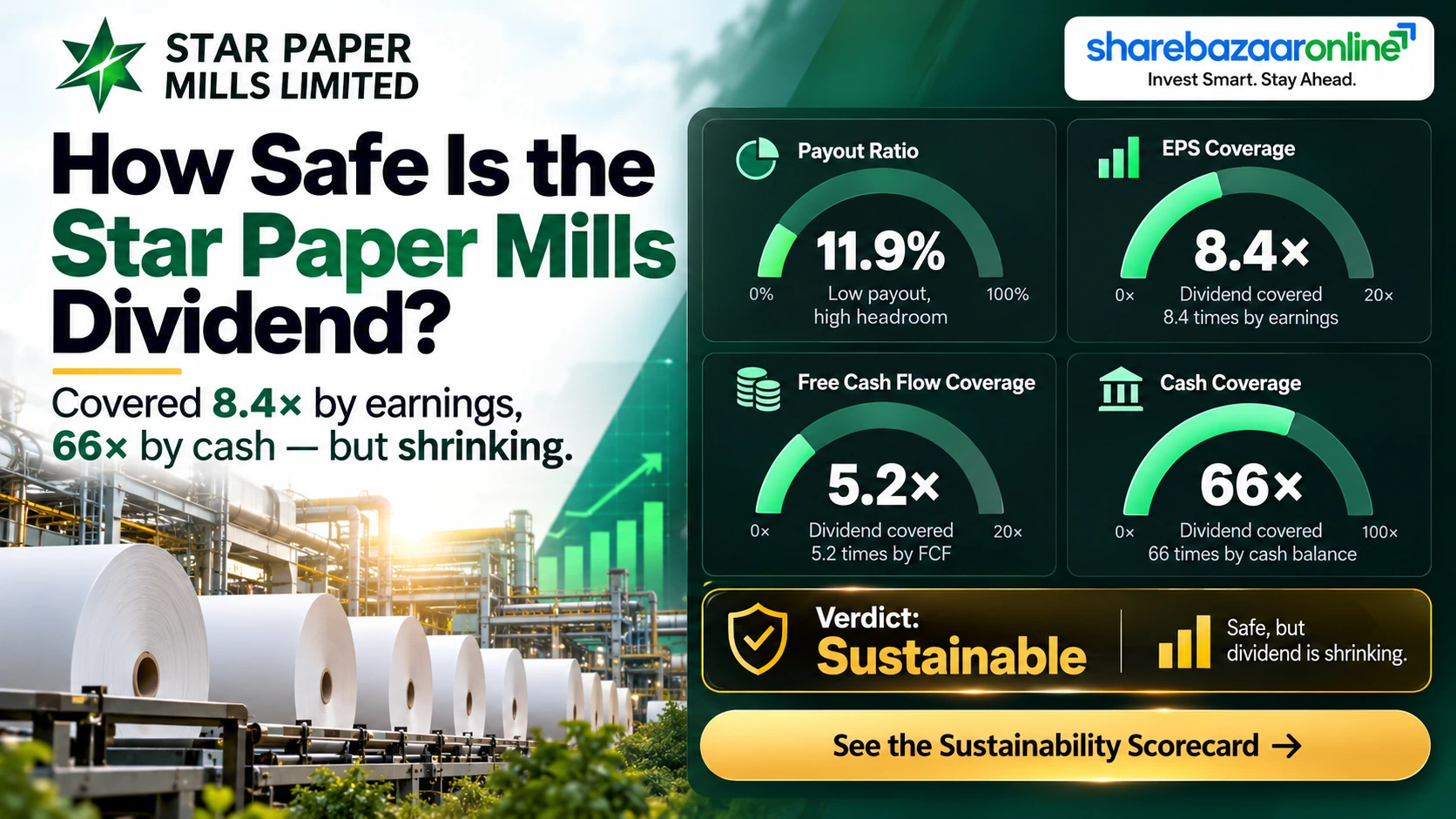
The most important signal is not the ₹2.50 dividend itself, but its downward trajectory: the payout has fallen from ₹4.00 (FY24) to ₹3.50 (FY25) to ₹2.50 (FY26), closely tracking a declining profit trend. At the same time, the dividend is extremely well covered — just 11.9% of earnings and barely 1.5% of the company's liquid investments. This is a company choosing caution over generosity despite a cash-rich balance sheet. For income investors, that means a very safe but shrinking and low-yielding payout. The real debate is about capital allocation: a large investment pile earning modest returns sits alongside a conservative distribution policy.
Future Outlook – Star Paper Mills Limited
Star Paper Mills enters FY2026-27 with pressure on the operating business — a Q4FY26 net loss and softer full-year profits reflect weak paper realisations and high input costs. The dividend outlook therefore depends more on earnings recovery than on affordability, since the balance sheet can sustain the current payout many times over. Investors should watch whether management deploys its ₹259 crore investment pile into capacity, modernisation, or a larger shareholder return. The company has not disclosed any specific forward guidance, buyback, or capex expansion plan. Any statement here about future dividends would be speculation; the disclosed position is simply that the FY26 dividend awaits AGM approval.
Dividend Announcement Summary – Star Paper Mills Limited
At its board meeting on 25 May 2026, the Board of Directors of Star Paper Mills Limited recommended a final dividend of ₹2.50 per equity share (25%) of ₹10 face value for the financial year ended 31 March 2026. The recommendation is subject to approval by shareholders at the ensuing Annual General Meeting. As disclosed in the audited results, the estimated total dividend outflow is ₹390.21 lakh (₹3.90 crore). The company confirmed its statutory auditors issued an unmodified (clean) audit opinion on the financial results. The dividend has not been recorded as a liability in the FY26 financial statements, pending AGM approval.
Key Dates Timeline – Star Paper Mills Limited
The record date of 17 September 2026 has passed. Under SEBI LODR Regulation 42 and the Companies Act, 2013, a final dividend must be paid within 30 days of its declaration at the AGM. The company has not separately disclosed an exact credit date.
Star Paper Mills Limited Dividend Yield Analysis
At the current market price of ₹144.46 (26 October 2026), the ₹2.50 dividend gives a yield of 1.73%. That is below a typical bank fixed deposit and modest for an income-focused buyer. The yield looks optically "reasonable" only because the share price has drifted lower — not because the payout is generous. In fact the dividend amount itself was reduced this year. Investors chasing a higher headline yield should note that the figure here is driven by a declining dividend and a subdued share price, not by rising distributions. The Star Paper Mills dividend yield should therefore be read alongside the earnings trend, not in isolation.
Star Paper Mills Limited Dividend History Analysis
Star Paper Mills is best classified as a consistent but cyclical payer. It has paid a dividend every year for well over a decade, which is a genuine positive. However, the amount moves with profitability rather than growing steadily: ₹2.00–₹2.50 in the late 2010s, a peak of ₹5.00 (including a special dividend) in FY2022-23, ₹4.00 in FY2023-24, then step-downs to ₹3.50 and now ₹2.50. The last two years show a clear declining pattern. There have been no dividend suspensions, but the trend confirms the payout is tied to earnings cycles in the paper industry rather than being a reliably rising income stream.
Financial Performance Analysis – Star Paper Mills Limited
Operating performance weakened in FY2025-26. Revenue from operations fell 6.0% to ₹409.94 crore, while net profit declined 20.4% to ₹32.75 crore. The sharper profit fall relative to revenue points to margin compression — cost of materials, power and fuel, and other expenses consumed a larger share of a smaller top line. The fourth quarter was notably weak: Star Paper Mills reported a net loss of ₹1.29 crore in Q4FY26, versus a ₹5.01 crore profit in Q4FY25, with a pre-tax loss driven partly by a mark-to-market loss on mutual fund investments. EPS fell from ₹26.36 to ₹20.98. The operating business, excluding investment income, is under clear pressure.
Cash Flow Analysis – Star Paper Mills Limited
Cash generation was a bright spot. Net cash from operating activities rose to ₹29.09 crore in FY2025-26 (from ₹14.84 crore), helped by inventory release. After capex of ₹8.67 crore, free cash flow was about ₹20.42 crore — comfortably more than five times the ₹3.90 crore dividend outflow. Importantly, the dividend is funded entirely from current cash generation, not from borrowings or asset sales. The company paid ₹5.44 crore in dividends during the year from internal accruals. With operating cash flow strongly positive and no debt funding the payout, the quality of the dividend from a cash perspective is high, even though the headline profit fell.
Balance Sheet Strength – Star Paper Mills Limited
This is the company's standout feature. Star Paper Mills is effectively debt-free (only small lease liabilities of ₹4.31 crore; finance cost just ₹0.93 crore). It holds ₹258.93 crore in cash, bank balances and investments — mostly mutual funds — against total equity of ₹708.30 crore. Book value is roughly ₹453.75 per share, so at ₹144.46 the stock trades at just 0.32× book. Strikingly, the company's entire market capitalisation of about ₹224 crore is lower than its ₹259 crore liquid investment pile. The balance sheet is fortress-like; the concern is that this cash earns modest returns and depresses ROE/ROCE rather than being actively deployed.
Star Paper Mills Limited Dividend Sustainability
On affordability, the dividend is highly sustainable: it absorbs under 12% of profit, is covered 8.4× by earnings and over 66× by liquid resources. The only caveat is that the size of the payout has been shrinking with earnings, so sustainability of the amount is not the same as growth of the amount.
Peer Comparison – Star Paper Mills Limited
| Company | P/E | ROE | Dividend Yield |
|---|---|---|---|
| Star Paper Mills | ~7.3 | 4.62% | 1.73% |
| JK Paper | ~20.6 | 6.14% | ~1.30% |
| West Coast Paper | ~22.7 | 6.43% | ~0.74% |
Star Paper Mills trades at a far lower P/E than larger peers like JK Paper and West Coast Paper, and offers a higher dividend yield, but its ROE is weaker. The low valuation reflects its small size, cyclical earnings and large under-utilised cash, rather than a clear growth story. Source: Value Research / public data.
Promoter Impact Analysis – Star Paper Mills Limited
Promoters hold 44.93% of Star Paper Mills, with FIIs at about 1.6%, DIIs negligible, and the public holding the majority (~53%). Of the ₹3.90 crore total dividend, promoters will receive roughly ₹1.75 crore, with the remaining ~₹2.15 crore distributed to public and institutional shareholders. Because the public float is larger than the promoter stake, most of the dividend flows to minority shareholders. The conservative payout means the promoter group is not extracting outsized cash from the company; the bigger question for minority investors is whether the large retained cash pile is being used to build long-term value on their behalf.
Taxation Analysis – Star Paper Mills Limited
Since FY2020-21, dividends are taxable in the hands of the shareholder at their applicable income-tax slab rate; there is no separate Dividend Distribution Tax. Companies deduct TDS under Section 194 at 10% for resident shareholders if total dividend exceeds ₹10,000 in a financial year (threshold raised from ₹5,000 effective FY2025-26). Non-resident shareholders face TDS under Section 195 (typically 20% plus surcharge and cess, subject to treaty relief).
Worked Example — 1,000 shares, 30% tax slab:
Key Risks – Star Paper Mills Limited
- Declining earnings: Net profit fell 20% in FY26 with a Q4 loss; continued weakness could push the dividend lower still.
- Shrinking dividend trend: The payout has dropped two years running (₹4.00 → ₹3.50 → ₹2.50).
- Cyclicality: Paper realisations, pulp and wood costs, and power & fuel inflation make margins volatile.
- Idle capital / low returns: A large investment pile keeps ROE and ROCE below 5%, dragging capital efficiency.
- Earnings volatility from investments: Mark-to-market swings on mutual fund holdings can distort quarterly profits, as seen in Q4FY26.
- Low liquidity & small size: A small-cap with thin trading volumes can see sharp price moves.
What To Monitor – Star Paper Mills Limited
- Operating margins: Whether EBITDA margins recover as input costs and realisations stabilise.
- Capital allocation: Any move to deploy the ₹259 crore cash pile into capex, modernisation, acquisition or buyback.
- Dividend trajectory: Whether FY27 reverses the two-year decline or cuts further.
- Quarterly profitability: A return to consistent operating profit after the Q4FY26 loss.
- Volume & realisation trends: Paper and paperboard demand and pricing in domestic markets.
- Return ratios: Any improvement in ROE/ROCE toward double digits.
Should You Consider Star Paper Mills Limited for Dividend Income?
Positives
- Debt-free, cash-rich balance sheet (₹259 Cr liquid)
- Dividend covered 8.4× by EPS, ~66× by cash
- Consistent payer for over a decade
- Trades well below book value (0.32×)
Negatives
- Dividend cut two years running
- Low yield of 1.73%
- Falling profits and a Q4 loss
- Weak ROE/ROCE from idle cash
Star Paper Mills offers an exceptionally safe but modest and declining dividend, backed by a fortress balance sheet that the market values at less than its cash pile. It is better understood as a deep-value, asset-rich situation than a high-yield income play. The information above is presented so readers can weigh the positives, negatives, risks and monitoring points, and decide for themselves.
Frequently Asked Questions About Star Paper Mills Limited Dividend
What dividend has Star Paper Mills announced for FY2025-26?
What is the Star Paper Mills dividend yield?
What is the record date for the Star Paper Mills dividend?
What is the ex-date for the Star Paper Mills dividend?
When will the Star Paper Mills dividend be paid?
Who is eligible for the Star Paper Mills dividend?
How is the Star Paper Mills dividend taxed?
Is the Star Paper Mills dividend sustainable?
What is the Star Paper Mills dividend history?
What should investors monitor in Star Paper Mills?
Why does Star Paper Mills trade below its book value?
What is the total dividend outflow for Star Paper Mills?
Disclaimer – Star Paper Mills Limited Dividend Analysis
This article is for informational and educational purposes only and does not constitute investment, legal or tax advice, or a recommendation to buy, sell or hold any security. All figures are based on Star Paper Mills Limited's audited financial results dated 25 May 2026 and publicly available market data as of 26 October 2026, which may change. Editorial analysis is clearly distinguished from disclosed facts and does not predict regulatory or corporate outcomes. Dividends are subject to shareholder approval and applicable regulations. Investors should conduct their own research and consult a SEBI-registered financial advisor before making any investment decision. ShareBazaar Online is not liable for any loss arising from the use of this information.