
Dividend Snapshot – Himatsingka Seide Limited
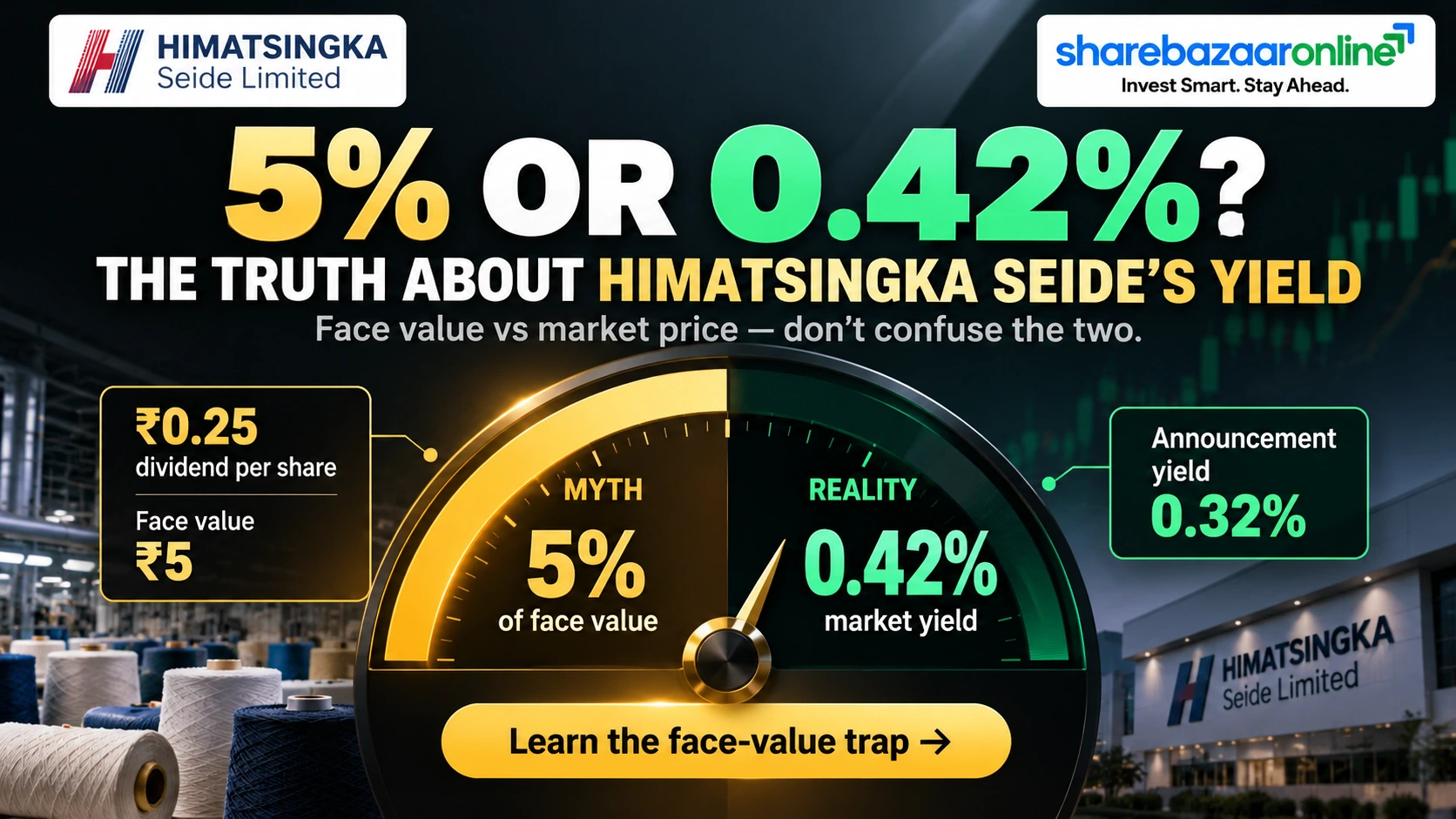
Himatsingka Seide Limited (NSE: HIMATSEIDE, BSE: 514043) has paid a final dividend of ₹0.25 per share for the financial year ended March 2026 — a headline 5% on the ₹5 face value. The record date was 17 September 2026. The catch retail investors miss: on a market price of roughly ₹60, that 5% headline converts to a real cash yield of just 0.42%. The total payout costs the company only about ₹3.14 crore, against net debt of nearly ₹2,547 crore. This is a token, symbolic dividend from a highly leveraged textile exporter whose profit has roughly halved over two years.
Key Numbers
- Dividend Per Share₹0.25
- Dividend %5% of face value
- Dividend TypeFinal
- Market Dividend Yield~0.42%
- Record Date17 Sep 2026
At a Glance
- Face Value₹5
- Total Payout~₹3.14 cr
- Payout Ratio~5%
- FY26 PAT (Consol.)₹62.24 cr
- Net Debt~₹2,547 cr
Himatsingka Seide Company Overview
Himatsingka Seide Limited is a vertically integrated global home-textile major incorporated in 1985 and headquartered in Bengaluru. It designs, manufactures and distributes bedding and bath products, drapery and upholstery fabrics, and fine-count cotton yarn, with among the largest such capacities in the world. The business is export-heavy, with North America contributing the bulk of revenue and sold largely through licensed brands and private labels for global retailers. This export dependence is central to understanding the Himatsingka Seide dividend: cash flows swing with the US home-furnishing cycle, the rupee-dollar rate and freight costs. The company trades well below book value (price-to-book of roughly 0.4x, book value around ₹167–186), reflecting the market's caution on its high debt and thin margins.
Himatsingka Seide Dividend Announcement Summary
The Board of Himatsingka Seide recommended a final dividend of ₹0.25 per equity share (5%) for FY2026 at its results meeting on 27 May 2026, subject to shareholder approval at the Annual General Meeting. At a subsequent board meeting on 25 August 2026, the company fixed 17 September 2026 as the record date to determine members eligible for the payout. This is a regular annual final dividend declared out of FY26 earnings — no interim or special dividend was involved. For the third year running, the per-share amount is unchanged at ₹0.25. The modest quantum signals the Board's intent to maintain a continuous dividend record while prioritising debt servicing and reinvestment over cash distribution.
Himatsingka Seide Dividend Record Date and Key Timeline
- Dividend Recommended27 May 2026
- Record Date Fixed (Board)25 Aug 2026
- Ex-Dividend Date17 Sep 2026
- Record Date17 Sep 2026
- Payment Date~23 Oct 2026
- Financial YearFY2025-26
Under India's T+1 settlement cycle, the ex-date and record date fall on the same day, 17 September 2026, as confirmed by exchange corporate-action data. Only shareholders on the register as of the record date were eligible; since all these dates have now passed, the eligibility window for this dividend is closed. The payment date of around 23 October 2026 follows the Companies Act requirement to credit dividends within 30 days of declaration/AGM approval.
Himatsingka Seide Dividend Yield Reality Check
The "5%" in a Himatsingka Seide dividend headline is a percentage of face value, not yield. Face value is ₹5, so 5% equals ₹0.25 — a fixed rupee amount, unrelated to the share price. The real dividend yield is ₹0.25 divided by the market price. At the current price near ₹60, the yield is about 0.42%. Had you bought around the 27 May 2026 announcement price of roughly ₹77, your yield on cost would be only 0.32%. In every case, the cash return is a small fraction of 1%. The higher-looking yield today exists only because the share price has fallen heavily, not because the dividend grew — a classic case where a weaker stock price, not a stronger payout, lifts the yield.
Himatsingka Seide Dividend History and Track Record
Himatsingka Seide Dividend Per Share (Recent Years)
| Financial Year | Dividend/Share | % of Face Value |
|---|---|---|
| FY2026 | ₹0.25 | 5% |
| FY2025 | ₹0.25 | 5% |
| FY2024 | ₹0.25 | 5% |
| FY2019 (peak era) | ₹5.00 | 100% |
Himatsingka Seide has distributed dividends for over two decades, but the pattern is cyclical, not steadily growing. The per-share payout has been flat at ₹0.25 for three straight years (FY24–FY26), a sharp step-down from the ₹5.00 paid in the stronger FY2019 cycle. The record shows cuts in weak years and no FY2026 increase despite completing the year profitably. On this evidence, Himatsingka Seide is best classified as a cyclical / irregular dividend payer rather than a consistent dividend-growth stock.
Himatsingka Seide Financial Performance vs Profit Growth
On a consolidated basis, Himatsingka Seide's revenue has drifted lower, from about ₹3,184 cr (FY22) to roughly ₹2,533 cr (FY26). More telling is the profit trajectory: PAT fell from ₹113 cr (FY24) to ₹76 cr (FY25) to ₹62 cr (FY26) — a decline of nearly 45% in two years. FY26 EBITDA held roughly flat at ₹576.67 cr, so the profit erosion is driven below the operating line, chiefly by a heavy interest burden of around ₹291 cr. The strain showed in Q4 FY26, when net profit collapsed to about ₹1.73 cr from ₹12 cr a year earlier, and continued into Q1 FY27 with profit down over 50%. Earnings are shrinking even as the dividend stays put.
Himatsingka Seide Cash Flow Analysis
Cash tells a cleaner story than reported profit. In FY26 Himatsingka Seide generated operating cash flow of about ₹204 cr — comfortably above its ₹62 cr net profit, a healthy sign that earnings are backed by real cash. With net investing outflow of only about ₹8 cr, free cash flow was roughly ₹196 cr. The tiny ₹3.14 cr dividend is therefore funded many times over by current cash generation, not by borrowing or asset sales. The pressure point is elsewhere: financing outflow of about ₹222 cr (debt servicing and interest) nearly consumed the entire operating cash, leaving a small net cash drawdown for the year. A watch item remains the company's very high debtor days (~297), which ties up working capital.
Himatsingka Seide Balance Sheet Strength
This is the real constraint on the Himatsingka Seide dividend. Total debt stands at roughly ₹2,636 cr against cash and investments of only about ₹88 cr, leaving net debt near ₹2,547 cr and a debt-to-equity ratio of about 1.2x. Interest cover is thin at roughly 1.4x (EBIT of ₹412 cr against interest of ~₹291 cr), meaning most operating profit is absorbed by lenders before shareholders. During FY26 the company also expanded its equity base — share capital rose from ₹49.23 cr to ₹62.87 cr, implying roughly 27% equity dilution. A balance sheet carrying this much leverage, with earnings falling, is the single biggest factor investors should weigh above the small dividend itself.
Himatsingka Seide Dividend Sustainability Scorecard
- Earnings Coverage (EPS/DPS)~19.7x ✓
- OCF Coverage~65x ✓
- FCF Coverage~62x ✓
- Cash Coverage~28x ✓
On the four standard coverage tests, the ₹0.25 dividend is trivially affordable — it consumes barely 5% of profit and a fraction of 1% of operating cash. Verdict: Sustainable by size. The honest caveat: the payout is so small (₹3.14 cr, about 0.12% of net debt) that "sustainability" is almost beside the point. The more relevant question is whether a company with falling profit and ₹2,547 cr of net debt should distribute cash at all, however little, versus accelerating deleveraging. The dividend is safe, but its tiny scale is itself the message.
Himatsingka Seide Peer Comparison (Dividend Yield)
| Home-Textile Peer | Approx. Dividend Yield |
|---|---|
| Trident Ltd | ~2.0% |
| Vardhman Textiles | ~0.9% |
| Himatsingka Seide | ~0.42% |
| Indo Count Industries | ~0.33% |
| Welspun Living | ~0.06% |
Within the home-textile pack, Himatsingka Seide's ~0.42% yield sits in the lower half — well below Trident (~2%) and Vardhman (~0.9%), broadly in line with Indo Count, and above Welspun Living. Himatsingka also screens weaker on profitability, with ROE around 3–4% and ROCE near 7.5%, and carries higher relative leverage than most listed peers. For a pure dividend-income screen, the sector offers better-yielding, lower-debt alternatives; Himatsingka's appeal, if any, is a deep-value / turnaround angle rather than income.
Himatsingka Seide Promoter Impact Analysis
Promoters hold about 37.48% of Himatsingka Seide (stable across recent quarters, with no meaningful pledging). Of the total ₹3.14 cr payout, the promoter group therefore receives roughly ₹1.18 cr, while public and retail shareholders — who own the majority at around 55% — collectively receive about ₹1.73 cr, and FIIs (~7.4%) about ₹0.23 cr. Because promoter ownership is below 40%, the bulk of this dividend flows to minority shareholders rather than insiders — a neutral-to-positive governance point. The amounts are immaterial at the household level: even the largest individual promoter stake translates to a few lakh rupees. This is a continuity gesture, not a wealth-transfer event for any shareholder class.
Himatsingka Seide Dividend Taxation Explained
Since FY2020-21, dividends in India are taxed in the shareholder's hands at their applicable income-tax slab rate; the earlier Dividend Distribution Tax no longer applies. Companies deduct TDS at 10% under Section 194 only if total dividend paid to a resident shareholder exceeds ₹5,000 in a financial year (20% without PAN).
Worked Example — 1,000 shares, 30% slab
- Gross dividend (1,000 × ₹0.25)₹250
- TDS (below ₹5,000 threshold)₹0
- Tax at 30% slab₹75
- Net in hand₹175
- Post-tax yield @ ₹60~0.29%
Illustration only, not tax advice. Actual liability depends on your total income and slab.
Expert Commentary on the Himatsingka Seide Dividend
Read correctly, the FY26 Himatsingka Seide dividend is a signalling exercise, not an income proposition. Management is preserving an unbroken payout record at minimum cost (₹3.14 cr), which keeps the stock eligible for dividend screens and reassures long-term holders — while directing the real cash toward a ~₹2,547 cr net-debt pile and a business model transition the company has flagged. The uncomfortable combination is falling profit, a recent ~27% equity dilution, and an unchanged dividend: capital is being raised and distributed at the same time. For investors, the dividend should be treated as a rounding error; the thesis stands or falls on deleveraging, margin recovery and the success of the stated pivot — not on ₹0.25 a share.
Himatsingka Seide Key Risks for Dividend Investors
- High leverage: Net debt of ~₹2,547 cr with interest cover of only ~1.4x leaves little buffer if earnings weaken further.
- Declining profitability: Consolidated PAT has fallen ~45% over two years; Q4 FY26 and Q1 FY27 profits dropped sharply.
- Export / currency concentration: Heavy reliance on US home-textile demand, freight costs and the rupee-dollar rate makes cash flow cyclical.
- Equity dilution: Share capital rose ~27% in FY26, spreading future earnings and dividends over more shares.
- Working-capital stress: Debtor days of ~297 and rising working-capital days tie up cash that could cut debt.
What to Monitor in Himatsingka Seide Going Forward
- Net-debt trajectory: Whether proceeds from fundraising and operating cash are genuinely reducing the ~₹2,547 cr net debt.
- Interest coverage: Improvement above ~1.4x would show earnings regaining headroom over finance costs.
- Margin recovery: EBITDA margin trend and whether the stated business pivot lifts realisations.
- Receivables & working capital: A fall in debtor days from ~297 would free up cash.
- Dividend direction: Any change from the flat ₹0.25 payout, up or down, as a signal of management confidence.
Himatsingka Seide Dividend Outlook
The near-term outlook for the Himatsingka Seide dividend is continuity at a low level. The company has disclosed no change in distribution policy, and with earnings under pressure and deleveraging the stated priority, a meaningful step-up from ₹0.25 is not indicated by any announced plan. A return toward the ₹5.00-era payouts would require a sustained profit and balance-sheet recovery that is not yet visible in the numbers. Conversely, the dividend's tiny size means even weak years are unlikely to force a cut. Investors should frame Himatsingka Seide as a leveraged, cyclical turnaround story where the share-price path — driven by debt reduction and margin repair — will matter far more than the token annual dividend.
Conclusion: Should You Consider Himatsingka Seide for Dividend Income?
The Himatsingka Seide FY2026 final dividend of ₹0.25 per share is fully affordable but almost immaterial — a ~0.42% market yield costing just ₹3.14 crore. The positives are a healthy operating cash flow, comfortable payout coverage, no promoter pledging, and an unbroken distribution record. The negatives are substantial: ~₹2,547 cr net debt, thin ~1.4x interest cover, a ~45% two-year profit decline, and ~27% equity dilution. For investors seeking dividend income, the sector offers higher-yielding, lower-debt options. For value or turnaround investors, the dividend is a side note to the real questions on debt and margins. We present the facts, positives and risks — the decision rests with you.
Frequently Asked Questions About Himatsingka Seide Dividend
What dividend has Himatsingka Seide announced for FY2026?
What is the Himatsingka Seide dividend yield?
What is the record date for the Himatsingka Seide dividend?
What is the ex-dividend date for Himatsingka Seide?
When will the Himatsingka Seide dividend be paid?
Who was eligible for the Himatsingka Seide dividend?
How is the Himatsingka Seide dividend taxed?
Is the Himatsingka Seide dividend sustainable?
What is the Himatsingka Seide dividend history?
How much is the total Himatsingka Seide dividend payout?
Why is the Himatsingka Seide dividend yield so low despite a 5% dividend?
What should investors monitor in Himatsingka Seide?
Disclaimer – Himatsingka Seide Dividend Analysis
This article is for informational and educational purposes only and does not constitute investment, tax or legal advice, or any recommendation to buy, sell or hold any security. Dividend details are based on company disclosures to the stock exchanges; financial, price, shareholding and peer figures are drawn from publicly available sources and may be approximate or subject to revision. Computed ratios are editorial estimates based on these inputs. Share prices and yields change continuously. Investors should verify all figures against primary filings and consult a SEBI-registered investment adviser and a qualified tax professional before making any decision. ShareBazaar Online and its authors accept no liability for actions taken based on this content.